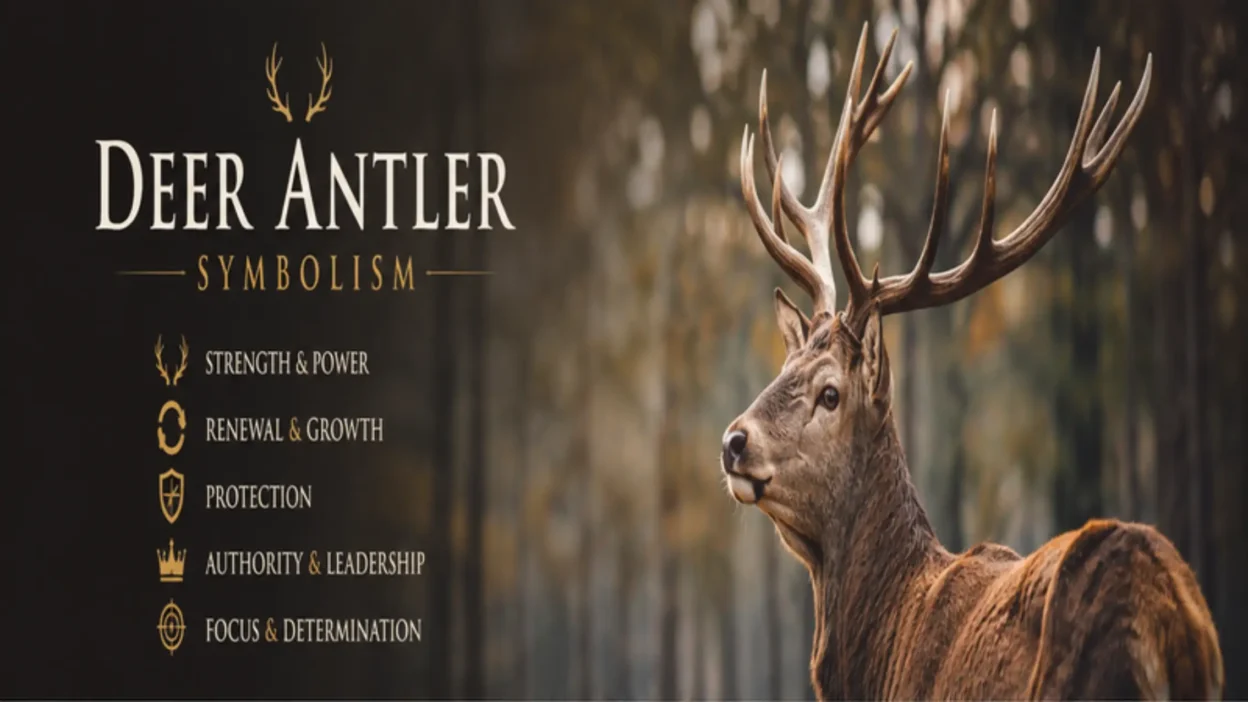
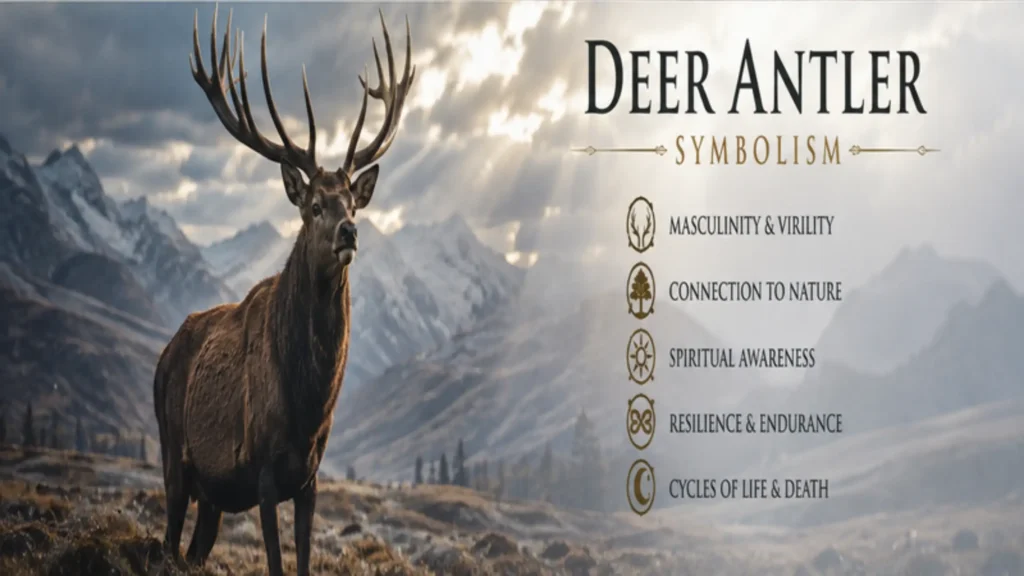
Deer antler symbolism most commonly represents renewal, strength, growth, maturity, protection, leadership, connection with nature, resilience, and letting go. The symbolism has an unusually strong biological foundation because deer antlers are not permanent. They grow, harden, serve an important role during the breeding season, fall away, and then grow again.
That yearly cycle turns the antler into a natural image of strength that can be released and rebuilt. Unlike horns, antlers are made of bone and are normally shed and regrown each year. While developing, they are covered by living tissue called velvet that carries blood and nutrients.
Antlers also have a long cultural history. Worked deer-antler headpieces are known from Mesolithic Britain, antlered stags appear prominently in Scythian art, deer antlers occur in Gallo-Roman religious imagery, and Chinese imperial records could treat unusually impressive antlers as auspicious.
Quick Answer
Deer antler symbolism commonly represents renewal, strength, growth, protection, maturity, resilience, and natural cycles. Because antlers are shed and regrown, they make an especially strong symbol of releasing what has completed its purpose and developing again. Their use in display and competition also adds meanings of confidence, vitality, authority, and earned strength.
TL;DR
- Deer antlers symbolize renewal, strength, growth, and resilience.
- Annual shedding makes them powerful symbols of release and rebirth.
- Large antlers can represent maturity, vitality, status, and confidence.
- Their branching form inspires modern ideas of connection and expansion.
- Historical antler imagery has different meanings across specific cultures.
- Tattoos often represent personal growth, protection, nature, or survival.
Deer Antler Symbolism: 9 Core Meanings
| Meaning | Antler Connection | Modern Interpretation |
|---|---|---|
| Renewal | Antlers fall and grow again | Starting another chapter |
| Strength | Mature antlers are strong bone | Personal power |
| Growth | Antlers develop rapidly | Progress and potential |
| Resilience | The growth cycle repeats | Recovering after loss |
| Maturity | Mature males develop impressive antlers | Confidence and experience |
| Protection | Antlers can be used in defense | Boundaries and guardianship |
| Leadership | Antlers are used in competition and display | Authority and presence |
| Nature | Antlers visually resemble branching trees | Connection with wilderness |
| Release | Old antlers are naturally shed | Letting go when a cycle ends |
These are modern symbolic interpretations informed by deer biology and cultural history. No single meaning applies to every culture or every antler image.
What Are Deer Antlers?
Antlers are branched bony structures produced by animals in the deer family, Cervidae.
They differ from true horns in an important way: horns are generally permanent, while antlers are usually shed and replaced.
Antlers begin growing covered in soft tissue known as velvet. The velvet supplies blood and nutrients during rapid development. Once growth is complete, the antlers harden and the velvet is lost. Later, hormonal changes cause the antlers to detach, allowing another set to develop in the next cycle.
Antlers occur mainly in males, although reindeer and caribou are an important exception because females normally grow them too.
Their biological purposes include display, competition during breeding seasons, and sometimes defense.
These real characteristics give deer antler symbolism much of its power.
Deer Antler Symbolism of Renewal
Renewal is arguably the strongest antler meaning.
A deer does not keep the same antlers forever.
The animal invests enormous biological resources into growing them, uses them for a season, and eventually loses them.
Then growth begins again.
That natural cycle creates a clear metaphor for human renewal.
A deer antler may represent:
- recovering after a setback
- starting a new career
- rebuilding confidence
- moving after a difficult period
- changing priorities
- recovering from loss
- beginning another stage of adulthood
The important part of the symbolism is that shedding is normal.
The deer does not fail because its antlers fall away.
Loss is built into the cycle.
That makes antlers especially meaningful for someone learning that an ending can be part of growth rather than evidence that growth has stopped.
Shed Deer Antler Symbolism and Letting Go
A shed antler strengthens this message even further.
It once represented an important part of the animal’s strength and appearance.
Then its purpose for that season ended.
The deer leaves it behind.
Symbolically, a shed antler can represent releasing:
an old identity,
resentment,
outdated expectations,
a finished relationship,
or a goal that no longer fits.
The lesson is not that the past was worthless.
The antler mattered when it was attached.
It simply does not need to remain forever.
This creates one of the most useful meanings within deer antler symbolism:
something can have served you well and still be ready to leave your life.
Growth and Personal Development
Antlers are also extraordinary symbols of growth.
Elk antlers, for example, can develop extremely rapidly during their growing season. NPS notes that mature elk can add roughly two-thirds of an inch per day during the fastest phase of growth.
That biological growth makes branching antlers a natural metaphor for development.
One main beam produces branches.
Those branches produce a larger structure.
Modern symbolism can apply that pattern to:
education,
skills,
relationships,
career development,
family,
or personal experience.
Growth rarely moves in one perfectly straight line.
A life can branch.
One decision leads to another.
One skill opens several possibilities.
An antler therefore works well as a symbol of growth that expands rather than simply moves forward.
Strength, Vitality, and Confidence
Antlers are highly visible structures.
In many deer species, males use them during the breeding season to compete with rivals and display condition. NPS identifies combat, dominance, defense, and signaling health or vitality among their important functions.
Humans naturally converted those traits into symbols of strength.
An antler can represent:
Physical strength, the ability to withstand pressure.
Emotional strength , remaining stable through hardship.
Confidence , being visible without apologizing for your presence.
Vitality , having the energy required to continue growing.
Competence, strength that develops rather than appearing instantly.
This meaning is particularly strong with a large branching rack.
But the healthier interpretation is not domination.
Real antlers are temporary.
The same structure that communicates strength is eventually dropped.
So deer antler symbolism combines power with impermanence.
Maturity and Earned Strength
Antlers can also represent maturity.
Young deer begin with smaller or simpler antler structures, while well-nourished mature males can develop larger racks. However, the number of antler points should not be treated as a simple way to determine a deer’s exact age.
Symbolically, this creates the idea of strength acquired through development.
Maturity is different from aggression.
It may mean:
better judgment,
stronger boundaries,
greater patience,
or confidence based on experience.
A young person may believe strength means proving something.
Maturity often involves realizing that strength does not require constant demonstration.
That distinction makes mature antlers a fitting image for earned authority.
Protection and Healthy Boundaries
Antlers are not simply decorative.
They can be used during competition and defense.
That gives them a natural connection with protection.
A deer-antler symbol may represent:
protecting family,
defending important principles,
maintaining personal boundaries,
or being prepared without actively seeking conflict.
The branching structure also creates a visual barrier around the animal’s head.
Modern artists and tattoo wearers often interpret that form as a kind of natural crown or shield.
Protection is healthiest when it creates safety rather than control.
For that reason, deer antlers symbolize the ability to defend what matters while remaining connected with a gentler animal.
Leadership, Status, and Authority
Large antlers naturally attract attention.
Historically, impressive stags also became connected with status.
The Metropolitan Museum of Art notes that Renaissance hunting culture treated a stag with many antler prongs as an ideal trophy. A dominant stag could metaphorically parallel sovereign authority over territory.
Scythian art offers another context. Fifth-century BCE elite objects included highly stylized stags with elaborate antlers. The Met describes these gold animal ornaments as probable status markers, while noting that scholars continue to debate their precise religious or symbolic meanings.
This supports modern associations with:
leadership,
prestige,
authority,
and standing out.
However, cultural meanings should not be simplified into “antlers always meant kingship.”
Different traditions used deer and antler imagery differently.
Deer Antlers as a Natural Crown
Antlers visually resemble a crown.
They rise above the head.
They branch outward.
They increase the apparent size of the animal.
This resemblance has made crown imagery one of the most intuitive modern interpretations of deer antlers.
Unlike a manufactured crown, however, antlers grow from the animal itself.
That creates a different symbolic message:
authority comes from what you develop, not merely from what is placed on you.
For tattoos or artwork, a stag facing forward with a symmetrical rack may therefore represent:
self-respect,
leadership,
confidence,
or personal sovereignty.
The idea is primarily a modern visual interpretation rather than one universal historical rule.
Deer Antler Symbolism and Connection With Nature
Antlers can look remarkably similar to branches.
Both begin from a central structure.
Both divide.
Both reach outward.
That visual similarity encourages modern symbolism connecting antlers with:
forests,
trees,
wilderness,
seasons,
and natural cycles.
The biological cycle strengthens the interpretation.
Antlers grow seasonally, harden, fall, and grow again.
In nature, even the shed antler continues to matter.
NPS notes that discarded antlers provide calcium and other minerals for wildlife such as rodents and other animals that chew them.
That ecological detail adds a powerful modern meaning:
what one creature releases can still have value within a larger system.
Deer Antler Symbolism in Prehistoric Europe
Some of the oldest striking antler objects come from Star Carr, an early Mesolithic site in Yorkshire, England.
The British Museum holds a worked red-deer antler frontlet dating to around 8000 BCE. It was produced from the skull of a large stag. Parts were deliberately cut and shaped, and holes in the skull were probably used to tie the object onto a person’s head.
This object is fascinating because it proves that people were deliberately transforming deer skulls and antlers into wearable objects thousands of years ago.
What it does not prove is every modern claim made about it.
It is tempting to call the object a shaman’s headdress and confidently assign meanings such as transformation, hunting magic, or spirit travel.
The artifact itself cannot tell us all of that.
A more responsible interpretation is that antlers clearly had enough importance to be specially modified and worn, while the exact ceremonial, practical, hunting, or social meaning remains open to interpretation.
Antlered Deities and Cernunnos
Antlers also occur in religious imagery from Iron Age and Gallo-Roman Europe.
The French Musée d’Archéologie nationale notes that deer antlers on certain seated divine figures allow them to be interpreted as representations of Cernunnos, an antlered deity known from ancient Gaul. Some related figures hold fruit or baskets, which has led scholars to connect them with the provision of wealth or abundance.
This supports historical associations involving:
divinity,
nature,
abundance,
and antlered supernatural power.
But caution is essential.
It is inaccurate to take one ancient deity and conclude that “Celts believed all antlers symbolized fertility, rebirth, and forest spirits.”
Ancient Celtic-speaking communities were diverse, and the surviving evidence is incomplete.
The strongest statement is that antlers could function as meaningful divine attributes within certain Gallo-Roman contexts.
Deer Antlers in Scythian Art
Stags were major animals in Scythian art.
Highly stylized antlers often became some of the most visually elaborate parts of the animal.
The Met describes gold ornaments from an elite fifth-century BCE burial context in which stag antlers even terminate in bird or griffin-like heads. Scholars have proposed meanings ranging from physical qualities such as strength or agility to protection or mythology, but the museum emphasizes that the exact meanings remain debated.
That uncertainty is valuable.
Good symbolism research does not need to pretend everything is known.
What can be said confidently is that the stag and its antlers were important enough to appear on elite ornaments and even in tattoo imagery within the wider Scythian artistic world.
Deer Antler Symbolism in Chinese History
Deer and antlers also appear within Chinese traditions of auspicious imagery.
A particularly interesting example comes from the Qianlong Emperor.
The Met preserves two paintings of deer antlers created by Qianlong in the eighteenth century. In an inscription accompanying one, he recalled a massive eight-point pair obtained by his grandfather, the Kangxi Emperor, in Central Asia and described as an auspicious sign.
That gives unusually specific historical support for antlers carrying favorable meaning in an imperial Chinese context.
Broader Chinese deer imagery can also be connected with longevity. British Museum collections, for example, show the longevity deity Shoulao riding a deer.
Still, it is better to distinguish deer symbolism from symbolism attached specifically to antlers.
The Qianlong example provides direct evidence that impressive antlers themselves could be treated as auspicious.
Deer Antlers in Christian Art
Deer antlers also became part of powerful Christian conversion legends.
One of the most famous is the story of Saint Hubert.
In medieval and later Christian art, Hubert encounters a stag carrying a crucifix between its antlers while hunting. The experience leads to his religious conversion. The Met holds an early-sixteenth-century relief depicting this moment.
A similar stag-and-crucifix theme appears in the legend of Saint Eustace.
Within these specific stories, the antlers frame a sacred vision.
They can therefore evoke:
revelation,
conversion,
divine interruption,
and changing one’s direction.
This does not mean Christianity generally teaches that ordinary antlers are supernatural signs.
The symbolism belongs to particular saints’ legends and their artistic traditions.
Deer Antlers and Wixárika Sacred Deer Imagery
Indigenous traditions should never be reduced to a generic claim that “Native Americans believed deer antlers meant spirituality.”
Different nations have their own beliefs.
One specific example is found in Wixárika cultural art, referred to as Huichol in British Museum cataloging.
The museum describes the deer as a sacred animal within Wixárika tradition, closely connected with peyote and capable of symbolic transformations involving peyote or maize. A twentieth-century yarn painting places an antlered deer at the center of religious imagery.
This is a culturally specific tradition.
It should not be generalized to Cherokee, Navajo, Lakota, Hopi, or every other Indigenous community.
That distinction makes the history more accurate and respectful.
Spiritual Meaning of Deer Antler Symbolism
In modern spirituality, deer antlers commonly represent:
Renewal, because they grow again.
Strength, because they become hard bone structures.
Release, because they are naturally shed.
Growth, because each new cycle produces development.
Protection, because antlers can function in defense and competition.
Connection with nature , because their cycle follows biological and seasonal rhythms.
These interpretations can be meaningful without being presented as supernatural facts.
Finding a deer antler does not scientifically predict:
wealth,
marriage,
pregnancy,
death,
or spiritual awakening.
A grounded spiritual use is to treat the antler as a prompt for reflection:
What have I outgrown?
What strength am I developing?
What am I carrying even though its season has ended?
That keeps the symbolism meaningful without turning wildlife into fortune-telling.
Finding a Shed Deer Antler Meaning
Finding a naturally shed antler can feel special because it is physical evidence that an animal passed through that landscape.
Symbolically, it most naturally suggests:
release,
renewal,
transition,
and strength left behind after completing its purpose.
It can also represent evidence of an unseen life.
You may never see the deer that carried it.
Yet the antler proves the animal was there.
That gives a found antler another modern meaning:
not everything meaningful has to remain visible for its effects to remain behind.
Practically, remember that collection rules vary by location. Protected lands can have restrictions, so local regulations should be checked before removing natural objects.
Deer Antler Symbolism in Tattoos
Deer antlers work exceptionally well in tattoo design because their branching form can be simple or highly detailed.
Common meanings include:
Renewal: surviving one stage and beginning another.
Strength: recognizing personal power.
Growth: becoming more capable over time.
Protection: defending family or boundaries.
Nature: maintaining a bond with forests or wildlife.
Maturity: strength gained through experience.
Release: letting an old chapter fall away.
A full stag head with antlers usually emphasizes confidence and strength.
A single shed antler can focus more strongly on release or renewal.
Antlers with flowers often combine strength with growth or beauty.
Antlers with trees emphasize wilderness and natural cycles.
A cross between antlers may reference the Saint Hubert or Saint Eustace traditions when used intentionally.
As always, personal intention matters more than an online tattoo dictionary.
Deer Antlers in Modern Home Decor
Antlers have become familiar visual elements in rustic, hunting-lodge, farmhouse, Western, and woodland-inspired interiors.
In these settings, their symbolism usually centers on:
wilderness,
strength,
heritage,
hunting culture,
and connection with the outdoors.
Naturally shed antlers create a different emotional tone from hunting trophies.
A shed antler may emphasize cycles and nature without representing the death of the deer that grew it.
This distinction can matter to someone who likes antler imagery but does not identify with hunting culture.
Positive and Negative Meanings of Deer Antler Symbolism
Positive meanings
Renewal: another stage can begin.
Strength: difficult experiences can build capability.
Growth: development can branch in several directions.
Resilience: loss does not prevent regrowth.
Protection: strength can defend rather than dominate.
Maturity: experience can create confidence.
Connection: human life remains part of larger natural cycles.
Negative or cautionary meanings
Pride: strength can become ego.
Competition: status seeking can overwhelm cooperation.
Aggression: protection can become domination.
Attachment: refusing to shed what has completed its purpose.
Status obsession: outward display can become more important than inner character.
The same symbol can therefore carry both encouragement and warning.
Antlers vs. Horns: Why the Difference Matters
Antlers and horns are often confused, but the distinction matters for symbolism.
Antlers are bone, usually branched, and normally shed and regrown.
Horns have a bony core covered by keratin and generally remain throughout the animal’s life.
That means renewal and shedding are especially appropriate for antler symbolism.
The same interpretation cannot automatically be transferred to horns.
A ram horn may symbolize enduring power partly because it remains.
A deer antler can symbolize cyclical power partly because it does not.
That difference makes deer antlers unusual symbols:
strength itself becomes seasonal.
Common Misunderstandings About Deer Antler Symbolism
One misconception is that antlers and horns are the same thing.
They are biologically different structures.
Another is that every deer with antlers is male. Most antlered cervids are males, but female reindeer and caribou normally grow antlers as well.
A third mistake is believing the number of antler points provides an exact age. NPS notes that antler characteristics are influenced by health and other factors and should not be treated as a simple age counter.
Another misconception is claiming that prehistoric antler headpieces prove one specific shamanic religion. The Star Carr frontlets clearly show deliberate modification and probable attachment to the head, but their exact purpose cannot be reduced to a single certain interpretation.
Finally, antlers do not need a supernatural explanation to be symbolically meaningful.
Their real biological cycle already provides an extraordinary metaphor for growth, strength, release, and renewal.
How Deer Antler Symbolism Has Evolved
Deer antler symbolism has developed through several overlapping sources.
First came biology.
Humans watched antlers grow, harden, serve their purpose, fall, and return.
That alone created powerful possibilities for interpreting renewal and cyclical strength.
Prehistoric Europeans deliberately shaped stag skulls and antlers into wearable frontlets.
Later societies incorporated antlered animals into religious, aristocratic, and artistic imagery. Gallo-Roman antlered deities, Scythian stag art, Chinese imperial antler paintings, and Christian stag legends each developed within their own historical settings.
Modern tattoo and design culture then turned those themes toward personal identity.
Today, an antler can mean:
I grew.
I survived.
I became stronger.
I know when to defend myself.
And perhaps most importantly:
I can let something go without losing my ability to grow again.
Frequently Asked Questions
What do deer antlers symbolize spiritually?
Deer antlers commonly symbolize renewal, strength, growth, resilience, protection, and natural cycles in modern spirituality. Their yearly shedding and regrowth make renewal especially appropriate.
Are deer antlers a good symbol?
They are generally interpreted positively because they suggest strength, growth, maturity, and renewal. They can also carry cautionary meanings involving pride, aggression, or excessive competition.
What does finding a deer antler mean?
Symbolically, finding a shed antler can represent release, renewal, resilience, or leaving behind something whose purpose has ended. Biologically, it is part of the normal annual antler cycle.
What does a deer antler tattoo mean?
A deer antler tattoo commonly represents strength, growth, protection, renewal, nature, or maturity. A shed antler may place more emphasis on letting go and beginning again.
Do deer antlers symbolize rebirth?
Renewal is usually the more accurate word. Antlers are naturally shed and then regrown, creating a strong biological metaphor for beginning another cycle.
What do deer antlers symbolize in Christianity?
In the legends of Saint Hubert and Saint Eustace, a stag appears with a crucifix between its antlers and inspires religious conversion. In that specific context, the antlered stag can represent revelation and spiritual redirection.
What does a shed antler symbolize?
A shed antler commonly represents letting go, completed cycles, transition, and the possibility of renewed growth. The symbolism fits the real deer life cycle because most cervids replace their antlers repeatedly.
Conclusion
Deer antler symbolism most naturally represents renewal, strength, growth, resilience, protection, maturity, leadership, connection with nature, and letting go. Its deepest meaning comes from something real: antlers are powerful structures, but they are temporary. They grow, become useful, fall away, and can grow again.
History adds several distinct layers. Mesolithic people created wearable red-deer antler frontlets; antlered imagery appeared in Gallo-Roman religion and Scythian art; Chinese imperial history could regard extraordinary antlers as auspicious; and Christian art placed a sacred vision between the antlers of the stag encountered by Saint Hubert.
The strongest modern message is simple: real strength is not only the ability to grow and hold on. Sometimes strength is recognizing when a season has ended, releasing what once served you, and trusting that growth can begin again.


