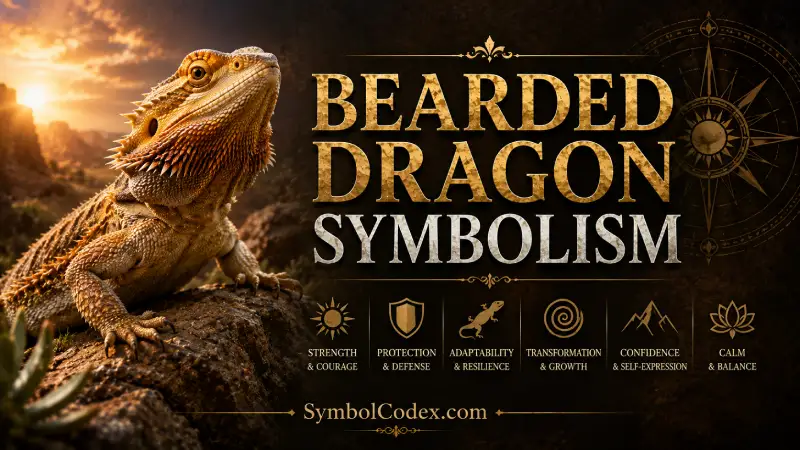
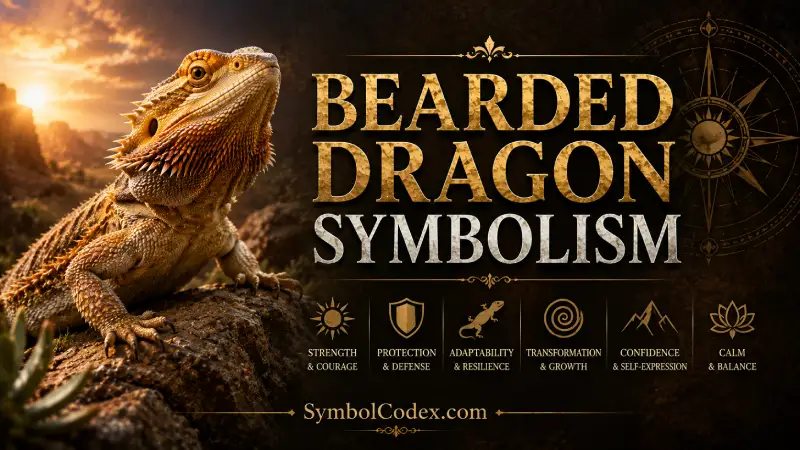
Bearded dragon symbolism commonly represents calm confidence, adaptability, protection, awareness, communication, resilience, and individuality. These meanings fit an Australian lizard that can remain relaxed while basking, dramatically expand its beard when threatened, change color, climb to observation points, and communicate through body language rather than constant aggression.
In the United States, bearded dragons are especially familiar as companion reptiles. The central or inland bearded dragon, Pogona vitticeps, is widely bred in captivity and is among the most popular pet reptiles in the country. That modern relationship has added meanings such as companionship, curiosity, trust, and quiet personality to an animal once known to Americans mainly through Australian wildlife.
Unlike wolves, ravens, snakes, or other animals with extensive documented mythological traditions, the bearded dragon does not have one universal ancient symbolic meaning. Most familiar interpretations today come from its real behavior, appearance, Australian origin, reptile symbolism, and modern pet culture.
Quick Answer
Bearded dragon symbolism most commonly represents calm strength, adaptability, protection, awareness, communication, and resilience. Its ability to bask peacefully yet display an enlarged dark beard when challenged makes it a natural modern symbol of staying composed while maintaining strong personal boundaries.
TL;DR
- Bearded dragons symbolize calm strength, adaptability, awareness, and protection.
- Their defensive beard represents boundaries without unnecessary aggression.
- Basking supports meanings of patience, restoration, and balanced energy.
- Body-language displays connect them with communication and social awareness.
- Their Australian habitat inspires resilience and environmental adaptation.
- U.S. pet culture adds companionship, curiosity, and individuality.
What a Bearded Dragon Looks Like
Bearded dragons belong to the Australian genus Pogona. Several species occur across Australia, while the central bearded dragon is the species most commonly kept as a pet internationally. These lizards have broad triangular heads, flattened bodies, sturdy limbs, and rows of pointed-looking scales along the throat and sides.
The famous “beard” consists of elongated scales beneath the jaw. When threatened or displaying, a bearded dragon can expand this area, darken it, open its mouth, and inflate its body so that it appears larger and more intimidating. Despite their sharp appearance, many of the beard scales are flexible rather than hard defensive spikes.
This contrast between appearance and behavior is central to the animal’s symbolism. A bearded dragon can look armored and formidable while spending long periods calmly basking or observing its surroundings.
Bearded Dragon Symbolism: 7 Powerful Core Meanings
The strongest modern meanings can be connected directly to recognizable behaviors.
| Symbolic Meaning | Bearded Dragon Trait | Modern Interpretation |
|---|---|---|
| Calm strength | Often rests and basks quietly | Confidence without constant display |
| Protection | Expands beard when threatened | Defending personal boundaries |
| Adaptability | Survives arid and semi-arid habitats | Adjusting to changing conditions |
| Awareness | Often watches from elevated perches | Observation before action |
| Communication | Uses head bobs and arm waves | Expressing intentions clearly |
| Resilience | Handles demanding Australian environments | Endurance during difficult periods |
| Individuality | Distinctive appearance and behavior | Confidence in being different |
These are modern symbolic interpretations rather than scientifically measurable spiritual qualities. They become meaningful because the metaphors closely reflect the animal’s observable biology.
Bearded Dragon Symbolism of Calm Confidence
One of the most natural meanings of the bearded dragon is quiet confidence.
These reptiles spend considerable time basking, resting on logs, rocks, fence posts, and branches while monitoring what happens around them. The behavior helps them regulate body temperature while also providing a useful position from which to observe predators, prey, competitors, and potential mates.
As symbolism, this creates an alternative to animals that represent strength through constant movement or aggression.
A bearded dragon can represent someone who:
- remains calm under pressure
- does not need constant attention
- watches before responding
- knows their abilities
- becomes assertive only when necessary
The symbolic message is not weakness or passivity. It is strength that remains controlled until circumstances require it.
Protection, the Beard, and Personal Boundaries
The defensive beard gives this reptile one of its strongest symbolic associations.
When alarmed, a bearded dragon may face the threat, open its mouth, expand its body, and puff out a darkened beard. This display makes the animal look larger and warns the intruder before physical confrontation becomes necessary.
That behavior creates a useful metaphor for healthy boundaries.
The bearded dragon does not begin with an attack. It communicates first.
As personal symbolism, this can represent:
Assertiveness. Making limits visible before conflict escalates.
Protection. Defending personal space or important relationships.
Self-respect. Refusing to remain silent when a boundary is crossed.
Restraint. Using the minimum force necessary to address a situation.
This makes the bearded dragon especially fitting for someone who values peace but does not want peacefulness mistaken for helplessness.
Adaptability and Surviving a Difficult Environment
Bearded dragons are native to Australia and occur across environments that can include arid and semi-arid woodland, shrubland, grassland, savanna, and other relatively dry landscapes. Central bearded dragons are adapted to changing temperatures and regulate their activity around environmental conditions.
They also use behavioral thermoregulation. Basking increases body temperature, while shade, posture, movement, and even changes in coloration can help them manage heat. Bush Heritage Australia notes that bearded dragons may become lighter during hotter weather and darker when conditions are cooler.
This makes them strong modern symbols of adaptability.
The metaphor is not simply “survive anything.”
It is more precise: change your behavior when the environment changes.
That interpretation can apply to moving, career changes, financial difficulty, relationships, education, or recovery after major disruption.
Flexibility becomes a form of strength.
Basking, Patience, and Restoring Energy
Few images are more strongly associated with bearded dragons than basking under warmth.
As ectothermic reptiles, they depend on environmental heat to regulate body temperature. In the wild, elevated rocks, branches, stumps, and other sunny positions can provide both warmth and visibility.
Modern symbolism can turn this behavior into an image of restorative patience.
Humans often treat rest as the opposite of productivity. A reptile provides a different model: sometimes remaining still is biologically necessary preparation for later activity.
A bearded dragon can therefore symbolize:
rest without guilt,
waiting for better conditions,
rebuilding energy,
or recognizing personal limits.
This is particularly useful symbolism for people who tend to equate constant movement with progress.
Sometimes preparation looks quiet.
Awareness and the Meaning of Observation
Bearded dragons often climb onto rocks, branches, stumps, and fence posts. From elevated positions, they can monitor their surroundings while basking.
That behavior supports symbolism involving awareness and perspective.
From a human viewpoint, stepping away from immediate problems can make patterns easier to see. A person may need distance before understanding a conflict, decision, or relationship.
The bearded dragon can represent:
looking at the larger situation,
collecting information,
and responding after observation rather than impulse.
This interpretation is more grounded than claiming the animal possesses supernatural foresight.
Its symbolic value comes from a simple behavioral fact: a better viewpoint often produces better information.
Bearded Dragon Symbolism of Communication
Bearded dragons communicate primarily through visual signals rather than vocalization.
The Australian Museum documents head bobbing, beard inflation, posture changes, and arm waving among their social displays. Different movements can communicate dominance, submission, courtship, or responsiveness depending on context.
That gives the animal an unusually strong connection with nonverbal communication.
Humans also communicate constantly without words through posture, facial expression, eye contact, distance, and movement.
The bearded dragon can therefore symbolize:
paying attention to body language,
communicating boundaries clearly,
understanding social signals,
and recognizing that silence still communicates.
Its famous arm wave is particularly memorable because it resembles a deliberate human gesture even though its biological meaning belongs to lizard behavior.
Strength Without Aggression
Bearded dragons sometimes appear intimidating because of their broad heads, rough scales, and spiny-looking beards.
Yet their first defensive response often involves display rather than immediate attack. The Australian Museum characterizes the central bearded dragon as relying heavily on appearing larger and more threatening before biting becomes necessary.
That contrast creates another symbolic lesson: strength does not have to become aggression.
Someone can be confident without being confrontational.
They can communicate disagreement without cruelty.
They can defend themselves without looking for conflict.
For that reason, bearded dragon imagery works well as a personal symbol for people learning assertiveness after previously being either too passive or unnecessarily reactive.
Color Change and the Symbolism of Transformation
Bearded dragons can change coloration relatively quickly.
Changes may relate to temperature regulation, communication, stress, dominance, or other conditions. The beard of a mature male can also darken dramatically during particular displays.
Modern symbolism can interpret this as responsive transformation.
Unlike a butterfly, which represents a dramatic life-stage change, the bearded dragon suggests adjusting appearance or behavior according to immediate circumstances.
This can symbolize:
adaptability,
emotional awareness,
changing strategies,
and responding appropriately to context.
The most grounded interpretation is not “change who you are.”
It is know which version of your abilities a situation requires.
Bearded Dragon Symbolism in the United States
The bearded dragon is an Australian animal, but it has developed a distinctly American cultural identity through the pet trade.
Veterinary sources describe the central bearded dragon as one of the most popular pet lizards in the United States. Captive breeding has made the species widely available, and American owners commonly refer to them affectionately as “beardies.”
That relationship changes the symbolism.
For many Americans, the bearded dragon does not represent a distant wild reptile. It represents a familiar animal that sits under a basking lamp, responds to its environment, investigates surroundings, and becomes part of household routines.
Modern U.S. meanings therefore include:
companionship,
curiosity,
gentleness,
individual personality,
and unconventional pet ownership.
The animal can also symbolize someone who prefers something different from mainstream expectations.
Companionship and Trust in Pet Culture
Bearded dragons have become especially popular because their behavior can make them relatively approachable compared with many reptiles.
Veterinary guidance describes captive bearded dragons as responsive, curious, and generally tolerant of appropriate handling, although individual temperament varies and proper husbandry remains essential.
This has given them emotional meanings rarely associated with wild reptiles.
A pet bearded dragon may represent:
a particular period in someone’s life,
responsibility learned through animal care,
companionship,
or affection for reptiles and unusual animals.
For owners, a tattoo or memorial image often does not mean “reptile spirituality” at all.
It means one specific animal.
That personal relationship can carry more emotional weight than any general symbolism list.
Bearded Dragon Symbolism in Tattoos
Bearded dragon tattoos can represent calm strength, protection, individuality, resilience, awareness, or personal connection with a beloved pet.
Pose changes the message significantly.
A relaxed bearded dragon basking on a rock can symbolize patience and peace.
An animal with an expanded black beard emphasizes protection and assertiveness.
A colorful design can highlight adaptability and transformation.
A realistic portrait may memorialize a particular pet.
Australian desert imagery can emphasize the species’ geographic origins, while sun imagery naturally complements themes of warmth, vitality, and restoration.
Because there is no standardized ancient bearded dragon tattoo tradition, personal context usually determines the meaning more than any fixed symbolic rule.
Spiritual Meaning of Bearded Dragon Symbolism
Modern spiritual interpretations often associate the bearded dragon with confidence, protection, adaptability, patience, awareness, and communication.
These ideas can work well as metaphors, but they should not be presented as scientifically proven spiritual properties.
A person may use bearded dragon imagery as a reminder to:
remain composed,
observe before reacting,
make boundaries clear,
adapt when conditions change,
or rest when energy needs rebuilding.
Those psychological uses can be meaningful without claiming that encountering a bearded dragon predicts future events.
The animal functions most effectively as a symbol when its metaphor remains connected to its actual behavior.
Is the Bearded Dragon Connected to Mythological Dragons?
The word dragon can create confusion.
Bearded dragons are real Australian lizards in the genus Pogona. Their common name refers to their dramatic appearance and expandable beard; it does not mean they are culturally equivalent to dragons from Chinese, European, or other mythological traditions. The genus name Pogona itself derives from a Greek word meaning “beard.”
This distinction matters because mythological dragon symbolism can include ideas such as imperial authority, treasure, cosmic forces, chaos, or supernatural protection depending on the culture.
Those meanings should not automatically be transferred to bearded dragons.
Someone may intentionally combine the two in contemporary art or personal symbolism, but that is a modern creative association rather than documented historical equivalence.
Indigenous Australian Context and Cultural Caution
Bearded dragons are native Australian animals and have shared landscapes with Aboriginal peoples for thousands of years.
However, Aboriginal Australia contains many distinct peoples, languages, countries, and cultural traditions. It is therefore inaccurate to claim that “Aboriginal Australians believed the bearded dragon meant” one universal concept.
Reliable public sources readily document the animal’s biology and Australian distribution, but they do not establish one universal Indigenous symbolic interpretation specific to Pogona. The responsible approach is therefore to avoid assigning generic sacred meanings without evidence from a particular community.
This distinction protects cultural accuracy.
An animal can be ecologically important and familiar within Indigenous landscapes without having one standardized symbolic definition across an entire continent.
Positive and Negative Meanings of Bearded Dragon Symbolism
Bearded dragon symbolism has both constructive and cautionary sides.
Positive meanings
Calmness: remaining composed under pressure.
Protection: maintaining clear boundaries.
Adaptability: responding effectively to changing conditions.
Awareness: observing before acting.
Communication: expressing intentions through clear signals.
Resilience: functioning in demanding environments.
Individuality: being comfortable with an unconventional identity.
Negative meanings
Defensiveness: reacting as though every challenge is a threat.
Withdrawal: remaining passive when action is actually required.
Dominance: turning healthy confidence into unnecessary competition.
Emotional signaling: communicating frustration indirectly instead of addressing problems clearly.
The meaning depends on context.
A defensive beard can symbolize admirable self-protection or excessive guardedness. Basking can represent restorative patience or avoidance. As with many symbols, the useful question is not whether the trait is good or bad, but whether it fits the situation.
Common Misunderstandings About Bearded Dragon Symbolism
The first misconception is that bearded dragons have one ancient spiritual meaning.
Most commonly repeated meanings today are modern interpretations built from animal behavior, general reptile imagery, and pet culture.
Another mistake is assuming that bearded dragons are naturally social animals in the same sense as dogs or humans. The Australian Museum describes central bearded dragons as generally solitary, even though individuals communicate during encounters and captive animals can become accustomed to people.
A third misconception is treating every arm wave as friendliness toward humans. In bearded dragon communication, arm waving can function as a submissive or social signal depending on context.
Finally, their calm appearance should not be mistaken for effortless pet care. Proper UVB exposure, temperature gradients, nutrition, enclosure space, and veterinary care are important for their health.
How Bearded Dragon Symbolism Has Evolved
Bearded dragon symbolism is largely a modern example of meaning developing from increased human familiarity with an animal.
In Australia, these reptiles are part of native ecosystems across dry woodlands, shrublands, grasslands, and other habitats. Their distinctive displays, basking behavior, climbing ability, and color changes are products of adaptation rather than symbolic performance.
International pet keeping added another layer.
Captive breeding brought central bearded dragons into American homes, classrooms, veterinary medicine, and reptile communities. Their relatively approachable behavior helped transform them from unfamiliar Australian wildlife into recognizable companion animals.
As a result, today’s bearded dragon can represent both wild adaptation and domestic companionship.
Its modern symbolic identity combines the desert survivor, calm observer, defensive communicator, unusual pet, and individual animal remembered by its owner.
Frequently Asked Questions
What does a bearded dragon symbolize spiritually?
In modern spiritual interpretation, a bearded dragon can symbolize calm strength, protection, awareness, adaptability, patience, and communication. These meanings are contemporary metaphors rather than one universal religious tradition.
Is seeing a bearded dragon a good sign?
There is no objective rule that makes seeing a bearded dragon a supernatural omen. Symbolically, someone might interpret the encounter as a reminder to remain calm, observe carefully, protect boundaries, or adapt to changing circumstances.
What does a bearded dragon tattoo symbolize?
A bearded dragon tattoo commonly represents resilience, confidence, individuality, protection, or patience. It may also simply honor a beloved pet, making the personal relationship more important than any general symbolic meaning.
Why does a bearded dragon symbolize protection?
The association comes from its defensive display. When threatened, the lizard can expand and darken its beard, inflate its body, and open its mouth to discourage an aggressor before physical confrontation becomes necessary.
What does a bearded dragon’s arm wave symbolize?
Biologically, arm waving is part of bearded dragon communication and can signal submission or social responsiveness depending on context. Symbolically, people may connect it with communication, diplomacy, or knowing when not to escalate conflict.
Does a bearded dragon symbolize transformation?
It can in modern symbolism. Because bearded dragons can alter coloration and adjust behavior according to temperature and social conditions, they provide a natural metaphor for adapting while remaining fundamentally the same animal.
Is bearded dragon symbolism positive or negative?
It is mostly positive when associated with calmness, resilience, communication, and healthy boundaries. Negative interpretations can include excessive defensiveness, passivity, dominance, or withdrawing instead of addressing a problem.
Conclusion
Bearded dragon symbolism most naturally represents calm confidence, adaptability, protection, awareness, communication, resilience, and individuality. Those meanings arise from an animal that spends much of its life quietly regulating its energy yet can transform its appearance dramatically when circumstances demand a response.
Modern American pet culture has added companionship and personality to that symbolism. For many people, a bearded dragon is not merely an Australian reptile but a familiar animal whose distinctive behaviors become part of everyday life.
Its most grounded symbolic lesson is simple: being calm does not mean being weak, adapting does not mean losing yourself, and strong boundaries do not require constant aggression.