Alligator symbolism commonly centers on strength, survival, patience, protection, instinct, adaptability, and controlled power. In the United States, these meanings are especially connected with the American alligator, an animal strongly identified with Florida, Louisiana, the Everglades, and the wetlands of the Southeast.
An alligator can remain almost motionless before acting with remarkable speed. It survives in environments that change between flood, drought, heat, and cold, while females also guard nests and young. Those real behaviors help explain why modern symbolic interpretations connect the animal with restraint, awareness, resilience, and protection.
The cultural story is more complex than a list of personality traits. Alligators have longstanding relationships with Indigenous peoples of the Southeast, later became important to Southern hunting and tourism, and eventually emerged as one of America’s best-known wildlife conservation success stories.
Quick Answer
Alligator symbolism most commonly represents strength, patience, survival, protection, instinct, and the ability to act decisively at the right moment in modern American culture. Historically, alligators have also held culturally specific importance for Indigenous communities of the Southeast and have become enduring symbols of Southern wetlands, particularly Florida and Louisiana.
TL;DR
- Alligators symbolize strength, patience, survival, instinct, and controlled action.
- Their protective parenting supports associations with guardianship and family.
- Alligator meanings are especially strong in Southern American culture.
- Indigenous traditions vary and should never be treated as one belief system.
- Their conservation recovery adds resilience and renewal to modern symbolism.
- Tattoos often emphasize power, independence, boundaries, and survival.
What an Alligator Looks Like and Why Its Appearance Matters
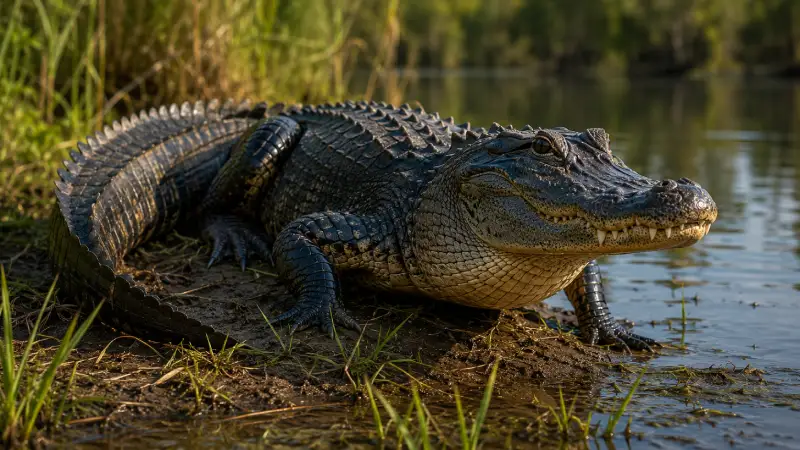
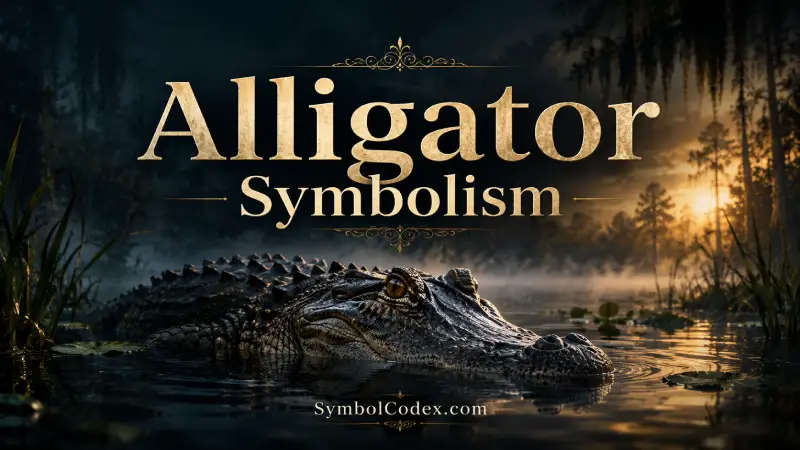
The American alligator, Alligator mississippiensis, is a large crocodilian with a broad snout, muscular tail, armored-looking skin, short legs, and a body built for both water and land. Adults usually appear dark gray, olive, or nearly black, while young alligators have brighter yellowish bands.
Much of the animal’s symbolic force comes from its appearance.
Its heavy scales suggest armor. Its strong jaws communicate physical power. Eyes and nostrils positioned near the top of the head allow an alligator to remain mostly submerged while still observing its surroundings.
That half-hidden posture has inspired associations with watchfulness, secrecy, patience, and unseen strength.
Unlike animals whose symbolism depends heavily on bright color or elaborate display, the alligator communicates through stillness. It can appear almost motionless and then act suddenly when necessary. This contrast is central to its modern meaning.
7 Core Meanings of Alligator Symbolism
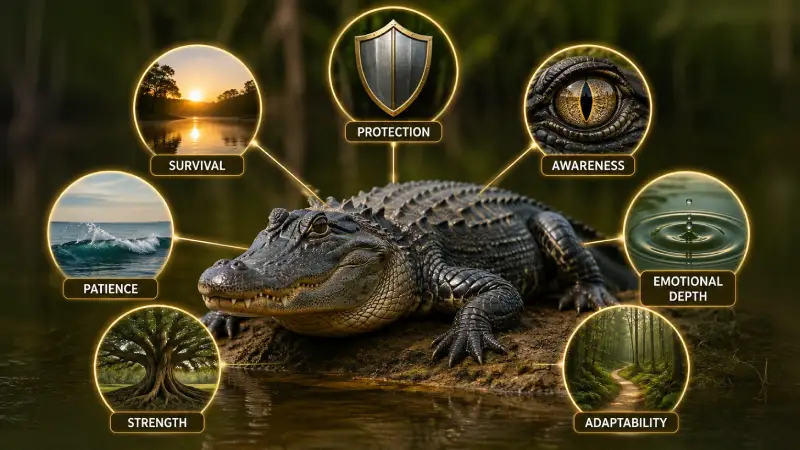
Although interpretations differ, seven meanings appear especially naturally in modern American symbolism.
| Symbolic Meaning | Why It Fits the Alligator | Modern Interpretation |
|---|---|---|
| Strength | Powerful body and jaws | Confidence and personal power |
| Patience | Waits quietly before acting | Choosing the right moment |
| Survival | Thrives in demanding wetlands | Resilience after hardship |
| Protection | Females guard nests and young | Defending family and boundaries |
| Instinct | Highly responsive predator | Trusting awareness and judgment |
| Adaptability | Functions in changing wetland conditions | Adjusting without losing identity |
| Controlled power | Strength is not constantly displayed | Self-control and strategic action |
These meanings are modern interpretations based partly on observable characteristics. They should not automatically be presented as ancient spiritual teachings.
Strength Without Constant Display
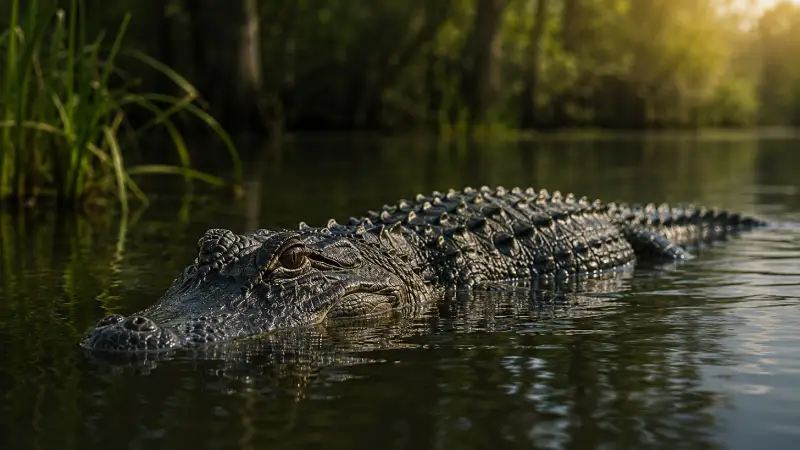
The alligator is an obvious symbol of strength, but its symbolism differs from animals associated with continuous aggression.
An alligator spends considerable time resting, basking, floating, or remaining nearly invisible in water. Its power is present even when that power is not being used.
That makes the animal a useful symbol of controlled strength.
In personal symbolism, an alligator can communicate the idea that confidence does not require constant performance. A person may be capable, determined, or difficult to intimidate without needing to demonstrate those qualities in every interaction.
This is one reason the animal works well in tattoos and logos. The image can feel threatening, but it can also communicate quiet authority.
The symbolic message is less “attack everything” and more know what you are capable of, then choose carefully when to act.
Patience, Timing, and Strategic Action
Alligators are frequently associated with patience because of the way they hunt and move through their environment.
They do not need to chase every opportunity. Much of their behavior depends on positioning, awareness, and conserving energy until action becomes worthwhile.
Symbolically, that translates into:
- waiting instead of forcing an outcome
- observing before responding
- conserving energy
- choosing opportunities carefully
- acting decisively once a decision is made
This makes alligator symbolism particularly relevant to situations involving strategy.
Someone drawn to the animal may see it as a reminder that patience is not the same as passivity. Waiting can itself be an active decision when it improves the chances of success.
The alligator therefore represents a specific type of patience: alert patience rather than inactivity.
Survival and Adaptability in Difficult Conditions
Survival is another central interpretation.
American alligators occupy freshwater wetlands across much of the southeastern United States, including marshes, swamps, rivers, lakes, ponds, and canals. They influence these habitats not only as major predators but also by modifying the landscape.
In the Everglades, alligators create or maintain depressions commonly called alligator holes. These areas can retain water during dry periods and provide refuge for fish and other wildlife. Their activities are important enough that researchers describe alligators as ecosystem engineers and a keystone species in parts of the Everglades.
That ecological role gives survival symbolism an additional dimension.
The alligator does not merely endure its surroundings. It can physically alter those surroundings in ways that help create usable habitat.
As a personal metaphor, this suggests adaptation through action: when circumstances become difficult, survival sometimes requires changing the environment rather than simply tolerating it.
Protection, Motherhood, and Family
The alligator’s intimidating reputation can hide one of its most interesting behaviors: maternal care.
Female alligators build nests, remain near them, respond to hatchlings, help open nests when young begin emerging, and can stay near their offspring for an extended period. Young alligators may remain with their mother for one to two years.
That behavior supports a second side of alligator symbolism: protective strength.
An alligator can therefore symbolize:
Guardianship. Strength used to protect something vulnerable.
Family loyalty. Commitment to those considered one’s own.
Boundaries. Knowing when another person has entered protected territory.
Maternal courage. Fierceness connected to caregiving rather than aggression for its own sake.
This meaning is especially useful in tattoos chosen by parents. An alligator accompanied by hatchlings can communicate a much different message from an alligator shown with open jaws.
Instead of danger alone, it can represent someone who is calm until family or personal boundaries require defense.
Instinct, Awareness, and Hidden Perception
Because alligators spend so much time partially submerged, they naturally lend themselves to symbolism involving what lies beneath the surface.
Only the eyes, nostrils, and upper head may be visible while most of the animal remains underwater.
Modern spiritual and psychological interpretations often turn this into a metaphor for awareness beyond what is immediately visible.
The alligator can represent paying attention to subtle signals, recognizing danger early, or trusting experience when a situation does not feel right.
This does not mean an alligator has supernatural powers or that seeing one predicts future events. Rather, the symbolism comes from the animal’s real ability to function effectively while remaining inconspicuous.
Emotionally, the image can represent a person who observes more than they reveal.
That interpretation has both positive and negative sides. It can mean perceptiveness and emotional intelligence, but it may also suggest guardedness, secrecy, or difficulty trusting others.
Alligator Symbolism in Indigenous Southeastern Cultures
Alligator symbolism should be handled carefully when discussing Native American traditions.
There is no single “Native American meaning” of the alligator. Indigenous nations have distinct languages, histories, clan structures, ceremonial practices, and relationships with local wildlife.
A documented example comes from the Seminole Tribe of Florida. Its current clan system includes Panther, Bear, Deer, Wind, Bigtown, Bird, Snake, and Otter, while the Tribe records Alligator as one of several historical clans that are now extinct. Seminole clans are extended family units associated with non-human entities and traits.
Alligators also remain closely connected with Miccosukee history in the Everglades. The Miccosukee describe traditions of capturing alligators for food and their durable hides; contemporary tribal presentations increasingly emphasize conservation, education, and the animal’s ecological role.
These examples demonstrate genuine cultural importance, but they should not be converted into a generic claim that “all Native Americans believed the alligator symbolized strength.”
The accurate approach is more specific: some Southeastern Indigenous communities developed their own relationships with alligators because they shared the same landscape.
The Alligator as a Symbol of Florida and the American South
Few American animals are as geographically recognizable as the alligator.
In popular imagination, an alligator immediately suggests Florida wetlands, Louisiana bayous, cypress swamps, Spanish moss, airboats, marshes, and the humid landscapes of the Gulf Coast.
Its natural U.S. range extends across much of the Southeast, from the Carolinas through Florida and westward into Louisiana and Texas, with populations also extending inland in parts of the region.
Because of this strong regional identity, the alligator has become more than wildlife. It functions as an informal emblem of Southern landscapes.
Businesses use alligator imagery on signs, sports teams adopt it as a mascot, tourist shops place it on souvenirs, and Florida attractions frequently use the animal as shorthand for the state itself.
In this context, the symbolism is often less spiritual than cultural.
An alligator can mean Florida, the swamp, the Gulf South, toughness, local pride, or life close to wild wetlands.
Fear, Danger, and Respect for Boundaries
Not every symbolic meaning is positive.
Alligators are large predators capable of injuring people, which means they also symbolize danger, intimidation, territoriality, and consequences.
This darker interpretation is common in visual culture.
An alligator with exposed teeth can suggest:
- “keep your distance”
- concealed danger
- retaliation
- a threatening personality
- unforgiving territory
- consequences for crossing a boundary
The important distinction is between symbolic danger and actual animal behavior.
Popular culture often portrays alligators as creatures constantly searching for humans to attack. That exaggeration is useful in horror, comedy, and advertising, but it should not replace wildlife knowledge.
As symbolism, however, the fear response matters. Animals become culturally meaningful partly through the emotions they trigger, and few people mistake a large alligator for something harmless.
Alligator Symbolism in Tattoos
Alligator tattoos usually emphasize strength, resilience, independence, survival, patience, or protection.
The exact meaning depends heavily on the pose.
A resting alligator can symbolize controlled confidence. One emerging from water may represent hidden strength or something previously concealed coming to the surface.
An aggressive open-jaw design emphasizes danger, fearlessness, and boundaries. A mother with young can shift the meaning toward guardianship and family.
Florida or Louisiana imagery can make the tattoo regional rather than spiritual. Cypress trees, marsh grass, maps, state flowers, or bayou scenes may turn the alligator into a symbol of home.
Some people also choose alligators after surviving a difficult period. In that context, the animal represents a simple statement: I adapted, endured, and remained strong enough to continue.
Spiritual Meaning of an Alligator
In contemporary spiritual culture, alligators are often interpreted as symbols of instinct, emotional depth, patience, protection, and personal power.
Water plays an important role in these interpretations.
Because alligators move between land and water, some people use them metaphorically to represent movement between rational thought and emotion, visible identity and private feeling, or conscious decisions and instinctive reactions.
These are modern symbolic frameworks rather than scientifically measurable effects.
Seeing an alligator does not prove that the universe is sending a particular message, and wearing an alligator symbol cannot guarantee courage, wealth, protection, or success.
Still, symbols can function as personal reminders. Someone may use an alligator pendant, drawing, or tattoo to remind themselves to remain observant, protect boundaries, or wait for the right moment before acting.
That psychological function does not require supernatural claims.
What Alligator Symbolism Can Mean Emotionally
Emotionally, alligator imagery often communicates guarded strength.
A lion typically displays itself openly. An alligator can disappear beneath dark water.
That difference creates a useful emotional metaphor.
Someone who identifies with alligator symbolism may see themselves as private, observant, difficult to intimidate, and slow to trust. They may prefer to understand a situation fully before showing their intentions.
The symbolism can also point toward emotional boundaries.
Healthy boundaries involve protecting time, privacy, relationships, and personal values without attacking others unnecessarily. In that sense, the alligator becomes an image of selective defense.
There is also a cautionary interpretation.
Too much guardedness can turn into isolation. Patience can become avoidance. Protection can become possessiveness. Strength can become intimidation.
Like many animal symbols, the alligator works best when its positive and negative meanings are considered together.
Conservation Changed the Alligator’s Modern Meaning
One of the most distinctly American meanings of the alligator comes from conservation history.
Overhunting, habitat loss, and pollution severely reduced American alligator populations during the twentieth century. Federal protection began in 1967, and hunting and commercial trade were heavily restricted during the endangered-species era. By 1987, the species had recovered enough to be removed from the endangered species list.
By 2026, federal wildlife officials estimated that nearly 5 million American alligators lived across the southeastern United States, including roughly 1.25 million in Florida. Modern trade remains regulated so that commercial use can coexist with conservation.
That recovery gives the animal a modern symbolism that earlier generations could not have understood in quite the same way.
The alligator can now represent recovery after decline.
Its story shows that a species once pushed toward disappearance can rebound when legal protection, habitat management, regulated trade, state agencies, Tribes, landowners, and conservation programs work together.
This meaning is grounded in history rather than mystical interpretation.
Alligator vs. Crocodile Symbolism
Alligator and crocodile imagery is frequently treated as interchangeable, but the two are not identical symbols.
In American settings, alligator imagery usually carries a strong connection with the Southeastern United States, especially Florida and Louisiana.
Crocodile symbolism has a much wider international cultural history because crocodiles occur across parts of Africa, Asia, Australia, and the Americas. Religious and mythological traditions involving crocodiles therefore cannot automatically be applied to alligators.
Visually, both animals can symbolize danger, strength, ancient survival, patience, and water.
Culturally, however, context matters.
If a historical source specifically discusses a crocodile, replacing it with “alligator” can create a false cultural claim. Likewise, an American alligator tattoo inspired by the Everglades does not automatically carry meanings associated with crocodiles in ancient Egyptian or other traditions.
Common Misunderstandings About Alligator Symbolism
The first common mistake is assuming that every symbolism website is describing an ancient tradition.
Many modern meanings, such as “manifestation,” “energy protection,” or highly specific predictions about relationships and money, are contemporary spiritual interpretations unless credible historical evidence says otherwise.
Another mistake is treating Native American cultures as one system.
The Seminole historical Alligator clan and Miccosukee relationships with alligators are specific cultural examples. They do not establish a universal Indigenous definition.
A third mistake is assuming that alligator symbolism must be negative because the animal is dangerous.
Its real ecology provides reasons for much broader interpretations: maternal protection, patience, environmental adaptation, ecosystem engineering, and extraordinary species recovery all complicate the simple image of a monster in a swamp.
How Alligator Meaning Has Evolved in American Culture
The meaning of the alligator has changed alongside America’s relationship with Southern wetlands.
For Indigenous communities in Florida and the Southeast, alligators existed within lived landscapes involving food, materials, clan identity, survival, and cultural tradition. Specific relationships varied between peoples.
As settlement and commercial hunting expanded, alligators increasingly became commodities. Their hides acquired substantial economic value, contributing to severe population declines before stronger regulation and conservation measures were introduced.
Tourism later helped turn the alligator into an instantly recognizable Florida icon.
Modern conservation changed the picture again. The animal is now simultaneously a predator, tourist attraction, managed wildlife resource, ecosystem engineer, regional emblem, and conservation success story.
That layered history explains why alligator symbolism can communicate both danger and protection, ancient toughness and ecological vulnerability, stillness and sudden action.
Its meaning depends on which part of the animal’s story a person chooses to emphasize.
Frequently Asked Questions
What does an alligator symbolize spiritually?
In modern spiritual interpretation, an alligator often symbolizes instinct, patience, protection, emotional awareness, resilience, and controlled personal power. These meanings are symbolic interpretations rather than universal religious teachings or proven supernatural properties.
Is seeing an alligator a good or bad sign?
There is no objective rule that makes seeing an alligator a good or bad omen. Symbolically, some people interpret the encounter as a reminder to stay alert, respect boundaries, remain patient, or take a situation seriously.
What does an alligator tattoo symbolize?
An alligator tattoo commonly represents strength, survival, patience, independence, protection, or Southern identity. Its pose and surrounding imagery can shift the meaning from calm confidence to aggression, family protection, or connection with Florida and Louisiana.
What does an alligator symbolize in Native American culture?
There is no single Native American interpretation. The Seminole Tribe of Florida documents a historical Alligator clan, while the Miccosukee describe longstanding practical and cultural relationships with alligators in the Everglades. Meanings should be attributed to specific communities rather than generalized across Indigenous peoples.
Why does the alligator symbolize patience?
The association comes largely from the animal’s behavior. Alligators can remain still and conserve energy before acting quickly when an opportunity appears, making them an intuitive metaphor for observation, timing, and strategic action.
Does an alligator symbolize protection?
Yes, protection is a reasonable modern interpretation, particularly because female alligators guard nests and remain with young after hatching. The symbolism often extends to family loyalty, motherhood, personal boundaries, and defending vulnerable people.
Are alligator and crocodile symbolism the same?
Not exactly. They share associations such as strength, danger, survival, and patience, but their cultural histories differ; alligator symbolism in the United States is particularly tied to the Southeast and the Everglades.
Conclusion
Alligator symbolism is most clearly understood through the animal’s real combination of strength, patience, adaptability, protective behavior, and close relationship with Southern wetlands. It can represent someone who watches before acting, survives difficult conditions, protects important boundaries, and does not need to display strength constantly.
Its meaning also reaches beyond personality symbolism. Alligators occupy specific places in Indigenous Southeastern histories, remain defining animals of Florida and Louisiana, and play an important ecological role in wetlands. Their twentieth-century decline and remarkable recovery added resilience and restoration to their modern American image.
The alligator’s strongest symbolic lesson is therefore grounded rather than mystical: power can be quiet, patience can be active, and survival often depends on knowing when to adapt and when to stand firm.