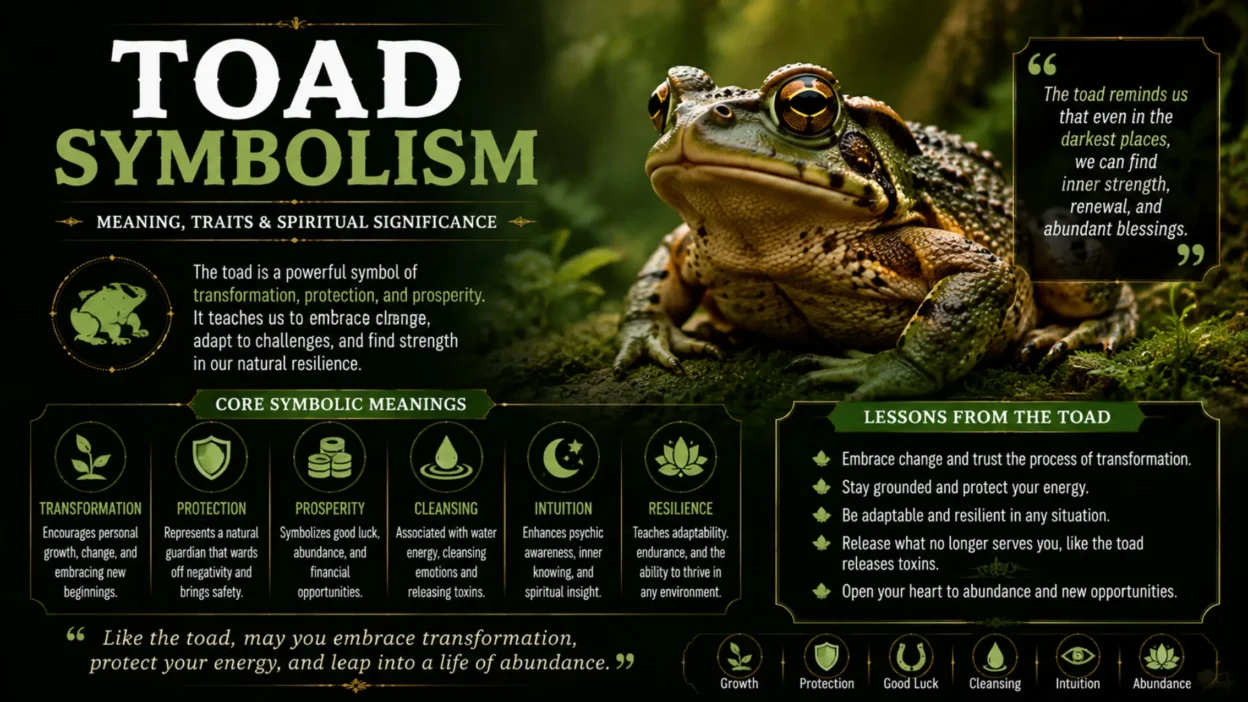
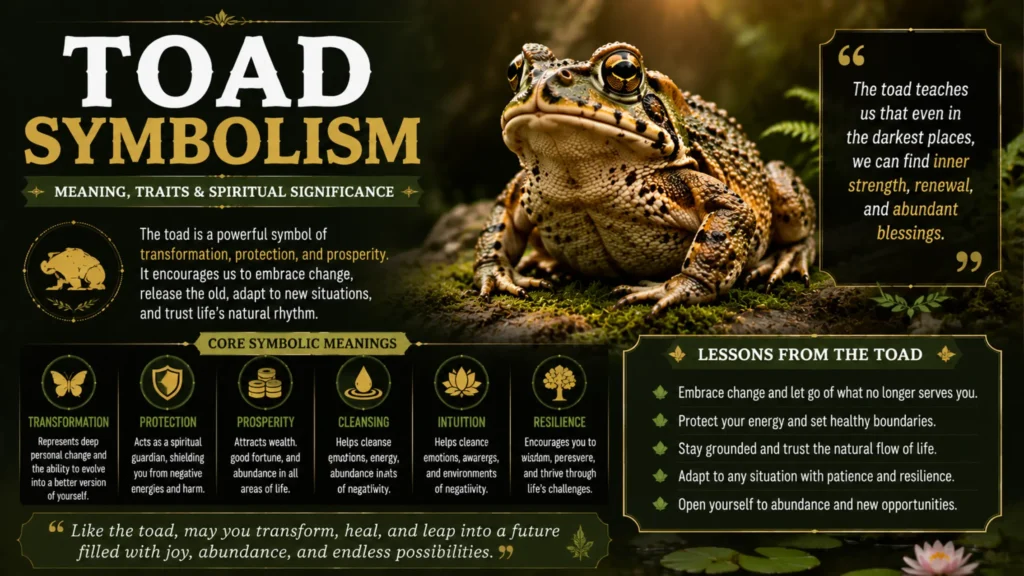
Toads are familiar amphibians known for their textured skin, compact bodies, nocturnal habits, and ability to live in surprisingly varied environments. Toad symbolism commonly represents transformation, resilience, patience, fertility, protection, and connection with the natural world.
Unlike animals celebrated mainly for beauty or speed, the toad often carries a more complicated image. Its rough appearance, nighttime activity, association with damp places, and unusual life cycle have made it a symbol of both renewal and things people may initially find strange or uncomfortable.
In the United States, toads appear in children’s stories, gardens, folklore, environmental education, fantasy art, tattoos, Halloween imagery, and popular culture. Their symbolism can be positive or negative depending on the context, making the toad a particularly interesting symbol of change and overlooked value.
Quick Answer
Toad symbolism commonly represents transformation, resilience, patience, fertility, and protection in modern American culture, especially in folklore, nature imagery, tattoos, and spiritual traditions. Historically, toads have also been associated with rain, fertility, healing, witchcraft, and the mysterious qualities of nighttime and wetlands.
TL;DR
- Toads commonly symbolize transformation, resilience, patience, and protection.
- Their life cycle connects them with change and renewal.
- Folklore often links toads with rain, fertility, magic, and healing.
- American culture gives toads both positive and negative meanings.
- Toad tattoos can represent survival, growth, or embracing individuality.
- Modern symbolism often celebrates the overlooked value of nature.
What Does a Toad Symbolize?
The toad has several symbolic meanings because people have interpreted its unusual appearance and behavior in different ways.
The most common associations include:
- Transformation , changing from one stage of life into another.
- Resilience , surviving in difficult or changing environments.
- Patience , remaining still and waiting for the right moment.
- Fertility , association with eggs, water, reproduction, and seasonal renewal.
- Protection , connection with defensive skin secretions and survival strategies.
- Adaptability , living in different habitats and adjusting to environmental conditions.
- Hidden value , representing something useful or meaningful that may initially appear unattractive.
- Mystery , Toad Symbolism: Meaning, History, and Modern Use: association with darkness, wetlands, nighttime, and folklore.
Not every tradition gives the toad all of these meanings. Symbolism develops from particular cultures, stories, environments, and historical periods.
Why Toads Represent Transformation
Transformation is one of the strongest symbolic ideas connected with amphibians.
Toads begin life as eggs and pass through a larval stage before becoming terrestrial adults. Although the exact development varies among species, this dramatic change provides an obvious metaphor for moving from one condition to another.
The transformation is especially meaningful because a young amphibian living in water eventually develops into an animal capable of spending much of its life on land.
Symbolically, this can represent:
- growing into a new identity
- leaving an old stage behind
- adapting to unfamiliar circumstances
- accepting physical or emotional change
- becoming capable of something previously impossible
This symbolism is often applied to major life transitions such as moving away from home, beginning a career, ending a relationship, or developing greater independence.
The toad does not symbolize transformation because it is magically changing into something else. Its real biological development simply gives people a useful natural metaphor for change.
Toad Symbolism and Resilience
Toads are often associated with resilience because many species can tolerate conditions that would challenge more delicate animals.
They may spend significant periods hidden beneath vegetation, soil, leaf litter, rocks, or other shelters. Depending on the species and environment, they can cope with seasonal changes, periods of dryness, temperature fluctuations, and limited access to water.
This has encouraged the symbolic idea of quiet survival.
A toad does not need to appear impressive to survive. It can remain hidden, conserve energy, and emerge when environmental conditions are favorable.
For modern readers, this can represent someone who has survived difficult circumstances without receiving much recognition.
The symbolism is therefore less about dramatic victory and more about persistence.
A toad can remind someone that survival itself can be an achievement.
The Meaning of Patience and Stillness
Toads often remain motionless while waiting for prey.
Rather than constantly moving through their environment, they can sit quietly and respond quickly when an opportunity appears.
This behavior naturally supports symbolism involving:
- patience
- observation
- timing
- restraint
- conserving energy
- acting at the right moment
In a culture that often celebrates speed and constant productivity, the toad offers a different metaphor.
Its lesson can be interpreted as: not every goal requires constant movement.
Sometimes waiting, watching, and responding at the right moment can be more effective than rushing.
This interpretation is especially useful when toad imagery appears in meditation, nature-based art, or personal symbolism.
Toads and Fertility Symbolism
Toads have long been associated with fertility in different folklore traditions.
The connection is understandable from their reproductive biology. Toads lay eggs, often in or near water, and favorable seasonal conditions can produce large numbers of young amphibians.
Their sudden appearance after rain has also helped connect them with renewal and reproductive abundance.
In symbolic traditions, fertility does not necessarily mean human pregnancy. It can also represent:
- new projects
- creativity
- abundance
- agricultural growth
- renewal
- new opportunities
This broader interpretation makes the toad useful as a symbol of beginnings.
A person might use a toad image to mark a new chapter or the start of something that they hope will grow over time.
Toads, Rain, and Water Symbolism
Toads are strongly associated with moisture, rainfall, ponds, wetlands, and other water-related environments.
In many regions, people notice amphibian activity increase after rainfall. Their calls can become especially noticeable during breeding seasons and wet weather.
This has created a longstanding symbolic connection between toads and rain.
Rain itself carries many symbolic meanings:
- renewal
- cleansing
- fertility
- relief
- growth
- seasonal change
When combined with the toad, these ideas create a natural image of renewal after dryness.
This may help explain why frogs and toads appear in stories and folklore involving rain and agricultural abundance.
The association is especially understandable for communities whose food production historically depended heavily on seasonal rainfall.
Ancient and Medieval Toad Symbolism
Toads appear in European folklore and medieval imagery, but their meanings were not consistently positive.
Because toads live in damp, dark environments and have unusual skin, they could be associated with things considered strange, dirty, or dangerous.
Medieval European traditions sometimes connected toads with witchcraft, poisons, and magical practices. Artistic depictions could therefore use the animal to represent unpleasantness or supernatural danger.
At the same time, other traditions associated amphibians with fertility, transformation, and natural cycles.
This contradiction is important.
The toad was not simply “good” or “evil.” Its meaning depended on the cultural context and on whether people emphasized its ecological role, unusual appearance, or association with folklore and magic.
Toads in European Folklore and Fairy Tales
The image of the toad became particularly famous through European fairy-tale traditions.
The best-known example is the story commonly called “The Frog Prince,” although versions differ and the amphibian may be described as a frog rather than a toad.
The story contributed to a familiar symbolic pattern: an unattractive or unexpected creature is transformed into something desirable.
This narrative can be interpreted as a lesson about:
- looking beyond appearances
- keeping promises
- transformation
- hidden identity
- unexpected worth
It is important, however, not to assume that the fairy tale proves all historical cultures believed toads represented transformation. The story is one cultural expression of a broader motif involving disguised or transformed beings.
Toad Symbolism in the United States
In the United States, toads occupy a curious place between nature, folklore, childhood stories, and popular culture.
American children may encounter toads in gardens, ponds, books, cartoons, and classroom lessons about amphibians. Adults may associate them with backyard wildlife, rainy evenings, camping, gardening, or rural landscapes.
Toads can therefore represent a direct connection with ordinary nature.
This is different from symbols such as eagles or bears, which often carry stronger national or wilderness associations.
The American toad is frequently encountered close to human habitation. People may find one under a porch light, beside a garden, or near a damp area after rain.
That familiarity contributes to its modern symbolic meaning as a creature that exists quietly alongside people.
In contemporary American culture, a toad may suggest:
- resilience
- natural wisdom
- environmental awareness
- patience
- transformation
- rural or garden life
- acceptance of unconventional beauty
Why Toads Can Symbolize Hidden Value
One of the most recognizable ideas surrounding the toad is hidden value.
The animal’s rough skin and unusual appearance do not immediately suggest beauty. Yet toads perform valuable ecological roles, including consuming large numbers of insects and other small prey.
This creates a useful symbolic contrast.
Something does not have to look beautiful to be valuable.
In personal symbolism, the toad can therefore represent:
- underestimated people
- overlooked talents
- unconventional beauty
- inner qualities
- practical usefulness
- discovering value beneath appearances
This meaning fits particularly well with modern discussions about individuality.
A toad can symbolize the choice to stop measuring worth entirely by appearance or social approval.
Toad Symbolism in Spiritual Traditions
Modern spiritual interpretations often connect toads with transformation, grounding, fertility, cleansing, and adaptation.
These ideas are partly influenced by the animal’s movement between water and land and its seasonal relationship with rain and reproduction.
Some contemporary spiritual practices may also treat encounters with toads as symbolic reminders to slow down, accept change, or reconnect with nature.
However, there is no single universal spiritual meaning.
A claim that “all ancient cultures believed toads were spiritual messengers” would be misleading. Different cultures developed different relationships with amphibians, and modern spiritual interpretations should be distinguished from documented historical beliefs.
For a personal spiritual practice, the toad can simply serve as a meaningful reminder of change without losing resilience.
Toad Symbolism in Love and Relationships
In relationships, the toad can symbolize patience, acceptance, transformation, and looking beyond appearances.
Its fairy-tale associations make it particularly relevant to the idea that love should not be based entirely on outward appearance.
A toad may represent learning to appreciate someone’s personality, loyalty, humor, or character rather than judging them immediately.
Its connection with transformation can also represent how relationships change over time.
People enter different stages of life, and healthy relationships often require both partners to adapt.
The negative side of the symbolism can involve settling for unhealthy behavior because of an idealized belief in someone’s “hidden potential.”
The more balanced interpretation is to value people for who they actually are rather than expecting them to transform into someone else.
Toad Symbolism in Tattoos
Toad tattoos can carry a surprisingly wide range of meanings.
Someone may choose a toad because they love amphibians, gardening, forests, wetlands, or childhood stories. Others may use the animal as a symbol of transformation, resilience, unconventional beauty, or personal growth.
Popular design combinations can change the message:
| Toad Tattoo Element | Common Meaning in the USA | Main Association | Typical Interpretation |
|---|---|---|---|
| Toad alone | Resilience | Survival | Quiet strength |
| Toad with mushrooms | Nature and mystery | Forest folklore | Unconventional identity |
| Toad with flowers | Growth | Renewal | Personal transformation |
| Toad near water | Adaptability | Natural cycles | Change and renewal |
| Toad with a crown | Hidden worth | Fairy tales | Unexpected value |
The visual style matters too.
A realistic toad may emphasize nature and ecological appreciation, while a cartoon or fairy-tale version may focus more on humor, transformation, or childhood nostalgia.
Toad Symbolism in Dreams
Dreams involving toads can have different meanings depending on the setting and emotional response.
A peaceful toad might represent patience, adaptation, or a gradual transition in the dreamer’s life.
A toad appearing after rain could symbolize renewal or the end of a difficult period.
A threatening or unpleasant toad might instead represent something the dreamer finds uncomfortable but needs to confront.
Because toads are sometimes associated with hidden places, a dream about one emerging from darkness could also symbolize something previously overlooked becoming visible.
Dream symbolism is personal rather than predictive. The most useful interpretation usually comes from asking what the toad represented emotionally to the dreamer.
Positive and Negative Toad Symbolism
The toad’s symbolism contains a clear tension between attraction and discomfort.
Positive meanings include:
- transformation
- resilience
- patience
- fertility
- renewal
- adaptability
- protection
- hidden value
- connection with nature
Negative meanings can include:
- ugliness
- unpleasantness
- secrecy
- fear
- deception
- contamination
- witchcraft
- something hidden or unwanted
These opposing meanings often come from the same physical characteristics.
Its unusual appearance can produce ideas of ugliness, while its ability to survive and contribute to ecosystems produces ideas of resilience and usefulness.
Its hidden lifestyle can suggest secrecy, but it can also suggest patience and discretion.
This makes the toad a good example of how symbolism depends on perspective.
Toads and Witchcraft: Historical Meaning vs. Modern Misuse
The association between toads and witches is one of the most persistent pieces of European folklore surrounding the animal.
Historical accounts and literary traditions sometimes connected toads with witches, poisonous substances, magical practices, or familiars. These ideas reflected older fears about unfamiliar animals and the perceived dangers of occult practices.
Modern popular culture has amplified the association.
Halloween decorations, fantasy movies, books, and costumes frequently place a toad beside witches, cauldrons, spell books, and other magical imagery.
But this should not be mistaken for a universal historical belief.
The toad’s association with witchcraft is primarily a specific European and later popular-cultural tradition, not an inherent meaning of the animal.
Today, using a toad in a fantasy design usually signals magic or folklore rather than making a serious claim about historical religious practice.
Toads and Environmental Symbolism
Modern environmental awareness has given the toad another important meaning: ecosystem health.
Amphibians are sensitive to environmental changes, and their populations can be affected by habitat loss, pollution, disease, invasive species, climate conditions, and other ecological pressures.
As a result, frogs and toads often appear in environmental education.
For Americans, seeing a toad in a backyard can also represent a healthy relationship between human spaces and wildlife.
A garden that provides shelter, native plants, moisture, and safe habitat may attract amphibians naturally.
The toad therefore works as a modern symbol of coexistence with wildlife.
Instead of representing something strange hiding at the edge of civilization, it can represent nature successfully sharing the same environment as people.
Common Misunderstandings About Toad Symbolism
One common misconception is that toads are simply poisonous versions of frogs.
Toads and frogs are both amphibians, and the terms are not strict scientific categories in every case. However, animals commonly called toads often have drier, more textured skin and spend more time on land than many typical frogs.
Another misconception is that touching a toad causes warts.
That is false. Human warts are caused by viruses, not by handling toads.
There is also a tendency to treat every toad as a symbol of witchcraft because of fairy tales and Halloween imagery. That connection comes from particular folklore traditions and does not represent the universal meaning of the animal.
Finally, claims about toads having magical powers should be treated as folklore or fiction rather than biological fact.
How Toad Meaning Has Evolved
Toad symbolism has changed as people’s relationships with nature have changed.
Earlier European folklore often emphasized the animal’s strange appearance, nighttime behavior, and association with damp places. These qualities could produce associations with magic, danger, or impurity.
Fairy tales introduced another interpretation: the unattractive creature could conceal unexpected value or another identity.
Modern environmental thinking has added still another layer. The toad is now increasingly understood as an ordinary but important part of local ecosystems.
This evolution is significant because it shows how symbolism reflects cultural attitudes.
The same animal can move from being portrayed as frightening or unpleasant to becoming a symbol of biodiversity, resilience, and appreciation for overlooked wildlife.
What Toad Symbolism Means Today
In modern American culture, the toad is best understood as a symbol of change, resilience, patience, and overlooked value.
Its life cycle makes transformation easy to understand. Its quiet hunting behavior supports ideas of patience. Its survival strategies suggest resilience. Its role in ecosystems gives it practical environmental significance.
At the same time, its place in fairy tales and folklore keeps older ideas about magic, hidden identity, and mystery alive.
That mixture makes the toad unusually flexible as a symbol.
It can represent someone embracing change, a person who feels underestimated, a connection with nature, or simply an appreciation for an animal that is often ignored because it does not fit conventional ideas of beauty.
Frequently Asked Questions
What does a toad symbolize spiritually?
A toad can symbolize transformation, resilience, patience, grounding, fertility, and renewal in modern spiritual interpretations. These meanings are symbolic rather than universal religious teachings.
What does seeing a toad mean?
Seeing a toad may be interpreted as a reminder to stay patient, adapt to change, or notice value in something easily overlooked. In everyday life, however, a toad may simply be responding to weather, food, shelter, or seasonal conditions.
What does a toad symbolize in love?
A toad can represent acceptance, patience, and looking beyond physical appearance in relationships. Its fairy-tale associations also make it a symbol of unexpected affection and transformation.
What does a toad mean in a dream?
A toad in a dream may represent change, hidden concerns, patience, or something the dreamer has overlooked. The dream’s setting and emotional tone are more important than any fixed interpretation.
What does a toad tattoo symbolize?
A toad tattoo can represent resilience, transformation, individuality, nature, or unconventional beauty. Some people choose the design because of personal experiences with amphibians rather than because of traditional symbolism.
Are toads symbols of good luck?
In some folklore traditions, toads have been associated with prosperity, fertility, or good fortune, but this is not a universal belief. Modern interpretations often focus more on resilience and transformation than luck.
Why are toads associated with witches?
European folklore and later popular culture connected toads with witchcraft, magical practices, and supernatural stories. Modern Halloween and fantasy imagery strengthened that association, but it should not be treated as the universal historical meaning of toads.
Conclusion
The central meaning of toad symbolism comes from an animal that is easy to underestimate. Its life cycle suggests transformation, its behavior suggests patience, its survival strategies suggest resilience, and its ecological role shows that something considered unattractive can still be valuable.
American culture adds several layers to this symbolism through fairy tales, gardens, environmental education, fantasy, tattoos, and Halloween imagery. Older associations with witchcraft and magic remain recognizable, but they exist alongside newer interpretations centered on nature and conservation.
The toad ultimately represents a grounded lesson about change: growth does not always look impressive while it is happening, and valuable things are not always beautiful at first glance.