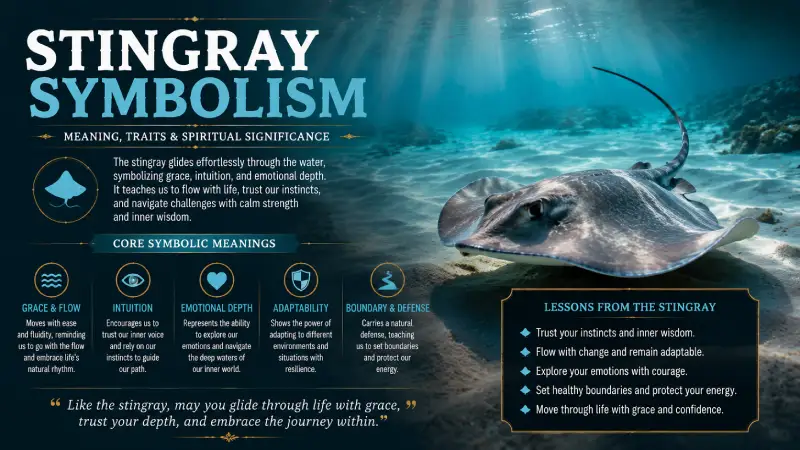
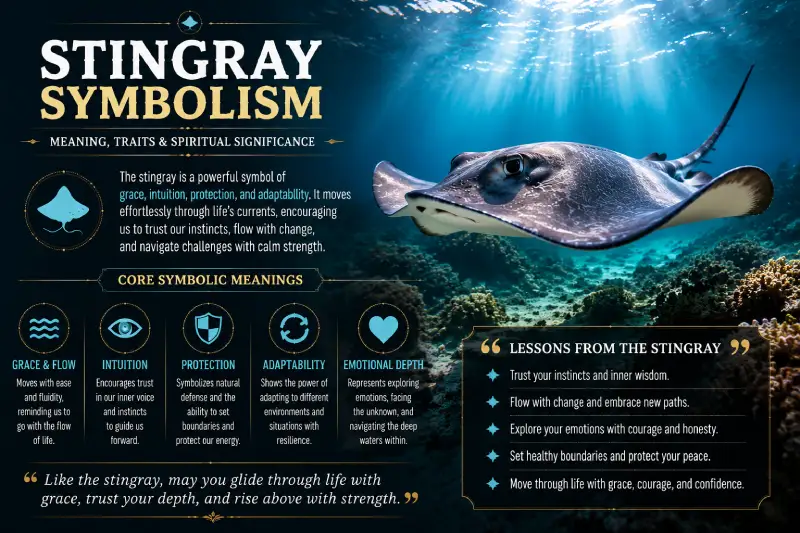
Stingrays are flat-bodied marine animals known for their smooth movements, sandy habitats, and distinctive defensive tails. Stingray symbolism commonly centers on calm strength, adaptability, protection, awareness, and the ability to move through difficult situations without unnecessary conflict.
For many people, the stingray is interesting because its appearance creates a contrast: it looks peaceful while carrying a natural defense mechanism. That combination makes it a useful symbol for quiet confidence, boundaries, and self-protection.
In the United States, stingray imagery appears in ocean-themed art, tattoos, jewelry, conservation messaging, and coastal design. Its meaning can also change depending on whether someone is focusing on the animal’s graceful movement, camouflage, defensive barb, or connection with the seafloor.
Quick Answer
Stingray symbolism commonly represents calm strength, adaptability, protection, and awareness in modern American culture, especially when the animal is used in tattoos, ocean imagery, and personal designs. Historically, coastal communities have also associated rays with the sea, practical knowledge, protection, and respect for potentially dangerous marine life.
TL;DR
- Stingrays commonly symbolize calmness, adaptability, and self-protection.
- Their hidden barb represents boundaries and defensive strength.
- Camouflage connects them with patience, awareness, and discretion.
- Pacific cultures developed specific traditions involving rays and marine life.
- American tattoo culture often uses stingrays to express ocean identity.
- Modern interpretations emphasize conservation and respectful coexistence.
What Does a Stingray Symbolize?
The stingray is most often interpreted through the contrast between grace and defense.
A stingray can glide across the water with little visible effort. It does not need to appear aggressive to survive. At the same time, many stingray species possess a venomous spine on the tail that functions primarily as a defense against threats.
This combination has produced several common symbolic meanings:
- Calm strength , remaining composed without appearing weak.
- Protection , having defenses when they are needed.
- Adaptability , adjusting to changing environments.
- Awareness , noticing what is happening before reacting.
- Patience , waiting rather than constantly forcing action.
- Discretion , knowing when to stay unnoticed.
- Emotional balance , moving through difficult circumstances without unnecessary confrontation.
These interpretations are not scientific properties of symbolism. They are human associations inspired by observable characteristics of the animal.
Why Stingrays Represent Calm Strength
Stingrays offer an unusual image of strength because they do not resemble traditionally aggressive animals.
A shark, bear, or eagle can symbolize strength through obvious physical dominance. A stingray suggests something different. Its broad body and smooth movement give it a quiet appearance, while its tail provides an effective defensive tool.
That contrast makes the stingray a useful metaphor for people who believe strength does not always need to be loud.
In modern American culture, this can translate into ideas such as staying calm under pressure, avoiding unnecessary arguments, and knowing that being peaceful does not mean being defenseless.
The symbolism is particularly relevant to personal identity. Someone may choose a stingray image to represent a personality that is relaxed and approachable but still has clear boundaries.
How Camouflage Shapes Stingray Symbolism
Many stingrays spend substantial amounts of time near the seafloor. Their flattened bodies and coloration can help them blend into sandy or muddy environments. Some species bury themselves beneath sediment, leaving little more than their eyes and breathing openings visible.
This behavior naturally lends itself to symbolism involving discretion and observation.
The stingray does not always need to announce its presence. It can remain still, observe its surroundings, and respond when necessary.
Symbolically, this can represent:
- keeping a low profile
- watching before acting
- protecting personal privacy
- avoiding unnecessary attention
- using patience instead of force
- recognizing danger early
For someone going through a stressful period, the stingray can therefore represent the idea that not every situation requires an immediate response.
Sometimes awareness and patience are more useful than confrontation.
The Stingray’s Tail and the Meaning of Protection
The most recognizable symbolic feature of a stingray is its tail and defensive spine.
The spine is not primarily an offensive weapon. It is a defense mechanism that can injure a predator or perceived threat. This distinction matters when interpreting the animal symbolically.
The stingray therefore represents protective strength rather than aggression.
A stingray tattoo, pendant, or artwork may communicate a message such as:
I am peaceful, but I know how to protect myself.
That idea makes the stingray particularly suitable for symbolism involving personal boundaries.
It can represent learning when to say no, recognizing unhealthy situations, or becoming more confident about protecting one’s time and emotional space.
The defensive tail can also represent consequences. A creature that appears harmless should not necessarily be disturbed. In this sense, stingray imagery can symbolize the importance of respecting boundaries, both your own and those of others.
What Stingrays Represent in the United States
In the United States, stingray symbolism is strongly connected with coastal life and the ocean.
Americans encounter stingrays in aquariums, marine education programs, beaches, documentaries, fishing communities, and popular ocean imagery. Southern stingrays and other species are particularly familiar along parts of the Atlantic, Gulf, and Pacific coasts.
Unlike symbols tied to major American holidays, stingrays do not have one standardized national meaning. Their symbolism is more personal and regional.
For many Americans, a stingray may suggest:
- beach life
- ocean exploration
- freedom
- marine wildlife
- respect for nature
- peaceful movement
- personal resilience
- coastal identity
The animal can also represent an appreciation for marine ecosystems. As ocean awareness has become more prominent in conservation and environmental education, images of rays can communicate admiration for marine biodiversity rather than simply serving as decorative symbols.
Stingray Symbolism in Pacific Cultures
Rays have longstanding cultural importance in parts of the Pacific, but it is important not to treat all Pacific traditions as one unified belief system.
In Māori tradition, whai is the word for stingray, and rays occur within broader relationships with the sea, fishing, place, ancestry, and traditional ecological knowledge. Their meaning is better understood within specific Māori communities and contexts rather than reduced to a single universal definition.
Other Pacific cultures have their own traditions involving rays and other marine animals. Some traditions emphasize respect, protection, navigation, fishing knowledge, or relationships between people and the ocean.
This history is important because modern websites sometimes combine stingrays, manta rays, and other rays into one generalized “ray symbolism.” They are related animals, but they are not interchangeable symbols.
A stingray’s defensive tail and bottom-dwelling behavior are different from the characteristics of a manta ray, which is much larger and lacks the venomous tail spine associated with stingrays.
Stingray Symbolism in Mythology and Folklore
Stingray folklore is less standardized than the mythology surrounding animals such as snakes, wolves, or eagles.
Where rays appear in coastal traditions, their symbolism often reflects direct human relationships with the sea. People who fish, travel, or live near shallow coastal waters naturally develop detailed knowledge of animals that share those environments.
A stingray can therefore occupy an interesting symbolic position: it belongs to an environment that humans cannot fully control, yet it is frequently encountered in relatively shallow water.
Its ability to disappear into sand can reinforce ideas about hidden dangers and things that cannot be immediately seen. Its defensive spine adds another layer: the sea may appear calm while containing animals that deserve caution and respect.
This does not mean that every traditional culture viewed stingrays as dangerous or supernatural. Interpretations varied considerably by location and community.
Emotional and Psychological Meaning of a Stingray
The stingray can also be interpreted psychologically as a symbol of quiet emotional control.
Its movement provides a useful metaphor. Instead of fighting every current, the animal moves through the water using its broad fins and body. Symbolically, this can represent learning how to adjust without losing direction.
The stingray may therefore appeal to someone who is trying to:
- stay calm during change
- stop reacting impulsively
- establish healthier boundaries
- become more observant
- protect personal energy
- accept uncertainty
- move forward without constant confrontation
Its symbolism is especially interesting because it combines softness and defense.
The lesson is not necessarily “become tougher.” It can instead be understood as become more aware of when strength is actually necessary.
Stingray Symbolism in Love and Relationships
In relationships, the stingray can represent trust, boundaries, emotional patience, and peaceful connection.
Its defensive nature gives the symbol a practical interpretation. Healthy relationships require closeness, but they also require personal boundaries.
A stingray may therefore symbolize a relationship in which both people can remain independent while still being connected.
For couples, stingray imagery can suggest:
- protecting the relationship from unnecessary conflict
- respecting personal space
- remaining patient during disagreements
- creating emotional safety
- adapting to changes together
A negative interpretation is also possible. If the stingray appears threatening in a personal context, it could represent defensiveness, fear of vulnerability, or someone who reacts strongly after feeling threatened.
The meaning depends heavily on the situation surrounding the symbol.
Stingray Symbolism in Tattoos and Personal Style
Stingray tattoos are often chosen by people with a connection to the ocean, coastal living, diving, fishing, surfing, or marine life.
The design can also carry personal meaning beyond geography.
A stingray tattoo may symbolize calm confidence, protection, adaptability, independence, or respect for the sea.
The shape works well in tattoo art because the animal’s wide fins create a distinctive silhouette. Some designs emphasize the full body, while others focus on the tail or combine the stingray with waves, coral, shells, flowers, or other ocean imagery.
The surrounding elements can change the message:
| Tattoo Element | Common Meaning in the USA | Common Association | Notes |
|---|---|---|---|
| Stingray alone | Calm strength | Independence | Simple personal symbol |
| Stingray with waves | Adaptability | Ocean connection | Emphasizes movement |
| Stingray with flowers | Balance | Growth and beauty | Softens the defensive symbolism |
| Stingray with compass | Direction | Travel and exploration | Common coastal theme |
| Stingray with family initials | Protection | Relationships | Makes the design personal |
A tattoo should not be assumed to have one universal meaning. For many people, its most important symbolism comes from a specific memory or personal experience.
Stingray Symbolism in Dreams
Dream symbolism is highly personal, so a stingray appearing in a dream does not have one fixed interpretation.
The animal’s behavior and the dreamer’s emotions usually matter more than the species itself.
A calm stingray moving through clear water might be interpreted as a metaphor for emotional balance, patience, or adapting to change.
A hidden stingray could suggest awareness of something that has not yet become obvious. Because stingrays can camouflage themselves, the image may fit situations involving uncertainty or information that is difficult to see.
Being stung may produce a different interpretation. It could reflect feeling hurt, threatened, betrayed, or reminded of a boundary that was crossed.
The emotional reaction is the most useful clue. A dream that feels peaceful should not automatically be interpreted negatively simply because a stingray has a defensive spine.
Spiritual Meaning of the Stingray
In modern spiritual symbolism, stingrays are often used as metaphors for flow, awareness, protection, and emotional balance.
These interpretations are best understood as personal or contemporary spiritual frameworks rather than universal religious teachings.
The animal’s connection with water makes it especially easy to associate with emotions and change. Its ability to glide through currents can become a metaphor for moving through life’s circumstances without resisting every change.
Its defensive tail adds another message: spiritual or emotional openness does not require abandoning boundaries.
For someone using the stingray as a personal spiritual symbol, the animal might represent the balance between staying open to life and knowing when protection is necessary.
Positive and Negative Stingray Symbolism
Stingray symbolism can have both positive and negative interpretations.
Positive meanings commonly include:
- adaptability
- calmness
- protection
- patience
- awareness
- emotional balance
- independence
- graceful movement
Negative meanings can include:
- excessive defensiveness
- hiding from problems
- avoiding confrontation when action is needed
- fear of vulnerability
- unexpected danger
- reacting sharply after feeling threatened
The negative interpretation often comes from the same characteristics that create the positive one.
For example, protection is positive when it establishes a healthy boundary. But constant defensiveness can prevent meaningful relationships.
Likewise, discretion can be wise, while excessive secrecy can create isolation.
How Stingray Meaning Has Changed Over Time
The symbolic interpretation of stingrays has shifted as people’s relationships with marine environments have changed.
In traditional coastal societies, the animal was understood through direct experience. People encountered rays while fishing, traveling, gathering food, and living near shallow water. Their physical characteristics therefore had practical importance.
Modern audiences often encounter stingrays differently. An American might first see one in an aquarium, nature documentary, beach photograph, tattoo, or social-media video.
This has encouraged a more aesthetic interpretation.
The stingray is now frequently associated with graceful swimming, ocean beauty, marine conservation, and relaxed coastal lifestyles. At the same time, its defensive spine continues to support older ideas about caution and protection.
The result is a symbol that combines beauty with boundaries.
Common Misunderstandings About Stingray Symbolism
One common mistake is treating every ray as a stingray.
Manta rays, eagle rays, electric rays, and stingrays belong to related groups, but their bodies, behavior, and defensive structures differ. A manta ray, for example, does not have the venomous tail spine associated with stingrays.
Another misunderstanding is assuming that stingrays are naturally aggressive. Their tail spine primarily functions as defense. Many encounters happen because people accidentally step on a ray that is resting or buried in sand.
It is also misleading to claim that one stingray meaning applies to every Pacific culture. Cultural symbolism is local and historically specific.
Finally, modern spiritual interpretations should not be presented as ancient facts. Ideas such as “stingrays are universal spiritual messengers” are contemporary interpretations unless a particular cultural tradition provides evidence for that belief.
Stingrays and Modern Ocean Conservation
Today, stingray imagery can also communicate concern for marine ecosystems.
People increasingly encounter marine animals through conservation campaigns, aquariums, wildlife photography, and educational programs. A stingray image can therefore symbolize respect for ocean biodiversity and the need to coexist responsibly with marine wildlife.
This interpretation fits the animal particularly well because human encounters can become dangerous when people disturb rays in shallow water.
The broader message is simple: observing wildlife respectfully is safer for both people and animals.
In this modern context, the stingray can represent coexistence rather than control.
What Stingray Symbolism Means Today
In 2026, the stingray works as a flexible symbol because it combines several ideas that remain relevant to modern life.
Its smooth movement suggests calmness. Its camouflage suggests discretion. Its defensive spine suggests boundaries. Its relationship with the seafloor suggests patience and awareness. Its ocean habitat connects it with exploration, nature, and coastal identity.
For Americans, its meaning is usually personal rather than tied to a single national tradition.
Someone may see a stingray as a reminder to stay calm. Another person may associate it with a favorite beach, childhood memory, diving experience, family trip, or love of marine life.
That flexibility is one reason stingray imagery works so well in contemporary art and personal design.
Frequently Asked Questions
What does a stingray symbolize spiritually?
A stingray can symbolize calm movement, adaptability, awareness, and protection in modern spiritual interpretations. Its defensive tail also makes it a useful metaphor for maintaining boundaries while remaining peaceful.
What does a stingray tattoo symbolize?
A stingray tattoo commonly represents ocean connection, calm strength, adaptability, independence, or self-protection. The exact meaning often depends on the person’s relationship with the ocean and the other elements included in the design.
Is a stingray a symbol of protection?
Yes, protection is one of the most natural modern interpretations of the stingray. Its defensive spine provides a biological basis for associating the animal with boundaries and the ability to protect oneself when threatened.
What does seeing a stingray mean?
Seeing a stingray can be interpreted as a reminder to remain observant, patient, and adaptable. If the encounter happens in real life, however, the most important message is practical: give the animal space and avoid disturbing it.
What does a stingray symbolize in love?
In love, a stingray can represent emotional safety, patience, trust, and healthy boundaries. It can also symbolize the idea that a peaceful relationship still requires both people to respect each other’s personal space.
What does a stingray mean in a dream?
A stingray in a dream may represent hidden concerns, emotional adaptability, patience, or self-protection. A threatening stingray can suggest feeling vulnerable or having a boundary crossed, while a peaceful encounter may suggest emotional balance.
Are stingrays and manta rays the same symbol?
Not exactly. They are related rays, but manta rays and stingrays have important biological differences, so their symbolism should not automatically be combined; a stingray is more strongly associated with defensive boundaries because of its tail spine.
Conclusion
The central meaning of stingray symbolism comes from the animal’s unusual combination of grace and defense. It can represent calm strength, adaptability, awareness, patience, and the ability to protect yourself without seeking conflict.
In modern American culture, the stingray is especially connected with ocean life, personal identity, tattoos, coastal design, and respect for marine wildlife. Its symbolism works best when it is connected to the real characteristics of the animal rather than exaggerated supernatural claims.
A stingray ultimately offers a straightforward metaphor: you can move gently through the world while still knowing where your boundaries are.