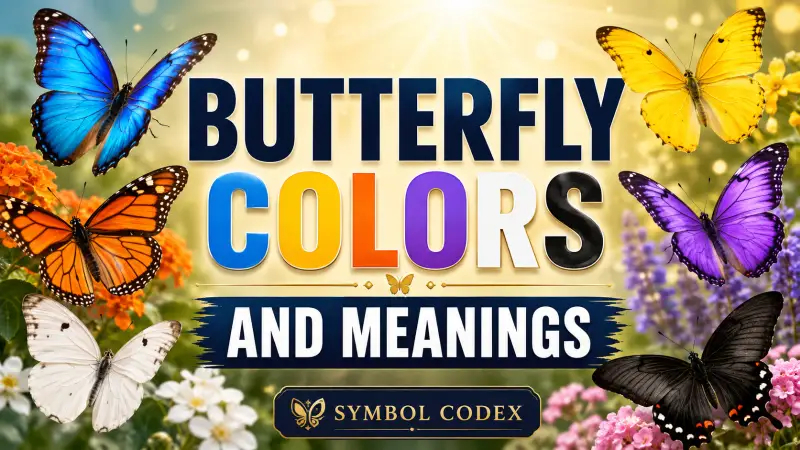
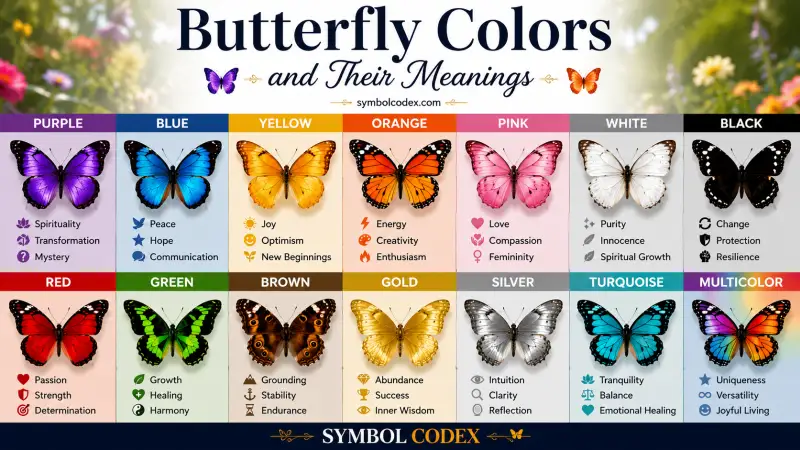
Butterfly colors and meanings are commonly associated with transformation, hope, renewal, emotion, and personal change, but the interpretation shifts with the color. White butterflies often suggest peace or fresh beginnings, black butterflies can represent endings or profound change, blue suggests hope and reflection, while orange and yellow tend to communicate energy, optimism, and confidence.
These meanings come from a mixture of general butterfly symbolism, modern color psychology, art, memorial traditions, tattoo culture, and personal interpretation. They should not be confused with fixed messages carried by the insects themselves.
Butterfly colors also have real biological functions. Butterfly wings are covered with tiny scales, and their colors may come from pigments, microscopic structures that manipulate reflected light, or a combination of both. Colors and patterns can contribute to camouflage, warning signals, and mimicry.
Quick Answer
Butterfly colors and meanings usually combine the butterfly’s symbolism of transformation and renewal with the emotional associations of its dominant color. White often represents peace and new beginnings, black suggests mystery or major transition, blue represents hope and reflection, yellow suggests joy, orange signals energy, and green commonly represents growth and renewal.
TL;DR
- White butterflies commonly represent peace, innocence, and fresh beginnings.
- Black butterflies suggest mystery, endings, protection, or major transformation.
- Blue butterflies symbolize hope, calm, reflection, and individuality.
- Yellow and orange butterflies communicate optimism, confidence, and creative energy.
- Green butterflies suggest renewal, balance, nature, and personal growth.
- Color symbolism is cultural and personal, not a biological prediction.
Butterfly Colors and Meanings at a Glance
Butterfly symbolism becomes easier to understand when color and the insect’s broader association with metamorphosis are considered together.
| Butterfly Color | Common Modern Meaning | Emotional Association | Common Personal Use |
|---|---|---|---|
| White | Peace, purity, new beginnings | Calm, simplicity | Memorials, renewal |
| Black | Transformation, mystery, endings | Strength, seriousness | Tattoos, major transitions |
| Blue | Hope, reflection, freedom | Calm, wonder | Recovery, personal growth |
| Yellow | Joy, optimism, opportunity | Happiness, warmth | Positive change |
| Orange | Energy, confidence, enthusiasm | Excitement, motivation | Courage, creativity |
| Red | Passion, vitality, determination | Intensity, love | Bold personal symbolism |
| Purple | Imagination, dignity, spirituality | Creativity, introspection | Spiritual or artistic designs |
| Green | Growth, renewal, balance | Freshness, harmony | Healing, nature symbolism |
| Brown | Grounding, simplicity, stability | Security, practicality | Earth connection |
| Black and White | Balance, contrast, duality | Clarity, tension | Life transitions |
| Multicolored | Diversity, individuality, change | Joy, complexity | Self-expression |
These meanings are best treated as interpretations rather than universal definitions.
Why Butterfly Color Matters Symbolically
Butterflies already carry one of nature’s clearest visual stories of change.
Their life cycle passes through egg, caterpillar, pupa, and adult stages. That transformation has made butterflies widely useful as metaphors for personal growth, transition, freedom, and renewal.
Color modifies the emotional tone.
A white butterfly and a black butterfly share the same general biological life cycle, but most Americans will respond to their colors differently. White tends to feel lighter and quieter. Black feels more serious or mysterious. Bright yellow appears cheerful, while deep purple can feel reflective or unusual.
The symbolic meaning therefore comes from two layers:
Butterfly meaning + color meaning.
Understanding that combination is more accurate than assuming each naturally occurring color has one ancient spiritual definition.
White Butterfly Meaning: Peace and New Beginnings
White butterfly symbolism commonly centers on peace, innocence, simplicity, renewal, and fresh beginnings.
White has longstanding associations in American culture with cleanliness, weddings, innocence, and simplicity. When combined with butterfly metamorphosis, it naturally creates an image of leaving something old behind and entering a quieter or cleaner stage.
A white butterfly may therefore symbolize:
- beginning again
- emotional peace
- forgiveness
- simplicity after chaos
- hope after grief
- moving into a new life stage
White butterflies are real and relatively familiar in the United States. The Smithsonian notes that whites and sulphurs form an important butterfly family, with around 60 species represented nationally; the cabbage white is among the country’s most familiar butterflies.
White butterflies are also frequently used in memorial imagery.
Some people interpret them as signs from deceased loved ones. That can be meaningful as a personal or spiritual belief, but there is no scientific evidence that a white butterfly literally carries a message from someone who has died.
As symbolism, however, its light appearance makes peace and remembrance understandable interpretations.
Black Butterfly Meaning: Mystery and Major Change
Black butterflies create a very different emotional impression.
Modern black butterfly symbolism commonly represents mystery, endings, major transformation, resilience, protection, and entering an unknown stage of life.
Black does not automatically mean death or bad luck.
In American visual culture, black can also communicate:
authority,
elegance,
privacy,
strength,
seriousness,
and independence.
Combined with the butterfly’s transformation symbolism, black often suggests a transition that feels more difficult or profound than the cheerful new beginning associated with brighter colors.
Someone may choose black butterfly imagery after:
leaving a difficult relationship,
recovering from trauma,
changing identity,
surviving grief,
or accepting that an old stage has permanently ended.
In that sense, the black butterfly symbolizes transformation through darkness rather than transformation without difficulty.
Claims that seeing a black butterfly guarantees death or misfortune should be treated as folklore or personal belief, not fact.
Blue Butterfly Meaning: Hope, Reflection, and Possibility
Blue butterflies often symbolize hope, calm, freedom, reflection, individuality, and seeing life differently.
The color blue commonly evokes open sky and water, which makes it visually compatible with ideas of space, freedom, peace, and emotional depth.
Blue butterfly symbolism becomes particularly interesting because some spectacular butterfly blues are not created mainly by blue pigment.
The blue morpho is the best-known example. Microscopic structures on its wing scales interact with light and reflect intense blue wavelengths, producing brilliant structural coloration and iridescence.
That physical effect creates an additional modern metaphor: perspective changes what becomes visible.
Move the butterfly or change the viewing angle, and the intensity of the blue can change.
A blue butterfly can therefore represent:
- hope after difficulty
- emotional recovery
- greater self-understanding
- freedom from an old limitation
- seeing a problem from another angle
- expressing an unusual identity
This is why blue butterflies frequently appear in tattoos centered on recovery or transformation.
Yellow Butterfly Meaning: Joy and Optimism
Yellow butterfly symbolism commonly represents joy, optimism, warmth, opportunity, curiosity, and positive change.
Yellow naturally attracts attention and is strongly associated with sunlight in modern visual culture.
Combined with a butterfly, it creates an energetic but relatively gentle symbol.
A yellow butterfly may represent:
finding happiness again,
approaching change with optimism,
discovering a new opportunity,
or becoming more socially and emotionally open.
Yellow butterflies are also biologically familiar in North America.
Sulphur butterflies include numerous species whose wings appear yellow, pale yellow, or yellow-orange.
The cheerful interpretation is therefore easy to understand, but it remains symbolic.
Seeing a yellow butterfly does not guarantee good luck, money, or positive news.
A more grounded interpretation is that a person can use the encounter as a reminder to notice optimism or possibility in their current circumstances.
Orange Butterfly Meaning: Energy and Confidence
Orange butterfly symbolism often represents energy, enthusiasm, confidence, creativity, courage, and active transformation.
Orange combines some of the visual warmth of red with the brightness of yellow.
That makes it especially suited to transitions involving action rather than quiet reflection.
An orange butterfly can symbolize:
starting something boldly,
regaining motivation,
expressing creativity,
taking a calculated risk,
or becoming more confident after change.
The monarch is the most recognizable orange butterfly in the United States.
Its orange-and-black wings and remarkable migration have made it one of America’s best-known insects. Smithsonian materials identify monarch migration as the classic U.S. example of butterfly migration, with populations traveling toward overwintering areas in Mexico and California.
Because of that journey, orange-and-black butterfly imagery can add endurance, travel, return, and persistence to the usual meanings of orange.
Red Butterfly Meaning: Passion and Vitality
Predominantly red butterflies are less familiar to many Americans than white, yellow, orange, or blue species, but red appears prominently in the wings and markings of numerous butterflies.
Symbolically, red usually adds passion, vitality, courage, love, determination, and urgency.
A red butterfly can therefore represent transformation driven by strong emotion.
That emotion could involve:
romantic love,
creative ambition,
anger turned into action,
renewed enthusiasm,
or determination after a setback.
Red can also function biologically as part of conspicuous wing patterns. In butterflies, colors are not created for human symbolic interpretation; patterns may play roles in camouflage, warning, mimicry, and recognition. Smithsonian research emphasizes that butterfly coloration functions as adaptation rather than decoration alone.
For personal symbolism, red works best when the intended meaning is intense rather than peaceful.
Purple Butterfly Meaning: Imagination and Inner Change
Purple butterfly symbolism commonly represents creativity, imagination, dignity, introspection, individuality, and spiritual reflection.
Purple has historically been visually distinctive and remains strongly associated in modern design with creativity and unconventionality.
A purple butterfly can therefore symbolize an internal transformation that is emotional, artistic, or philosophical rather than purely practical.
It may appeal to someone who identifies with:
creative work,
personal spirituality,
self-discovery,
unconventional identity,
or becoming more comfortable with their imagination.
Naturally occurring butterfly wings may appear purple or violet because of pigments, structural coloration, or interactions between color and viewing angle.
Like blue, purple can therefore reinforce the symbolic idea that appearance is affected by light and perspective.
This makes purple butterfly imagery particularly effective in artistic tattoos, fantasy designs, and personal symbols of individuality.
Green Butterfly Meaning: Growth and Renewal
Green butterfly symbolism commonly represents growth, renewal, nature, balance, healing, and adaptation.
The meaning is easy to understand because green is strongly associated with vegetation and new plant growth.
When combined with butterfly metamorphosis, the result is an especially direct symbol of growing into a new stage.
A green butterfly can represent:
recovering gradually,
returning to emotional balance,
reconnecting with nature,
developing healthier habits,
or creating stability after major change.
Green butterflies are less visually familiar than orange monarchs or yellow sulphurs, but green occurs in the coloration and markings of various butterfly species.
Symbolically, green is especially useful when transformation is meant to feel restorative rather than dramatic.
The message is less “become someone completely different” and more continue growing into something healthier.
Brown Butterfly Meaning: Grounding and Stability
Brown butterflies usually attract less attention than brilliant blue or orange species.
That understated appearance gives them a distinct symbolic quality.
Brown butterfly symbolism commonly represents grounding, stability, simplicity, humility, practicality, and connection with the earth.
Many butterflies use brown coloration as camouflage.
The underside of blue morpho wings, for example, is much less brilliant than the upper surface and helps the butterfly visually blend with its environment when its wings are closed.
Camouflage is one of the recognized adaptive functions of butterfly coloration.
This real function makes brown a particularly fitting symbol of not needing constant attention.
A brown butterfly may represent:
quiet progress,
finding security,
valuing ordinary life,
or developing strength without public recognition.
Its symbolism is especially suitable for people who see transformation as becoming more stable rather than more visible.
Black-and-White Butterfly Meaning: Balance and Duality
A butterfly containing strong black-and-white patterns creates an immediate visual contrast.
Modern black-and-white butterfly symbolism often represents balance, duality, opposing experiences, clarity, and accepting more than one side of life.
The symbolism may involve contrasts such as:
joy and grief,
strength and vulnerability,
independence and connection,
past and future,
or certainty and uncertainty.
This interpretation does not mean black literally represents evil while white represents good.
That simplistic opposition can distort both colors.
A more useful reading is that two contrasting experiences can exist simultaneously.
Someone can feel grateful and sad.
A major transition can feel exciting and frightening.
Independence can bring both freedom and loneliness.
The butterfly provides the transformation theme, while the contrasting colors make complexity visible.
Multicolored Butterfly Meaning: Individuality and Complexity
Not every butterfly fits neatly into one color category.
Many species combine orange, black, blue, yellow, red, white, brown, green, or iridescent tones in elaborate patterns. Smithsonian resources emphasize the extraordinary diversity of butterfly coloration and note that wing colors can involve both pigments and structural mechanisms.
A multicolored butterfly therefore works naturally as a modern symbol of:
Individuality. Identity does not need one defining characteristic.
Diversity. Different qualities can exist together.
Complexity. A person can contain seemingly contradictory traits.
Joy. Multiple bright colors create an energetic visual effect.
Personal freedom. Identity can resist simple categorization.
This symbolism works especially well for creative self-expression.
A multicolored butterfly tattoo may intentionally avoid one standardized meaning because the point is precisely that the wearer cannot be reduced to one label.
Why Butterfly Wings Have Different Colors
Butterfly color is more scientifically interesting than many symbolism articles suggest.
Butterfly wings are covered with microscopic scales. The Smithsonian describes two main ways their colors can appear: pigment coloration and structural coloration, and both can occur in the same butterfly.
Pigments work by absorbing certain wavelengths of light and reflecting others.
Structural colors work differently.
Microscopic physical features affect how light reflects and interferes. Blue morpho butterflies provide a famous example: extremely small structures on their scales strongly reflect blue light, producing their intense iridescent appearance.
Colors and patterns can help butterflies:
- blend with backgrounds
- advertise unpalatability
- mimic other species
- interact during courtship
- create disruptive visual patterns
This distinction matters for symbolism.
A butterfly is not blue because nature assigned it the spiritual meaning of hope. Its coloration exists because of biology and evolution.
Humans add symbolic meaning afterward.
Keeping those two levels separate makes the symbolism more credible.
Butterfly Colors and Meanings in Modern American Culture
Americans encounter butterfly colors in many contexts beyond seeing living insects outdoors.
Butterflies appear in:
tattoos,
memorial art,
jewelry,
weddings,
nursery decor,
fashion,
social media,
gardens,
conservation campaigns,
and mental-health or recovery imagery.
The United States has around 750 butterfly species, giving Americans a wide range of naturally occurring colors and patterns to encounter.
Modern U.S. symbolism is especially personal.
Someone may associate an orange monarch with a deceased grandmother because monarchs appeared in her garden.
Another person may associate blue butterflies with recovery.
A bride may use white butterflies to represent a new beginning.
A tattoo wearer may choose black because their transformation followed grief.
None of these interpretations has to be universal to be meaningful.
Personal experience often becomes the strongest layer of symbolism.
Butterfly Color Meanings in Tattoos
Color can dramatically change the message of a butterfly tattoo.
A white butterfly may represent peace, remembrance, or starting over.
A black butterfly often emphasizes survival, grief, mystery, or profound transformation.
A blue butterfly can represent hope, recovery, freedom, or personal reflection.
A yellow butterfly communicates optimism and joy.
An orange butterfly may symbolize confidence, energy, and determination.
A red butterfly can emphasize passion, love, or vitality.
A purple butterfly commonly suggests individuality, creativity, or spirituality.
A green butterfly can represent growth, healing, or reconnection with nature.
Multiple colors can represent several stages of life or different qualities within one identity.
Design matters as much as color.
Broken chains can emphasize freedom.
Flowers add growth and natural beauty.
Dates or initials can turn the butterfly into a memorial.
A chrysalis or life-cycle design makes transformation especially explicit.
There is no universal tattoo dictionary that overrides the wearer’s personal meaning.
Spiritual Meaning of Different Butterfly Colors
Modern spiritual communities frequently assign specific messages to butterfly colors.
Some people interpret:
white as a loved one’s presence,
black as a warning or transformation,
blue as spiritual guidance,
yellow as good fortune,
orange as encouragement,
purple as intuition,
and green as healing or abundance.
These beliefs can provide personal comfort, but they should be distinguished from established fact.
There is no scientific evidence that butterfly color predicts future events or carries a guaranteed supernatural message.
The same color can also have different meanings across religions and cultures.
A more grounded spiritual approach is to treat the butterfly as a prompt for reflection.
If a blue butterfly feels meaningful during a difficult period, the useful question may be why hope or calm feels especially relevant at that moment, not whether the insect objectively predicted what will happen next.
Do Butterfly Colors Mean a Deceased Loved One Is Near?
Butterflies have become common memorial symbols in the United States.
Their short adult lives, dramatic metamorphosis, light flight, and seasonal reappearance make them emotionally compatible with themes of mortality, remembrance, continuation, and transition.
As a result, people sometimes interpret a white, blue, yellow, or other butterfly appearing after a death as a visit or message from the person who died.
That interpretation belongs to personal spirituality and grief symbolism.
It cannot be scientifically verified.
Its emotional meaning can still be genuine.
A butterfly may become associated with a particular person because of a shared memory, favorite color, garden, funeral, or significant encounter.
In memorial symbolism, what the butterfly means to the grieving person often matters more than a generic color chart.
Common Misunderstandings About Butterfly Colors and Meanings
The biggest misconception is that every butterfly color has one fixed spiritual definition.
It does not.
Color symbolism changes across cultures, religions, historical periods, artistic traditions, and personal experiences.
Another mistake is assuming a butterfly is displaying a color specifically for humans.
Butterfly coloration is biological. Wing colors and patterns can function in camouflage, warning, mimicry, and communication.
A third misconception is believing all brilliant colors come from pigment.
Some do, but structural coloration is also important. Blue morphos demonstrate how microscopic wing structures can create intense color by manipulating reflected light.
Finally, symbolism should not become prediction.
Seeing a particular butterfly may inspire a meaningful personal interpretation, but color alone cannot reliably predict luck, death, love, pregnancy, money, or another future event.
How Butterfly Color Symbolism Has Evolved
Butterflies attracted human attention long before modern biology explained how their colors work.
Their metamorphosis provided an obvious metaphor for change.
Artists, religions, folklore, and personal traditions added ideas involving souls, mortality, renewal, beauty, and freedom in different cultural settings.
Modern color symbolism then layered additional associations onto those older butterfly themes.
White became linked with peace.
Black with mystery or serious change.
Blue with calm and hope.
Yellow with optimism.
Orange with energy.
Green with renewal.
Modern science contributes another fascinating layer.
We now know that butterfly wings use both pigment and structure to create color and that wing patterns are controlled through complex biological development and evolution. Research has identified genes capable of dramatically altering butterfly wing patterns, while microscopy has revealed structures responsible for iridescence.
That knowledge does not weaken symbolism.
It makes it more precise.
The colors have biological causes, while their meanings belong to human culture and imagination.
Frequently Asked Questions
What do different butterfly colors symbolize?
Different butterfly colors commonly modify the broader butterfly meaning of transformation. White often symbolizes peace and new beginnings, black suggests mystery or major change, blue represents hope, yellow suggests joy, orange signals energy, green represents growth, and purple often suggests creativity or spirituality.
What color butterfly means good luck?
No butterfly color is scientifically or universally established as a sign of good luck. Yellow, orange, blue, and white butterflies are often given positive meanings in contemporary symbolism, but the interpretation depends on culture and personal belief.
What color butterfly represents transformation?
All butterfly colors can represent transformation because metamorphosis is part of butterfly biology. Black butterflies are often used for difficult or profound transformation, while blue and white designs tend to suggest hopeful renewal.
What does a black butterfly mean spiritually?
A black butterfly commonly represents mystery, transition, protection, an ending, or transformation in modern spiritual symbolism. It does not objectively predict death or bad luck.
What does a blue butterfly symbolize?
Blue butterfly symbolism commonly includes hope, freedom, calm, reflection, and personal growth. Structural blue butterflies such as morphos also make perspective a fitting modern interpretation because their visual intensity changes with light and angle.
What butterfly color represents a deceased loved one?
White butterflies are frequently used in contemporary memorial imagery, but no particular butterfly color universally represents someone who has died. People also personally associate blue, yellow, orange, or other butterflies with deceased loved ones based on memories and experiences.
Can butterfly colors predict what will happen?
No reliable evidence shows that butterfly colors predict future events. Symbolic meanings can be personally or culturally important, but they should be distinguished from biological facts and factual prediction.
Conclusion
Butterfly colors and meanings combine one of nature’s clearest images of transformation with human emotional responses to color. White often suggests peace and renewal, black gives transformation a more serious or mysterious tone, blue adds hope and reflection, yellow communicates optimism, orange adds energy, green suggests growth, and multicolored butterflies naturally fit individuality and complexity.
The biology behind those colors is equally interesting. Butterfly wings use pigments, microscopic structures, or both to produce an extraordinary range of shades and patterns, while those patterns can help the insects camouflage themselves, communicate, or warn predators.
The most useful interpretation is therefore not that each butterfly arrives carrying a predetermined message. Color gives transformation an emotional tone, and personal experience determines which meaning feels most relevant when the butterfly appears.