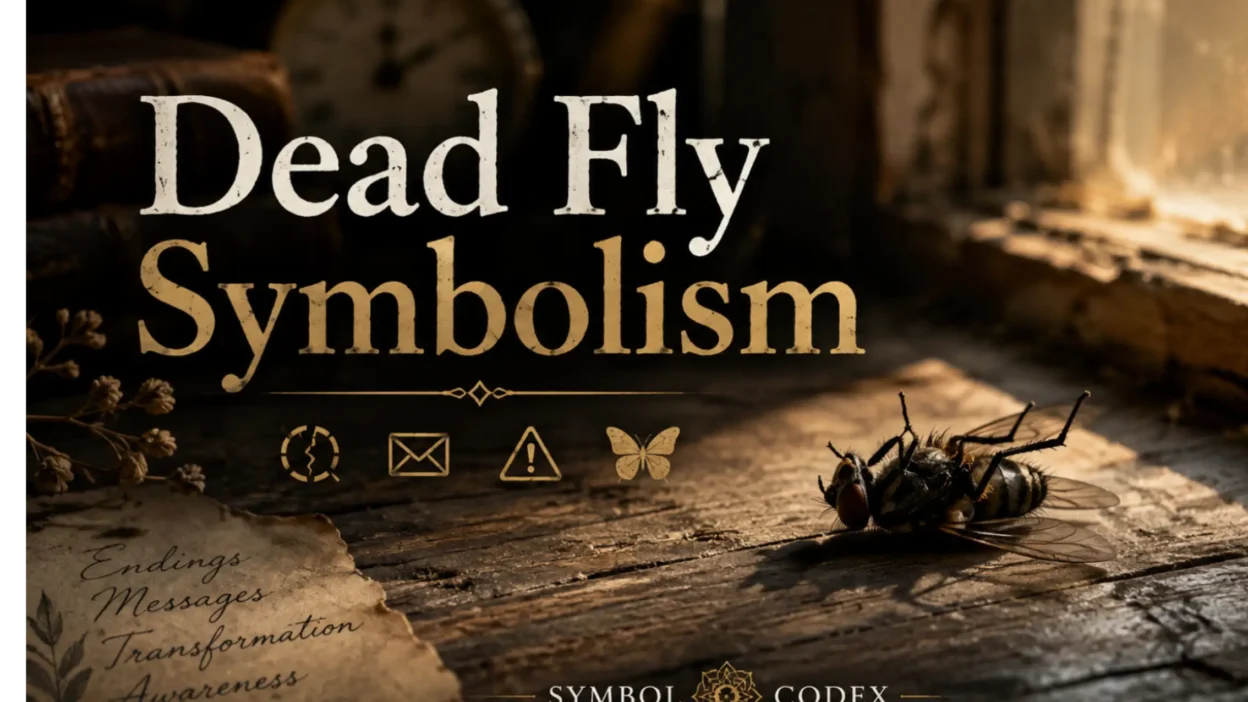
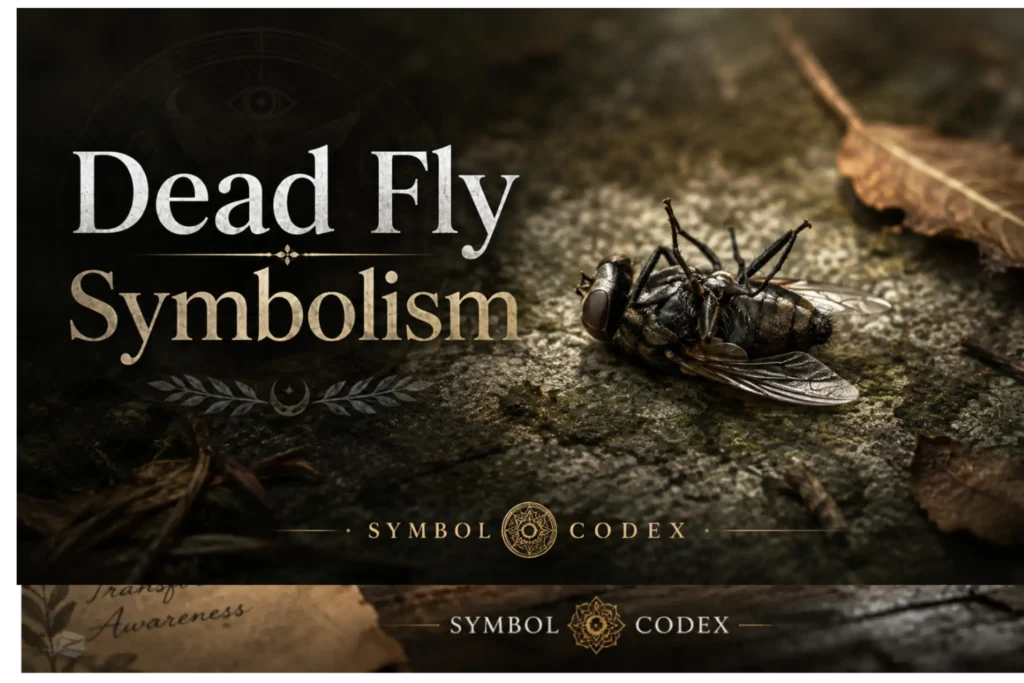
Dead fly symbolism most commonly represents an ending, release, impermanence, neglected problems, the loss of persistence, necessary change, small issues with larger consequences, and clearing away what no longer serves a purpose. Because living flies are associated with persistence, rapid activity, decomposition, food, and their ability to keep returning after being disturbed, a dead fly naturally reverses or modifies many of those meanings.
A dead fly does not scientifically predict death, bad luck, betrayal, or another future event. Symbolic interpretations are cultural or personal rather than biological facts.
There is, however, genuine historical material behind broader fly symbolism. Ancient Egyptians made fly-shaped amulets for thousands of years, and museum evidence suggests the insect could be admired for its persistence and rapid response. Some gold fly objects also functioned as honorific awards. The Bible provides an even more direct dead-fly image: Ecclesiastes 10:1 uses dead flies spoiling perfume as a metaphor for how a small amount of foolishness can damage something otherwise valuable.
Quick Answer
Dead fly symbolism most commonly represents the end of a problem, release from something irritating, mortality, neglected issues, wasted energy, or a small mistake with unexpectedly large consequences. In biblical symbolism, dead flies can represent minor foolishness spoiling something valuable, while broader ancient Egyptian fly imagery connects the living insect with persistence and tenacity.
TL;DR
- Dead flies commonly symbolize endings, release, and impermanence.
- They can represent a persistent problem finally losing its power.
- Biblical imagery connects dead flies with small mistakes causing major damage.
- Ancient Egyptian fly imagery could represent persistence and determination.
- Dreams may reflect irritation, neglect, exhaustion, or unfinished issues.
- Many dead flies indoors usually have a practical insect explanation.
Dead Fly Symbolism: 9 Powerful Core Meanings
| Meaning | Why It Fits | Modern Interpretation |
|---|---|---|
| Ending | Life and movement have stopped | Closing a chapter |
| Release | A persistent nuisance is gone | Freedom from irritation |
| Impermanence | Even highly active creatures die | Remembering that nothing lasts forever |
| Neglect | Flies often gather around overlooked organic matter | Addressing ignored problems |
| Small consequences | Biblical dead flies spoil valuable perfume | Minor mistakes can damage larger things |
| Exhaustion | Constant activity has ended | Recognizing burnout or depleted energy |
| Transformation | Decay returns material to larger cycles | Change after an ending |
| Lost persistence | A notoriously persistent insect is motionless | Knowing when to stop pushing |
| Awareness | A dead insect can reveal an unseen household issue | Paying attention to small signs |
These meanings are interpretive rather than universal rules.
What Dead Fly Symbolism Really Means
The meaning becomes clearer when the symbolism of a living fly is considered first.
Flies are persistent.
They move quickly, return repeatedly to food or other resources, reproduce effectively, and exploit environments that many animals avoid. Some species feed or reproduce around decaying organic material, while others participate in decomposition and nutrient cycling. Carrion-feeding flies, for example, use dead animals, wounds, or fecal material as food or reproductive resources.
When the fly is dead, the symbolism changes.
Movement becomes stillness.
Persistence stops.
Something known for returning again and again finally does not return.
That reversal makes a dead fly especially suitable as a symbol of something irritating, repetitive, or exhausting finally reaching its endpoint.
Dead Fly Symbolism of Endings
An ending is the most straightforward interpretation.
A fly that was once active is now motionless. As human symbolism, that can represent something in life that has finished or needs to finish.
Examples include:
- a repetitive conflict
- an unhealthy habit
- an exhausting job
- a draining relationship
- a period of anxiety
- a project that no longer has value
- an old way of thinking
This does not make the dead fly a prediction that something will end.
Instead, the image can become a metaphor when an ending is already relevant to someone’s circumstances.
The distinction matters.
Symbolism works best as a way to interpret experience, not as fortune-telling.
Release From Irritation and Persistent Problems
Few insects are culturally associated with annoyance as strongly as flies.
People swat them.
They buzz around food.
They return after being chased away.
Ancient Egyptians clearly knew this irritating quality, yet the Met notes that the same persistence may have contributed to the fly being admired for its fast reactions and “indomitable” presence.
That makes a dead fly an unusually effective symbol of release.
Something that would not leave you alone finally has.
This can represent:
ending an argument,
resolving a recurring problem,
breaking a compulsive habit,
or reaching emotional distance from someone who once occupied too much mental space.
The symbolism is not dramatic rebirth in the way butterfly imagery often is.
It is closer to relief after irritation.
Dead Fly Symbolism in the Bible
The Bible contains one of the clearest historical uses of an actual dead fly as a symbol.
Ecclesiastes 10:1 describes dead flies spoiling perfumed oil and then compares that effect with a small amount of foolishness outweighing wisdom or honor. The USCCB commentary explains the proverb as emphasizing how wisdom can be vulnerable to even a small amount of folly.
This creates a very specific biblical interpretation of dead fly symbolism:
something small can ruin something valuable.
Applied metaphorically, that can mean:
a careless statement damaging a reputation,
one dishonest act weakening trust,
a small neglected problem growing larger,
or foolish behavior overshadowing years of good judgment.
This meaning is more historically grounded than generic claims that dead flies always mean spiritual attack, demons, or approaching death.
Ecclesiastes is not presenting the dead fly as an omen.
It uses the insect as an analogy for disproportionate consequences.
Small Problems With Large Consequences
The Ecclesiastes image also works outside explicitly religious interpretation.
A fly is tiny.
Perfume is valuable.
Yet the small insect can spoil the whole mixture.
That creates a practical symbolic lesson about scale.
Small problems are not always unimportant.
A small leak can damage a wall.
One neglected password can compromise an account.
One repeated disrespectful behavior can damage a relationship.
A small unhealthy habit can become significant after years of repetition.
Dead fly symbolism can therefore encourage attention to details that appear too minor to deserve concern.
The lesson is not to obsess over every imperfection.
It is to recognize when a small issue has the ability to contaminate something larger.
Ancient Egyptian Fly Symbolism and Persistence
Ancient Egyptian history complicates the modern assumption that flies were seen only as dirty pests.
Fly-shaped amulets appear in Egyptian archaeological material from very early periods. The Met notes that examples are known from Predynastic graves and that scholars have proposed several explanations for their amuletic meaning, including fecundity or protection against the pest itself.
Another Met fly amulet explains that Egyptians appear to have respected the fly for its fast reactions and persistent presence.
Gold flies could also have honorific significance. A New Kingdom fly-shaped gold amulet in the British Museum is identified as part of an honorific award.
This historical symbolism belongs primarily to the living fly, not specifically to dead flies.
But it creates an interesting contrast.
If a living fly represents persistence, a dead fly can symbolically suggest:
the end of persistence,
knowing when effort is exhausted,
or the moment when determination must give way to another approach.
Sometimes persistence solves a problem.
Sometimes continuing to push only wastes energy.
Exhaustion and Knowing When to Stop
Modern culture often treats persistence as automatically positive.
Keep working.
Keep trying.
Never quit.
The dead fly offers a useful counter-symbol.
Even persistence has limits.
A fly endlessly trying to escape through a closed window creates an easy metaphor for effort applied in the wrong direction. Eventually, activity without a workable route accomplishes nothing.
Symbolically, a dead fly can therefore represent exhaustion caused by repeating the same unsuccessful approach.
That may relate to:
burnout,
an impossible relationship,
a failing strategy,
or constantly seeking approval from someone unwilling to give it.
The message is not simply “give up.”
It is:
consider whether persistence still serves the goal.
Changing direction can sometimes be more intelligent than trying harder.
Neglect, Decay, and What Has Been Overlooked
Flies are strongly connected with decomposing and fermenting organic material because many species use such resources for food or reproduction.
House flies can feed around fecal material and other moist decaying matter, while fruit flies are associated with fermenting produce and organic residues.
That biology has encouraged cultural associations between flies and neglect.
Symbolically, a dead fly can therefore represent something overlooked for too long.
This may be a neglected:
conversation,
responsibility,
health routine,
home repair,
relationship,
or emotional issue.
The symbolism becomes especially fitting when a person keeps avoiding something because it seems unpleasant.
Ignored problems do not always disappear.
Sometimes they attract more complications.
Dead Fly Symbolism and Impermanence
A fly is often imagined as almost impossible to get rid of.
Yet its individual life remains temporary.
A dead fly therefore creates a simple reminder that constant activity does not equal permanence.
Human life contains similar contradictions.
People can feel indispensable at work.
A conflict can seem endless.
A stressful situation can feel permanent.
Then circumstances change.
The dead fly can symbolize the fact that even highly persistent conditions eventually alter or end.
This can be comforting when someone is moving through a difficult period.
It can also function as a reminder not to waste too much limited time on irritations that will eventually matter very little.
Death, Decay, and Natural Cycles
Flies are closely tied to ecological cycles of decomposition.
Carrion flies feed and reproduce on animal remains and waste. Smithsonian researchers have even used carrion-feeding flies as biological samplers because the insects pick up DNA from the mammals whose remains or waste they consume.
Other species can play useful roles in converting organic waste. Smithsonian researchers have studied black soldier fly larvae as a tool for converting food scraps into useful biological products.
This creates a more balanced symbolic interpretation.
Decay is not simply destruction.
Within ecosystems, decomposition returns nutrients and materials to larger cycles.
A dead fly can therefore represent the idea that an ending may still become part of what supports the next stage.
This is different from claiming the insect literally symbolizes reincarnation.
It is an ecological metaphor for transformation after loss.
Dead Fly Symbolism in Dreams
Dreaming about dead flies can feel unpleasant, but dream imagery does not reliably predict future events.
A useful interpretation depends on what was happening in the dream and what the dreamer is experiencing in waking life.
Dreaming of One Dead Fly
One dead fly may represent a specific irritation or recurring problem that is losing importance.
It can also suggest that something small deserves attention before it affects something larger.
Dreaming of Many Dead Flies
Many dead flies may symbolize accumulated problems, exhaustion, or a situation that has become emotionally stale.
Practically minded dream interpretation might ask whether several small stresses have been ignored until they became overwhelming.
Dead Flies on a Window
A window can symbolically represent opportunities, boundaries, or seeing beyond current circumstances.
Dead flies near one may suggest repeated attempts to move in a direction that was not actually open.
Dead Flies in Food
This imagery naturally evokes contamination.
Symbolically, it may represent one unpleasant factor spoiling an otherwise positive situation, an interpretation that closely resembles the biblical image in Ecclesiastes 10:1.
Sweeping Away Dead Flies
Cleaning them away can represent closure, clearing old irritations, or deciding that a finished problem no longer deserves attention.
These interpretations are metaphors, not predictions.
Spiritual Meaning of Dead Fly Symbolism
In contemporary spirituality, a dead fly may be interpreted as representing:
release,
the end of negativity,
cleansing,
transition,
or an invitation to address neglected problems.
These ideas can be useful as personal reflection.
They should not be presented as guaranteed supernatural messages.
There is no reliable evidence that a dead fly predicts:
death,
betrayal,
financial loss,
illness,
or evil spiritual activity.
A grounded spiritual interpretation might ask:
What small issue have I been ignoring?
What repetitive problem has finally ended?
Where am I wasting energy?
What needs to be cleaned up before it affects something larger?
Those questions preserve the symbolic usefulness without treating an ordinary insect death as prophecy.
Is a Dead Fly a Bad Omen?
There is no universal reason to interpret a dead fly as a bad omen.
In fact, historical fly symbolism is mixed.
Ancient Egyptian fly amulets show that the insect could have amuletic value and could be admired for persistence.
The biblical dead-fly image is cautionary, but it concerns foolishness damaging something valuable rather than predicting future disaster.
Modern superstition may assign negative meanings because flies are associated with decay and contamination.
That association explains why the image feels unpleasant.
It does not make it a supernatural warning.
A more defensible interpretation is closure or a reminder to deal with small neglected problems.
Dead Fly in the House: Symbolism vs. Practical Meaning
Finding one dead fly indoors is usually not mysterious.
Flies enter houses through doors, screens, cracks, vents, and other openings. Some indoor fly species are drawn toward windows and light, where they may eventually die if they cannot get back outside.
If you repeatedly find large numbers of dead flies, the species and location matter.
Cluster flies, for example, enter wall voids and attics to overwinter. Penn State notes that they can emerge during warmer periods and collect around windows; large numbers may eventually die inside.
The University of Minnesota likewise notes that piles of dead cluster flies can be discovered inside buildings after overwintering populations emerge.
So before interpreting a pile of dead flies spiritually, look for an ordinary explanation.
Several dead flies can indicate:
an overwintering insect problem,
an entry point around a window or wall,
a nearby breeding source,
or insects attracted indoors that cannot survive there.
Practical causes do not prevent personal symbolism, but they should be considered first.
What Do Many Dead Flies Symbolize?
Symbolically, many dead flies can intensify the meaning of one.
Instead of one irritation ending, the image may represent clearing accumulated problems.
Possible interpretations include:
- multiple frustrations reaching an endpoint
- emotional clutter
- burnout after prolonged activity
- removing several unhealthy habits
- recognizing consequences of long-term neglect
But in a real home, many dead flies warrant a practical explanation before a spiritual one.
Cluster flies can overwinter in buildings in substantial numbers, and some fly invasions are concentrated around windows or doors because the adults are attracted to light.
Dead Fly Symbolism in Tattoos
Dead fly tattoos are uncommon compared with butterflies, moths, snakes, or living fly designs, which gives them a distinctive emotional tone.
Possible meanings include:
Mortality: every living thing eventually stops.
Release: an irritation or harmful influence has ended.
Exhaustion: acknowledging the cost of relentless effort.
Persistence: honoring how long someone kept going before change became necessary.
Decay: accepting uncomfortable parts of natural life.
Dark humor: making an ordinary disliked insect into unexpected art.
Small consequences: referencing the Ecclesiastes image of dead flies spoiling something valuable.
A dead fly with perfume imagery can make the biblical reference clearer.
A fly surrounded by flowers can create a contrast between decay and beauty.
An Egyptian-inspired fly amulet design would communicate something different, persistence, historical symbolism, or honor, and should not automatically be treated as a dead-fly motif.
Dead Fly Symbolism and the Meaning of Cleaning Up
A particularly useful modern interpretation is cleanup.
Dead flies are normally removed.
They are swept away, vacuumed, or discarded.
That ordinary act can become a metaphor for dealing with things that have already ended but continue occupying space.
People sometimes keep emotional equivalents of dead flies:
old grudges,
unused commitments,
finished relationships,
obsolete plans,
or guilt about events that cannot be changed.
The problem is no longer active.
It is simply still present.
Dead fly symbolism can therefore represent the difference between something ending and actually clearing it away.
Closure sometimes requires a final action.
Positive and Negative Meanings of Dead Fly Symbolism
Positive meanings
Closure: a recurring problem is ending.
Release: something irritating has lost its influence.
Awareness: small issues are being noticed.
Change: an outdated pattern is finished.
Acceptance: impermanence is recognized.
Cleanup: emotional or practical clutter can finally be removed.
Negative or cautionary meanings
Neglect: something important may have been ignored.
Contamination: one problem may be affecting a larger situation.
Exhaustion: excessive effort has reached its limit.
Decay: something once useful is no longer functioning.
Wasted persistence: continued effort may be going in the wrong direction.
Carelessness: a small foolish act may have disproportionate consequences.
The last interpretation has especially strong biblical support through Ecclesiastes 10:1.
Common Misunderstandings About Dead Fly Symbolism
One common mistake is saying a dead fly predicts death.
There is no evidence for that.
Another is assuming flies were universally negative symbols historically. Ancient Egyptian fly amulets show that flies could carry amuletic value and associations with persistence, while gold flies could form part of honorific awards.
A third mistake is misreading Ecclesiastes 10:1 as an omen. The biblical passage uses dead flies metaphorically to illustrate how a relatively small amount of foolishness can spoil something valuable.
Another misconception is that a group of dead flies inside a home must have spiritual significance. Cluster flies and other nuisance species can enter buildings in large numbers, gather around windows, and die indoors for entirely biological reasons.
Finally, “fly symbolism” and “dead fly symbolism” are not identical.
Living flies emphasize persistence and activity.
Death changes that meaning toward completion, exhausted effort, release, or consequences.
How Dead Fly Symbolism Has Evolved
Fly symbolism has accumulated several very different layers.
Ancient Egypt provides some of the earliest clear material evidence. Fly-shaped amulets existed across long periods, and scholars have proposed meanings ranging from fecundity and protective amuletic functions to admiration for persistence. Gold fly objects could also serve as honorific awards.
Biblical literature added one particularly memorable dead-fly image.
Ecclesiastes used flies corrupting perfume to explain how a small amount of folly can outweigh wisdom and honor.
Modern culture contributed associations with contamination, decay, annoyance, and persistence.
Ecology adds another layer. Flies participate in decomposition and organic recycling, while some fly larvae are now actively studied for converting food waste into useful material.
Modern dead fly symbolism therefore contains several overlapping ideas:
something persistent ending,
a small problem causing larger damage,
neglect becoming visible,
and dead material becoming part of a larger cycle.
That is more nuanced than simply calling the dead fly a symbol of bad luck.
Frequently Asked Questions
What does a dead fly symbolize spiritually?
A dead fly commonly symbolizes release, an ending, wasted energy, neglected problems, or clearing away something that no longer serves a purpose. These are modern personal interpretations rather than guaranteed supernatural messages.
Is seeing a dead fly a bad omen?
No reliable evidence shows that a dead fly predicts bad luck or death. Historically, flies have carried both positive and negative symbolism, including persistence in ancient Egypt and cautionary imagery in Ecclesiastes.
What does a dead fly mean in the Bible?
Ecclesiastes 10:1 uses dead flies spoiling perfumed oil as an analogy for how a small amount of foolishness can damage wisdom or honor. The image is a moral metaphor rather than a supernatural omen.
What does dreaming of dead flies mean?
A dead-fly dream may symbolize irritation ending, accumulated stress, neglect, exhaustion, or concern that a small problem is damaging something larger. Dream interpretation is personal and cannot reliably predict future events.
What does finding many dead flies in your house mean?
Practically, it may indicate an indoor nuisance-fly problem. Cluster flies can overwinter inside wall voids and attics, emerge around windows, and die indoors in significant numbers.
Does a dead fly symbolize transformation?
It can in modern symbolism. The meaning usually centers on something ending and being cleared away so another stage can begin, rather than the dramatic metamorphosis associated with butterflies or moths.
What does a dead fly tattoo symbolize?
A dead fly tattoo may represent mortality, exhaustion, closure, release, dark humor, or the end of something persistent. A design referencing Ecclesiastes may also represent how one small mistake can spoil something valuable.
Conclusion
Dead fly symbolism most naturally represents endings, release, impermanence, neglected problems, exhausted persistence, and the importance of dealing with small issues before they cause larger damage. Unlike more dramatic symbols of death, the dead fly often points toward something ordinary but persistent finally reaching its limit.
History adds useful depth. Ancient Egyptian fly imagery could communicate persistence and amuletic value, while gold fly objects could serve an honorific function. Biblical literature gives the dead fly an especially memorable cautionary meaning: something very small can spoil something far more valuable.
The most grounded message is simple: not every problem deserves endless energy, but small neglected problems can still matter. Sometimes wisdom means knowing what to fix, what to release, and what has already ended and simply needs to be cleared away.