
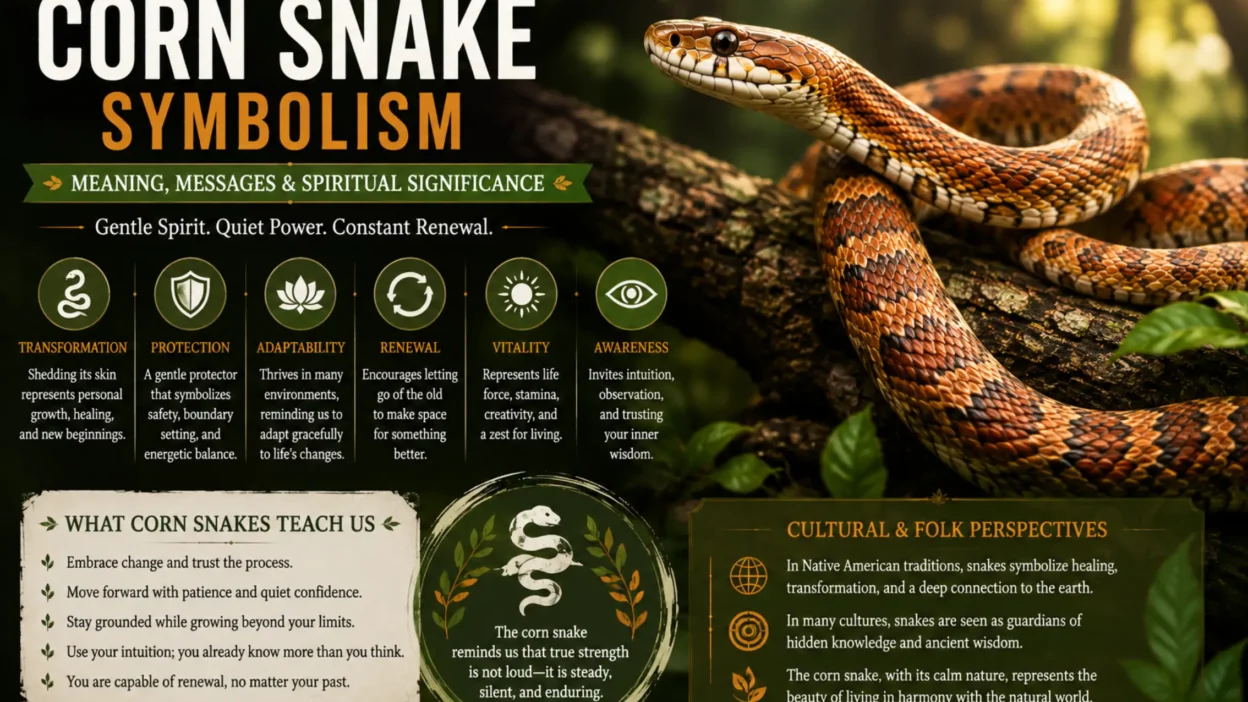
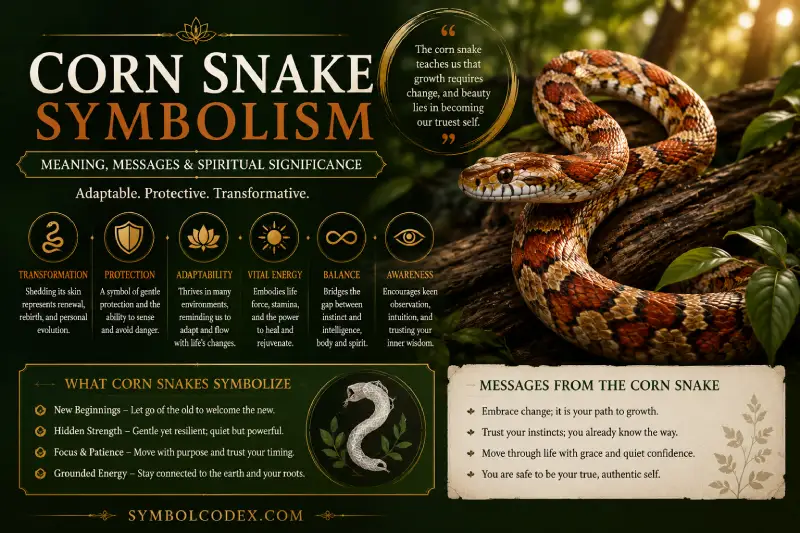
Corn snake symbolism most commonly represents transformation, adaptability, patience, quiet confidence, resourcefulness, protection, renewal, hidden strength, and peaceful coexistence. These meanings fit a nonvenomous North American snake that survives through camouflage, climbing ability, careful hunting, seasonal adaptation, and avoidance rather than relying on venom or aggressive displays.
Corn snakes also have an unusually practical connection with American agricultural history. Their common name is associated with old Southern corn cribs, where stored grain attracted mice and rats, and the snakes followed those rodents. Farmers therefore encountered corn snakes in places where the snakes were effectively helping control pests.
Unlike the cobra or some other culturally prominent snakes, however, the corn snake does not have one well-documented ancient religious symbolism of its own. Most meanings attached specifically to the species today are modern interpretations based on its biology, appearance, agricultural associations, pet popularity, and broader snake symbolism.
Quick Answer
Corn snake symbolism commonly represents transformation, adaptability, patience, renewal, resourcefulness, and strength without aggression. Its skin shedding makes it a natural symbol of leaving an old stage behind, while its nonvenomous nature, camouflage, and long relationship with farms encourage meanings of useful presence, peaceful protection, and working quietly in the background.
TL;DR
- Corn snakes symbolize transformation, patience, adaptability, and renewal.
- Shedding represents outgrowing an old identity or life stage.
- Their camouflage suggests discretion and hidden strength.
- Rodent hunting connects them with usefulness and practical protection.
- Their calm reputation adds controlled strength rather than aggression.
- Tattoos often symbolize recovery, growth, independence, or reinvention.
What Is a Corn Snake?
The corn snake, Pantherophis guttatus, is a nonvenomous rat snake native to the southeastern and eastern United States. Adults are commonly around 30 to 48 inches long, although larger individuals occur. Typical wild corn snakes have orange, red, or reddish-brown blotches outlined in dark pigment and a distinctive black-and-white checkerboard pattern on the belly.
Their habitats are varied. Corn snakes occur in pine forests, hardwood areas, agricultural fields, swamps, suburban environments, and places around barns or other structures where rodents are available. They are capable climbers and may hide beneath logs, bark, rocks, or other cover.
They subdue much of their prey by constriction rather than venom. Rodents form an important part of their diet, although birds, eggs, reptiles, and amphibians may also be taken depending on location and opportunity.
These traits explain why corn snake symbolism feels noticeably different from cobra, rattlesnake, or viper symbolism.
The corn snake represents quiet effectiveness more naturally than obvious danger.
Corn Snake Symbolism: 9 Powerful Core Meanings
| Meaning | Corn Snake Trait | Modern Interpretation |
|---|---|---|
| Transformation | Sheds its skin as it grows | Leaving an old identity behind |
| Renewal | Fresh coloration follows shedding | Beginning another stage |
| Adaptability | Lives in forests, farms, and suburban habitats | Adjusting to circumstances |
| Patience | Hunts through careful positioning | Waiting before acting |
| Resourcefulness | Uses trees, burrows, debris, and buildings | Making use of available opportunities |
| Hidden strength | Relies heavily on camouflage | Ability that is not immediately obvious |
| Protection | Helps reduce rodent populations | Quietly protecting useful resources |
| Independence | Primarily solitary | Self-reliance |
| Peaceful confidence | Nonvenomous and generally avoids people | Strength without unnecessary aggression |
These are modern symbolic interpretations rather than fixed supernatural meanings.
Corn Snake Symbolism of Transformation
Transformation is one of the most natural meanings attached to any snake because snakes periodically shed their outer skin.
Corn snakes continue shedding throughout life. Juveniles shed frequently as they grow, and their colors can appear brighter and patterns clearer after the old skin comes away.
That process creates an intuitive human metaphor.
A corn snake can symbolize:
- leaving old habits behind
- changing careers
- recovering from a difficult period
- becoming more confident
- moving beyond an earlier identity
- beginning again after failure
- accepting personal growth
The strongest interpretation is not that everything from the past should be discarded.
The old skin once served a purpose.
Growth simply reached the point where it no longer fit.
That makes corn snake symbolism especially appropriate for situations where someone has outgrown something that was once useful.
Renewal and Starting Fresh
Transformation describes change.
Renewal emphasizes what follows it.
After shedding, a corn snake continues life with a new outer surface. Human symbolism naturally turns that into an image of refreshment, recovery, and another opportunity to move forward.
Renewal may involve:
ending an unhealthy routine,
recovering confidence,
moving to a new place,
changing relationships,
or simply deciding that an earlier way of living no longer works.
Unlike butterfly symbolism, which involves a dramatic shift into a completely different body form, snake renewal feels more continuous.
The snake remains recognizably itself.
That gives corn snake symbolism a valuable message: growth does not always require becoming an entirely different person.
Sometimes renewal means becoming a healthier version of what was already there.
Adaptability and Living in Changing Environments
Corn snakes occupy several kinds of habitat and can live relatively close to human development. Florida Museum records them in pinelands, hardwood hammocks, swamps, agricultural fields, and suburban neighborhoods.
That versatility makes adaptability one of the strongest species-specific interpretations.
Corn snake symbolism can represent someone who learns how to function when circumstances change.
That might mean:
moving between cultures,
changing jobs,
adjusting to a new family structure,
living somewhere unfamiliar,
or developing a different strategy when the original plan stops working.
Adaptability does not mean having no principles.
A corn snake remains a corn snake whether it is moving through forest litter, climbing vegetation, or hunting around an agricultural structure.
The human metaphor is similar: adjusting your method does not require abandoning your identity.
Patience and Acting at the Right Moment
Snakes tend to inspire symbolism of patience because successful hunting often depends on timing rather than constant movement.
Corn snakes hunt small vertebrates and subdue prey through constriction. They may move through burrows, vegetation, structures, or other cover while searching for food.
This lends itself to symbolism of deliberate action.
A corn snake can represent:
waiting for enough information,
observing before making a decision,
conserving effort,
or choosing the right moment rather than reacting emotionally.
Patience here should not be confused with avoidance.
There is a difference between waiting strategically and never acting.
Corn snake symbolism works best as a reminder that timing can matter as much as force.
Camouflage and Hidden Strength
Wild corn snakes possess reddish, orange, brown, gray, and black patterning that can blend effectively with leaf litter, bark, soil, and other natural backgrounds. Avoiding predators through camouflage and escape is an important part of their survival strategy.
That creates a strong modern meaning of hidden strength.
Some forms of ability are immediately visible.
Others are not.
A quiet employee may understand more than people realize.
A private person may possess enormous emotional resilience.
Someone who avoids confrontation may still be capable of defending themselves.
Corn snake imagery can therefore symbolize being underestimated without feeling compelled to correct everyone.
Its message is:
Not everything powerful needs to be highly visible.
Corn Snake Symbolism of Resourcefulness
Corn snakes are good climbers as well as ground-moving snakes. They may hunt in trees, use rodent burrows, hide beneath natural debris, and take advantage of human-made structures when those environments provide food or shelter.
That makes them effective symbols of resourcefulness.
Resourcefulness means looking at what is actually available and finding a practical way forward.
It can mean:
using an existing skill differently,
finding opportunity in an overlooked place,
working creatively with limited resources,
or refusing to wait for perfect conditions.
This meaning becomes particularly fitting when the history of the corn crib is considered.
The snake found food because rodents gathered around stored grain. It benefited from a human-created environment while simultaneously helping reduce the pests within it.
That is adaptation with practical value.
Why Is It Called a Corn Snake?
The name adds an unusually American layer to corn snake symbolism.
According to the Florida Museum of Natural History, the name reflects the period when Southern farmers stored ears of corn in wooden structures known as corn cribs. Mice and rats entered to eat the grain, while corn snakes followed them to hunt the rodents.
The association therefore is not simply with corn as a plant.
It is with:
farms,
food storage,
rodent control,
barns,
and the relationship between wildlife and human livelihoods.
Symbolically, that can represent usefulness without recognition.
The snake was not producing the crop.
It was not harvesting it.
Yet by feeding on rodents, it could provide an indirect benefit to the people storing food nearby.
This gives corn snake symbolism a particularly grounded message: important contributions are not always obvious.
Protection Without Aggression
Corn snakes are nonvenomous and are not considered dangerous to people or pets. They generally avoid direct contact, though an individual may bite defensively if deliberately handled or threatened.
That makes protection a subtler corn snake meaning than it is with cobras or rattlesnakes.
The protection comes from ecological usefulness.
By consuming mice and other small mammals, corn snakes can help control animals that damage stored food or crops and may spread disease.
As symbolism, this can represent:
helping without demanding attention,
solving problems quietly,
protecting resources,
or contributing to a system from the background.
It is protection through usefulness rather than intimidation.
Independence and Solitude
Corn snakes are primarily solitary animals outside reproductive interactions. Communication is limited compared with highly social mammals, and individuals spend much of their lives hunting, resting, or sheltering independently.
That naturally supports symbolism of independence.
A corn snake may represent:
self-reliance,
comfort with solitude,
private growth,
or working successfully without constant validation.
There is a caution here.
Human beings are much more socially dependent than corn snakes.
The symbolism should therefore remain metaphorical.
Healthy independence means being able to function on your own when necessary, not refusing every relationship or source of help.
Corn Snake Colors and Their Symbolic Meanings
Wild corn snakes are best known for orange, reddish-brown, cream, black, and white patterning, but selective breeding has produced a vast range of captive color and pattern morphs. Animal Diversity Web notes captive colors ranging from white and yellow to much darker forms, with spots, stripes, and other variations.
That diversity has expanded modern corn snake symbolism.
Orange and red can add meanings of energy, courage, warmth, and vitality.
White or pale morphs may suggest renewal, simplicity, or individuality.
Dark morphs can emphasize mystery, privacy, or controlled strength.
High-contrast patterns may represent complexity or duality.
These color meanings come from human color symbolism, not from a spiritual code inherent in the snake.
The biology creates the appearance.
People create the interpretation.
Corn Snake Symbolism in Modern American Culture
Corn snakes have a uniquely American symbolic identity because they are native to the United States and historically associated with farms and agricultural landscapes. Their natural range includes substantial portions of the Southeast, including Florida and South Carolina.
Modern Americans may encounter them in two very different contexts.
The first is wild nature: forests, farms, neighborhoods, and other southeastern habitats.
The second is reptile keeping.
Corn snakes are among the species that the Florida Museum lists as suitable choices for beginning snake keepers because captive-bred animals are generally manageable, mild-mannered, attractive, and straightforward to maintain when cared for correctly.
That pet popularity has softened their cultural image.
Rather than symbolizing terror or deadly danger, corn snakes often represent curiosity, appreciation of reptiles, individuality, and learning not to fear an animal simply because it is a snake.
From Fear to Understanding
Corn snake symbolism can also represent overcoming assumptions.
Their orange and reddish coloration sometimes causes people to mistake them for venomous snakes. Yet corn snakes are harmless constrictors.
This creates a valuable modern symbolic theme:
appearance does not always reveal danger accurately.
Humans frequently judge people, animals, situations, and unfamiliar ideas based on first impressions.
The corn snake offers a grounded reminder that something which looks intimidating can turn out to be useful and relatively peaceful once it is understood.
That makes the species an especially appropriate symbol of replacing fear with knowledge.
Corn Snake Symbolism in Tattoos
Corn snake tattoos can represent several meanings without carrying the aggressive tone of a cobra or rattlesnake tattoo.
Common meanings include:
Transformation: shedding an old version of yourself.
Adaptability: succeeding in changing environments.
Patience: knowing when to wait.
Independence: trusting your own direction.
Renewal: entering a cleaner or healthier stage.
Hidden strength: having abilities people may overlook.
Resourcefulness: finding solutions from what is available.
A corn snake wrapped around flowers can emphasize growth and renewal.
A design showing shed skin makes transformation especially clear.
A realistic orange-and-red corn snake may communicate appreciation for native U.S. wildlife or reptile keeping.
A checkerboard belly pattern can make the tattoo distinctly identifiable as a corn snake rather than generic snake art.
Spiritual Meaning of Corn Snake Symbolism
In contemporary spiritual interpretation, corn snakes are sometimes associated with transformation, grounding, patience, renewal, intuition, adaptability, and releasing the past.
These interpretations can work well as personal metaphors.
They should not be presented as established ancient corn snake beliefs.
There is no evidence that seeing a corn snake objectively predicts money, relationships, pregnancy, death, or another future event.
A grounded spiritual interpretation might instead ask:
What have I outgrown?
Do I need to adapt rather than force an old plan?
Am I judging something too quickly?
Would patience work better than confrontation?
What useful strength do I possess that others may not notice?
The snake becomes a prompt for reflection rather than a fortune-telling device.
Positive and Negative Meanings of Corn Snake Symbolism
Corn snake symbolism is generally more positive than threatening.
Positive meanings
Transformation: growing beyond an old stage.
Adaptability: responding intelligently to change.
Patience: choosing the right moment.
Resourcefulness: finding practical solutions.
Independence: functioning confidently alone.
Hidden strength: not needing constant recognition.
Protection: quietly reducing problems around you.
Negative or cautionary meanings
Secrecy: hiding important information.
Withdrawal: turning independence into isolation.
Passivity: waiting when action is already necessary.
Misjudgment: assuming appearances reveal the whole truth.
Fear: allowing unfamiliar things to seem more dangerous than they are.
The same trait can become helpful or harmful depending on how far it is taken.
Privacy can protect.
Too much secrecy can damage trust.
Patience can improve judgment.
Permanent delay can become avoidance.
Common Misunderstandings About Corn Snake Symbolism
One misunderstanding is assuming the corn snake is venomous because of its bright reddish pattern.
It is not. Corn snakes are nonvenomous constrictors and are not considered dangerous to humans or ordinary household pets.
Another is assuming the name means they primarily eat corn.
They do not.
The historical association comes from corn storage buildings where rodents attracted the snakes. Their diet consists primarily of animal prey.
A third mistake is assigning the corn snake a universal ancient spiritual tradition.
Broader snake symbolism is ancient and widespread, but the familiar modern meanings attached specifically to Pantherophis guttatus should not automatically be presented as Egyptian, Greek, Indigenous, or other historical teachings without specific evidence.
Finally, a corn snake should not automatically be killed when seen around a yard or farm. The Florida Museum emphasizes that the species is nonvenomous and beneficial because of its heavy predation on animals people often consider pests.
How Corn Snake Symbolism Has Evolved
Corn snake meaning begins with the broader human reaction to snakes: animals that move quietly, shed their skin, and often remain hidden.
But the corn snake developed a more specific American identity.
Its presence around old corn cribs connected it with farms, rodent control, stored food, and an unnoticed form of ecological usefulness.
Modern biology strengthened meanings of adaptation, climbing ability, camouflage, and nonvenomous predation.
The pet trade added another layer. Captive breeding produced numerous color morphs, while the species’ manageable temperament helped make it a familiar introduction to snake keeping.
Today, corn snake symbolism often feels less like an image of menace and more like one of transformation, quiet usefulness, individuality, and understanding what first appears frightening.
Frequently Asked Questions
What does a corn snake symbolize spiritually?
A corn snake commonly symbolizes transformation, renewal, patience, adaptability, hidden strength, and releasing an old stage of life in modern spiritual interpretation. These meanings are contemporary rather than one documented universal ancient tradition.
Is seeing a corn snake a good sign?
There is no scientifically established good or bad omen attached to a corn snake encounter. Symbolically, someone may interpret it as a reminder to adapt, be patient, outgrow an old pattern, or look beyond first impressions.
What does a corn snake tattoo symbolize?
A corn snake tattoo can represent transformation, independence, resilience, adaptability, quiet confidence, or appreciation for reptiles and native American wildlife. Designs incorporating shed skin especially emphasize renewal.
Why does a corn snake symbolize transformation?
Corn snakes periodically shed their outer skin as they grow. That natural process makes leaving an old stage or identity behind an intuitive modern symbolic interpretation.
Why is it called a corn snake?
The Florida Museum traces the name to Southern corn cribs. Stored corn attracted rodents, and corn snakes entered the structures to hunt them.
Are corn snakes dangerous?
Corn snakes are nonvenomous and are not considered dangerous to people or pets. They usually avoid contact, although a threatened or deliberately handled individual can bite defensively.
What does an orange corn snake symbolize?
In modern symbolism, its natural orange and red coloration can add associations with vitality, courage, warmth, creativity, and energy. Those are human color interpretations rather than biological meanings.
Conclusion
Corn snake symbolism most naturally represents transformation, renewal, adaptability, patience, resourcefulness, independence, hidden strength, and protection without aggression. Its real life supports those interpretations: the snake sheds its skin, uses varied habitats, hunts carefully, relies on camouflage, and can live close to people without posing the danger often associated with venomous snakes.
Its American agricultural history adds an especially useful layer. Corn snakes entered corn cribs because rodents were attracted to stored grain, turning the snake into an accidental ally of farmers rather than a threat to the crop itself.
The most grounded message is simple: growth can mean shedding what no longer fits, strength does not have to look threatening, and something initially misunderstood may prove far more useful than fear first suggests.