
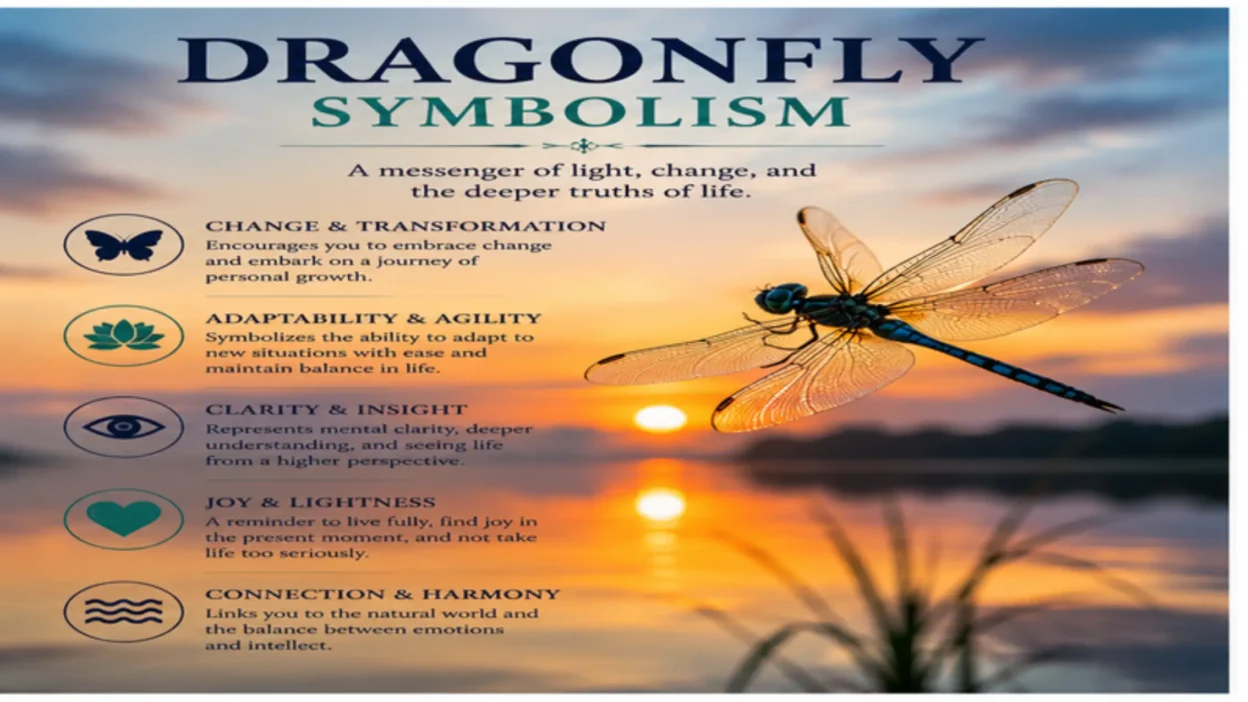
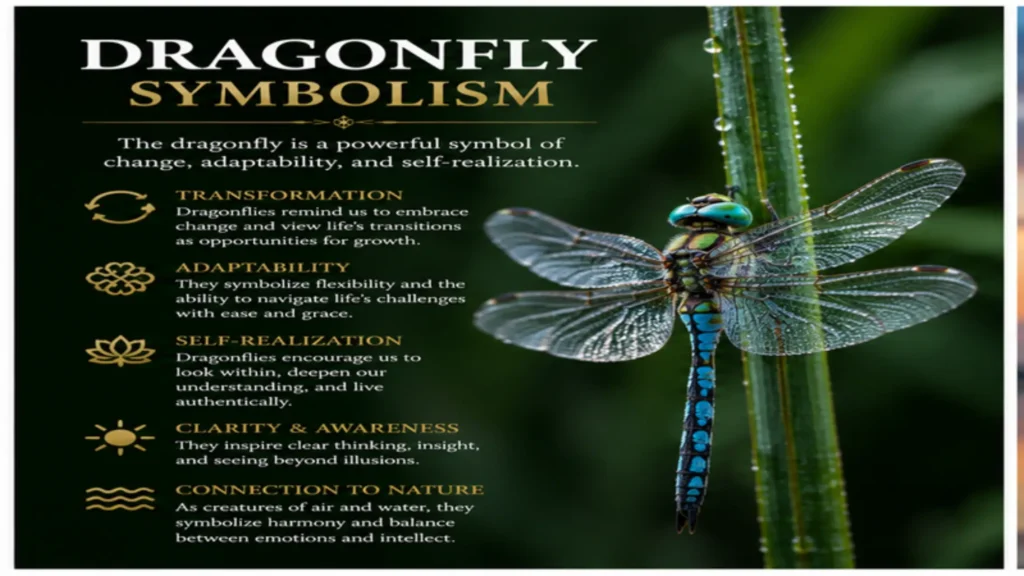
Dragonfly symbolism most commonly represents transformation, adaptability, self-awareness, resilience, freedom, clarity, courage, emotional maturity, and living fully in the present. These meanings have a strong foundation in the insect’s unusual life cycle: dragonflies spend most of their lives underwater as juveniles before climbing out, shedding their old outer skin, expanding their wings, and beginning a dramatically different adult existence.
Dragonflies also carry genuine cultural meanings. In Japanese art, for example, they have represented bravery and were used on sword fittings; they were also admired as signs of autumn and the changing seasons.
For modern Americans, dragonflies commonly appear in tattoos, jewelry, memorial art, gardens, spiritual imagery, and nature photography. Their shimmering wings, fast directional changes, strong connection with water, and transition from aquatic nymph to aerial adult make them especially effective symbols of change without losing your essential identity.
Quick Answer
Dragonfly symbolism most commonly represents transformation, adaptability, resilience, clarity, courage, freedom, and emotional growth. Its aquatic-to-aerial life cycle makes it a particularly strong symbol of moving into a new stage, while Japanese artistic traditions add documented meanings of bravery and seasonal change.
TL;DR
- Dragonflies symbolize transformation, adaptability, and personal growth.
- Their emergence from water represents moving into a new stage.
- Fast, controlled flight suggests flexibility and freedom.
- Their large eyes inspire modern meanings of awareness and perspective.
- Japanese tradition connects dragonflies with bravery and autumn.
- Dragonfly tattoos often mark recovery, change, freedom, or remembrance.
- Water adds emotional and reflective meanings.
- Seeing a dragonfly is not scientifically a supernatural prediction.
Dragonfly Symbolism: 9 Powerful Core Meanings
| Meaning | Dragonfly Connection | Modern Interpretation |
|---|---|---|
| Transformation | Aquatic nymph becomes winged adult | Major personal change |
| Adaptability | Exceptional control in flight | Adjusting without losing direction |
| Resilience | Long juvenile stage before emergence | Surviving difficult periods |
| Clarity | Large compound eyes | Seeing situations differently |
| Freedom | Powerful aerial movement | Independence and release |
| Courage | Historical Japanese symbolism | Facing difficulty confidently |
| Emotional growth | Life begins underwater | Developing through deep feelings |
| Timing | Adult stage is relatively brief | Using opportunities while present |
| Self-awareness | Dramatic change between stages | Understanding who you are becoming |
These meanings overlap, but context determines which interpretation fits best.
What Is a Dragonfly?
Dragonflies are predatory insects closely associated with freshwater environments such as ponds, rivers, wetlands, lakes, and streams.
Adults have elongated bodies, enormous compound eyes, and two pairs of wings. They are exceptional fliers capable of hovering and changing direction rapidly. NPS materials note that dragonflies can fly upward, downward, and hover in ways that have even inspired engineering research.
Yet the familiar flying adult represents only one portion of a dragonfly’s life.
Dragonflies begin life in water.
Depending on species and environmental conditions, the juvenile stage can last from months to several years. Nymphs are predators themselves, feeding on aquatic insects and sometimes tadpoles or small fish. When development is complete, the nymph climbs above the water, its outer skin splits, and the winged adult emerges.
That dramatic movement from water to air provides much of the foundation for modern dragonfly symbolism.
Dragonfly Symbolism of Transformation
Transformation is the strongest dragonfly meaning.
But dragonfly transformation differs from butterfly transformation.
Butterflies pass through a pupal stage.
Dragonflies undergo incomplete metamorphosis: egg, aquatic nymph, and adult. There is no chrysalis or pupal stage.
When mature, the dragonfly nymph leaves the water and climbs onto vegetation or another firm surface. The adult then emerges from its old exoskeleton, expands its wings, dries, and eventually flies away. The discarded outer skin is called an exuvia.
Symbolically, this can represent:
- leaving an old environment
- recovering after hardship
- becoming more independent
- changing careers
- rebuilding identity
- growing emotionally
- moving beyond an earlier stage of life
The symbolism is powerful because the adult does not erase the aquatic stage.
That hidden stage made the adult possible.
Dragonfly symbolism therefore suggests that your earlier experiences can shape you without permanently defining where you must remain.
Water, Emotion, and Emerging Into a New Life
Water is essential to the dragonfly life cycle.
Juveniles spend most of their lives beneath the surface, often for much longer than the visible adult stage.
Modern symbolism often associates water with emotions, memory, introspection, and the unconscious.
Combining that human interpretation with dragonfly biology creates a powerful metaphor:
development can happen in emotional depths before it becomes visible in the outside world.
Someone may spend months or years:
processing grief,
building confidence,
understanding themselves,
or preparing for a major change.
To other people, progress may appear minimal.
Then circumstances change, and the results become visible.
The dragonfly therefore fits experiences where internal growth eventually produces external change.
Adaptability and Changing Direction
Dragonflies are extraordinary aerial hunters.
Their four wings can be controlled in ways that allow hovering, rapid acceleration, and sudden changes in direction. NPS descriptions emphasize their remarkable maneuverability and aerial hunting ability.
That makes adaptability one of the most natural modern meanings of dragonfly symbolism.
Adaptability does not mean changing your beliefs every time circumstances become difficult.
It means changing your method when necessary.
A dragonfly can therefore symbolize:
adjusting to a new workplace,
moving between cultures,
responding to unexpected challenges,
changing a plan,
or learning how to function in unfamiliar circumstances.
The dragonfly does not fly only in a straight line.
Neither does a successful human life.
Sometimes changing direction is not evidence that the original goal was wrong.
It simply means circumstances require a different route.
Resilience and the Hidden Years Before Flight
The adult dragonfly may look delicate.
Its wings are thin and almost transparent.
Yet reaching that stage requires surviving an entirely different life underwater.
Dragonfly nymphs can live underwater for months or years, molt multiple times, hunt other animals, avoid predators, and survive changing aquatic conditions before becoming adults.
This gives dragonflies a strong symbolic connection with resilience.
But this is not the loud kind of resilience.
It is not constant visible struggle.
It can represent surviving quietly.
Someone may be developing strength while nobody notices.
Recovery may look inactive.
Studying may produce no immediate reward.
Building a business may involve years of invisible preparation.
Dragonfly symbolism suggests that a hidden stage is still part of the journey.
Clarity, Awareness, and Seeing More
The dragonfly’s head is dominated by enormous compound eyes.
That striking appearance has inspired modern symbolic associations with:
clarity,
perspective,
awareness,
and seeing beyond the obvious.
The Smithsonian describes the dragonfly head as being dominated by large eyes, while its body carries two pairs of intricately veined wings.
Symbolically, vision can mean more than eyesight.
It can mean recognizing:
a pattern you previously missed,
someone’s real behavior,
your own contribution to a problem,
or possibilities that were always present but ignored.
This makes dragonfly symbolism useful during periods when someone needs not merely more information but a different perspective.
Sometimes clarity does not come from looking harder.
It comes from looking differently.
Freedom and Movement
Once the adult dragonfly leaves its aquatic environment, an entirely different world becomes available.
The animal that spent most of its earlier life underwater can suddenly move through air.
That contrast naturally supports symbolism of freedom.
A dragonfly may represent freedom from:
fear,
old expectations,
a restrictive relationship,
self-doubt,
or an identity that has become too narrow.
However, freedom should not be confused with having no responsibilities.
The more useful dragonfly meaning is mobility.
You are not permanently trapped in one place simply because you spent a long time there.
The dragonfly embodies the possibility of moving into a different environment while remaining connected to everything that prepared you for it.
Dragonfly Symbolism of Courage
Courage is not merely a modern interpretation.
Dragonflies have a documented connection with bravery in Japanese decorative art.
The Metropolitan Museum of Art explains that the dragonfly symbolized bravery in Japan and therefore frequently appeared on sword fittings. The same source notes that dragonflies were appreciated for their beauty and were associated with the arrival of autumn.
This makes Japanese dragonfly symbolism particularly important.
The insect could communicate:
Bravery , facing danger with steadiness.
Martial association , appearing on objects related to warriors.
Seasonal transition , marking the movement toward autumn.
Beauty , especially through shimmering or iridescent wings.
Japanese dragonfly imagery should therefore not be reduced only to the modern Western word “transformation.”
It has its own historical context.
Dragonflies in Japanese Art
Dragonflies appear repeatedly in Japanese visual culture.
A nineteenth-century Japanese iron vase in the Met combines ivy with dragonflies. The museum notes that the dragonfly represented bravery and often appeared on sword fittings.
Dragonflies also appear in seasonal painting.
A sixteenth-century Japanese painting attributed to the Kano-school tradition places a dragonfly alongside autumn flowers and insects, reinforcing its association with seasonal observation.
A twentieth-century Japanese summer kimono decorated with dragonflies and flowing water uses the insects to evoke the fleeting character of the seasons and the passage from summer toward autumn.
That creates a culturally grounded combination of meanings:
bravery,
beauty,
autumn,
seasonal transition,
and impermanence.
Dragonfly Symbolism and the Passage of Time
The Japanese seasonal association leads naturally to another dragonfly meaning: impermanence.
Dragonflies spend much longer underwater than many people realize. NPS notes that juveniles may remain aquatic for months or years, while adults may survive only around a month in some species.
That contrast creates a strong metaphor.
A long period of preparation can lead to a much shorter period when a particular opportunity is available.
Graduation comes after years of schooling.
Children become adults.
Careers change.
Summers end.
Relationships move through stages.
The dragonfly can therefore represent appreciating a moment because it will change, not despite that fact.
Temporary experiences can still be deeply meaningful.
Self-Awareness and Becoming Who You Already Prepared to Be
Transformation symbols are often interpreted as encouragement to become a completely new person.
Dragonfly symbolism offers a subtler lesson.
The adult did not appear from nowhere.
Everything required to produce that adult developed through earlier stages.
As a personal metaphor, that can represent discovering abilities that were developing long before they became obvious.
Someone may suddenly appear confident after years of learning.
An artist may appear “successful overnight” after years of practice.
A person may finally establish boundaries after quietly reconsidering relationships for a long time.
The dragonfly therefore represents visible change built on invisible preparation.
Dragonfly Symbolism and New Beginnings
Because the adult begins a dramatically different mode of life after emerging from water, dragonflies can also symbolize new beginnings.
This meaning works especially well for:
graduations,
moves,
new jobs,
recovery milestones,
divorce followed by rebuilding,
retirement,
or another major transition.
But dragonfly symbolism emphasizes something important:
a new beginning rarely starts from zero.
The aquatic stage is still part of the dragonfly’s history.
Likewise, human beginnings carry:
skills,
memories,
lessons,
and experience
from earlier stages.
Starting again does not mean becoming inexperienced.
It can mean using old lessons in a new environment.
Dragonfly Colors and Their Symbolic Meanings
Dragonflies occur in a remarkable range of colors.
Modern color symbolism can therefore change the emotional tone of a dragonfly image.
Blue Dragonfly Symbolism
A blue dragonfly commonly represents calm, clarity, communication, freedom, and emotional balance.
Because blue is strongly associated with sky and water in modern Western color symbolism, it works especially well with the dragonfly’s movement between aquatic and aerial environments.
Green Dragonfly Symbolism
Green dragonflies commonly suggest growth, nature, renewal, healing, and balance.
Green creates a particularly strong ecological association because dragonflies are closely tied to wetlands and healthy freshwater systems.
Red Dragonfly Symbolism
Red dragonflies may symbolize energy, courage, passion, vitality, and determination.
In a Japanese-inspired context, red dragonflies can also strengthen the connection with autumn.
Black Dragonfly Symbolism
Black commonly adds meanings of mystery, privacy, seriousness, protection, and deep transformation.
It does not automatically mean death or bad luck.
Yellow or Golden Dragonfly Symbolism
Yellow and gold commonly suggest optimism, warmth, confidence, success, and vitality.
Purple Dragonfly Symbolism
Purple often adds modern associations with creativity, individuality, dignity, and spiritual reflection.
These color interpretations come primarily from human color symbolism rather than messages encoded into dragonfly biology.
Dragonfly Symbolism in Indigenous North American Contexts
Claims about “Native American dragonfly symbolism” need particular care.
There is no single Native American belief system.
Hundreds of distinct Indigenous nations have different histories, languages, artistic traditions, and relationships with animals.
Smithsonian’s National Museum of the American Indian preserves a dragonfly-shaped pendant associated with Pikuni (Piegan/Blackfeet) culture, dating to around 1880. The artifact confirms the use of dragonfly imagery in specific material culture, but the museum catalog does not assign the pendant a universal spiritual meaning.
NMAI also preserves contemporary Indigenous artwork that uses dragonfly imagery, including a Diné artist’s work titled Dragonfly Spring.
These records demonstrate cultural presence.
They do not justify generic claims such as:
“Native Americans believed dragonflies represented purity,” or
“All tribes saw dragonflies as messengers.”
Without a source tied to a specific nation and tradition, those statements are too broad.
Dragonfly Symbolism in Modern American Culture
Modern American dragonfly symbolism draws from several sources at once.
Biology contributes:
transformation,
water,
flight,
and adaptability.
Japanese cultural influence contributes documented ideas of bravery and seasonal change.
Jewelry and tattoo culture emphasize:
freedom,
growth,
remembrance,
and personal identity.
Environmental awareness adds another meaning.
Dragonfly larvae are now used in scientific monitoring because they can accumulate mercury from aquatic food webs. The National Park Service’s Dragonfly Mercury Project uses larvae to help understand environmental contamination across parks.
That gives modern dragonflies a meaning their historical symbols could not have had:
environmental awareness.
Dragonflies as Signs of Environmental Health
Dragonflies spend their juvenile lives in water.
That makes them closely connected with wetlands, streams, ponds, and lakes.
The National Park Service and partner researchers use dragonfly larvae as bioindicators of mercury contamination because the larvae occupy relatively high positions in aquatic food webs and accumulate mercury from prey.
Symbolically, this creates a modern association with:
ecological awareness,
interconnection,
and paying attention to subtle warning signs in the environment.
A dragonfly is therefore not merely a beautiful decoration.
Its life connects water, insects, fish, birds, and larger ecosystems.
That ecological reality strengthens the idea that transformation never occurs entirely in isolation.
Dragonfly Symbolism in Tattoos
Dragonfly tattoos are especially popular because the insect has a symmetrical shape, delicate wings, and several layers of meaning.
Common interpretations include:
Transformation: becoming substantially different after a major experience.
Freedom: leaving a restrictive period behind.
Resilience: surviving a long hidden or difficult stage.
Clarity: seeing life more accurately.
Courage: facing uncertainty.
Emotional growth: moving from symbolic water into air.
Remembrance: honoring someone whose life changed the wearer.
New beginnings: entering another life chapter.
A dragonfly with water emphasizes emotional development.
A dragonfly with flowers adds growth and beauty.
A dragonfly with a lotus may emphasize emergence from difficult conditions, though the lotus has its own cultural and religious history.
A Japanese-style dragonfly can deliberately reference bravery and seasonal themes.
A dragonfly paired with a name or date usually becomes a memorial or personal milestone tattoo.
The wearer’s intention matters more than any universal tattoo dictionary.
Spiritual Meaning of Dragonfly Symbolism
In contemporary spirituality, dragonflies are often associated with:
transformation,
awakening,
clarity,
emotional maturity,
freedom,
and living more consciously.
These ideas can be personally meaningful.
However, seeing a dragonfly does not scientifically predict:
marriage,
pregnancy,
money,
death,
good luck,
or a supernatural message from another person.
A grounded spiritual interpretation might instead use the encounter as a prompt:
What is changing in my life?
Am I seeing the situation clearly?
What old environment have I outgrown?
Do I need to adapt rather than force one direction?
Am I using the opportunities available now?
The dragonfly supplies the metaphor.
The observer supplies the meaning.
Does a Dragonfly Represent a Deceased Loved One?
Many people use dragonflies in memorial jewelry, tattoos, garden ornaments, or artwork after someone dies.
The symbolism works naturally because the insect combines transformation, brief adult life, movement, and beauty.
Some people interpret a dragonfly appearing after a death as a visit or message from the deceased.
That belief can be emotionally meaningful, but it is a spiritual interpretation rather than something science can verify.
A dragonfly can also represent remembrance without making a supernatural claim.
It may simply mean:
this person changed me, and their influence continues even though their life ended.
That meaning can be just as powerful.
Dragonfly Dream Meaning
Dreaming of a dragonfly can symbolize change, freedom, uncertainty, or perspective, but dreams do not reliably predict future events.
Context matters.
Dreaming of a Flying Dragonfly
A flying dragonfly may represent freedom, movement, or finally being able to move beyond a difficult stage.
Dreaming of a Blue Dragonfly
Blue may emphasize calm, communication, emotional clarity, or reflection.
Dreaming of Many Dragonflies
A group of dragonflies may represent rapid change or feeling surrounded by several possibilities at once.
Dreaming of Catching a Dragonfly
This may reflect an attempt to control something temporary or difficult to hold onto.
Dreaming of a Dead Dragonfly
A dead dragonfly could symbolize stalled change, the end of a transition, disappointment, or an opportunity that feels lost.
Dreaming of a Dragonfly Landing on You
This may represent becoming consciously aware of a change already taking place.
These are reflective interpretations rather than fixed dream predictions.
Is Seeing a Dragonfly a Good Sign?
In modern symbolism, a dragonfly is usually interpreted positively.
Its common meanings include:
growth,
adaptability,
courage,
freedom,
and renewal.
Japanese cultural evidence also supports positive associations such as bravery and admiration for the insect’s beauty.
But there is no scientific rule making a dragonfly encounter a guaranteed “good omen.”
A more grounded interpretation is:
seeing one can be a useful reminder that change, timing, flexibility, and perspective matter.
Positive and Negative Meanings of Dragonfly Symbolism
Positive meanings
Transformation: becoming capable of living differently.
Adaptability: changing direction when circumstances demand it.
Resilience: surviving long periods of hidden development.
Clarity: seeing from a broader perspective.
Freedom: moving beyond old limitations.
Courage: facing uncertain conditions.
Self-awareness: understanding how past stages shaped the present.
Renewal: beginning another chapter.
Negative or cautionary meanings
Impermanence: opportunities do not last forever.
Restlessness: constantly changing direction without purpose.
Superficiality: being attracted only to appearances.
Avoidance: using “freedom” as an excuse to escape responsibility.
Impatience: rushing transformation before preparation is complete.
The healthiest symbolic interpretation balances movement with purpose.
Change alone is not always growth.
Dragonfly vs. Butterfly Symbolism
Dragonflies and butterflies both symbolize transformation, but the emotional emphasis differs.
Butterfly symbolism centers strongly on complete metamorphosis: caterpillar, pupa, and winged adult.
Dragonfly symbolism emphasizes moving from an aquatic juvenile existence into aerial adulthood without a pupal stage.
As modern metaphors:
A butterfly often suggests becoming a new version of yourself.
A dragonfly often suggests developing in one environment and then learning to function in another.
Dragonflies also add stronger themes of:
adaptability,
clarity,
speed,
water,
and directional change.
Both are transformation symbols, but they tell different stories.
Common Misunderstandings About Dragonfly Symbolism
One common mistake is claiming dragonflies spend most of their lives flying.
They usually do not.
The aquatic juvenile stage can last months or years, while adult life is much shorter.
Another misunderstanding is calling the dragonfly’s transformation the same as butterfly metamorphosis.
Dragonflies undergo incomplete metamorphosis and do not form a chrysalis.
Another mistake is claiming every Indigenous American community assigns dragonflies the same spiritual meaning. NMAI collections document dragonfly imagery among specific peoples, but those records do not support one universal Native interpretation.
It is also misleading to claim that seeing a dragonfly guarantees good fortune or a message from a deceased person.
Those are personal spiritual interpretations.
Finally, dragonflies should not be described as harmless decorative insects that merely float around ponds. They are skilled predators both as aquatic nymphs and adults.
How Dragonfly Symbolism Has Evolved
Dragonfly symbolism begins with biology.
The insect spends a long period underwater.
It eventually leaves that environment.
Its former outer body is shed.
Wings expand.
Flight begins.
That sequence naturally encouraged modern meanings of transformation, adaptability, and emergence.
Cultural traditions added their own layers.
In Japan, dragonflies became associated with bravery and appeared on sword fittings, while seasonal art connected them with autumn and the passage of time.
Indigenous North American collections document dragonfly imagery within particular cultural contexts without supporting one universal meaning.
Modern tattoos and memorial art added personal growth, freedom, and remembrance.
Environmental science added something new again: dragonfly larvae now help researchers assess mercury contamination in aquatic ecosystems.
The dragonfly has therefore evolved into a symbol connecting personal transformation, cultural memory, seasonal change, and environmental awareness.
Frequently Asked Questions
What does a dragonfly symbolize spiritually?
A dragonfly commonly symbolizes transformation, adaptability, clarity, freedom, resilience, and emotional growth in modern spirituality. Japanese tradition also provides documented associations with bravery and seasonal change.
Is seeing a dragonfly a good sign?
Many people interpret seeing one positively because dragonflies are associated with change, resilience, courage, and freedom. There is no scientifically established supernatural omen attached to an encounter.
What does a dragonfly tattoo mean?
A dragonfly tattoo commonly represents personal transformation, freedom, adaptability, resilience, clarity, or remembrance. The surrounding colors and imagery can change the emphasis.
What does a blue dragonfly symbolize?
In modern color symbolism, a blue dragonfly commonly represents calm, clarity, communication, emotional balance, and freedom. These are human interpretations rather than biological signals.
What do dragonflies symbolize in Japan?
Japanese dragonflies have documented associations with bravery and were frequently used on sword fittings. They also appear as admired seasonal insects associated with autumn.
Does a dragonfly symbolize a deceased loved one?
Dragonflies are commonly used in modern memorial symbolism and may represent continuing love, transformation, or remembrance. Some people interpret encounters as messages from deceased loved ones, but that remains a personal spiritual belief.
Why do dragonflies symbolize transformation?
Dragonflies spend most of their early lives underwater as nymphs before leaving the water, shedding their juvenile exoskeleton, expanding their wings, and becoming aerial adults.
Conclusion
Dragonfly symbolism most naturally represents transformation, adaptability, resilience, freedom, clarity, courage, emotional maturity, self-awareness, and living with an awareness that time moves quickly.
Its strongest meanings begin with real biology. A dragonfly spends much of its life underwater before climbing into a completely different environment, shedding its previous outer form, opening its wings, and taking flight.
History adds more depth. Japanese art gives the dragonfly a documented connection with bravery, beauty, autumn, and seasonal change, while Indigenous North American museum collections show dragonfly imagery within specific cultural traditions that should not be reduced to one generic meaning.
Modern environmental science adds another layer: dragonfly larvae can even help researchers understand the health of aquatic ecosystems and mercury contamination.
The strongest modern message is simple: you do not have to remain in the environment where you developed. Growth can prepare you for an entirely different way of living, and sometimes the clearest sign of progress is finally having the freedom to move in a new direction.