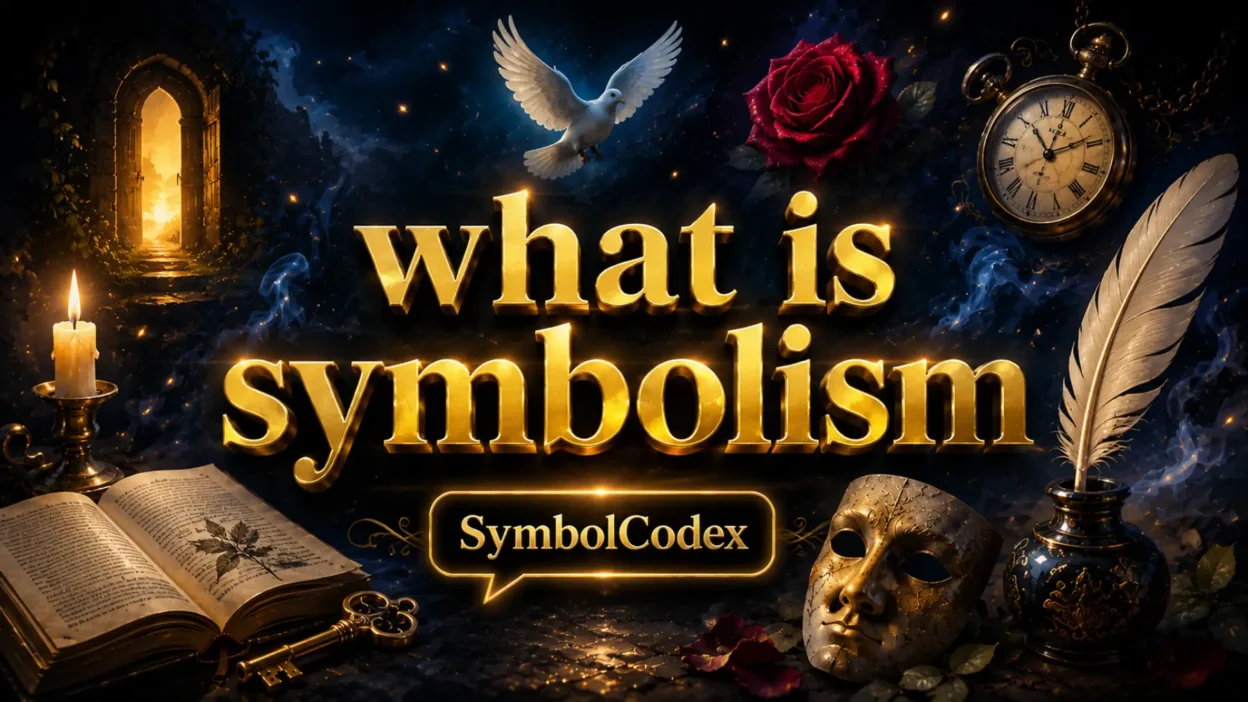
If you have ever wondered what is symbolism, the simplest answer is that symbolism is the use of a person, object, color, place, image, or action to represent an idea beyond its literal meaning. A key can represent access or opportunity, a road can suggest a life journey, and a candle can communicate hope or remembrance.
Symbolism appears everywhere. Writers use it to develop themes, artists use it to communicate ideas visually, religions preserve meanings through sacred objects, and cultures build associations around colors, animals, clothing, monuments, and rituals.
The important point is that symbols do not always have one permanent meaning. Context, history, culture, and personal experience determine how a symbol should be understood.
Quick Answer
Symbolism is the practice of using something concrete to represent an additional idea, emotion, belief, or concept. In literature, art, religion, and everyday culture, symbols help communicate meanings such as freedom, love, death, identity, authority, hope, or change without stating those ideas directly.
TL;DR
- Symbolism gives ordinary things additional meanings.
- Objects, colors, animals, places, and actions can become symbols.
- Context determines which symbolic meaning fits.
- Writers use symbolism to strengthen themes and character development.
- Cultural meanings can differ between communities and historical periods.
- A strong interpretation depends on evidence rather than assumptions.
WordPress note: Place the actual Rank Math Table of Contents block here instead of typing a manual contents list.
What Does Symbolism Mean?
Symbolism occurs when one thing stands for or suggests something more than itself.
A rose is literally a flower. In a romantic setting, however, it may represent love or attraction. At a funeral, the same flower may express grief, remembrance, or respect.
This difference between literal and additional meaning is the foundation of symbolism.
Consider a few simple examples:
| Symbol | Literal Meaning | Possible Symbolic Meaning |
|---|---|---|
| Key | Opens a lock | Access, trust, opportunity |
| Bridge | Connects two places | Transition, reconciliation |
| Candle | Provides light | Hope, remembrance, life |
| Mirror | Reflects an image | Identity, truth, vanity |
| Chain | Connects objects | Bond, duty, captivity |
| Road | Route for travel | Choice, journey, future |
These meanings are possibilities rather than fixed definitions. A chain representing family connection in one story could symbolize imprisonment in another.
Why Do People Use Symbolism?
People use symbols because abstract ideas can be difficult to communicate directly.
You cannot physically hold freedom, grief, loyalty, or ambition. However, you can represent these ideas through recognizable objects and images.
A broken chain can make the idea of liberation visible. An empty chair can communicate absence. A rising sun can suggest a beginning.
Symbols also make communication more memorable. Instead of explaining an idea in several sentences, a familiar image can communicate it quickly.
This is why symbolism appears in:
- Literature
- Poetry
- Film and television
- Painting and photography
- Religion
- Architecture
- Tattoos
- Jewelry
- Political imagery
- Memorials
- Advertising
- Digital communication
Understanding contextual symbolism is especially important because the surrounding situation often determines which meaning applies.
How Symbolism Works
Symbolism usually develops through association.
People notice what an object physically does and connect that function with an abstract idea.
A key opens, so it can symbolize opportunity.
An anchor holds something steady, so it can represent stability.
A bridge connects separated places, so it can represent reconciliation.
A clock measures passing time, so it can suggest aging or mortality.
Cultural repetition then strengthens these associations. When an image repeatedly appears in stories, ceremonies, religious traditions, art, or public life with similar meanings, audiences learn to recognize it symbolically.
However, writers and artists can also reverse familiar associations. A traditionally positive image can become threatening when placed in a different context.
What Is Symbolism in Literature?
In literature, symbolism occurs when an author gives a character, object, setting, color, action, or recurring image meaning beyond its literal role.
Imagine a novel about a teenager who wants independence. Every time she considers leaving home, she watches birds flying beyond her bedroom window.
The birds are real animals within the story. Their repeated connection with her desire to leave may also make them symbols of freedom.
Writers use literary symbolism to communicate:
- Themes
- Character emotions
- Internal conflict
- Social criticism
- Relationships
- Changes in identity
- Moral questions
- Historical ideas
Readers can learn how to identify symbolism in literature by examining repetition, context, character reactions, contrast, and changes in important objects.
Symbolism vs Theme
Symbolism and theme are connected, but they are not the same thing.
A symbol is an element that carries additional meaning.
A theme is a broader idea explored throughout a work.
For example, imagine a story where a locked gate repeatedly separates a child from an expensive neighborhood.
The gate may symbolize exclusion.
The larger theme may concern economic inequality or social class.
The symbol helps communicate the theme.
Symbolism vs Metaphor
A metaphor directly describes one thing as another to create a comparison.
For example:
“Time is a thief.”
Time is not literally a thief. The metaphor emphasizes how passing time takes experiences away.
A symbol works differently. A clock appearing repeatedly throughout a story may gradually represent time, aging, deadlines, or mortality without directly stating the comparison.
Metaphors usually function through comparison. Symbols work through association and context.
Symbolism vs Motif
A motif is a recurring element that contributes to a larger pattern.
Imagine that mirrors appear repeatedly throughout a novel.
The recurring mirrors form a motif.
Individual mirrors might symbolize identity, self-knowledge, appearance, or deception.
Motifs often help strengthen symbols and themes because repetition encourages readers to notice connections.
Symbolism vs Allegory
Allegory operates on a larger scale than ordinary symbolism.
A single object may function as a symbol, while an allegorical story may use numerous characters, places, and events to represent another set of ideas.
Political and moral allegories frequently construct entire fictional situations that parallel real social structures or philosophical questions.
Symbolism can exist without allegory, but allegories commonly rely heavily on symbols.
Major Types of Symbolism
Several forms of symbolism commonly appear in literature, art, and culture.
Object Symbolism
Ordinary objects can represent larger concepts.
Examples include:
- Keys , access or opportunity
- Rings , commitment
- Clocks , time
- Mirrors , identity
- Anchors , stability
- Doors , transition
For more examples, see common objects and their symbolism.
Color Symbolism
Colors frequently acquire emotional, cultural, political, or ceremonial meanings.
Red may suggest:
- Love
- Danger
- Blood
- Anger
- Confidence
White may suggest purity in one context but mourning in another cultural tradition.
Color symbolism therefore requires careful attention to setting and culture.
Animal Symbolism
Animals often gain meanings from their behavior, appearance, mythology, folklore, or cultural history.
Examples may include:
- Dove , peace
- Owl , wisdom
- Lion , authority
- Butterfly , transformation
- Snake , danger, renewal, knowledge, or healing
Animal meanings can differ greatly between cultures.
Nature Symbolism
Natural features often become symbolic because people connect environmental patterns with human experience.
Examples include:
- Rivers , change
- Mountains, challenge
- Spring , renewal
- Winter , endings or hardship
- Storms , conflict
- Sunrise , beginnings
Religious Symbolism
Religions use objects, gestures, clothing, numbers, architecture, images, and rituals to communicate theological teachings or sacred relationships.
Religious symbols should be interpreted according to their actual traditions rather than reduced to generic modern meanings.
Personal Symbolism
An object can carry meaning for one individual even if the association is not widely shared.
An inherited watch might symbolize a grandfather.
A particular song might remind someone of a relationship.
A childhood house might represent security for one sibling and restriction for another.
15 Clear Examples of Symbolism
1. Key
A key commonly symbolizes access, knowledge, trust, or opportunity.
2. Door
A door can represent transition, possibility, exclusion, or a new stage of life.
3. Mirror
Mirrors can suggest identity, truth, appearance, self-examination, or vanity.
4. Candle
A burning candle commonly communicates hope, remembrance, prayer, or continued life.
5. Clock
Clocks often emphasize time, aging, routine, deadlines, or mortality.
6. Anchor
An anchor may represent stability, security, loyalty, or emotional grounding.
7. Bridge
A bridge can symbolize connection, reconciliation, transition, or overcoming separation.
8. Ring
Rings commonly communicate commitment, continuity, unity, or membership.
9. Chain
Chains can symbolize bonds and connection, but they can also represent captivity or oppression.
10. Road
A road often symbolizes movement, choices, independence, uncertainty, or a life journey.
11. Window
A window may represent perspective, possibility, observation, freedom, or separation.
12. Mask
Masks can suggest performance, concealment, identity, protection, or transformation.
13. River
A river may represent continuous change, time, boundaries, purification, or transition.
14. Empty Chair
An empty chair can symbolize absence, death, exclusion, or someone expected to return.
15. Broken Object
A broken mirror, ring, clock, or photograph can represent damaged identity, relationships, memory, or interrupted continuity.
How Context Changes Symbolic Meaning
Context is one of the most important rules in symbolism.
Consider fire.
In one story, fire may destroy a home and symbolize devastation.
In another, people gather around a fire for warmth, making it a symbol of community.
Elsewhere, fire may represent purification, anger, knowledge, rebellion, or transformation.
The object alone does not provide the complete answer.
Ask:
- Where does the symbol appear?
- Who interacts with it?
- What happens immediately before it?
- How does the character react?
- Is it repeated?
- Does its condition change?
- What themes surround it?
- Does cultural history affect its meaning?
This method produces a stronger interpretation than simply searching for a fixed definition.
Symbolism in American Culture
American culture uses symbols throughout public and private life.
The American flag can represent national identity, citizenship, military service, public mourning, protest, or political allegiance depending on the setting.
The Statue of Liberty is associated with liberty, immigration, national ideals, and welcome, although its meaning can also become part of debates about whether American institutions have fulfilled those ideals equally.
Wedding rings commonly represent commitment. Graduation caps symbolize educational achievement. Memorial candles communicate remembrance, while broken chains frequently signify liberation.
Commercial imagery uses symbolism as well. Shields suggest security, crowns imply status, and light bulbs commonly indicate ideas.
Even digital interfaces depend on symbolic objects. A bell represents notifications, a lock represents security, and a trash-can icon indicates deletion.
Emotional and Psychological Symbolism
Symbols can make emotions visible.
A person experiencing grief may keep an old photograph.
A character afraid of change may repeatedly lock doors.
Someone seeking independence may dream about roads or open landscapes.
The connection does not need to be mystical. Objects become emotionally meaningful because people associate them with memories, relationships, fears, or goals.
Writers and artists use these associations to communicate psychological states indirectly.
A cracked mirror may suggest a fractured self-image. An abandoned house may communicate memory or emotional neglect. A repaired object can sometimes represent reconciliation or recovery.
How Symbolic Meanings Change Over Time
Symbolic meanings are not permanently fixed.
Historical events can transform an image. Religious traditions can add theological associations. Political movements can adopt existing symbols for new purposes. Popular culture can turn older symbols into fashion or entertainment imagery.
Personal interpretation changes as well.
A wedding ring may initially represent romantic commitment. After a divorce, the same object might represent grief, regret, experience, or a closed chapter.
Understanding what is symbolism therefore involves understanding change as well as established meanings.
Common Mistakes When Interpreting Symbolism
One common mistake is assuming everything represents something.
Not every tree, cup, storm, or color is symbolic. Sometimes details simply establish setting or move the plot forward.
Another mistake is using a symbolism dictionary as proof.
A guide might say that birds symbolize freedom, but a caged bird in a particular story could emphasize restriction instead.
Readers should also avoid assuming that a symbolic interpretation is universal.
Cultural context matters, especially for:
- Religious objects
- Ceremonial clothing
- Indigenous imagery
- Political emblems
- Colors
- Animals
- Sacred designs
Finally, avoid making interpretations unnecessarily complicated. The strongest symbolic reading usually explains several details with a clear idea.
How to Interpret Symbolism Correctly
Use this simple process:
- Identify the object, color, place, action, or image.
- Describe its literal role.
- Look for repetition or unusual emphasis.
- Notice character reactions.
- Examine what happens around it.
- Consider cultural and historical associations.
- Connect it with a central theme.
- Look for changes in the symbol.
- Gather more than one piece of evidence.
- Choose the interpretation that best explains the pattern.
Instead of writing:
“The window symbolizes freedom.”
A stronger analysis would explain:
“The repeated open window suggests freedom because the character looks through it whenever she considers leaving the restrictive household.”
The second interpretation explains both the meaning and the evidence supporting it.
Frequently Asked Questions
What is symbolism?
Discover 10 powerful examples, hidden meanings, and how symbolism works in literature with this simple guide.
Why is symbolism important?
A locked door may symbolize exclusion or emotional isolation when a story repeatedly connects it with a character who feels trapped. The surrounding context determines the meaning.
Why is symbolism important?
Symbolism helps communicate complex ideas, emotions, themes, and cultural beliefs through recognizable images. It can make a story, artwork, ceremony, or message more memorable.
What are the main types of symbolism?
Common types include object, color, animal, nature, literary, religious, cultural, and personal symbolism. These categories frequently overlap.
Is symbolism always intentional?
Not necessarily. Readers may identify meaningful patterns even when an author has not publicly confirmed a particular intention. Strong interpretations should therefore rely on evidence within the work.
Can one symbol have multiple meanings?
Yes. A mirror can represent truth, identity, vanity, memory, or deception depending on how it is used.
How do you recognize symbolism in literature?
Look for repetition, unusual emphasis, emotional reactions, changes in important objects, contrasts, and connections with major themes. Context should always guide the final interpretation.
Conclusion
Understanding what is symbolism begins with a simple principle: something literal can also carry an additional meaning. Keys can suggest access, bridges can represent connection, clocks can emphasize time, and mirrors can explore identity.
But symbolism is not a fixed code. History, culture, character experience, repetition, and surrounding events determine which interpretation makes sense.
The strongest symbolic reading does more than name a possible meaning. It explains why that meaning fits the context and how the symbol contributes to the larger message.