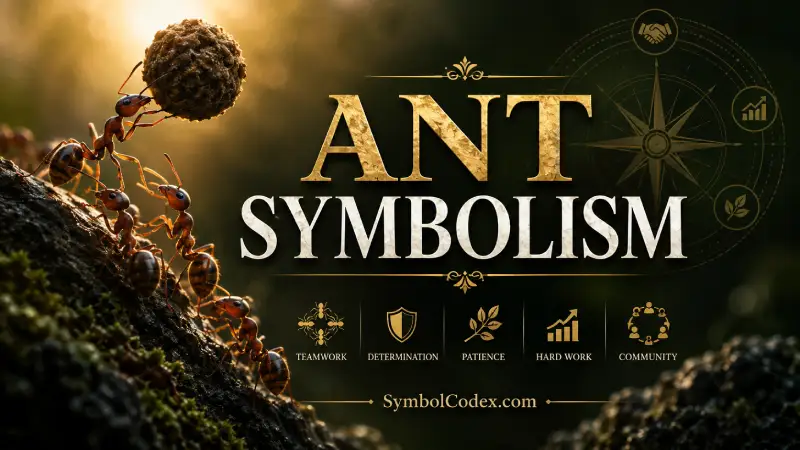
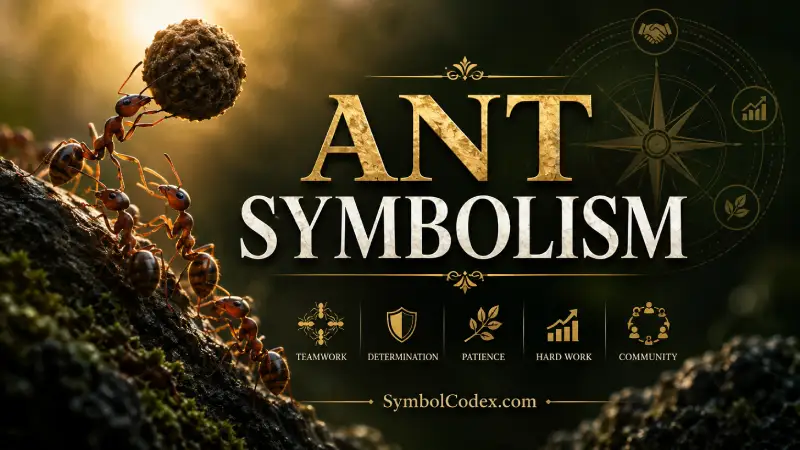
Ant symbolism commonly represents hard work, teamwork, patience, preparation, persistence, organization, and the strength of community. These meanings feel natural because ants accomplish demanding tasks through coordinated colonies in which workers gather food, maintain nests, defend the colony, and care for developing young.
For Americans, the ant is an unusually familiar symbol. It appears in backyards and kitchens, children’s stories, biblical lessons, cartoons, school discussions about cooperation, business metaphors, and nature documentaries. Depending on context, the same insect can represent admirable diligence or frustrating persistence.
Its symbolism is also older than modern motivational culture. Ants appear as examples of preparation and industry in ancient fable traditions and biblical wisdom literature, helping establish meanings that remain recognizable in the United States today.
Quick Answer
Ant symbolism most commonly represents hard work, teamwork, patience, preparation, persistence, and community in modern American culture. Older literary and religious traditions also use ants as examples of foresight, self-discipline, and the wisdom of preparing before hardship arrives.
TL;DR
- Ants symbolize teamwork, diligence, patience, preparation, and persistence.
- Their colonies make community one of their strongest modern meanings.
- Ancient fables associate ants with planning ahead and disciplined work.
- Biblical imagery presents ants as examples of wisdom and preparation.
- American culture also connects ants with productivity and collective effort.
- Negative meanings include conformity, overwork, invasion, and relentless pressure.
What Ants Are and Why Their Behavior Shapes the Symbol
Ants belong to the family Formicidae and are social insects that live in colonies. AntWeb currently recognizes more than 16,000 valid ant species and subspecies, which means there is enormous variation in their size, diet, nesting behavior, defense, and social organization.
A typical colony includes reproductive individuals and numerous workers. Workers are generally wingless females responsible for activities such as gathering food, maintaining or enlarging the nest, tending immature ants, and defending the colony.
Those visible behaviors strongly influence human symbolism.
One ant looks small and vulnerable. A functioning colony can appear highly organized and remarkably persistent. Humans therefore tend to interpret the ant not through physical size but through what coordinated effort allows small individuals to accomplish.
That contrast between small size and large collective effect is central to nearly every modern ant meaning.
Ant Symbolism: 7 Core Meanings
Seven interpretations appear especially often and fit both ant behavior and modern cultural use.
| Meaning | Why Ants Suggest It | Modern Interpretation |
|---|---|---|
| Hard work | Workers perform many colony tasks | Consistent effort |
| Teamwork | Colonies depend on coordinated activity | Cooperation toward shared goals |
| Persistence | Ants repeatedly forage and rebuild | Continuing despite setbacks |
| Preparation | Some species collect or store resources | Planning ahead |
| Community | Individuals function within colonies | Belonging and mutual responsibility |
| Patience | Large outcomes develop through repeated small actions | Long-term progress |
| Organization | Colonies divide tasks among members | Structure and effective coordination |
These meanings are symbolic interpretations rather than universal rules about every ant species. Ant societies are highly diverse, so familiar human ideas about “the ant” simplify a much more complex group of insects.
Ant Symbolism of Hard Work and Diligence
Hard work is probably the most familiar meaning attached to ants.
People regularly see workers carrying food, moving material, excavating nests, tending young, or traveling along established routes. Colony life depends on repeated labor performed by many individuals rather than on one dramatic act.
That pattern makes ants a natural symbol for consistent effort.
The symbolic lesson is not necessarily that a person should remain busy every minute. A better interpretation is that small actions become significant when repeated over time.
This makes ant imagery useful in settings involving school, business, athletics, saving money, learning skills, and long projects. Progress may initially seem insignificant, yet accumulated effort can eventually create a result that would have been impossible through one burst of work.
The ant therefore represents discipline more effectively than spectacle.
Its strength is repetition.
Teamwork and the Strength of the Colony
Ant symbolism is also closely tied to cooperation.
Ant colonies are examples of eusocial organization, meaning they include overlapping generations, cooperative care of young, and reproductive division of labor. Workers perform tasks that support the larger colony rather than functioning solely as independent individuals.
Humans readily translate that structure into the idea that cooperation multiplies individual ability.
A lone ant may be tiny. Thousands working within an organized system can build nests, locate resources, defend territory, raise offspring, and alter the surrounding environment.
In modern American culture, this image works particularly well as a metaphor for teams.
A successful workplace, sports team, volunteer group, or family depends on people contributing different kinds of effort toward a shared result. The ant symbolizes the idea that contribution matters even when one person’s role receives little attention.
This meaning also explains why ants frequently appear in illustrations about cooperation aimed at children.
Persistence and the Meaning of Not Giving Up
Ants often appear difficult to discourage.
Block a familiar trail and workers may begin searching for another route. Disturb a nest and surviving members may continue colony-related activity. Remove one food opportunity and foragers search elsewhere.
Human observers interpret this behavior as persistence.
Symbolically, the ant represents continuing after minor setbacks instead of treating every obstacle as a final defeat.
This does not require romanticizing the insect. Persistence is simply one of the qualities humans notice when ants repeatedly return to a task or location.
The meaning can be especially relevant during long periods when progress feels slow.
An ant symbol can communicate that advancement does not always look dramatic. Sometimes it means testing another path, adjusting direction, and continuing with the resources available.
That makes the ant an unusually grounded symbol of resilience.
Ant Symbolism of Preparation and Planning Ahead
Preparation is one of the oldest literary meanings associated with ants.
In versions of Aesop’s Ant and the Grasshopper, ants gather provisions during the productive season while the grasshopper fails to prepare for winter. When difficult conditions arrive, the contrast becomes a moral lesson about foresight and responsibility. Versions of this fable have circulated for centuries and remain among the best-known stories associated with Aesop.
The symbolic ant therefore came to represent more than labor.
It represents working today with tomorrow in mind.
That interpretation remains easy to apply in American life. Saving money, studying before an exam, maintaining a home, preparing for emergencies, or gradually developing professional skills all depend on giving future needs attention before they become urgent.
Biologically, ant species differ substantially in how they obtain and manage food, so the fable should not be treated as a scientific description of every colony.
As symbolism, however, the message remains clear: preparation creates options when circumstances change.
Ant Symbolism in the Bible
Ants have a particularly recognizable place in biblical symbolism because of the Book of Proverbs.
Proverbs 6 directs the lazy person to observe the ant and learn wisdom from its behavior. The following lines emphasize preparation and gathering provisions rather than waiting until need becomes urgent. Proverbs 30 likewise places ants among small creatures described as notably wise because they prepare food despite their limited strength.
Within this context, the ant represents wisdom expressed through responsible action.
The emphasis is not physical power.
The ant is small, yet it behaves in a way that the text presents as worthy of human observation. That reversal gives the symbol much of its force: wisdom does not have to come from something impressive in size or status.
For American Christian readers, this biblical background has helped reinforce associations with diligence, foresight, personal responsibility, and avoiding laziness.
The ant’s religious meaning is therefore closely connected with work, but its deeper lesson is about recognizing consequences before they arrive.
Ancient Fables and the Historical Meaning of Ants
The ant also became culturally important through fable traditions.
Stories grouped under the name of Aesop have circulated for more than two millennia, and animal characters in these stories typically model human qualities or provide moral contrasts. The Library of Congress notes the enormous historical influence of Aesopian fables and their continued presence across languages and adaptations.
In The Ant and the Grasshopper, the ant became the character of foresight and labor, while the grasshopper represented living only for the present.
Later retellings sometimes softened or challenged the severity of the original moral, but the basic association survived.
That history helps explain why modern Americans can see an ant carrying food and immediately think of industriousness even without consciously remembering the fable.
Symbols often work this way.
Observed animal behavior creates an initial metaphor. Stories then repeat it until the association becomes part of ordinary cultural language.
Community, Belonging, and Shared Responsibility
The colony gives ant symbolism a social meaning that goes beyond teamwork.
Teamwork usually refers to completing a specific task. Community implies something broader: belonging to a system in which the welfare of individuals and the larger group are connected.
Ant colonies depend on specialized roles. Reproductive queens, workers, and males perform different biological functions, while workers themselves may handle activities ranging from brood care to food collection and nest defense.
Modern symbolism translates this into shared responsibility.
An ant image may therefore represent loyalty to family, dedication to a community, or willingness to contribute even when the contribution is not glamorous.
This interpretation can be positive, but it has an important limit.
Human beings are not ants. Healthy human communities leave room for individuality, disagreement, choice, and personal boundaries.
The symbol works best when it emphasizes cooperation rather than unquestioning conformity.
Small Size and the Symbolism of Quiet Strength
The ant is one of the clearest examples of a symbol whose meaning contradicts its physical size.
Humans often connect size with importance. Ants challenge that assumption.
Their ecological influence can be substantial. Ants move soil, redistribute nutrients, prey on other organisms, and disperse seeds. In eastern North American forests, ant-mediated seed dispersal is especially important for numerous understory plants.
This gives the ant a modern symbolic meaning of small but consequential.
Someone may identify with the ant because they do not feel physically imposing, socially prominent, wealthy, or publicly recognized.
The symbolism suggests that visibility is not the same thing as impact.
A teacher helping one student at a time, an employee doing essential work behind the scenes, or a person making small improvements every day can all fit the metaphor.
Ant symbolism therefore offers a useful counterpoint to animal symbols based on dominance.
Influence can accumulate quietly.
Ants, Nature, and the Meaning of Building
Ants do more than move through ecosystems. Many species physically modify them.
By digging tunnels and constructing nests, ants can aerate soil, redistribute nutrients, change moisture conditions, and influence where water moves. Some species also transport seeds, creating important relationships with plants.
These ecological functions add building and stewardship to modern ant symbolism.
The ant does not simply occupy a place. It alters its surroundings through repeated activity.
As a human metaphor, that can represent creating a home, establishing a business, building financial security, developing a family tradition, or gradually shaping a life through accumulated decisions.
The meaning differs subtly from ambition.
Ambition focuses on the desired destination.
Ant symbolism focuses on construction: the repeated work that creates something capable of lasting.
Ant Symbolism in Modern American Culture
In the United States, ants occupy an unusual cultural position because they are simultaneously admired and disliked.
People praise “worker ants” as examples of diligence while calling pest-control companies when colonies enter kitchens or damage property.
Children encounter ants through science lessons, fables, cartoons, toys, and animated films. The 1998 film A Bug’s Life, for example, was inspired in part by the Ant and Grasshopper fable and transformed the colony into a story about cooperation, oppression, courage, and collective action.
Business language also easily borrows ant imagery because colony organization resembles familiar ideas about teams, logistics, and division of labor.
At the same time, Americans frequently experience carpenter ants, fire ants, and household ants as pests. Carpenter ants can damage structural wood, while invasive fire ants are a serious concern in parts of the southern United States.
Modern American ant symbolism therefore contains an interesting contradiction.
The ant is admirable when its persistence serves a metaphorical goal and annoying when that same persistence enters someone’s house.
Ant Symbolism in Tattoos
Ant tattoos are less common than wolf, snake, butterfly, or bird designs, which gives them a distinctive personal quality.
The most natural meanings are persistence, hard work, community, humility, and strength through cooperation.
A single ant can emphasize independence, modesty, or the significance of small actions.
A line of ants changes the meaning toward organization and steady progress.
Several ants carrying an object together emphasize teamwork.
An anthill or colony design can represent family, community, or something large built through many small contributions.
Ant tattoos can also carry a humorous or unconventional quality. Because the insect is ordinary rather than majestic, choosing it deliberately may communicate that the wearer values usefulness over prestige.
The symbolism becomes especially effective when the design connects to a personal story: building a business from little, supporting a family, recovering gradually, or succeeding through consistency rather than dramatic luck.
Emotional Meaning of Ant Symbolism
Emotionally, the ant often represents the ability to keep going when a task feels larger than the individual.
That can be reassuring for people facing long-term responsibilities.
Not every problem can be solved immediately. Raising children, earning a degree, managing debt, recovering health, developing a career, and learning a difficult skill all involve progress that accumulates slowly.
Ant symbolism frames that pace as legitimate.
One small action may seem insignificant, but repeated actions create direction.
The ant can also represent feeling responsible for others. Someone who strongly identifies with the colony metaphor may value reliability and contribution.
There is a caution here as well.
A person who believes they must always work, provide, organize, and solve problems may eventually turn diligence into exhaustion.
The ant is useful as a symbol of persistence, but it should not become a metaphor for never resting.
Negative Meanings: Overwork, Conformity, and Invasion
Not all ant symbolism is positive.
A colony can represent conformity when individuality appears secondary to collective function.
The worker-ant metaphor can also become negative when used for people trapped in repetitive labor, especially when their contribution feels unnoticed or interchangeable.
Ants may therefore symbolize:
relentless work without personal fulfillment,
social pressure to conform,
crowded or impersonal systems,
small problems multiplying rapidly,
or unwanted intrusion.
The pest association is particularly strong in everyday American life.
A single ant in a kitchen often signals that more may follow. That experience creates a symbolic connection between ants and problems that begin small but become difficult when ignored.
This darker interpretation provides a useful counterbalance to romantic ideas about productivity.
Hard work is admirable. Endless work without autonomy is not necessarily the same thing.
Ant Symbolism and Ecology: More Than a Work Metaphor
Reducing ants to “hard workers” overlooks their ecological importance.
Ants help aerate and mix soil, participate in nutrient cycling, prey on other invertebrates, and move plant seeds. Seed dispersal by ants is called myrmecochory, and in some eastern North American forests, a substantial portion of understory herbs depend on ants to move their seeds.
Some ant lineages also developed remarkably specialized relationships with other organisms. Attine ants, including leafcutters and their relatives, cultivate fungi for food, with this form of ant agriculture evolving tens of millions of years before human farming.
These facts deepen the symbolism.
Ants do not simply work hard. They participate in networks.
Their actions affect plants, soil, microorganisms, predators, prey, and other parts of the environment.
A modern ecological interpretation can therefore connect ants with interdependence: the idea that small actions spread outward through systems in ways that are not always immediately visible.
Common Misunderstandings About Ant Symbolism
The biggest mistake is assuming every symbolic meaning comes from an ancient spiritual tradition.
Many familiar ant associations can be explained directly through observed behavior, biblical literature, European fables, and modern cultural metaphors. Not every claim about “ant spirit energy” or a universal ancient ant message has a documented historical foundation.
Another misconception is that all ant species behave exactly alike.
They do not. Thousands of recognized species have different diets, nesting systems, colony sizes, reproductive strategies, and ecological relationships.
It is also misleading to describe ant colonies as if a queen consciously commands every worker.
The queen’s central biological role is reproduction; workers handle much of the colony’s maintenance, food collection, brood care, and defense. Colony organization emerges through biological and chemical systems rather than a human-style ruler giving daily instructions.
Accurate symbolism starts by keeping metaphor separate from biology.
How Ant Symbolism Has Evolved
The ant’s symbolism developed through several overlapping layers.
First came human observation. Ants were small, common, social, and visibly active.
Literary traditions then turned those behaviors into moral lessons. Aesopian fables made the ant a memorable figure of preparation, while biblical wisdom literature connected it with foresight and disciplined action.
Modern science added another layer.
We now understand much more about colony organization, eusociality, seed dispersal, soil modification, fungus cultivation, and the enormous diversity within the ant family.
Contemporary culture expanded the symbol again through animation, education, productivity language, tattoo culture, and ecological awareness.
As a result, today’s ant is no longer merely a symbol of working hard.
It can represent the larger idea that small, coordinated actions accumulate into consequences much greater than any one action suggests.
Frequently Asked Questions
What does an ant symbolize spiritually?
In modern spiritual interpretation, an ant commonly represents patience, persistence, cooperation, discipline, and preparation. These meanings largely reflect observable ant behavior and older cultural associations rather than one universal religious doctrine.
What does seeing an ant mean?
There is no objective supernatural meaning to seeing an ant. Symbolically, someone may use the encounter as a reminder to stay consistent, cooperate with others, prepare ahead, or pay attention to a small issue before it grows.
Is an ant a symbol of good luck?
Ants are not universal good-luck symbols. However, their associations with productivity, stored resources, community, and steady progress can give them positive meanings involving prosperity or future security in modern personal symbolism.
What does the Bible say ants symbolize?
Biblical wisdom literature uses the ant as an example of foresight and industrious behavior. Proverbs encourages readers to observe the ant’s preparation and learn wisdom from it.
What does an ant tattoo mean?
An ant tattoo commonly symbolizes hard work, resilience, humility, teamwork, or determination. A single ant may emphasize quiet strength, while multiple ants can highlight community and cooperation.
What do black ants symbolize?
Black ants do not have one separate universal symbolic meaning based solely on color. In contemporary personal symbolism, people may associate them with discipline, persistence, groundedness, or quiet strength, but these interpretations depend on context.
Is ant symbolism positive or negative?
It can be either. Positive meanings include diligence, teamwork, preparation, resilience, and community, while negative meanings include overwork, conformity, invasion, and problems that multiply when neglected.
Conclusion
Ant symbolism most clearly represents hard work, cooperation, preparation, persistence, patience, and the cumulative strength of small actions. Those meanings come from a combination of real colony behavior and centuries of stories that taught people to view ants as examples of disciplined effort.
American culture has inherited the ant of Proverbs and Aesop while adding newer associations with teamwork, productivity, animation, household pests, and ecological interdependence. Science adds an important correction to the simple stereotype: ants are not merely tireless workers. They are diverse social insects that can reshape soils, move seeds, cultivate fungi, defend colonies, and participate in complicated ecological relationships.
The grounded lesson is straightforward: important results do not always begin with impressive size or dramatic action. Consistent effort, coordination, and preparation can make small contributions matter.