
Bee symbolism commonly represents hard work, cooperation, community, abundance, persistence, protection, and purposeful activity. These associations are especially influenced by honey bees, whose highly organized colonies and visible gathering behavior have made the hive one of the world’s most recognizable metaphors for collective effort.
The meaning becomes more interesting when bees are viewed beyond the familiar honey bee. The United States has about 4,000 native bee species, and many live very different lives from hive-forming honey bees. European honey bees are not native to North America, while many American native bees are solitary pollinators.
For Americans today, bees can represent everything from a productive community to environmental responsibility. They appear in state symbols, tattoos, jewelry, religious imagery, gardening culture, conservation campaigns, and expressions such as the familiar idea of being “busy as a bee.”
Quick Answer
Bee symbolism most commonly represents hard work, teamwork, community, persistence, abundance, and the rewards of sustained effort. Historically, bees have also appeared in royal, biblical, and civic symbolism, while modern American culture increasingly connects them with pollination, conservation, and ecological interdependence.
TL;DR
- Bees commonly symbolize diligence, teamwork, abundance, and community.
- Pollination adds meanings of growth, renewal, and interconnected life.
- The sting makes bees symbols of protection and firm boundaries.
- Ancient Egyptian bee imagery was connected with royal authority.
- Biblical bee imagery includes sweetness, danger, abundance, and pursuit.
- Utah uses the beehive to represent industry, cooperation, and community.
What Bees Are and Why Their Behavior Shapes the Symbol
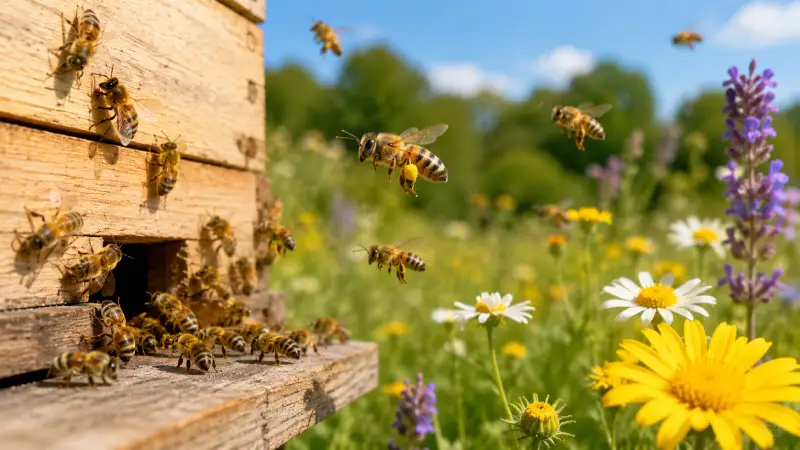
“Bee” describes a remarkably diverse group of insects rather than one lifestyle.
More than 20,000 bee species are known worldwide, and roughly 4,000 are native to the United States. They range from tiny solitary species only a few millimeters long to large carpenter bees and bumble bees.
The bee most people picture, however, is usually the western honey bee, Apis mellifera. Honey bees live in large social colonies containing a reproductive queen, workers, and male drones. Workers carry out many of the activities needed to maintain the colony, while the queen’s primary biological role is reproduction.
That organized colony life strongly shaped human symbolism.
A hive appears busy but coordinated. Individual workers contribute to something much larger than themselves. Honey is produced gradually, while flowers must be visited repeatedly before resources accumulate.
From those behaviors come familiar meanings such as work, cooperation, productivity, patience, order, and reward.
There is one important correction: not all bees live this way. The vast majority of wild bee species are solitary, with individual females building and provisioning their own nests.
So when people use bees to symbolize teamwork, they are usually drawing specifically from honey bees and other social species.
Bee Symbolism: 7 Powerful Core Meanings
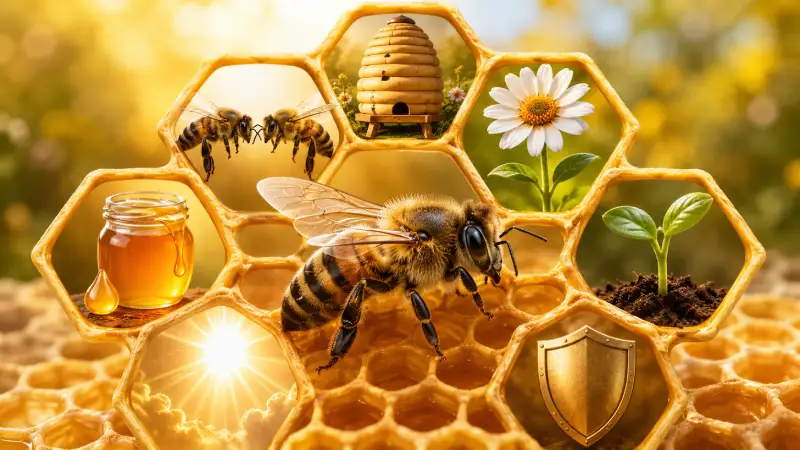
| Symbolic Meaning | Bee Association | Modern Interpretation |
|---|---|---|
| Hard work | Repeated foraging and hive tasks | Consistent effort produces results |
| Teamwork | Social colony organization | Cooperation strengthens communities |
| Abundance | Honey and successful pollination | Growth, prosperity, and reward |
| Persistence | Repeated flower visits and foraging | Continuing despite slow progress |
| Protection | Workers defend colonies | Healthy boundaries and courage |
| Community | Colony members depend on shared systems | Belonging and mutual responsibility |
| Purpose | Specialized roles and focused activity | Using abilities toward meaningful goals |
These meanings are metaphors rather than universal spiritual laws. Their strength comes from recognizable bee behavior and centuries of cultural interpretation.
Bee Symbolism of Hard Work and Diligence
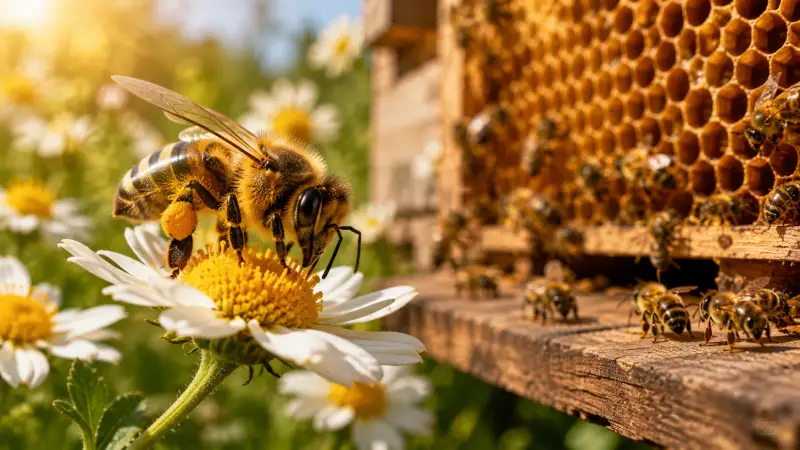
Hard work is probably the most familiar meaning associated with bees.
A worker honey bee performs different jobs during its life, while foragers repeatedly leave the colony to gather nectar, pollen, water, and other resources. A colony’s success depends on countless small actions rather than one spectacular effort.
That makes the bee an especially effective symbol of consistency.
The lesson is not simply “work harder.”
Bee symbolism suggests that worthwhile results often come from repeated contributions that initially seem small.
Studying for twenty minutes may not transform someone’s knowledge in one evening. Saving a small amount of money does not immediately create financial security. Working on a skill for one day rarely produces mastery.
Over time, however, those actions accumulate.
Honey provides an almost perfect metaphor for this idea: a valuable store is created gradually through repeated gathering.
The bee therefore represents productive effort that has direction.
Teamwork, Cooperation, and the Meaning of the Hive
The hive adds another major meaning: cooperation.
Honey bees are social insects. Thousands of individuals can participate in foraging, brood care, nest maintenance, temperature regulation, defense, and other colony functions. Communication occurs through chemical signals and behaviors that help coordinate colony activity.
Humans naturally turn that organization into a metaphor for teamwork.
A beehive can symbolize:
- family cooperation
- effective workplaces
- neighborhood participation
- shared responsibility
- coordinated communities
- people contributing different abilities
This symbolism works because no single worker bee performs every colony function at once.
The larger result comes from many individuals doing different things within the same system.
However, human communities are not bee colonies. People need individuality, choice, privacy, and disagreement in ways that insect societies do not.
The healthiest human interpretation is therefore cooperation without loss of individuality.
Bees, Pollination, Growth, and Abundance
Pollination gives bee symbolism a broader ecological meaning.
When bees visit flowers for nectar or pollen, they can transfer pollen between flowers, enabling many plants to reproduce and form seeds or fruit. In the United States, native bees and managed honey bees contribute significantly to agriculture and natural ecosystems. USDA estimates place the economic contribution of pollination to U.S. crop production in the billions of dollars annually.
This biological relationship supports modern associations with:
Growth. Bee activity helps many flowering plants reproduce.
Abundance. Pollination contributes to fruits, seeds, and future plant generations.
Connection. The bee, flower, plant, and larger ecosystem depend on interacting biological relationships.
Productivity. One activity can create consequences far beyond the individual bee.
This is where bees sometimes become symbols of fertility or renewal.
That interpretation should be framed carefully. Pollination provides a natural metaphor for reproduction and new growth, but it does not mean every historical culture universally treated bees as fertility symbols.
A more grounded modern meaning is life continuing through connection.
Persistence and the Meaning of Small Progress
A bee’s contribution can look insignificant when viewed in isolation.
One flower visit seems small.
One pollen load seems small.
One cell of honeycomb seems small.
Yet repeated activity creates something much larger.
That makes bees compelling symbols for people dealing with long-term goals.
Bee symbolism can encourage:
continuing after slow progress,
working through ordinary setbacks,
accepting gradual improvement,
and trusting accumulated effort.
This differs from dramatic resilience symbolism associated with surviving one catastrophic event.
The bee represents everyday persistence.
Its symbolic message is especially relevant when success depends less on one courageous moment and more on showing up repeatedly.
Protection, Courage, and the Symbolism of the Sting
Bees are not only symbols of sweetness and productivity.
They can defend themselves.
Worker honey bees may sting perceived threats to the colony. For a honey bee worker, stinging a mammal can be fatal because the barbed stinger may remain lodged in the skin.
That defensive ability gives bee symbolism a sharper side.
A bee can represent:
Protection. Valuable things deserve defense.
Boundaries. Gentleness does not require unlimited tolerance.
Courage. Small size does not necessarily mean helplessness.
Consequences. Ignoring a warning can have painful results.
This creates an interesting contrast.
The same animal that produces honey can sting.
Symbolically, bees therefore fit people who value kindness but also believe kindness needs boundaries.
The message is not aggressive.
It is closer to: be productive and cooperative, but remain capable of protecting what matters.
Queen Bee Symbolism and Leadership
The phrase “queen bee” has developed meanings far beyond biology.
In modern American language, it can describe a socially dominant woman, a central female figure, someone with high status, or a person who attracts considerable attention.
In jewelry and personal symbolism, queen bee imagery may represent:
leadership,
feminine confidence,
independence,
status,
motherhood,
or personal authority.
Biology is more complicated than the metaphor suggests.
A honey bee queen is not a tiny monarch issuing instructions to workers. Her primary role is reproduction, and colony organization emerges through interactions among many bees, chemical communication, environmental conditions, and worker behavior. USDA descriptions specifically identify egg laying as the queen’s primary function.
So “queen bee as ruler” is a human social metaphor, not a literal description of how honey bee colonies operate.
Bee Symbolism in Ancient Egypt
Bees had an important place in ancient Egyptian royal imagery.
One of the Egyptian king’s royal titles combined the sedge plant and bee. Surviving inscriptions and objects show the sedge representing Upper Egypt and the bee representing Lower Egypt, together expressing kingship over the unified country.
That makes the bee historically connected with royal authority and political identity in this specific Egyptian context.
This meaning should not be stretched into claims that every ancient Egyptian bee represented spirituality, immortality, wealth, or a particular deity.
Historical symbols depend on context.
A bee appearing in a royal title carries a more specific meaning than a bee appearing in a modern necklace.
The Egyptian example is important because it demonstrates how old bee imagery can be while also showing why symbolism should not be reduced to a universal list.
Bee Symbolism in the Bible
Biblical bee symbolism is more varied than modern inspirational descriptions often suggest.
Honey and honeycomb frequently appear positively. Proverbs 16:24 compares pleasant or gracious words to the sweetness of honeycomb, connecting honey with pleasantness and well-being.
Bees themselves, however, can also represent something threatening.
Deuteronomy 1:44 describes enemies pursuing people like bees, using the image of a swarm to communicate relentless attack. Isaiah 7:18 similarly uses bees in an image connected with an approaching foreign power.
The story of Samson adds another memorable bee-and-honey image: a swarm settles in the carcass of a lion, producing the honey that later becomes part of Samson’s riddle.
For Christian or biblical symbolism, then, bees should not be reduced to “hard work.”
The broader imagery includes sweetness, provision, danger, swarming force, and unexpected abundance.
Bee Symbolism in the United States
The United States has one especially clear civic example of bee symbolism: Utah.
The beehive became Utah’s official state emblem in 1959 and is closely associated with the state motto, “Industry.” Utah’s official historical materials connect the hive with hard work, thrift, perseverance, community, and cooperation.
The image has much older roots in Utah’s territorial and pioneer history and appears on state seals and flags.
Utah’s current state flag, officially adopted in 2024, places a beehive prominently in its design. Official state explanations describe it as representing Utah’s history, community, and industry.
This gives bee and beehive symbolism a particularly American meaning:
people building a functioning community through sustained shared effort.
The symbol has historical connections with Latter-day Saint culture but is also widely used today as a secular emblem of Utah identity.
Native Bees and a New American Meaning
Modern American bee symbolism increasingly extends beyond honey and hives.
The United States has about 4,000 native bee species, ranging enormously in appearance, size, behavior, and ecological relationships. Honey bees, although economically important, were introduced from Europe rather than being native to North America.
Many native bees are solitary.
That fact changes the symbolism.
A solitary mason, leafcutter, or ground-nesting bee may be a better symbol of:
independence,
specialization,
quiet contribution,
or accomplishing important work without belonging to a large group.
Native bees are also critical pollinators. Some specialize on particular plants, creating close ecological relationships in which the loss of one species can affect the other.
This adds interdependence and ecological responsibility to twenty-first-century bee symbolism.
Bees, Conservation, and Environmental Responsibility
The bee has become one of America’s most recognizable conservation symbols.
Pollinators face pressures that can include habitat loss, reduced floral diversity, pesticides, pests, disease, and climate-related changes. The specific threats differ substantially among honey bees, bumble bees, and other native species.
That distinction matters.
“Save the bees” can sound as though all bees face exactly the same problem. They do not.
Managed honey bees are agricultural animals maintained by beekeepers, while thousands of native species depend on suitable nesting sites, native plants, and intact habitat.
Modern bee symbolism therefore increasingly means more than productivity.
A bee on a garden sign, environmental poster, or piece of jewelry may represent:
biodiversity,
pollinator-friendly gardening,
native plant conservation,
sustainable agriculture,
or responsibility toward ecosystems.
The symbol has shifted from what bees produce for humans toward what healthy ecosystems require from humans.
Bee Symbolism in Tattoos and Jewelry
Bee imagery is especially popular in tattoos and jewelry because a small design can carry several meanings at once.
A single bee may represent persistence, personal purpose, independence, or a hardworking personality.
Several bees together emphasize friendship, family, teamwork, or community.
A bee with flowers naturally strengthens themes of growth, pollination, renewal, and connection with nature.
A bee and honeycomb often represents structure, productivity, home, or something valuable built gradually.
A queen bee design can suggest feminine confidence, leadership, motherhood, or status.
A bee memorial tattoo may represent a person remembered for diligence, warmth, loyalty, or a shared nickname.
Because bees can both produce sweetness and defend themselves, tattoo symbolism can also combine softness with strength.
That contrast is one reason bee designs work especially well as personal symbols.
Emotional and Psychological Meaning of Bee Symbolism
Emotionally, the bee often represents purposeful activity.
People can feel overwhelmed when a goal seems too large. Bee imagery shifts attention away from the finished result and toward the next useful action.
Gather something.
Build something.
Contribute something.
Then repeat.
This can make the bee meaningful during education, career development, recovery, parenting, business building, or any other process that depends on cumulative effort.
Community adds another emotional layer.
The hive can symbolize the comfort of belonging to a family, team, neighborhood, or social network in which individual contributions matter.
There is also a caution.
People sometimes glorify busyness for its own sake. Human beings require rest, personal freedom, and time that is not measured by productivity.
Bee symbolism is healthiest when it represents purpose, not endless work.
Positive and Negative Meanings of Bee Symbolism
Bee symbolism is mostly positive, but several traits have darker interpretations.
Positive meanings
Diligence: continuing useful work.
Community: contributing to something shared.
Abundance: enjoying rewards produced gradually.
Persistence: making progress through repetition.
Protection: maintaining boundaries.
Growth: supporting processes that create new life.
Purpose: directing effort toward a meaningful outcome.
Negative meanings
Overwork: treating constant productivity as a virtue.
Conformity: placing the group above individual judgment.
Aggression: responding defensively when no real threat exists.
Social pressure: expecting everyone to perform one assigned role.
Swarming chaos: many small pressures becoming overwhelming at once.
The bee’s meaning therefore depends on which part of its behavior or cultural image is emphasized.
Common Misunderstandings About Bee Symbolism
One common mistake is treating bee and honey bee as interchangeable.
They are not.
Honey bees are one branch of an enormous bee diversity. The United States contains thousands of native species, and many are solitary rather than hive-living.
Another misconception is calling the queen the “boss” of the hive.
She is essential for reproduction, but she does not run the colony like a human monarch managing employees.
A third mistake is assuming every modern bee meaning has ancient origins.
Ideas such as “bee energy,” guaranteed prosperity, manifestation, or precise supernatural messages are contemporary beliefs unless tied to a documented tradition.
Finally, bee symbolism is not always positive.
Ancient and biblical imagery can use swarming and stinging bees as images of danger just as easily as later cultures use honey and hives to represent abundance.
How Bee Symbolism Has Evolved
Bee symbolism developed because human relationships with bees kept changing.
Early societies encountered wild bees through honey gathering and observation.
Agricultural cultures increasingly recognized the relationship among flowers, bees, food, and seasonal abundance.
Ancient Egyptian political imagery gave the bee a specific royal meaning connected with Lower Egypt. Biblical literature used honey for sweetness while also using bees as images of threatening pursuit.
Beekeeping later made hive organization and honey production increasingly familiar metaphors for work and social cooperation.
In American culture, Utah transformed the beehive into a civic symbol of industry and community.
Modern ecology has added perhaps the largest change.
Today, people increasingly understand bees not simply as honey producers but as thousands of different species participating in complex ecological relationships.
As a result, the modern bee can symbolize both individual effort and interconnected life.
Frequently Asked Questions
What does a bee symbolize spiritually?
In modern spiritual interpretation, bees commonly symbolize purpose, diligence, community, abundance, persistence, and cooperation. These are symbolic interpretations rather than scientifically proven messages or one universal religious doctrine.
Is seeing a bee a good sign?
There is no objective rule that makes seeing a bee a supernatural good omen. Symbolically, someone may interpret the encounter as a reminder to stay focused, value cooperation, notice growth, or protect something important.
What does a bee tattoo symbolize?
A bee tattoo commonly represents hard work, resilience, loyalty, community, family, purpose, or personal growth. A queen bee can emphasize confidence or leadership, while flowers and honeycomb can add themes of pollination, abundance, and home.
What do bees symbolize in the Bible?
Biblical bee imagery is mixed. Honey and honeycomb can represent sweetness and pleasantness, while swarming bees can represent dangerous pursuit or overwhelming enemies.
What does a queen bee symbolize?
In modern culture, a queen bee commonly represents feminine confidence, leadership, status, motherhood, or authority. Biologically, however, the queen’s primary colony role is reproduction rather than commanding worker bees.
Why do bees symbolize hard work?
The association comes primarily from honey bee colony life and repeated foraging. Many workers contribute numerous small tasks to maintaining the colony, making bees a natural metaphor for diligence and cumulative effort.
Do bees symbolize good luck and prosperity?
They can represent prosperity in modern personal symbolism because honey, pollination, productivity, and thriving colonies suggest abundance. However, good luck is not one universal historical bee meaning across all cultures.
Conclusion
Bee symbolism most commonly represents hard work, cooperation, community, persistence, abundance, purpose, and protection. These meanings grew partly from the familiar honey bee colony, where many small contributions combine into something much larger.
The history is broader than the hive. Ancient Egyptian royal imagery, biblical literature, Utah’s civic symbolism, American beekeeping, native pollinator conservation, tattoos, and environmental culture have all given bees different meanings at different times.
Perhaps the bee’s most grounded modern message comes from pollination itself: individual actions rarely exist in isolation. Small contributions can spread outward, supporting relationships and results far larger than the individual who began them.