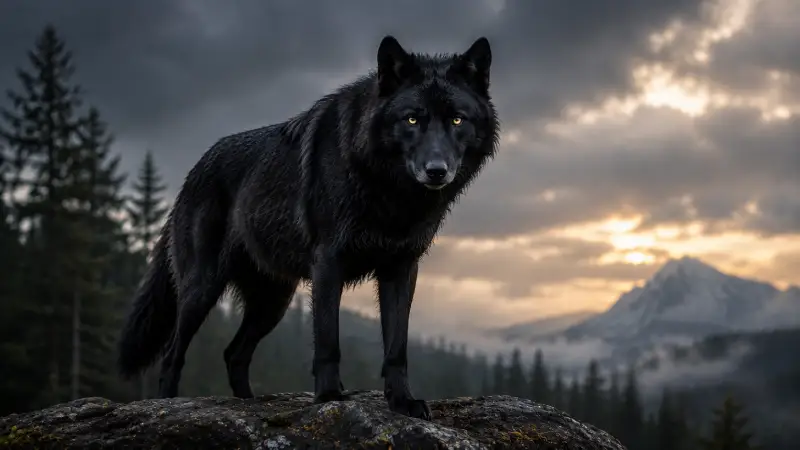
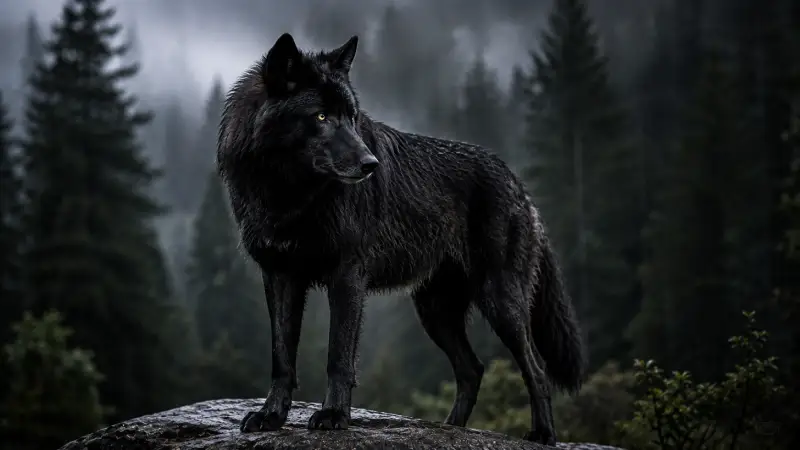
Black wolf symbolism commonly represents strength, mystery, independence, loyalty, protection, resilience, and controlled power. The image combines the social intelligence and endurance associated with wolves with the visual associations people often attach to a dark coat: secrecy, seriousness, the unknown, and strength that does not need to announce itself.
A black wolf is not a separate wolf species. It is generally a gray wolf, Canis lupus, carrying a genetic variant that produces a dark coat. Black wolves are especially familiar to Americans through Yellowstone National Park, where black and gray coat colors both occur and black animals make up a substantial part of the population.
That real biology gives the symbol an additional modern meaning. A black wolf can represent being visibly different while still belonging to the same family, community, or identity.
Quick Answer
Black wolf symbolism most commonly represents quiet strength, mystery, resilience, independence, loyalty, protection, and confidence in being different. In modern American culture, the image is also closely associated with wilderness and Yellowstone, while broader wolf traditions add meanings of family bonds, cooperation, survival, and respect for the wild.
TL;DR
- Black wolves symbolize strength, mystery, resilience, loyalty, and independence.
- Their dark coats add meanings of privacy and the unknown.
- Pack life supports symbolism of family, cooperation, and belonging.
- Solitary dispersal adds independence and self-reliance.
- Yellowstone gives black wolves a strong modern American identity.
- Tattoos often represent survival, protection, individuality, or controlled power.
What a Black Wolf Really Is
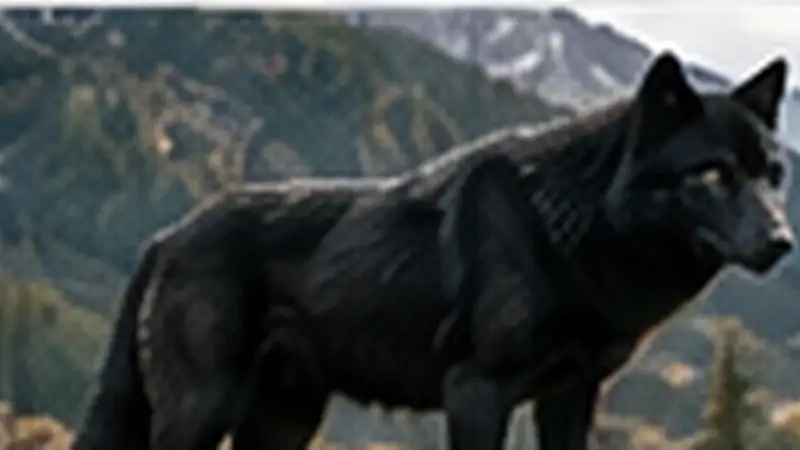
Despite the name, a black wolf is not a separate species comparable to a gray wolf or red wolf.
Black wolves are generally gray wolves whose coats are dark because of a genetic variant at the K-locus, involving the gene CBD103. Yellowstone research found that the black-color allele is dominant over the gray form. Scientists believe the mutation originally developed in domestic dogs and later entered North American wolf populations through ancient wolf-dog hybridization.
In Yellowstone, black wolves are not exceptionally rare. The National Park Service reports that the population contains roughly similar proportions of black and gray animals.
This makes the black wolf symbolically interesting.
Its dark appearance makes it look unusual, but biologically it remains part of the same species and social world as lighter wolves.
That naturally supports symbolism involving difference without separation.
Black Wolf Symbolism: 7 Powerful Core Meanings
| Symbolic Meaning | Wolf Connection | Modern Interpretation |
|---|---|---|
| Strength | Powerful predator and endurance traveler | Confidence and capability |
| Mystery | Dark coat and elusive behavior | Privacy and the unknown |
| Loyalty | Wolves maintain strong social bonds | Family and commitment |
| Independence | Wolves may disperse from natal packs | Self-reliance and personal direction |
| Protection | Pack members defend territory and young | Boundaries and guardianship |
| Resilience | Wolves survive demanding environments | Endurance after hardship |
| Individuality | Black coloration stands out visually | Confidence in being different |
These meanings are modern symbolic interpretations rather than one universal historical belief system.
Black Wolf Symbolism of Quiet Strength
The black wolf is an effective symbol of strength partly because wolves do not depend on dramatic displays every moment.
Wolves travel long distances, defend territories, raise young, hunt large prey, and survive severe winters. In Yellowstone, their major prey includes elk, with wolves also taking deer and occasionally bison.
Yet much of wolf life is not aggressive.
Wolves rest, travel, socialize, investigate scent, care for pups, and coordinate with pack members.
That difference makes the black wolf a useful symbol of power under control.
It can represent someone who:
- knows their abilities without boasting
- remains calm under pressure
- does not respond to every provocation
- acts decisively when necessary
- allows actions to demonstrate strength
The dark coat adds visual seriousness to this meaning.
Instead of loud dominance, black wolf imagery often suggests confidence that remains partially hidden.
Mystery, Darkness, and the Unknown
Black is commonly used in modern American visual culture to suggest mystery, privacy, authority, danger, mourning, sophistication, or the unknown.
When combined with a wolf, those associations become especially strong.
A dark wolf appearing from a forest, moving through snow, or standing at the edge of a landscape naturally suggests something that cannot be completely understood at first glance.
Symbolically, this can represent:
Privacy. Not every part of identity needs to be publicly available.
Hidden ability. Important strengths may not be immediately obvious.
Uncertainty. Some periods of life require moving forward without complete information.
The unknown self. People may possess ambitions, fears, or abilities they have not yet explored.
This is why black wolf symbolism frequently works in dark fantasy, tattoo art, gothic imagery, and psychological symbolism.
Darkness here does not automatically mean evil.
It can simply mean what has not yet been revealed.
Loyalty, Family, and Pack Bonds
One of the strongest broader wolf meanings is family.
Wolf packs are usually family-based social groups rather than random collections of aggressive animals. Yellowstone researchers have documented complex packs built around breeding adults, offspring, and extended family relationships.
That social structure gives black wolf symbolism a meaning of loyalty and belonging.
A black wolf may represent:
- dedication to family
- standing beside trusted people
- cooperation during difficulty
- responsibility toward younger or vulnerable members
- maintaining relationships over time
This meaning creates an important balance with independence.
Wolves can function independently, but their social lives also demonstrate the advantages of cooperation.
Black wolf symbolism therefore does not have to mean choosing solitude over connection.
It can mean being strong enough to stand alone while still valuing the people who belong beside you.
Independence and Walking Your Own Path
Young wolves sometimes leave their natal pack and disperse in search of territory, mates, or opportunities to establish another pack.
That behavior gives wolves a natural connection with independence.
A black wolf can therefore symbolize:
leaving familiar surroundings,
choosing a different path,
building a new identity,
or becoming comfortable without constant approval.
This meaning is particularly strong when artwork shows a single black wolf rather than a pack.
The lone wolf image is often romanticized, however.
Wild wolves are fundamentally social animals even though individuals may spend periods alone during dispersal. Their independence does not mean they are biologically designed to reject all companionship.
As a human metaphor, the most balanced meaning is self-reliance without permanent isolation.
Protection, Boundaries, and Guardianship
Wolves defend territories and protect young, resources, and social groups.
That behavior naturally supports symbolism involving guardianship.
A black wolf can represent protecting:
family,
personal values,
privacy,
home,
or emotional boundaries.
The symbol does not require aggression.
Strong boundaries often work best when they prevent conflict rather than create it.
Someone may choose black wolf imagery because they identify with the idea:
I do not seek confrontation, but I will protect what matters.
This meaning is particularly common in tattoos showing an alert wolf, a wolf standing before pups, or a wolf positioned at the edge of a forest.
Resilience and Survival in Harsh Conditions
Wolves can inhabit environments ranging from forests and mountains to northern tundra and open landscapes.
Yellowstone wolves endure cold winters, territorial conflict, food uncertainty, disease, injuries, and other pressures. The park’s long-running wolf research has documented differences in survival and life history among individuals.
That makes resilience an intuitive black wolf meaning.
The animal can symbolize:
surviving a difficult period,
continuing after loss,
adapting to changing conditions,
or becoming more capable because of experience.
Interestingly, coat color itself has biological implications in Yellowstone. Research has connected the black-coat gene with immune function and found survival differences associated with coat-color genetics, although those relationships involve trade-offs rather than a simple rule that black wolves are biologically “stronger.”
Symbolically, the more useful message is straightforward:
survival often depends on adaptation rather than appearance alone.
Black Wolf Symbolism and Individuality
Black wolves provide an unusually grounded metaphor for individuality.
They look dramatically different from many gray-coated wolves, but the difference is largely a variation of coat color within the same species.
That creates a modern symbolic idea of belonging without looking identical.
Someone may connect with a black wolf because they feel:
different from their family,
unusual within a community,
independent in taste or personality,
or comfortable rejecting conventional expectations.
The black wolf does not have to leave the pack simply because its coat is different.
That makes it a particularly useful symbol for people who want to express individuality without rejecting connection.
Difference can exist inside belonging.
Black Wolf Symbolism in Indigenous Cultural Contexts
Claims about “Native American black wolf symbolism” require special caution.
There is no single Native American wolf belief shared across hundreds of distinct Indigenous nations.
Wolf traditions vary by community, language, geography, ceremony, and oral history.
One well-documented example is the Quileute Nation of Washington State. The Smithsonian’s National Museum of the American Indian created an exhibition specifically to correct popular misconceptions about Quileute wolf traditions after those traditions were heavily fictionalized in the Twilight series. The exhibition included historical wolf headdresses, oral traditions, artwork, and information presented in cooperation with Quileute cultural perspectives.
That example demonstrates why broad claims should be avoided.
A Quileute wolf tradition belongs to the Quileute people. It does not establish a universal Indigenous meaning for every wolf, much less every black wolf.
Modern claims that “Native Americans believed black wolves always symbolized spiritual protection” should therefore be treated cautiously unless tied to a specific documented community.
Black Wolf Symbolism in Modern American Culture
In the United States, black wolf imagery has a particularly strong connection with the American West.
Yellowstone is central to that association.
Wolves were systematically eliminated from Yellowstone during the early twentieth century. After decades of policy changes, research, public debate, and conservation planning, wolves were reintroduced beginning in 1995. Thirty-one Canadian wolves were brought to Yellowstone in 1995 and 1996, and the restored population later expanded across the Greater Yellowstone Ecosystem.
Because black-coated animals are conspicuous within Yellowstone’s population, wildlife photography has made the black wolf a recognizable image of American wilderness.
Today it can symbolize:
the Rocky Mountain West,
wild landscapes,
predator restoration,
ecological recovery,
and the return of animals once removed by people.
This is a distinctly modern American meaning.
Conservation and the Symbolism of Return
Few modern American animal stories changed public attitudes toward wolves as dramatically as Yellowstone restoration.
Wolves disappeared from the park after organized predator-control campaigns. Decades later, the United States deliberately returned them as part of an effort to restore a native predator and ecological processes.
That history gives black wolf symbolism another meaning: return after absence.
It can represent:
restoration,
second chances,
reclaiming lost identity,
or returning to a place where something important had disappeared.
This is different from ordinary resilience.
Resilience means surviving.
Restoration means coming back after something has been lost.
For modern conservation-minded Americans, that meaning can be as important as the wolf’s traditional associations with power or wilderness.
Black Wolf Symbolism in Tattoos
Black wolves are especially suited to tattoo art because their natural coloration works well with black-and-gray ink.
Common meanings include:
Strength. Confidence that does not depend on attention.
Loyalty. Commitment to family or chosen community.
Independence. Following one’s own direction.
Protection. Defending loved ones and boundaries.
Survival. Continuing after hardship.
Mystery. Keeping part of one’s identity private.
Individuality. Being visibly different without apology.
A lone black wolf can emphasize self-reliance.
Two wolves can symbolize partnership or loyalty.
A wolf with pups may represent parenthood and protection.
A black wolf surrounded by mountains or pine forest strengthens wilderness and American West associations.
A moon can add mystery, although the familiar image of wolves “howling at the moon” is more artistic than biological. Wolves howl primarily as communication, not because the moon itself causes the behavior.
Spiritual Meaning of Black Wolf Symbolism
In contemporary spiritual culture, the black wolf is often interpreted as a symbol of intuition, protection, transformation, inner strength, independence, or moving through uncertainty.
These meanings can be useful as personal metaphors, but they should not be presented as universal spiritual laws.
Seeing a black wolf does not objectively predict:
death,
romance,
money,
betrayal,
or a supernatural transformation.
A grounded symbolic interpretation might instead use the animal as a reminder to:
trust experience,
remain aware of surroundings,
protect important relationships,
accept periods of uncertainty,
or stop hiding a strength merely because it makes you different.
The black wolf works particularly well as a symbol of moving confidently through situations that are not fully understood.
Positive and Negative Meanings of Black Wolf Symbolism
Black wolf imagery can have both constructive and cautionary meanings.
Positive meanings
Strength: knowing what you are capable of.
Loyalty: remaining committed to important relationships.
Independence: functioning without excessive approval.
Protection: defending meaningful boundaries.
Resilience: surviving difficult circumstances.
Individuality: being comfortable with difference.
Mystery: maintaining a private inner life.
Negative meanings
Isolation: refusing healthy relationships.
Aggression: using strength unnecessarily.
Secrecy: hiding what should be communicated.
Distrust: treating everyone as a possible threat.
Dominance: confusing leadership with control.
Fear: allowing the unknown to become automatically threatening.
The same quality can move between positive and negative depending on degree.
Privacy can be healthy.
Complete emotional withdrawal may not be.
Independence can create confidence.
Refusing all support can create unnecessary isolation.
Common Misunderstandings About Black Wolf Symbolism
One misconception is that black wolves are a separate species.
They are not. In Yellowstone, black and gray individuals are members of the gray wolf species, and the dark coat is associated with a particular genetic variant.
Another mistake is treating black wolves as exceptionally rare everywhere.
They are uncommon in some wolf populations, but Yellowstone has a notably high proportion of black-coated wolves.
A third misconception is assuming every Indigenous culture assigned the black wolf the same spiritual meaning.
Indigenous wolf traditions are culturally specific. The Smithsonian’s work with Quileute wolf traditions illustrates exactly why those differences matter.
Finally, the “lone wolf” image should not erase real wolf biology.
Wolves are highly social animals. Temporary solitude and dispersal exist within a larger life history that often includes family groups and cooperative living.
How Black Wolf Symbolism Has Evolved
Black wolf meaning developed from several overlapping layers.
The first layer comes from the wolf itself: a social predator capable of cooperation, endurance, territorial defense, and independent movement.
Specific Indigenous peoples developed their own wolf traditions long before modern American popular culture, but those meanings belong to individual cultures rather than one universal system.
European-American history added another layer by portraying wolves alternately as dangerous predators, wilderness animals, competitors, and eventually conservation subjects.
The near-removal of wolves from much of the United States made the animal a symbol of lost wilderness.
Yellowstone restoration then changed the story again. Wolves returned in 1995, creating one of the most closely watched wildlife restoration projects in modern American history.
Genetics added an unexpected final layer.
Scientists discovered that Yellowstone’s black coat is linked to a mutation probably inherited through ancient hybridization between wolves and domestic dogs.
Today the black wolf can therefore symbolize wilderness and human history at the same time.
Its appearance carries both wild ancestry and evidence of an ancient relationship between wolves, dogs, and people.
Frequently Asked Questions
What does a black wolf symbolize spiritually?
A black wolf commonly symbolizes protection, mystery, resilience, independence, loyalty, and inner strength in modern spiritual interpretation. These meanings are contemporary symbolic frameworks rather than one universal religious tradition.
Is a black wolf a real wolf?
Yes. Black-coated gray wolves are real, and Yellowstone has a particularly visible population. Their dark coloration is associated with a dominant genetic variant at the K-locus.
What does a black wolf tattoo symbolize?
A black wolf tattoo commonly represents strength, survival, independence, loyalty, protection, mystery, or individuality. A lone wolf emphasizes self-reliance, while multiple wolves can strengthen themes of family and belonging.
Does a black wolf symbolize protection?
It can. Wolves defend territories and care for their young, making protection a natural modern interpretation; black coloration often adds a visual sense of seriousness, warning, or hidden strength.
What does seeing a black wolf mean?
Seeing a black wolf has no scientifically established supernatural meaning. Someone may personally interpret the encounter as a reminder to stay alert, value individuality, protect important relationships, or remain confident during uncertainty.
Are black wolves more aggressive than gray wolves?
Black coat color does not simply mean greater aggression. Yellowstone research has actually found behavioral and fitness differences connected with coat color, including evidence that gray wolves can show greater aggression during territorial conflict in some observations.
Is black wolf symbolism positive or negative?
It can be either. Positive meanings include strength, resilience, loyalty, independence, and protection, while negative interpretations may involve isolation, secrecy, aggression, fear, or distrust.
Conclusion
Black wolf symbolism most naturally combines strength, mystery, loyalty, independence, protection, resilience, and confidence in being different. The symbolism works particularly well because a black wolf is not another species, it is a striking variation within the gray wolf itself.
Its American meaning has become especially connected with Yellowstone. Black wolves now move through a landscape where their species was once eliminated and later deliberately restored, adding themes of return, conservation, and recovery to an already complex symbol.
The black wolf ultimately offers a grounded message: difference does not require isolation, strength does not require constant aggression, and belonging does not require everyone to look or move through the world in exactly the same way.