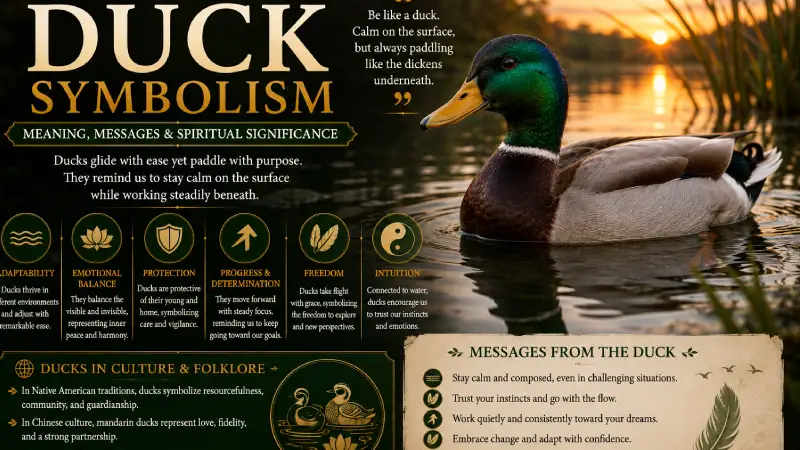
Duck symbolism most commonly represents adaptability, emotional balance, family, community, resourcefulness, protection, transition, love, and moving calmly through change. These meanings fit birds that comfortably move between water, land, and air and can adjust to habitats ranging from natural wetlands to city parks.
Ducks do not have one universal symbolic meaning. A mother duck with ducklings naturally suggests caregiving and family, a migrating flock can represent transition and shared direction, and a pair of mandarin ducks has a specific historical connection with marriage and fidelity in East Asian art.
For a U.S. audience, the mallard provides a familiar biological reference point. Mallards are widespread dabbling ducks found across North America in wetlands, ponds, rivers, agricultural landscapes, and urban environments. Their flexibility helps explain why adaptability sits at the center of modern duck symbolism.
Quick Answer
Duck symbolism most commonly represents adaptability, emotional balance, family, community, protection, love, and navigating change with flexibility. Ducks move between water, land, and air, while many populations migrate seasonally. Specific traditions add other meanings: paired mandarin ducks represent marital happiness and fidelity in East Asian art, while some ancient Egyptian duck amulets were associated with food offerings and, in certain forms, renewal.
TL;DR
- Ducks commonly symbolize adaptability, balance, family, and community.
- Water strengthens modern meanings involving emotion and flexibility.
- Migration can represent transition, return, and changing life stages.
- Mother ducks add protection, caregiving, and family symbolism.
- Mandarin ducks historically represent marital bliss and fidelity in East Asian art.
- Duck tattoos can represent love, resilience, freedom, or family.
- A duck encounter is not scientifically a prediction of future events.
Duck Symbolism: 9 Powerful Core Meanings
| Meaning | Duck Connection | Modern Interpretation |
|---|---|---|
| Adaptability | Ducks function on water, land, and in air | Adjusting to change |
| Emotional balance | Strong association with water | Handling feelings without becoming overwhelmed |
| Family | Females care for ducklings | Nurturing and protection |
| Community | Ducks often gather in groups | Belonging and cooperation |
| Transition | Many ducks migrate seasonally | Moving into another life stage |
| Resourcefulness | Mallards use many habitats and foods | Making the best of circumstances |
| Love | Paired mandarin ducks in East Asian art | Partnership and affection |
| Protection | Mothers guide and defend young | Looking after vulnerable people |
| Calm progress | Ducks appear to glide steadily across water | Moving forward without unnecessary drama |
These are broad interpretations. Historical meanings should always be connected to the specific culture that produced them.
What Ducks Are and Why They Became Symbolic
Ducks belong to the waterfowl family Anatidae, alongside geese and swans.
They are not all biologically alike. Some are dabbling ducks, feeding mainly near the surface, while others dive underwater for food. Mallards are dabblers: they commonly tip forward with the tail pointing upward while reaching submerged vegetation and other foods.
Mallards can occupy an unusually wide range of habitats, including marshes, lakes, ponds, reservoirs, floodplains, farms, estuaries, roadside ditches, and city parks. They also eat varied foods, from vegetation and seeds to aquatic invertebrates.
That flexibility makes the duck a particularly strong symbol of living successfully in changing conditions.
Duck Symbolism of Adaptability
Adaptability is one of the most grounded duck meanings.
A duck can swim.
It can walk on land.
Most species can fly.
Many migrate between seasonal habitats.
Mallards take that versatility even further by living successfully around both wild wetlands and heavily human-modified environments. The U.S. Fish and Wildlife Service describes the mallard as North America’s most abundant duck and notes that it occurs in virtually every kind of freshwater habitat.
As a human metaphor, duck symbolism may represent adapting to:
a new job,
a different city,
a changing family situation,
financial uncertainty,
or unfamiliar social surroundings.
The useful message is not to change who you are every time conditions change.
It is to change your method while keeping your direction.
Water and Emotional Balance
Water dominates duck imagery.
That makes emotional balance one of the most popular modern interpretations.
Water is frequently used metaphorically for emotion because it moves, changes depth, becomes calm, and becomes turbulent. Ducks are comfortable within that constantly changing environment.
A duck floating on water can therefore symbolize feeling emotions without being controlled by every emotional shift.
It may represent:
remaining calm during uncertainty,
allowing feelings to pass,
or learning how to function even when life feels emotionally complicated.
The symbolism comes from human interpretation rather than duck biology assigning spiritual meaning to water.
Still, the image works naturally.
The duck does not need the water to remain perfectly still before it moves forward.
Duck Symbolism of Family and Motherhood
A female mallard handles most of the visible parental care.
Mallard pairs can form before the breeding season, but the female incubates the eggs and cares for the ducklings. Newly hatched ducklings are highly developed and can leave the nest very quickly, yet they continue following their mother for protection and guidance.
That familiar image gives mother-duck symbolism strong associations with:
caregiving,
guidance,
family responsibility,
and protecting young people while allowing them to develop independence.
A mother duck followed by ducklings is especially appropriate as a symbol of leadership through example.
The young do not remain physically attached to her.
They follow.
That creates a useful image of parenting as guidance rather than permanent control.
Protection and Guiding the Vulnerable
Protection follows naturally from family symbolism.
A mother duck must guide her brood through an environment containing predators, changing water, roads, people, and other hazards.
The symbolic meaning is softer than the protection associated with a bear, cobra, or Doberman.
Duck protection is less about intimidation.
It is more about:
keeping vulnerable individuals together,
finding a safe route,
remaining attentive,
and leading others through danger.
This makes duck symbolism particularly suitable for parents, teachers, older siblings, caregivers, or anyone responsible for helping less experienced people navigate unfamiliar conditions.
Community, Flocks, and Belonging
Ducks often gather together, particularly outside the nesting period and during migration.
U.S. wildlife refuges can host large concentrations of waterfowl during seasonal movements, providing places where migrating birds feed and rest before continuing their journey.
That gives ducks a modern association with community.
A flock can represent:
belonging,
shared direction,
social support,
and the safety of moving through difficult conditions with others.
However, community does not mean permanent togetherness.
Migration itself shows that relationships and groups can change with season and circumstance.
Duck symbolism can therefore express a balanced idea:
belong somewhere without believing you must remain there forever.
Migration, Transition, and Moving On
Many North American mallards migrate.
The U.S. Fish and Wildlife Service notes that while mallards occur year-round across much of North America, many northern breeders move south to the southern United States and Mexico for winter before returning north.
Migration naturally supports symbolism involving:
transition,
journey,
return,
timing,
and knowing when circumstances require movement.
This meaning can be especially relevant during:
graduation,
relocation,
career changes,
retirement,
or leaving a relationship.
Migration is not random wandering.
The bird moves because conditions change.
That makes duck symbolism a useful reminder that leaving one place is not always rejection, it can be an appropriate response to a changing season.
Returning Home and Finding Your Way Back
Migration also adds another meaning: return.
Some duck populations repeatedly move between breeding and wintering regions as seasons change.
That cycle can symbolize returning to:
family,
home,
personal values,
or something important that was temporarily left behind.
Not every journey requires permanent separation from the starting point.
Sometimes distance helps clarify what deserves to remain part of life.
For people who have moved away from their hometown, culture, or family, migratory waterfowl can become meaningful symbols of having more than one place that feels like home.
Resourcefulness and Making Use of What Is Available
Mallards are generalist feeders.
They consume aquatic plants, seeds, invertebrates, agricultural grain, and other available foods depending on season and habitat. Their ability to use artificial wetlands, farms, and urban parks further demonstrates their ecological flexibility.
That makes ducks natural symbols of resourcefulness.
Resourcefulness means working intelligently with what exists rather than waiting endlessly for ideal conditions.
It can involve:
using existing skills differently,
making limited resources stretch farther,
or finding opportunity in a situation that initially appears inconvenient.
The duck’s modern symbolic message is not merely “go with the flow.”
It is:
understand the environment well enough to know how to function within it.
Calmness on the Surface
One of the most popular visual ideas attached to ducks is calm movement across water.
A swimming duck can appear almost effortless from above.
That image has produced a modern metaphor for maintaining outward calm while continuing to work toward a goal.
The metaphor should not be mistaken for literal duck psychology.
Still, it makes effective symbolism.
Calmness does not mean inactivity.
Someone can remain composed while still:
planning,
working,
adjusting,
and making steady progress.
Duck symbolism therefore suits people who value quiet competence over dramatic displays of effort.
Duck Symbolism in Chinese Culture
One of the most clearly documented historical meanings involving ducks comes from China.
Mandarin ducks, particularly when shown as a pair, became long-standing symbols of marital happiness and fidelity.
The Metropolitan Museum of Art holds Tang dynasty gold comb tops from the eighth century decorated with paired mandarin ducks and identifies them specifically as symbols of marital fidelity.
The symbolism continued for centuries.
A Ming dynasty dish featuring mandarin ducks and lotus flowers uses the birds to express marital fidelity, while the combination of ducks and lotuses communicates harmony between spouses.
Paired duck imagery could therefore appear on:
wedding gifts,
decorative objects,
and artworks celebrating marriage.
This is much more historically defensible than claiming that every duck everywhere represents romance.
Mandarin Duck Symbolism and Love
Mandarin ducks deserve separate treatment because their romantic symbolism has become internationally recognizable.
A late-fifteenth-century Chinese painting by Lü Ji uses paired mandarin ducks to represent a happy marriage, with surrounding flowers reinforcing wishes for prosperity for the bride and groom.
In East Asian decorative arts, mandarin ducks also represent marital bliss, affection, and fidelity. Japanese lacquer objects adopted the same auspicious imagery.
There is an important caution.
This historical symbolism should not be converted into the biological claim that all ducks mate for life.
Mallards, for example, form seasonal pair bonds, and the female alone handles incubation and duckling care.
So romantic duck symbolism is culturally real, but it should not be generalized as universal duck behavior.
Duck Symbolism in Japanese Art
Mandarin duck imagery also appears in Japanese decorative culture.
An eighteenth-century Japanese incense container at the Met depicts two mandarin ducks beneath a camellia tree. The museum explains that mandarin ducks in East Asia represented an ideal couple, marital fidelity, and conjugal affection.
A later pair of Japanese incense boxes in the shape of mandarin ducks likewise carries associations with marital bliss and weddings.
In this context, duck symbolism emphasizes:
partnership,
affection,
endurance through difficulty,
and harmony between spouses.
Again, this meaning belongs primarily to paired mandarin ducks, not to every duck image in Japanese art.
Duck Symbolism in Ancient Egypt
Duck imagery also appears in ancient Egyptian material culture, but its meaning was different from East Asian marriage symbolism.
A Late Period or Ptolemaic duck-shaped object documented through the British Museum’s Naukratis project was probably an amulet or pendant. Museum commentary notes that Egyptian duck amulets were often interpreted as representations of food offerings.
In some examples where the duck is shown with its head turned backward in a resting or sleeping position, scholars have interpreted that sleeping pose as carrying a possible idea of reawakening and resurrection.
The museum also makes clear that the precise function of every duck amulet is not certain.
That uncertainty matters.
Ancient Egyptian duck symbolism should therefore be described as potentially involving food provision and, in particular forms, reawakening, not reduced to a single invented meaning.
Duck Symbolism of Abundance and Provision
The Egyptian food-offering context helps explain another possible duck meaning: provision.
Ducks have long been hunted, domesticated, and used for food. The mallard is also the wild ancestor behind most domestic duck breeds.
That gives duck symbolism a practical relationship with:
food,
household provision,
and material resources.
This meaning differs from luxury or sudden wealth.
Like chicken symbolism, duck abundance is often more grounded.
It can represent having what is needed and maintaining resources through changing seasons.
Duck Colors and Their Symbolic Meanings
Color changes how modern viewers interpret duck imagery.
White Duck Symbolism
White ducks commonly suggest peace, innocence, simplicity, purity, and calm.
These meanings come mainly from broader modern color symbolism.
Black Duck Symbolism
A black duck can suggest mystery, independence, protection, seriousness, or individuality.
Black does not automatically mean death or misfortune.
Green-Headed Mallard Symbolism
The iridescent green head of the male mallard can add modern associations with growth, vitality, prosperity, nature, and confidence.
Male mallards are particularly recognizable because of that glossy green head.
Brown Duck Symbolism
Brown ducks often suggest grounding, home, practicality, modesty, and stability.
The mottled brown plumage of female mallards also provides effective concealment around nesting habitats.
Yellow Duckling Symbolism
Yellow ducklings are strongly associated in modern culture with childhood, innocence, happiness, playfulness, and new beginnings.
These color meanings are human interpretations rather than fixed messages inherent in the birds.
Duckling Symbolism
Ducklings shift the symbolism toward new life.
They commonly represent:
innocence,
beginnings,
dependence,
learning,
and family.
Mallard ducklings hatch alert and covered in down and can leave the nest within hours.
This makes them especially interesting symbols of early independence with continued guidance.
They are capable surprisingly quickly, but they still remain with their mother.
For human life, that can represent the stage when someone begins doing things independently while still benefiting from experience, protection, or mentorship.
Spiritual Meaning of Duck Symbolism
In contemporary spirituality, duck symbolism often represents:
emotional balance,
adaptability,
family,
transition,
intuition,
and remaining calm while circumstances change.
Some of these meanings draw naturally from the duck’s close relationship with water and its flexible movement between environments.
Others come from specific cultural traditions, such as East Asian mandarin-duck symbolism of marriage and harmony.
Seeing a duck does not scientifically predict:
money,
marriage,
pregnancy,
death,
or good luck.
A grounded spiritual interpretation is to use the encounter as a prompt:
Where do I need to adapt?
Am I resisting a transition whose season has already arrived?
Which relationships deserve more care?
Can I move through emotional uncertainty without losing direction?
That preserves symbolic meaning without turning ordinary wildlife into fortune-telling.
Is Seeing a Duck a Good Sign?
In modern symbolism, ducks are usually interpreted positively.
They commonly suggest:
family,
adaptability,
calmness,
and forward movement.
Paired mandarin ducks have an especially positive historical meaning connected with marital happiness in East Asian art.
But an ordinary duck encounter is not an objectively good or bad omen.
Its personal meaning depends on context.
Seeing a mother with ducklings may evoke family.
Watching a migrating flock may evoke change.
A pair may suggest partnership.
A solitary duck may suggest independence.
The encounter becomes meaningful because of the connection you make, not because the animal predicts what happens next.
Duck Dream Meaning
Duck dreams can be interpreted metaphorically, but dreams do not provide reliable predictions.
Dreaming of Ducks Swimming
Swimming ducks may represent moving through emotional circumstances while maintaining direction.
Dreaming of Flying Ducks
Flying ducks can suggest freedom, transition, travel, or deciding that it is time to move on.
Dreaming of Ducklings
Ducklings may represent something new and vulnerable that needs guidance.
Dreaming of Two Ducks
Two ducks may suggest partnership or companionship. If they are specifically mandarin ducks, the image has a documented East Asian connection with marital happiness.
Dreaming of a White Duck
A white duck may reflect modern associations with peace, simplicity, or emotional calm.
Dreaming of a Dead Duck
A dead duck can symbolically suggest the end of a period of adaptability, a disrupted relationship, or difficulty navigating change. It does not predict literal death.
The best interpretation starts with the dreamer’s actual circumstances.
Duck Symbolism in Tattoos
Duck tattoos can carry surprisingly different meanings depending on the species and design.
Common interpretations include adaptability, family, freedom, migration, love, resilience, and connection with water or nature.
A mallard tattoo may emphasize wilderness, hunting culture, wetlands, personal independence, or familiarity with North American wildlife.
A mother duck with ducklings strongly suggests family, parenting, and protection.
A pair of mandarin ducks can deliberately reference marital love and fidelity within East Asian symbolism.
A flying duck may represent freedom or transition.
A duck on calm water can communicate emotional balance.
Dates, names, or flowers can turn the design toward remembrance or personal milestones.
The wearer’s own reason remains more important than a generic tattoo dictionary.
Duck Symbolism in Modern American Culture
Ducks occupy several overlapping roles in American culture.
They are familiar park animals.
They are also major wetland wildlife, migratory birds, hunting species, domestic animals, cartoon characters, and symbols associated with childhood.
The mallard is particularly influential because it is widespread and abundant throughout North America.
That familiarity produces a softer symbolic personality than animals such as wolves, bears, or snakes.
Duck imagery can feel:
friendly,
domestic,
peaceful,
humorous,
or family-oriented.
At the same time, wild migration and wetland ecology add deeper themes of endurance, seasonal change, and habitat dependence.
Duck Symbolism and Wetlands
Ducks cannot be separated symbolically from wetlands.
Waterfowl depend on marshes, ponds, lakes, floodplains, and other aquatic environments for feeding, resting, breeding, or migration. U.S. wildlife refuges often provide critical stopover habitat for migrating ducks.
That adds a modern environmental meaning to duck symbolism:
interdependence.
A migrating duck may travel enormous distances, but it still depends on suitable places to rest and feed along the route.
For human symbolism, this offers a useful lesson.
Independence does not mean needing nothing.
Even strong travelers need safe places to stop.
Positive and Negative Meanings of Duck Symbolism
Positive meanings
Adaptability: responding intelligently to changing conditions.
Family: caring for and guiding others.
Love: partnership and marital harmony in specific traditions.
Community: moving with supportive groups.
Transition: recognizing when it is time to move.
Calmness: maintaining direction through emotional conditions.
Resourcefulness: using what an environment provides.
Protection: helping vulnerable people reach safety.
Negative or cautionary meanings
Avoidance: floating along without addressing an important problem.
Overdependence: relying too heavily on a group.
Restlessness: constantly moving without building stability.
Emotional suppression: appearing calm while refusing to acknowledge real feelings.
Conformity: following a group even when another direction would be healthier.
The symbol becomes more useful when both sides are recognized.
Adaptability is valuable.
Changing yourself endlessly to satisfy everyone else is different.
Duck vs. Swan Symbolism
Duck and swan symbolism both involve water, relationships, and graceful movement, but they usually carry different emotional tones.
Duck symbolism tends to emphasize:
adaptability,
family,
resourcefulness,
community,
and practical movement through change.
Swan symbolism is more commonly associated with:
beauty,
elegance,
romance,
and transformation.
The duck feels more ordinary and practical.
That is part of its symbolic strength.
It represents living well within everyday changing circumstances rather than appearing extraordinary.
Common Misunderstandings About Duck Symbolism
One common mistake is claiming all ducks mate for life.
They do not.
Mandarin ducks became powerful symbols of fidelity in East Asian art, but mallard pair bonds are seasonal, and females handle incubation and duckling care.
Another mistake is claiming every duck represents romantic love.
That interpretation is especially well documented for paired mandarin ducks, not every duck species or culture.
Another misconception is saying ancient Egyptian duck amulets had one certain spiritual meaning. Museum evidence suggests food offerings were important, and certain resting forms have been interpreted in relation to reawakening, but individual objects can remain ambiguous.
It is also inaccurate to say all ducks migrate. Some mallards remain year-round where adequate resources are available, while others undertake seasonal movements.
Finally, seeing a duck does not guarantee marriage, pregnancy, wealth, or another future event.
Symbolism is interpretation, not prediction.
How Duck Symbolism Has Evolved
Duck symbolism began with real human observation.
Water made ducks natural images of emotional and environmental flexibility.
Flight and migration added movement and transition.
Ducklings added parenting and family.
Their ability to use several habitats encouraged modern meanings of adaptability and resourcefulness.
Specific cultures created more specialized meanings.
Ancient Egyptian duck-shaped amulets could represent food provision, with certain resting forms linked by scholars to reawakening.
Chinese art made paired mandarin ducks enduring symbols of marital happiness and fidelity as early as at least the Tang dynasty, and that symbolism later appeared broadly across East Asian decorative arts.
Modern American culture added city-park familiarity, wetland conservation, hunting traditions, children’s imagery, tattoos, and personal spirituality.
The result is a remarkably versatile symbol.
A duck can represent love when paired, family when surrounded by ducklings, transition when migrating, emotional balance when swimming, and adaptability simply by being what a duck naturally is.
Frequently Asked Questions
What does a duck symbolize spiritually?
A duck commonly symbolizes adaptability, emotional balance, family, transition, resourcefulness, and community in modern spiritual interpretation. Paired mandarin ducks add a culturally specific historical meaning of marital happiness and fidelity.
Is seeing a duck a good sign?
Many people interpret ducks positively because they suggest adaptability, family, calm movement, and transition. There is no scientifically established supernatural omen attached to seeing one.
What do two ducks symbolize?
Two ducks can generally suggest companionship or partnership. In Chinese and wider East Asian art, paired mandarin ducks specifically represent marital bliss, conjugal affection, and fidelity.
What does a duck tattoo symbolize?
A duck tattoo can represent adaptability, freedom, family, migration, nature, or emotional balance. Mandarin duck pairs may intentionally symbolize romantic commitment or marriage.
What does a white duck symbolize?
In modern color symbolism, a white duck commonly represents peace, simplicity, innocence, calm, or a fresh beginning. This is a contemporary interpretation rather than a universal historical rule.
What does a mother duck symbolize?
A mother duck commonly represents protection, caregiving, leadership, and family. Female mallards incubate their eggs and guide the young after hatching.
Why do ducks symbolize adaptability?
Ducks can function across water, land, and air, while species such as mallards successfully occupy habitats ranging from wild marshes to farms and city parks.
Conclusion
Duck symbolism most naturally represents adaptability, emotional balance, family, community, resourcefulness, protection, transition, love, and steady movement through change. These meanings begin with real characteristics: ducks navigate different environments, many move seasonally between habitats, and familiar species such as mallards can thrive across both wild wetlands and human landscapes.
Cultural history adds more specific meanings. Paired mandarin ducks became enduring symbols of marital happiness and fidelity across East Asian art, while some ancient Egyptian duck amulets were associated with food provision and, in certain resting forms, possible reawakening symbolism.
The strongest modern message is simple: you do not need perfect conditions to keep moving. Like a duck shifting between water, land, and air, adaptability means understanding where you are, using what the environment offers, and knowing when the season has arrived to move in a new direction.