Meta Description: Explore cobra symbolism, from protection and power to rebirth, ancient Egypt, Indian traditions, tattoos, spiritual meaning, and modern use.
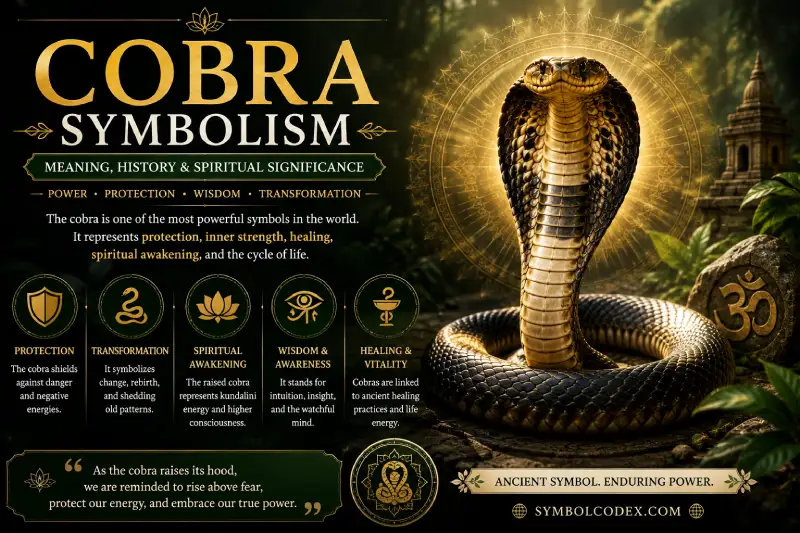
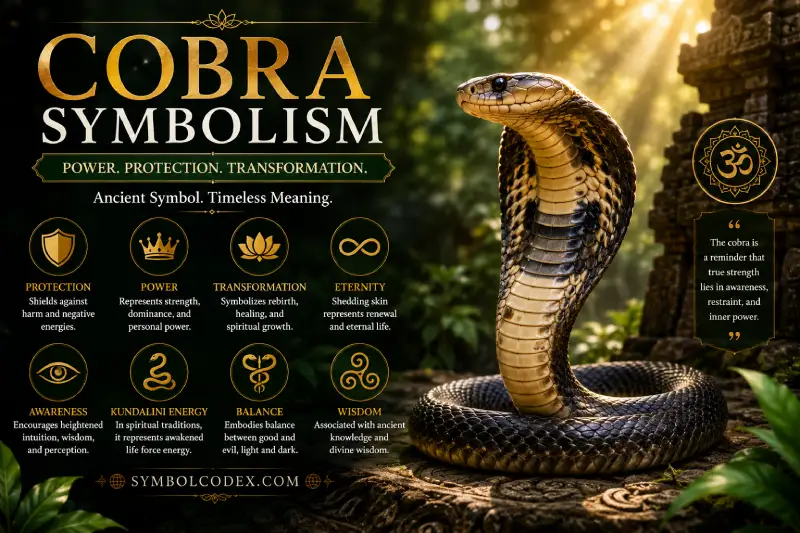
Cobra symbolism most commonly represents protection, power, transformation, vigilance, authority, courage, hidden danger, renewal, and controlled strength. The cobra’s ability to rise, spread its hood, and create an unmistakable warning display has made it one of the world’s most visually powerful snake symbols.
Its meaning also has genuine historical depth. In ancient Egypt, the rearing cobra or uraeus represented royal authority and divine protection, especially through the goddess Wadjet. Across South Asian religious art, cobra-hooded serpent beings known as nagas became associated with water, fertility, protection, abundance, and sacred guardianship. These traditions are distinct and should not be merged into one vague “ancient cobra meaning.”
Modern cobra symbolism adds personal meanings such as maintaining firm boundaries, knowing when to defend yourself, and possessing strength without using it recklessly.
Quick Answer
Cobra symbolism most commonly represents protection, authority, transformation, vigilance, courage, renewal, and power held under control. Ancient Egyptian cobra imagery strongly represented royalty and protection, while cobra-hooded nagas in South Asian traditions can symbolize guardianship, water, fertility, abundance, and sacred power.
TL;DR
- Cobras commonly symbolize protection, power, vigilance, and authority.
- Their expanded hood represents warning and firm boundaries.
- Shedding skin adds transformation and renewal symbolism.
- Egyptian uraei represented royalty and divine protection.
- South Asian nagas connect serpents with protection, water, and abundance.
- Cobra tattoos often symbolize strength, survival, or controlled danger.
What Is a Cobra?
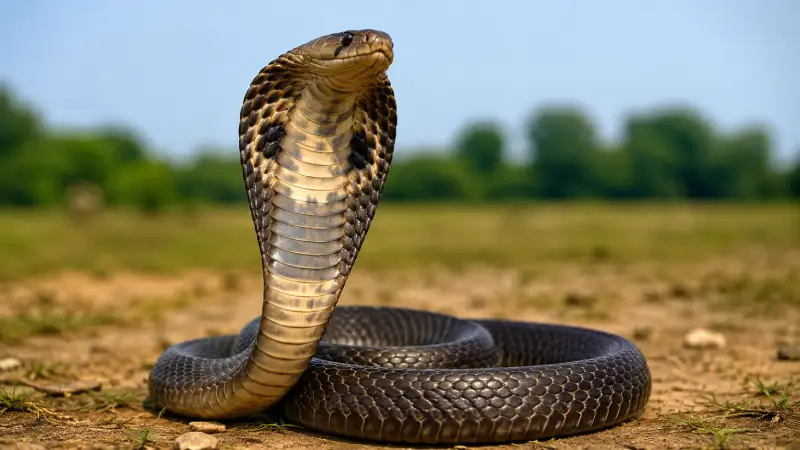
“Cobra” refers to several venomous snakes, especially species in the genus Naja. The famous king cobra belongs to a different genus, Ophiophagus, despite its common name.
What visually unites cobra imagery is the hood.
When threatened, cobras can raise the front portion of their body and expand elongated ribs in the neck, stretching the skin into the distinctive hood people recognize immediately. Indian cobras use this defensive posture when threatened, while king cobras can also rise substantially off the ground and flatten the neck into a hood.
The display is important symbolically because it communicates something before physical force is used.
The snake is effectively saying:
You are too close.
That makes boundaries and warning central to cobra symbolism.
Cobra Symbolism: 9 Powerful Core Meanings
| Meaning | Cobra Connection | Modern Interpretation |
|---|---|---|
| Protection | Defensive hood display | Guarding what matters |
| Power | Venom and imposing posture | Personal authority |
| Vigilance | Highly responsive to threats | Awareness and preparedness |
| Boundaries | Warns before escalating | Knowing when to say no |
| Transformation | Snakes shed outer skin | Personal renewal |
| Courage | Faces threats with dramatic display | Standing your ground |
| Authority | Egyptian royal cobra imagery | Leadership and status |
| Sacred guardianship | Cobra-hooded nagas protect sacred spaces | Spiritual protection |
| Hidden danger | Can remain inconspicuous until threatened | Respecting unseen risks |
The exact interpretation depends heavily on culture and context.
Cobra Symbolism of Protection
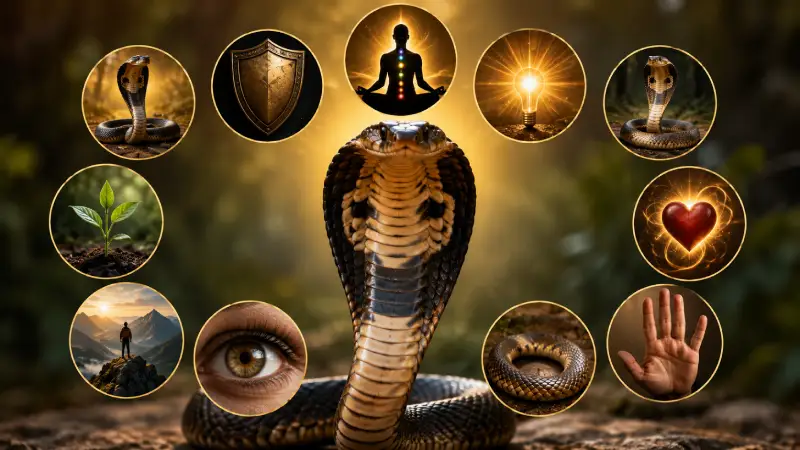
Protection is one of the strongest documented cobra meanings.
A cobra’s defensive display is visually unmistakable. It lifts itself, widens its hood, and may hiss before resorting to a strike.
That sequence creates a useful metaphor for protection with warning.
Someone drawn to cobra symbolism may identify with:
- protecting family
- defending personal boundaries
- recognizing danger early
- refusing intimidation
- remaining peaceful until defense becomes necessary
This is different from symbolism based on constant aggression.
Smithsonian information on king cobras notes that despite their dangerous reputation, they generally prefer escape when possible and tend to attack humans when cornered, defending themselves, or protecting eggs.
That makes the cobra especially appropriate as a symbol of power that does not need to attack first.
Warning, Boundaries, and the Cobra Hood
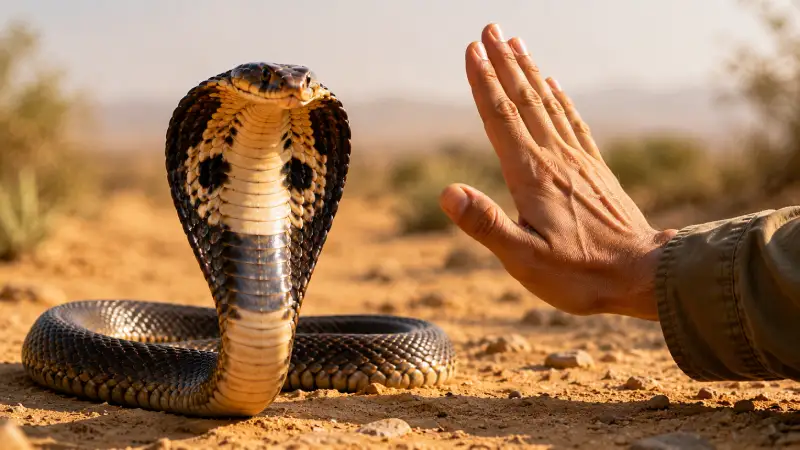
The hood deserves its own symbolic meaning.
Many animals defend themselves.
Few create such a clear visual transformation before doing so.
A relaxed cobra can suddenly become tall, wide, and intimidating. That change communicates that a boundary has been crossed.
In personal symbolism, this can represent learning to communicate limits before resentment becomes overwhelming.
Healthy cobra symbolism can mean:
Speak clearly before conflict escalates.
It may appeal to someone who has learned that constant accommodation eventually becomes harmful.
The cobra does not need to be interpreted as hostile.
Its display can instead represent making consequences visible.
That gives cobra imagery unusual relevance to discussions of assertiveness, self-respect, and emotional boundaries.
Power and Controlled Strength
Cobras naturally communicate power because they are venomous predators.
Yet symbolic power becomes more interesting when restraint is included.
The king cobra provides a useful example. It is a formidable snake capable of delivering dangerous venom, but Smithsonian zoological guidance describes it as generally cautious and inclined to escape unless provoked.
This supports a modern interpretation of controlled strength.
Someone who genuinely possesses authority may not need to demonstrate it constantly.
Cobra symbolism can therefore represent:
confidence without boasting,
strength without unnecessary cruelty,
and readiness without constant confrontation.
This differs from symbols built around domination.
The cobra’s power feels strongest precisely because the observer knows what the animal could do.
Transformation, Shedding, and Renewal
Like other snakes, cobras periodically shed the outer layer of their skin as they grow.
Smithsonian natural-history material notes that snakes and other squamates shed their outer skin rather than continually losing it in tiny flakes as humans do.
Humans have long found symbolic meaning in this process.
An old external layer is removed.
The living animal continues.
That makes cobra symbolism particularly suitable for:
- personal reinvention
- leaving old habits behind
- recovery
- changing identity
- emotional renewal
- beginning another stage of life
The symbolism should not be taken too literally.
A snake does not intentionally decide to abandon its past.
Skin shedding is biology.
Humans create the metaphor.
Still, few natural processes illustrate the idea of outgrowing an old exterior as clearly.
Vigilance and Awareness
Cobras also symbolize vigilance.
The raised head and expanded hood create the impression of an animal intensely aware of what is happening around it.
Ancient cultural symbolism sometimes reinforces this interpretation.
Egyptian cobra imagery placed the uraeus directly on royal foreheads, facing outward toward potential enemies. The cobra represented protective force ready to defend king, deity, or sacred space.
In modern symbolism, vigilance can mean:
watching before reacting,
recognizing danger,
understanding the environment,
or refusing to become careless simply because circumstances currently seem safe.
There is also a cautionary side.
Constant vigilance can become fear.
The healthier meaning is awareness without paranoia.
Cobra Symbolism in Ancient Egypt
Ancient Egypt provides one of the clearest historical examples of cobra symbolism anywhere in the world.
The rearing cobra was known by the Greek term uraeus, with iaret being the Egyptian term. It represented protective divine power and was especially connected with Wadjet, the cobra goddess and patron deity of Lower Egypt.
Pharaohs commonly wore the uraeus on the forehead.
The Metropolitan Museum of Art describes it as a fundamental symbol of royalty. In Egyptian imagery, the cobra stood ready with raised head and expanded hood to defend the ruler.
Cobra images also appeared on shrines and architectural elements.
Rows of raised cobras could define and protect sacred spaces, while royal and divine figures wore cobra imagery as a protective emblem.
Within this context, the cobra could represent:
Royal authority: the legitimate power of the ruler.
Divine protection: supernatural defense surrounding king or deity.
Danger turned toward enemies: the snake’s feared qualities became protective when directed outward.
Political unity: particular uraeus imagery could identify rulership over Egyptian territory.
Ancient Egyptian cobra symbolism is therefore much more specific than simply “snakes mean transformation.”
Its central ideas were royalty, protection, sacred power, and dangerous force controlled on behalf of legitimate authority.
Wadjet and the Protective Cobra
Wadjet was especially important to Egyptian cobra imagery.
She was associated with Lower Egypt and often appeared as a cobra or through the uraeus.
The British Museum explains that the feared power of the cobra could symbolically be turned toward protecting the user. Royal cobra imagery was understood as capable of destroying enemies while defending the ruler.
This creates a symbolic principle that survives remarkably well in modern interpretations:
danger can become protection when it is controlled and directed responsibly.
The cobra does not lose its frightening qualities.
Those qualities become part of what makes it protective.
That is why Egyptian-inspired cobra tattoos and jewelry often communicate authority and guardianship rather than simple menace.
Cobra Symbolism in Indian Religious Traditions
Cobras and cobra-like serpent beings also hold major importance across the Indian subcontinent.
The key concept here is the naga.
Nagas are sacred or semidivine serpent beings appearing in Hindu, Buddhist, and Jain traditions. They are frequently represented with cobra hoods, but it is more accurate to describe them as religious serpent beings than to claim that every naga is simply a biological cobra.
Historically, nagas became associated with:
- protection
- water
- fertility
- agricultural abundance
- wealth
- sacred places
- supernatural power
The Met notes that naga deities were associated with water and agricultural abundance while also retaining dangerous qualities linked with venom, floods, and destruction.
This dual meaning is important.
The cobra-like serpent can nourish and protect.
It can also threaten.
That combination of beneficial and dangerous power appears repeatedly in cobra symbolism across cultures.
Shiva and Cobra Imagery
Cobra imagery is also strongly associated with the Hindu god Shiva.
Art commonly shows a cobra entwined around Shiva’s neck. Smithsonian educational material identifies the naga around Shiva as a symbol connected with fertility and strength.
A modern Metropolitan Museum print depicting Shiva in meditation likewise shows a cobra wrapped around his neck as part of his sacred iconography.
Because Shiva himself carries complex meanings involving creation, destruction, asceticism, time, and transformation, the snake can take on additional interpretation within devotional contexts.
However, these meanings belong to Hindu religious tradition.
They should not be reduced to a generic statement such as “a cobra always means kundalini” or “all cobra encounters are messages from Shiva.”
Specific religious symbolism deserves specific context.
Nagas, Buddhism, and Sacred Protection
Cobra-hooded nagas also became important protective beings in Buddhist art.
The Metropolitan Museum describes nagas as nature spirits that were incorporated into early Buddhism and came to function as guardians and protectors. In Buddhist stories, naga figures are connected with sacred relics, water, and important events in the Buddha’s life.
One particularly famous artistic theme shows the Buddha sheltered beneath the expanded hood of a multiheaded naga.
Examples spread beyond India into Southeast Asia. A Cambodian sculpture at the Met depicts the Buddha meditating on a serpent’s coils while a seven-headed naga raises its hoods above him as protection.
Here, the cobra-like hood communicates:
shelter,
guardianship,
sacred protection,
and controlled supernatural power.
Again, this is not generic snake symbolism.
It is a specific Buddhist artistic and religious tradition.
Cobra Symbolism of Danger and Respect
Cobra symbolism cannot be separated entirely from danger.
Cobras are venomous snakes.
That reality is part of why their symbolic imagery feels powerful.
But danger does not necessarily mean evil.
A cliff is dangerous.
Fire is dangerous.
The ocean can be dangerous.
All can still symbolize strength, transformation, beauty, or life.
The cobra works similarly.
Its symbolism can represent something deserving respect because consequences are real.
This may apply metaphorically to:
personal power,
sexual attraction,
authority,
anger,
knowledge,
or situations that require caution.
The darker side of cobra symbolism therefore warns against arrogance.
Being powerful does not make someone invulnerable.
Approaching power carelessly can have consequences.
Courage Without Recklessness
A raised cobra appears fearless.
That has helped make it a symbol of courage and defiance.
However, interpreting defensive behavior as simple fearlessness misses the biology.
A cobra displaying its hood is responding to a perceived threat.
In many situations, the purpose of such a display is precisely to avoid having to escalate further.
That gives courage a more useful meaning:
standing your ground when necessary without seeking unnecessary fights.
Human courage works similarly.
Courage is not ignoring danger.
It is understanding that danger exists and deciding when something is important enough to face it.
The cobra is therefore a stronger symbol of assertive courage than reckless aggression.
King Cobra Symbolism
The king cobra creates its own modern symbolic associations.
Despite its common name, it is not a Naja cobra. It belongs to the genus Ophiophagus and is famous for feeding largely on other snakes. Smithsonian’s National Zoo identifies it as the world’s longest venomous snake.
Symbolically, the word king and the animal’s imposing size encourage interpretations involving:
authority,
mastery,
confidence,
leadership,
and dominance.
But its behavior adds a more nuanced meaning.
The Smithsonian notes that king cobras often prefer avoidance to confrontation unless cornered or protecting eggs.
That makes the king cobra particularly suited to a symbol of authority that does not need to prove itself constantly.
Cobra Symbolism in Modern American Culture
Cobras are not native wildlife across the United States, so American cobra symbolism comes mostly through cultural exposure rather than everyday encounters.
Americans see cobra imagery in:
tattoos,
Egyptian-inspired art,
museum collections,
religious art,
fashion,
logos,
movies,
games,
snake exhibits,
and popular depictions of India and Egypt.
The hood makes the animal instantly recognizable.
In American visual culture, it often communicates:
danger,
confidence,
rebellion,
mystery,
power,
or protection.
This modern use frequently mixes historical influences.
An Egyptian cobra crown has a different cultural meaning from a Hindu naga or a modern blackwork cobra tattoo.
Designers and writers should avoid treating them as interchangeable simply because each involves a hooded serpent.
Cobra Symbolism in Tattoos
Cobra tattoos are popular because the expanded hood produces an unusually dramatic symmetrical design.
Common meanings include:
Protection. Guarding yourself or people you love.
Power. Recognizing personal strength.
Transformation. Leaving an earlier stage behind.
Boundaries. Warning others not to cross an important line.
Courage. Standing firm despite danger.
Authority. Leadership or control over one’s own life.
Survival. Enduring circumstances that required vigilance.
An Egyptian-style cobra may emphasize royalty, Wadjet, protection, or authority.
A cobra with a crown usually strengthens themes of power and leadership.
A cobra shedding its skin makes transformation more explicit.
A cobra and lotus may be used for spiritual contrast, though the cultural context of both symbols should be understood rather than combined randomly.
A cobra with a skull often shifts the design toward danger, mortality, or confrontation with death.
The wearer’s intent ultimately determines the tattoo’s meaning.
Spiritual Meaning of Cobra Symbolism
In contemporary spirituality, cobras are often interpreted as symbols of awakening, transformation, protection, hidden knowledge, intuition, personal power, or spiritual energy.
Some of these interpretations overlap with documented historical traditions.
Protection, for example, is strongly documented in both Egyptian uraeus imagery and South Asian naga traditions.
Other modern claims should be treated more carefully.
Seeing a cobra does not scientifically predict:
money,
marriage,
betrayal,
death,
or spiritual awakening.
A grounded spiritual interpretation can instead use cobra symbolism as a reflective metaphor.
It may ask:
Where do I need stronger boundaries?
Am I using power responsibly?
Have I outgrown an old version of myself?
Am I reacting to a real danger or merely expecting one?
The symbol becomes useful without becoming fortune-telling.
Positive and Negative Meanings of Cobra Symbolism
Cobra symbolism contains both constructive and cautionary meanings.
Positive meanings
Protection: defending what matters.
Authority: possessing legitimate personal power.
Transformation: moving beyond an old stage.
Courage: refusing intimidation.
Vigilance: recognizing danger early.
Restraint: possessing strength without misusing it.
Sacred guardianship: protecting important spaces or principles.
Negative meanings
Danger: consequences may be serious.
Intimidation: using power primarily to frighten others.
Aggression: escalating conflict unnecessarily.
Secrecy: concealing harmful intentions.
Revenge: turning protection into retaliation.
Domination: controlling others rather than yourself.
The same symbolic trait can shift depending on how it is used.
A warning can protect.
Constant threats can intimidate.
Power can create safety.
Power without restraint can create fear.
Common Misunderstandings About Cobra Symbolism
One common mistake is assuming cobra symbolism means the same thing everywhere.
It does not.
Ancient Egyptian uraeus imagery centered strongly on royalty and protection, while South Asian naga traditions have their own associations with water, fertility, abundance, guardianship, and sacred power.
Another mistake is treating all nagas as ordinary biological cobras.
Nagas are religious serpent beings frequently represented with cobra hoods. Their meaning belongs to specific Hindu, Buddhist, Jain, and regional traditions.
A third misconception is that cobras spread their hoods because they are automatically preparing to attack.
The hood is primarily a threat or defensive display. Avoidance can still be the preferred outcome.
Another popular misconception comes from snake charming.
The familiar image of a cobra “dancing” to music does not mean the snake is hypnotized by a melody. Smithsonian zoological material notes that snake-charming performances rely on the cobra responding defensively to movement rather than musical enchantment.
Finally, cobra symbolism should not be used to justify dangerous handling of real snakes.
A real cobra is wildlife, not a spiritual prop.
How Cobra Symbolism Has Evolved
Cobra symbolism developed in different places for different reasons.
In Egypt, the rearing hood became a royal and divine protective emblem. Wadjet and the uraeus connected the animal’s dangerous defensive power with kingship, sacred space, and protection against enemies.
Across South Asia, cobra-hooded serpent beings became integrated into Hindu, Buddhist, and Jain religious traditions. Nagas could represent water, fertility, abundance, danger, guardianship, and protection.
Modern visual culture added personal interpretations.
Skin shedding became transformation.
The hood became boundaries.
Venom became dangerous power.
The raised posture became confidence.
Tattoos transformed these older and biological associations into highly individual messages involving survival, independence, authority, and self-protection.
Today, cobra symbolism works because the animal embodies a tension humans immediately recognize: it can remain still and controlled while possessing the ability to become formidable in an instant.
Frequently Asked Questions
What does a cobra symbolize spiritually?
A cobra can symbolize protection, transformation, vigilance, sacred power, courage, and controlled strength. Documented Egyptian and South Asian traditions also connect cobra imagery with royalty, guardianship, water, fertility, and divine protection.
What does a cobra tattoo symbolize?
A cobra tattoo commonly represents strength, protection, boundaries, transformation, courage, or survival. Egyptian-style cobra designs may additionally reference royalty, Wadjet, or divine protection.
What did the cobra symbolize in ancient Egypt?
The rearing cobra or uraeus was an important symbol of royalty and protection. It was closely associated with the goddess Wadjet and appeared on royal and divine headdresses as a defensive emblem.
What does a cobra symbolize in Hinduism?
Cobra imagery appears within the wider symbolism of nagas, sacred serpent beings associated with protection, water, fertility, abundance, and supernatural power. Shiva is also frequently represented with a cobra around his neck.
Does a cobra symbolize protection?
Yes. Protection is one of the strongest historically supported cobra meanings. Ancient Egyptian uraei guarded rulers and sacred spaces, while cobra-hooded nagas can function as guardians in South Asian religious traditions.
Does a cobra symbolize transformation?
Yes, especially in modern symbolism. Like other snakes, cobras periodically shed the outer layer of their skin, making renewal and outgrowing an old stage intuitive symbolic interpretations.
Is seeing a cobra a good or bad sign?
There is no scientifically established omen attached to seeing a cobra. Symbolically, someone may interpret it as a reminder about boundaries, awareness, transformation, or power, but a real encounter should first be treated as a wildlife-safety situation.
Conclusion
Cobra symbolism most naturally represents protection, power, authority, transformation, vigilance, courage, boundaries, and controlled danger. Its meanings begin with real characteristics: an animal that can remain inconspicuous but rise dramatically, expand its hood, and communicate a powerful warning when threatened.
History gives the cobra much deeper meaning. Ancient Egyptian rulers used the uraeus as an emblem of royalty and divine protection, while South Asian religious traditions developed complex cobra-hooded naga imagery connected with guardianship, water, fertility, abundance, and sacred power.
The most grounded modern message is simple: real power does not require constant aggression. The cobra symbolizes knowing your strength, making your boundaries clear, and using force only when restraint is no longer enough.


