
Meta Description: Explore chicken symbolism, from protection and abundance to courage, vigilance, biblical meaning, family, tattoos, and modern cultural meanings.
Chicken symbolism commonly represents protection, motherhood, abundance, vigilance, courage, community, fertility, reliability, and everyday resourcefulness. At the same time, English-speaking cultures have given the chicken a negative association with fear or cowardice, creating a symbol with more complexity than its ordinary farmyard image might suggest.
Chickens have lived closely with humans for thousands of years. The domestic chicken is related to the red junglefowl of southern Asia, and its long history as a source of eggs, meat, companionship, and farm life has made hens, roosters, chicks, and eggs familiar cultural images across much of the world.
The meaning also changes depending on which chicken appears. A hen often emphasizes caregiving and protection. A rooster more naturally represents awakening, confidence, vigilance, and courage. A chick can symbolize innocence, vulnerability, or a beginning, while eggs add associations with fertility, potential, and provision.
Quick Answer
Chicken symbolism most commonly represents family, protection, abundance, vigilance, courage, community, and new beginnings. Hens strengthen meanings of motherhood and shelter, roosters add confidence and awakening, and chicks suggest innocence or fresh potential. In modern English, however, “chicken” can also symbolize fear or cowardice.
TL;DR
- Chickens symbolize family, protection, abundance, and everyday provision.
- Hens strongly represent motherhood, shelter, and caregiving.
- Roosters symbolize vigilance, courage, confidence, and awakening.
- Chicks suggest innocence, vulnerability, and new beginnings.
- Flock behavior adds community, hierarchy, and belonging.
- Modern English also uses “chicken” to mean cowardly.
Chicken Symbolism: 9 Core Meanings at a Glance
| Meaning | Chicken Connection | Modern Interpretation |
|---|---|---|
| Protection | Hens shelter and communicate with chicks | Caring for vulnerable people |
| Motherhood | Brooding and chick care | Family devotion |
| Abundance | Eggs and long association with food | Provision and prosperity |
| Vigilance | Rooster crowing and territorial signaling | Awareness and readiness |
| Courage | Roosters can be assertive and defensive | Confidence and standing your ground |
| Community | Chickens live within social flocks | Belonging and relationships |
| Social order | Flocks maintain a pecking order | Hierarchy and status |
| New beginnings | Chicks hatch from eggs | Potential and fresh starts |
| Fear | “Chicken” means coward in modern English | Timidity or lost nerve |
No single meaning applies in every culture. The most accurate interpretation depends on whether the image shows a hen, rooster, chick, flock, or egg and on the cultural setting in which it appears.
What Chickens Are and Why They Became Symbolic
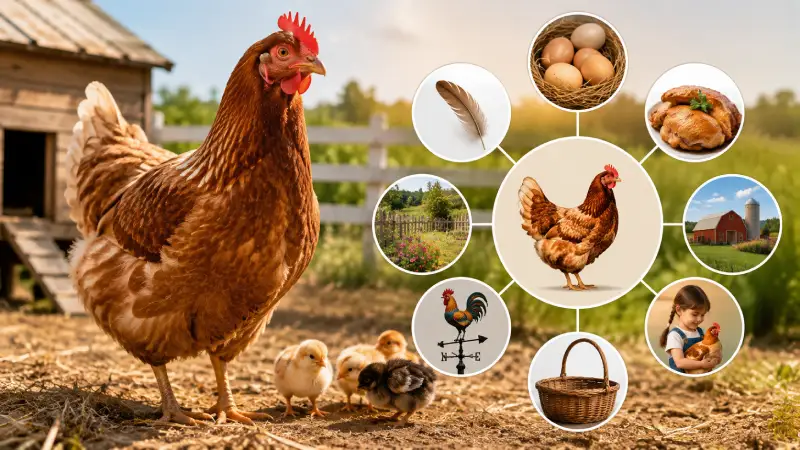
The domestic chicken is a familiar farm bird descended from Asian junglefowl. Roosters are generally larger than hens and often have more conspicuous combs, wattles, and plumage. Chickens use their feet to scratch for food, and they communicate through a range of vocalizations. Roosters are particularly famous for crowing, while hens cluck to chicks and may vocalize after laying an egg.
Their close relationship with people helps explain their unusually broad symbolism.
Chickens are not distant wilderness animals. For much of human history, they have lived close to houses, fields, villages, and farms.
People observed hens raising chicks, roosters announcing themselves, birds scratching for food, flocks establishing hierarchy, and eggs providing a recurring source of food.
Those ordinary behaviors gradually became metaphors for human life.
Chicken Symbolism of Protection and Motherhood
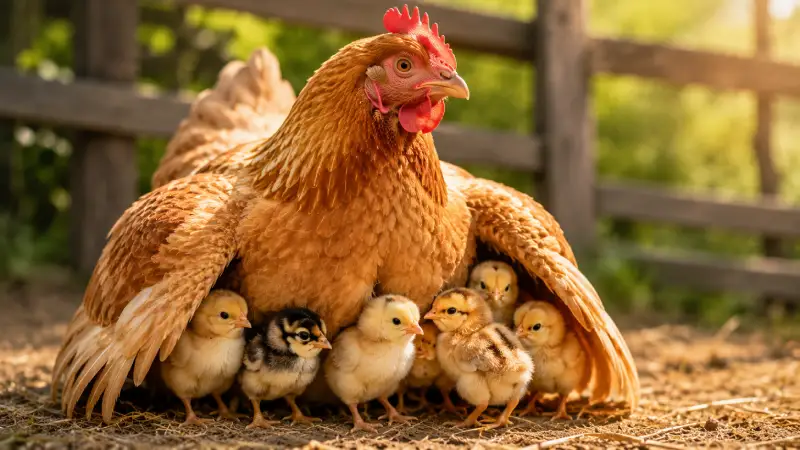
Protection is one of the strongest meanings associated with the hen.
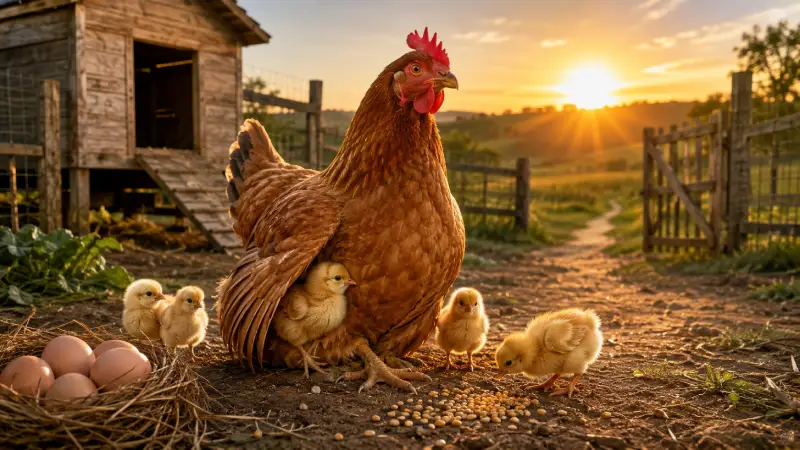
A mother hen communicates with her chicks, keeps them close, and provides a central point of safety during their earliest stage of life. This familiar behavior became so recognizable that “mother hen” developed into an English expression for an especially protective or attentive person.
The symbolism is not based on aggression alone.
A hen represents protection through presence.
She stays close.
She gathers vulnerable young.
She responds when something threatens them.
That makes hen symbolism particularly suitable for parents, grandparents, caregivers, teachers, or anyone whose strength is expressed through making other people feel safe.
The meaning can also extend beyond biological motherhood. Someone can act like a protective hen toward friends, students, younger siblings, coworkers, or members of a community.
Chicken Symbolism in the Bible
Chicken imagery appears in important biblical passages and carries more than one meaning.
In Luke 13:34, Jesus describes his desire to gather Jerusalem’s people in language comparing it to a hen gathering her brood beneath her wings. The image expresses shelter, care, protection, and the desire to bring vulnerable people close. A parallel image appears in Matthew 23.
The rooster carries a very different biblical association.
Before Peter’s denial, Jesus tells him that Peter will deny knowing him three times before the cock crows. Luke then describes Peter’s three denials, followed immediately by the rooster’s crow and Peter’s realization of what he has done.
Because of that story, Christian rooster symbolism can involve vigilance, moral awakening, repentance, human weakness, and the moment when denial gives way to recognition.
These two biblical images show how important context is.
The hen protects.
The rooster awakens.
Both belong to chicken symbolism, but they communicate very different ideas.
Rooster Symbolism: Vigilance, Awakening, and Confidence
A rooster’s crow is one of the most recognizable sounds associated with rural mornings.
Biologically, crowing is communication. Smithsonian material notes that roosters use their characteristic crow in territorial signaling toward other males.
Humans added another layer because crowing is strongly associated with the start of the day.
That connection produced symbolic meanings such as:
Awakening , recognizing something that had previously been ignored.
Vigilance, remaining alert while others are less attentive.
Confidence , making one’s presence known.
Reliability, returning to an expected routine.
New beginnings, the arrival of another morning.
The rooster therefore carries a more outward, assertive symbolic personality than the hen.
A rooster standing tall with bright plumage can communicate self-confidence, while a crowing rooster can represent speaking up or calling attention to something important.
Chicken Symbolism in Chinese Culture
The rooster has a particularly well-documented place in Chinese cultural history.
It is one of the twelve animals of the Chinese zodiac. The Metropolitan Museum of Art notes that zodiac animals were associated with the Chinese calendar by the third century BCE and were firmly established by the first century. Because the rooster rises early, people born in Rooster years have traditionally been associated with diligence and industriousness.
Chinese rooster imagery also developed auspicious associations.
The Met explains that an early-crowing heavenly rooster appears in Chinese legend and that the bird could be associated with bringing out the sun and dispelling darkness. Roosters consequently became popular artistic motifs.
Smithsonian material adds another layer, describing the rooster in Chinese lore as connected with protection from harmful influences and with qualities such as courage, reliability, benevolence, and scholarly or military virtues. Roosters, hens, and chicks together could also signify caring parents.
In this context, chicken symbolism reaches far beyond ordinary farm life.
It can communicate auspiciousness, reliability, family care, courage, and the victory of daylight over darkness.
Courage Versus the Idea of Being “Chicken”
One of the most interesting contradictions in chicken symbolism appears in English.
Actual roosters can be assertive and territorial.
Yet calling someone a “chicken” means calling that person fearful or cowardly. Merriam-Webster lists “coward” as one definition of the noun and “scared” or “timid, cowardly” as adjectival meanings. “Chickenhearted” likewise means timid or cowardly and is recorded in English from the seventeenth century.
This creates an important symbolic tension.
The same animal can represent both courage and fear.
A proud rooster suggests confidence.
The phrase “chickening out” suggests losing nerve.
That contradiction is useful rather than confusing because animal symbolism rarely follows biology perfectly. Human language selects certain imagined characteristics and exaggerates them.
The idea that chickens are inherently cowardly should therefore be understood as cultural language, not an accurate biological description of every chicken.
Community, Flock Life, and the Pecking Order
Chickens are social animals.
Within a flock, individuals establish relationships and status differences. The familiar expression “pecking order” comes from this kind of social hierarchy. Penn State poultry guidance notes that flock hierarchy can influence which birds gain access to food and water, particularly when resources are limited.
That gives chicken symbolism a connection with community and social structure.
A flock can symbolize belonging.
But it can also represent hierarchy.
Those two meanings are not identical.
Belonging emphasizes being part of something larger.
Hierarchy emphasizes the reality that groups often develop differences in influence, access, and status.
As a personal symbol, a flock of chickens may therefore raise questions about where someone fits within a family, workplace, school, or community.
It can represent cooperation when the group functions well, or unhealthy competition when social ranking becomes more important than collective welfare.
Abundance, Provision, and Everyday Prosperity
Chicken symbolism is also closely connected with food and provision.
Unlike an exotic treasure symbol, the chicken represents ordinary abundance.
For generations, domestic chickens have provided eggs and meat while fitting into relatively small household and farm systems. This everyday usefulness made them closely connected with food security and rural livelihood rather than luxury alone. Smithsonian materials describe chickens as long-domesticated birds whose lives are deeply intertwined with people.
That gives abundance a practical meaning.
A chicken may symbolize:
having enough,
feeding a household,
daily provision,
productive routine,
or resources that continue to arrive gradually.
The egg strengthens this association because it can represent both food and future life.
Chicken abundance is therefore usually not about sudden wealth.
It is more naturally a symbol of steady provision.
Eggs, Chicks, and New Beginnings
A chick emerging from an egg makes new beginnings another intuitive chicken meaning.
The symbolism works on several levels.
An egg holds potential before that potential becomes visible.
A chick represents vulnerability at the start of life.
Growth follows gradually.
As personal symbolism, chicks and eggs can represent a new project, new relationship, pregnancy or parenthood imagery, childhood, an early-stage business, or any situation in which something valuable is only beginning to develop.
The meaning is different from butterfly transformation.
A butterfly emphasizes becoming radically different.
A chick emphasizes something new entering the world and needing time to grow.
That makes chicken imagery especially appropriate for beginnings that require patience, protection, and care.
Reliability, Routine, and Daily Work
Chickens are also strongly associated with everyday routine.
Healthy backyard chickens spend much of the day moving, pecking, scratching, dusting, feeding, and communicating.
There is nothing dramatic about most of these activities.
That is precisely why they can become meaningful.
Chicken symbolism can represent doing ordinary work consistently.
Feeding a family.
Maintaining a home.
Going to work.
Growing food.
Caring for children.
Completing small responsibilities that rarely receive public recognition.
The rooster’s association with morning strengthens this meaning.
Together, rooster and hen can symbolize a life built less through one spectacular achievement and more through repeated useful actions.
Resourcefulness and Finding What You Need
Chickens naturally scratch at the ground while searching for food. Their claws are well suited to disturbing soil and leaf litter as they investigate what is available.
That behavior lends itself to a modern symbolic meaning of resourcefulness.
A chicken does not wait for everything to appear perfectly arranged.
It searches.
It investigates.
It works with the environment directly in front of it.
For people, this can symbolize making intelligent use of ordinary opportunities.
Resourcefulness may mean learning from what is nearby, repurposing something instead of replacing it, using existing skills creatively, or finding useful information other people overlooked.
This is not glamorous symbolism.
It is practical symbolism, which fits the chicken remarkably well.
Chicken Symbolism in Modern American Culture
In the United States, chickens carry a mixture of rural, domestic, humorous, commercial, and emotional meanings.
A rooster on kitchen decor may suggest farmhouse life.
A hen with chicks may communicate family.
A rooster silhouette can evoke dawn, independence, or country living.
Backyard chickens may represent self-sufficiency and food production.
At the same time, everyday English preserves the negative idea of “being chicken” when someone is afraid.
This creates a symbol that can feel both serious and playful.
Unlike the eagle, chicken imagery usually does not suggest national grandeur.
Unlike the lion, it does not automatically suggest royalty.
Its power comes from familiarity.
The chicken represents ordinary life close to home.
That can make it an especially effective symbol of family, work, food, persistence, and the quiet importance of everyday responsibilities.
Chicken Symbolism in Tattoos
Chicken tattoos can carry very different meanings depending on whether the design shows a rooster, hen, chick, or full flock.
A rooster tattoo often suggests courage, confidence, vigilance, morning, individuality, or refusing to back down.
A hen tattoo can represent motherhood, nurturing, home, protection, or family devotion.
A hen with chicks strongly emphasizes parenting and caregiving.
A chick tattoo can communicate innocence, youth, humor, or a fresh beginning.
A rooster and hen together may represent partnership or complementary personalities.
Some people also choose chicken tattoos because of farming backgrounds, childhood memories, family businesses, favorite animals, or simple humor.
There is no universal tattoo definition.
The design and the wearer’s story determine which meaning is strongest.
Spiritual Meaning of Chicken Symbolism
In contemporary spiritual interpretation, chicken symbolism is often associated with protection, abundance, awakening, family, fertility, grounding, and paying attention to everyday responsibilities.
The rooster can symbolize waking up to something important.
The hen can symbolize shelter and care.
The chick can symbolize vulnerability or new potential.
The flock can represent community.
These interpretations can be useful as personal metaphors, but they should not be treated as guaranteed supernatural messages.
Seeing a chicken does not scientifically predict wealth, pregnancy, danger, marriage, or another future event.
A more grounded spiritual interpretation is to ask what part of the animal’s symbolism fits the moment.
Do you need to protect something?
Do you need to speak up?
Are you caring for a new beginning?
Are you allowing fear to stop you?
Are you contributing fairly to your community?
The chicken can provide the metaphor without pretending to provide a prophecy.
What Does Seeing a Chicken Mean?
Seeing an ordinary chicken usually means exactly what it appears to mean: you encountered a chicken.
Symbolically, however, a person may connect the encounter with whatever the animal currently represents in their life.
A hen surrounded by chicks might remind a parent to focus on family.
A rooster crowing during an important morning could become associated with waking up, taking action, or making a decision.
A chick might feel meaningful during a fresh start.
A flock struggling over resources could even become a reminder of unhealthy competition.
Context matters more than a generic omen chart.
Symbolism becomes useful when an encounter helps someone notice an idea that already matters, not when every animal sighting is treated as a coded prediction.
Positive and Negative Meanings of Chicken Symbolism
The positive side of chicken symbolism includes protection, caregiving, abundance, community, courage, vigilance, reliability, and new beginnings.
The negative side can include fear, excessive conformity, competition, social ranking, defensiveness, and dependence on the group.
Some qualities can move between the two sides.
Protection can become overprotection.
Confidence can become aggression.
Community can become conformity.
Caution can become cowardice.
Hierarchy can become bullying.
This balance makes chicken symbolism more psychologically useful than a simple claim that chickens always mean prosperity or always mean fear.
Common Misunderstandings About Chicken Symbolism
One common mistake is treating chicken, hen, rooster, and chick symbolism as identical.
They overlap, but emphasis changes significantly. Hens are more strongly connected with motherhood and protection, while roosters emphasize vigilance and confidence.
Another misconception is assuming the cowardly meaning comes directly from accurate chicken behavior.
Modern English certainly uses “chicken” for cowardice, but roosters can also show territorial and confrontational behavior. The negative meaning belongs to language and cultural imagination rather than being a scientific personality description.
A third mistake is presenting Chinese rooster symbolism as universal chicken symbolism. Chinese zodiac and auspicious rooster traditions belong to specific East Asian cultural histories.
Finally, biblical hen and rooster imagery should not be blended into one message. The protective hen of Luke 13 communicates a different idea from the rooster associated with Peter’s denial in Luke 22.
How Chicken Symbolism Has Evolved
Chicken symbolism grew from an unusually close human-animal relationship.
Domestication made chickens part of daily life.
Egg production encouraged associations with provision and potential.
Hens caring for young created powerful images of motherhood and shelter.
Rooster crowing encouraged connections with morning, awareness, reliability, and confidence.
Social flock behavior contributed the idea of the pecking order.
Religious traditions added further layers. Biblical imagery connected the hen with shelter and the rooster with Peter’s moral awakening, while Chinese traditions made the rooster an auspicious zodiac animal associated with diligence, daylight, courage, and reliability.
English language then added an ironic countermeaning by turning “chicken” into a synonym for coward.
Modern chicken symbolism therefore contains several apparently opposite ideas: courage and fear, protection and competition, individuality and flock membership, ordinary domesticity and religious significance.
That complexity is what makes the symbol useful.
Frequently Asked Questions
What does a chicken symbolize spiritually?
A chicken can symbolize protection, abundance, family, awakening, fertility, community, and practical responsibility in modern spiritual interpretation. The specific meaning changes depending on whether the image is a hen, rooster, chick, or flock.
What does a hen symbolize?
A hen most commonly represents motherhood, caregiving, protection, home, and family. Biblical imagery also uses the hen gathering chicks beneath her wings as an image of shelter and protective care.
What does a rooster symbolize?
Rooster symbolism often includes vigilance, confidence, courage, awakening, and reliability. In Chinese tradition, the rooster is a zodiac animal associated with diligence and auspicious meanings, while Christian tradition links its crow with Peter’s denial and recognition.
What do baby chicks symbolize?
Baby chicks commonly symbolize innocence, vulnerability, youth, potential, and new beginnings. Their dependence on adult care can also strengthen meanings of family and protection.
Why does “chicken” mean cowardly?
“Chicken” has developed a well-established figurative meaning of coward or timid person in English. Merriam-Webster records both noun and adjective uses connected with fear or cowardice.
What does a chicken tattoo mean?
A chicken tattoo can represent family, farming roots, humor, abundance, or everyday resilience. Rooster tattoos often emphasize courage and vigilance, while hens and chicks more naturally represent parenting and protection.
Is seeing a chicken a good omen?
There is no scientifically established good or bad omen attached to seeing a chicken. A person may choose to interpret the encounter as a reminder of family, courage, awareness, provision, or a new beginning.
Conclusion
Chicken symbolism is much richer than the modern insult “chicken” suggests. Across everyday life, religion, language, and cultural traditions, chickens can represent protection, motherhood, abundance, vigilance, courage, community, social order, reliability, and new beginnings.
The meaning changes with the bird. A hen gathering chicks suggests shelter and caregiving. A rooster announcing itself suggests awareness and confidence. A newly hatched chick suggests potential. A flock brings attention to belonging and hierarchy. Biblical and Chinese traditions add specific historical layers that should be understood within their own cultural settings.
The most grounded meaning is simple: strength does not always look dramatic. Sometimes it looks like caring for others, showing up every morning, finding what you need, protecting what matters, and continuing the ordinary work that keeps a family or community going.


