


Cicada symbolism most commonly represents rebirth, transformation, patience, renewal, personal growth, finding your voice, timing, resilience, and the temporary nature of life. These meanings fit an insect that may spend years developing underground before emerging, shedding its old outer skin, becoming a winged adult, and filling summer landscapes with sound.
Cicadas are especially meaningful symbols in the United States because periodical cicadas are a uniquely North American phenomenon. Some populations emerge in synchronized 13-year or 17-year cycles, while annual cicadas appear every summer. Periodical adults live above ground for only a few weeks, during which they mate, lay eggs, and begin the next generation.
Cicada symbolism also has genuine historical depth. In ancient China, the insect became associated with rebirth, immortality, purity, and high status. During the Han dynasty, jade cicada amulets were even placed with the dead as symbols of hoped-for renewal beyond death.
Quick Answer
Cicada symbolism most commonly represents rebirth, transformation, patience, resilience, renewal, timing, and finding your voice. Its emergence from underground and shedding of an old exoskeleton make it a natural symbol of personal change, while ancient Chinese traditions add documented associations with immortality, purity, and resurrection.
TL;DR
- Cicadas symbolize rebirth, transformation, patience, and renewal.
- Years underground suggest hidden growth and long preparation.
- Molting represents leaving an old identity or stage behind.
- Male cicada songs add meanings of voice and self-expression.
- Chinese history connects cicadas with immortality and purity.
- Short adult lives strengthen symbolism of timing and impermanence.
What Cicada Symbolism Really Means
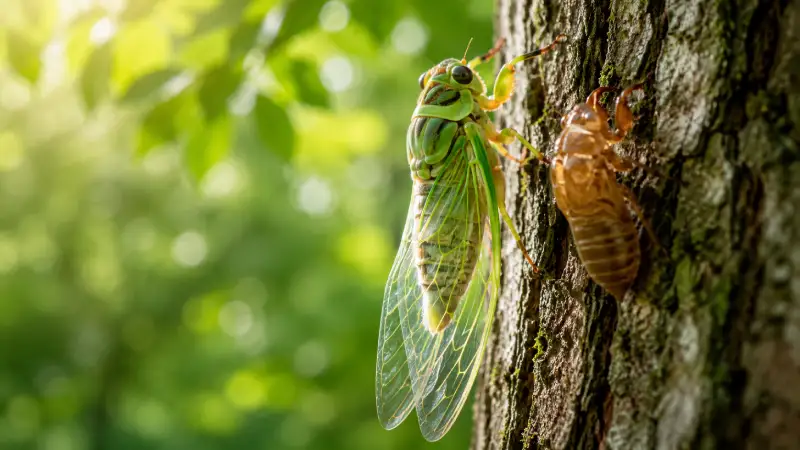
The meaning of the cicada begins with its unusual life cycle.
Cicadas are insects in the order Hemiptera. Thousands of species occur around the world, but their life cycles share a basic pattern: females lay eggs in plant material, young nymphs eventually move underground, the nymphs feed from tree roots, and mature individuals later return to the surface to become winged adults.
Periodical cicadas make this process especially dramatic.
Certain Magicicada species in the eastern United States remain underground for either 13 or 17 years before enormous numbers emerge at approximately the same time. Once above ground, they molt into adults, reproduce, and die within weeks.
Humans naturally see metaphor in that sequence.
Something disappears beneath the surface.
Years pass.
Growth continues where no one can see it.
Then the insect returns in a completely different form.
That makes the cicada particularly well suited to symbolism involving change that takes time.
Cicada Symbolism: 9 Powerful Core Meanings

| Meaning | Cicada Connection | Modern Interpretation |
|---|---|---|
| Rebirth | Adult emerges after a long hidden stage | Beginning life again |
| Transformation | Nymph molts into winged adult | Becoming a new version of yourself |
| Patience | Years can pass underground | Trusting slow development |
| Renewal | New generation repeats the cycle | Fresh beginnings |
| Resilience | Survives long subterranean development | Enduring difficult periods |
| Voice | Males produce powerful songs | Speaking and being heard |
| Timing | Synchronized emergence | Acting when the moment arrives |
| Community | Periodical cicadas emerge in huge numbers | Shared experience and collective strength |
| Impermanence | Adult life is brief | Valuing limited time |
These meanings overlap, but each emphasizes a different part of the cicada’s biology or cultural history.
Cicada Symbolism of Rebirth and Renewal
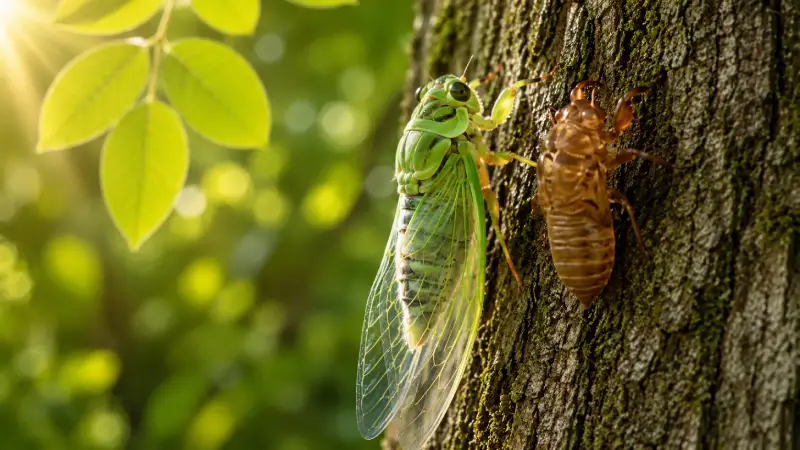
Rebirth is one of the oldest documented cicada meanings.
The symbolism is visually compelling.
A mature cicada nymph climbs out of the soil and attaches itself to a tree, plant, or another surface. Its outer skin splits, and the winged adult emerges, leaving behind an empty shell known as an exuvia.
To human observers, the abandoned shell can look like a body that has been left behind.
Ancient Chinese people made the same symbolic connection centuries ago. Smithsonian’s National Museum of Asian Art explains that the cicada’s emergence from the ground and shedding of its old body became an analogy for resurrection and the hope that the dead could rise into another state of existence.
In modern personal symbolism, rebirth may represent:
- starting again after loss
- rebuilding life after failure
- recovering from a difficult relationship
- returning after isolation
- adopting a new identity
- beginning another career
- entering a healthier stage of life
The cicada does not erase its earlier stage.
It develops through it.
That makes renewal a more useful meaning than simply “becoming someone else.”
Transformation and Shedding an Old Identity
The empty cicada shell provides one of nature’s clearest images of leaving something behind.
The adult cannot remain inside its old nymphal skin.
Growth requires emergence.
As a human metaphor, that can represent outgrowing:
old habits,
limiting beliefs,
social roles,
fear,
relationships,
or versions of yourself that no longer fit.
This symbolism is especially powerful because the old shell is not portrayed as worthless.
It served an important purpose during an earlier stage.
The same can be true of human identities.
A behavior that once protected someone may later become restrictive.
A career that once fit may eventually feel limiting.
A relationship may have been important without being permanent.
Cicada symbolism therefore suggests that outgrowing something does not mean it never had value.
Patience and Years of Hidden Growth
Periodical cicadas make patience one of the strongest meanings associated with the insect.
Some remain underground for 13 years and others for 17 years before emerging as adults. During that hidden period, nymphs feed from tree roots and continue developing beneath the surface.
From a human perspective, almost nothing appears to be happening.
Biologically, development continues.
This makes the cicada an unusually good symbol for long-term goals.
It may represent:
studying for years before entering a profession,
building a business privately,
recovering slowly,
learning a skill,
saving money,
or waiting until circumstances make action possible.
Modern culture often rewards visible progress.
The cicada offers a different message:
important development can happen before other people can see the result.
Patience here does not mean doing nothing.
It means allowing enough time for preparation to become meaningful.
Cicada Symbolism of Timing
Patience matters, but eventually the cicada emerges.
That makes timing another major symbolic meaning.
Periodical cicadas do not simply appear randomly one by one. Entire broods can emerge in synchronized events involving enormous numbers of insects across broad areas. Smithsonian resources note that emergence begins when underground conditions, including soil temperature, become suitable.
Symbolically, this creates a useful distinction:
There is a time to prepare.
There is also a time to act.
Someone can spend years learning, planning, or recovering, but preparation eventually needs an outlet.
A cicada can therefore symbolize recognizing when:
a project should finally launch,
a difficult conversation needs to happen,
an opportunity should be accepted,
or hiding is no longer useful.
The deeper meaning is not “wait forever.”
It is do not confuse preparation with permanent postponement.
Voice, Sound, and Being Heard
Cicadas are impossible to understand symbolically without considering sound.
Male cicadas produce their characteristic calls by vibrating specialized membranes called tymbals. During a large periodical emergence, thousands or millions calling simultaneously can create an overwhelming summer chorus.
That makes the cicada a natural modern symbol of voice.
After spending years hidden underground, the adult stage is anything but silent.
As human symbolism, the cicada may represent:
speaking after being ignored,
sharing creative work,
telling the truth,
expressing an identity more openly,
or refusing to remain invisible.
This does not mean louder communication is always better.
The more useful symbolism involves finding the moment when silence no longer serves you.
Someone who has spent years learning or healing may eventually need to say:
This is who I am.
This is what I know.
This is what I need.
The cicada’s song makes that transition from hidden development to public expression especially vivid.
Community and Collective Emergence
Periodical cicadas also transform the meaning of community.
One cicada can seem vulnerable.
Millions appearing together create an entirely different experience.
The synchronized strategy is biologically important because predators can consume enormous numbers while still leaving enough cicadas alive to reproduce.
Smithsonian resources describe periodical emergences as events involving billions of cicadas spread across entire regions.
That naturally supports symbolism of strength through shared timing.
A cicada can represent the idea that individual change sometimes becomes more powerful when it happens alongside others.
Examples might include:
a graduating class,
a social movement,
a community rebuilding after disaster,
a generation reaching adulthood,
or people publicly speaking about an experience that was previously hidden.
The symbolism is not merely “follow the crowd.”
It is that some moments become possible because many individuals are ready at the same time.
Cicada Symbolism in Ancient Chinese Culture
Chinese cicada symbolism is one of the best-documented historical traditions involving the insect.
Cicadas were associated with rebirth and immortality because their emergence from underground seemed to resemble a return from death.
During the Han dynasty, carved jade cicadas were placed on the tongues of deceased people as funerary objects expressing hope for rebirth and eternal existence.
The symbolism did not stop there.
Chinese tradition also connected cicadas with purity and elevated status. Smithsonian’s National Museum of Asian Art explains that cicadas were considered pure because people believed they lived on dew and lofty because they occupied high treetops. Cicada imagery could consequently represent refinement, modesty, alertness, and qualities expected of high-ranking officials.
Golden cicada images also appeared in the headgear of rulers and nobles, where prominent eyes could symbolize awareness and attentiveness.
This historical record is important because it shows that cicada symbolism was never limited to one idea.
The insect could represent:
rebirth,
immortality,
purity,
status,
awareness,
summer,
and even mortality.
Cicadas and the Cycle of Life
Chinese literature also gives the cicada a darker meaning.
Smithsonian’s National Museum of Asian Art discusses a story associated with the Zhuangzi in which a cicada is caught by a mantis while a bird waits to catch the mantis. The scene became an illustration of the interconnected cycle of predator and prey.
This adds a useful counterbalance to optimistic rebirth symbolism.
The cicada can represent new life.
But it can also represent vulnerability.
It emerges.
It sings.
It reproduces.
And then its adult life ends.
That makes the insect a symbol of the cycle of life rather than endless personal triumph.
Growth and mortality can exist in the same symbol.
Summer, Heat, and Seasonal Meaning
For many Americans, cicadas mean summer before they mean anything spiritual.
Annual cicadas commonly appear during the warmer months, and their loud calls can become part of the acoustic background of late summer afternoons and evenings.
Smithsonian Gardens distinguishes these annual or “dog-day” cicadas from periodical cicadas, noting that annual species appear every year and are commonly seen later in summer.
That makes cicadas strongly connected with:
heat,
long afternoons,
childhood summers,
trees,
vacation,
and seasonal memory.
Symbols do not need ancient religious histories to become emotionally powerful.
Someone raised in the eastern United States may hear cicadas and immediately remember:
a grandparent’s yard,
summer break,
baseball games,
evenings outside,
or walking through humid woods.
In this sense, cicada symbolism can simply mean home remembered through sound.
Cicada Symbolism in the United States
Periodical cicadas give American cicada symbolism a particularly distinctive character.
They occur only in eastern North America and are famous for synchronized 13-year and 17-year emergences.
Their appearances can become regional events.
Residents suddenly find lawns, trees, sidewalks, and fences covered with insects and empty exoskeletons. The sound can become unavoidable.
A brood emergence may consequently symbolize:
return,
collective memory,
generational change,
and the passage of time.
People can remember where they lived during the previous emergence and compare how much their lives have changed since then.
That gives periodical cicadas an unusually human connection with measuring time through memory.
A 17-year interval can contain childhood, graduation, marriage, parenthood, career changes, loss, and enormous personal transformation.
When the cicadas return, the landscape may look familiar while the observer has become someone else.
Resilience and Survival
Cicadas appear fragile after they emerge.
Their wings are thin.
Their adult lives are short.
Yet reaching that adult stage can require years of subterranean survival.
This creates a strong symbolic meaning of resilience.
Resilience is often imagined as constantly fighting.
The cicada suggests something different.
Survival can involve:
staying protected,
developing slowly,
waiting,
and appearing only when conditions allow the next stage.
That makes cicada symbolism particularly suitable for people whose strength has not always been visible.
Someone recovering privately may look inactive from the outside.
Someone building a skill may receive little recognition.
Someone enduring a difficult period may simply be surviving until conditions improve.
The cicada symbolizes the possibility that quiet endurance is still endurance.
Impermanence and the Short Adult Life
Periodical cicadas can spend 13 or 17 years underground but live as adults for only about three to four weeks.
That extraordinary contrast gives the insect a powerful relationship with impermanence.
Years of preparation lead to a brief window of adult activity.
Symbolically, that can represent:
limited opportunities,
the value of timing,
mortality,
and the importance of using the present.
The message does not need to encourage urgency or anxiety.
Instead, it can remind us that some moments matter because they cannot be extended indefinitely.
A conversation can be postponed too long.
An opportunity can pass.
A relationship can change.
A season eventually ends.
Cicada symbolism therefore adds an important question to patience:
When your moment arrives, will you recognize it?
Cicada Symbolism in Tattoos
Cicada tattoos can carry unusually rich meanings because several parts of the insect’s life cycle translate well into visual art.
Common meanings include:
Rebirth. Returning after a major ending.
Transformation. Leaving an earlier identity behind.
Patience. Accepting a long developmental process.
Resilience. Surviving years that felt hidden or difficult.
Voice. Becoming willing to speak openly.
Timing. Acting when the right moment arrives.
Mortality. Remembering that visible opportunities can be brief.
A realistic cicada emphasizes nature and life cycles.
A cicada emerging from an old shell makes transformation explicit.
A jade-style cicada can reference historical Chinese symbolism, though culturally specific imagery should be used with understanding rather than treated as generic decoration.
A cicada paired with flowers may emphasize summer and renewal.
Dates or numbers such as 13 or 17 can refer to periodical cycles or personally significant spans of time.
Spiritual Meaning of Cicada Symbolism
In contemporary spirituality, cicadas are commonly interpreted as symbols of rebirth, awakening, patience, transformation, intuition, renewal, and finding your voice.
Some of these themes have genuine historical parallels, especially the Chinese association between cicadas, resurrection, and immortality.
Modern spiritual claims should still be separated from documented history.
Seeing a cicada does not scientifically predict:
money,
marriage,
pregnancy,
death,
or a major future event.
A grounded spiritual interpretation might instead use the cicada as a reflective question:
What am I preparing for?
What have I outgrown?
Where have I remained silent?
Is this a period for patience, or has the moment to act finally arrived?
Symbolism works best here as a metaphor rather than a prediction.
What Does Seeing a Cicada Mean?
Seeing a cicada has no universal supernatural meaning.
Context matters.
Finding an empty cicada shell might naturally suggest letting go.
Watching a cicada emerge could feel like a symbol of transformation.
Hearing an enormous chorus may inspire thoughts about community or expression.
Encountering a periodical brood after 17 years might make someone reflect on everything that has changed since the previous emergence.
These meanings are personally useful because they connect with what the animal is actually doing.
An encounter does not need to be an omen to feel significant.
Cicada Shell Symbolism
The empty cicada shell deserves its own interpretation.
Unlike many animal remains, an exuvia does not mean the cicada died there.
It usually means the insect successfully moved into another stage.
That distinction makes the shell a particularly strong symbol of:
release,
growth,
survival,
and an identity that has served its purpose.
Someone may keep or photograph cicada shells because they represent a visible reminder that leaving something behind can be evidence of growth rather than loss.
This is one reason cicada imagery differs from symbols centered only on death and rebirth.
The old form remains visible.
The living animal has simply moved beyond it.
Positive and Negative Meanings of Cicada Symbolism
Cicada symbolism is mainly positive, but it also has cautionary meanings.
Positive meanings
Rebirth: entering another stage of life.
Patience: allowing development enough time.
Resilience: surviving long periods of difficulty.
Voice: becoming willing to express yourself.
Renewal: beginning again after an ending.
Community: acting alongside others.
Timing: recognizing when preparation should become action.
Negative or cautionary meanings
Delay: remaining hidden after preparation is complete.
Noise: speaking constantly without listening.
Impermanence: recognizing that opportunities can be brief.
Overexposure: emerging publicly before feeling ready.
Inattention: failing to recognize consequences while focused on immediate needs.
These darker meanings make the symbol more balanced.
Patience is valuable.
Permanent postponement is not.
Voice is valuable.
Noise without communication is different.
Common Misunderstandings About Cicada Symbolism
One common misconception is that all cicadas live underground for 17 years.
They do not.
Periodical cicadas include 13-year and 17-year species, while many other cicada species have different developmental schedules and appear annually in a region.
Another misunderstanding is that cicadas and locusts are the same insect.
They are not. Cicadas are true bugs in the order Hemiptera, while locusts are a form of grasshopper.
A third mistake is treating every modern spiritual claim as ancient history.
Chinese cicada symbolism genuinely includes documented themes of rebirth, immortality, purity, and elevated status. Claims that cicadas universally guarantee money, romance, or good luck are different and require their own evidence.
Finally, an empty cicada shell does not normally indicate that the insect died inside it.
It usually marks a successful molt into the adult stage.
How Cicada Symbolism Has Evolved
Cicada symbolism developed from people observing one of the insect world’s strangest life cycles.
Ancient Chinese observers saw cicadas disappear underground and later emerge into winged adulthood. That process inspired associations with resurrection and immortality, while the insect’s imagined diet of pure dew and high position in trees contributed meanings of purity, refinement, and social status.
In the United States, periodical cicadas added a different cultural layer.
Their synchronized 13- and 17-year appearances turn cicada emergence into a public event that connects natural history with human memory.
Modern symbolism has expanded further.
Tattoos use cicadas for transformation and resilience.
Spiritual imagery uses them for awakening.
Mental-health interpretations emphasize unseen growth.
The insects’ enormous songs make them natural symbols of finding a voice.
And their short adult lives encourage reflection on timing and mortality.
The result is a symbol that connects three powerful experiences:
waiting, emerging, and being heard.
Frequently Asked Questions
What does a cicada symbolize spiritually?
A cicada commonly symbolizes rebirth, transformation, patience, renewal, resilience, and finding your voice. Ancient Chinese traditions also give the insect documented meanings connected with immortality, purity, and resurrection.
Is seeing a cicada a good sign?
There is no scientifically established good or bad omen attached to seeing a cicada. Symbolically, many people interpret one positively as a reminder of renewal, patience, personal growth, or recognizing the right time to act.
What does a cicada tattoo symbolize?
A cicada tattoo often represents rebirth, resilience, transformation, patience, self-expression, or surviving a long hidden period. An emerging cicada or empty shell can emphasize leaving an old identity behind.
What does a cicada symbolize in Chinese culture?
Historically, Chinese cicadas have represented rebirth, immortality, purity, high status, and awareness. Han dynasty jade cicadas were used in burial contexts to express hope for renewed or eternal existence.
What does an empty cicada shell symbolize?
An empty cicada shell commonly symbolizes growth, release, transformation, and leaving an old stage behind. Biologically, it is the exoskeleton left after the nymph molts into its adult form.
Why do cicadas symbolize patience?
Periodical cicadas can remain underground for 13 or 17 years before emerging as adults. That long hidden stage makes them natural modern symbols of preparation, patience, and development that other people cannot yet see.
What does hearing cicadas symbolize?
In modern symbolism, cicada song can represent voice, expression, summer, community, or the moment when something hidden finally becomes impossible to ignore. Biologically, male cicadas produce songs primarily as part of reproductive communication.
Conclusion
Cicada symbolism most naturally represents rebirth, transformation, patience, resilience, renewal, voice, timing, community, and the temporary nature of life. These meanings begin with real biology: cicadas spend a large portion of their lives underground, emerge into another form, shed an old exterior, and devote their short adult stage to reproduction and continuation of the next generation.
History gives the symbol even greater depth. Ancient Chinese traditions connected cicadas with immortality, resurrection, purity, refinement, and awareness, while American periodical cicadas have become extraordinary markers of generational time and collective emergence.
The most useful message is simple: growth does not stop because other people cannot see it. There is a time to remain beneath the surface, a time to leave the old shell behind, and a time to emerge and make your voice heard.


