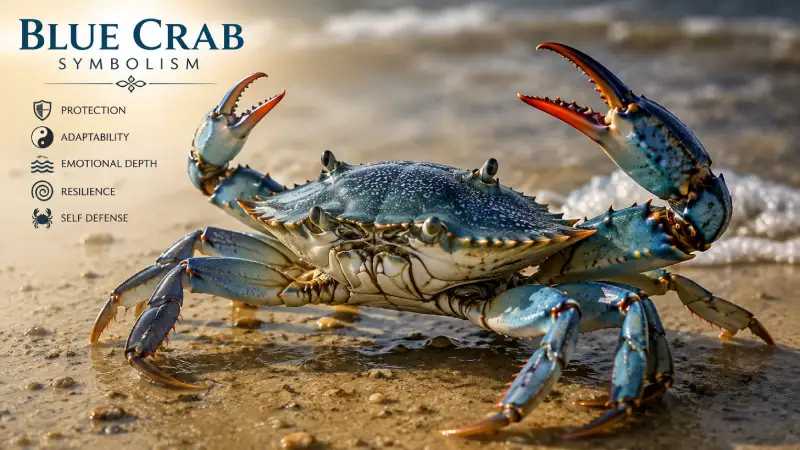
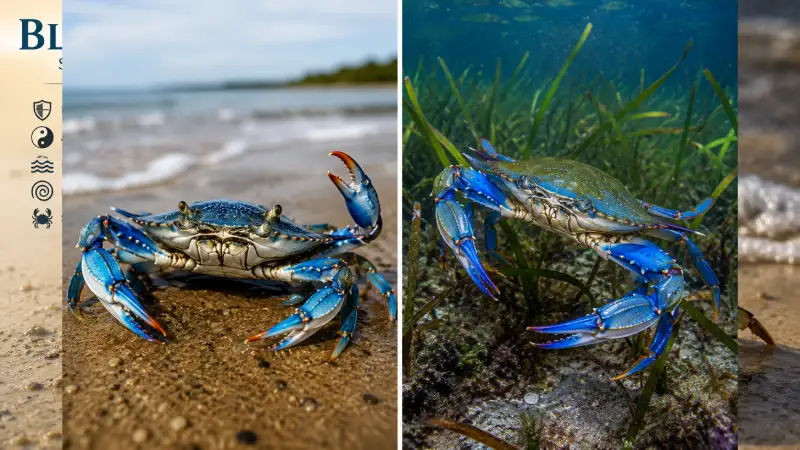
Blue crab symbolism commonly represents resilience, protection, adaptability, renewal, resourcefulness, emotional boundaries, and connection to coastal life. The animal’s hard shell, defensive claws, sideways movement, repeated molting, and ability to move between waters of different salinities make it an especially natural modern symbol of surviving change without losing the ability to protect yourself.
In the United States, the blue crab carries an additional regional meaning. Callinectes sapidus is one of the Chesapeake Bay’s most recognizable animals, supports an important commercial and recreational fishery, and is Maryland’s official state crustacean. NOAA describes it as a keystone species in the Chesapeake ecosystem and the Bay’s most valuable fishery.
Unlike symbols such as the Egyptian scarab or the biblical dove, however, the blue crab does not have one widely documented ancient symbolic tradition. Most meanings associated with it today grow from its biology, Chesapeake identity, fishing culture, food traditions, tattoos, and the broader symbolism humans attach to crabs.
Quick Answer
Blue crab symbolism most commonly represents resilience, adaptability, protection, renewal, resourcefulness, and strong personal boundaries. In modern American culture, it also symbolizes Chesapeake Bay heritage, Maryland identity, coastal livelihoods, and the ability to adjust to changing conditions while remaining firmly defended.
TL;DR
- Blue crabs symbolize resilience, adaptability, protection, and renewal.
- Molting makes them natural symbols of growth and personal transformation.
- Their claws suggest boundaries, courage, and defensive strength.
- Sideways movement can represent unconventional approaches to problems.
- Chesapeake culture adds meanings of home, livelihood, and regional pride.
- Conservation connects the crab with environmental responsibility and balance.
What a Blue Crab Looks Like and Why It Matters Symbolically
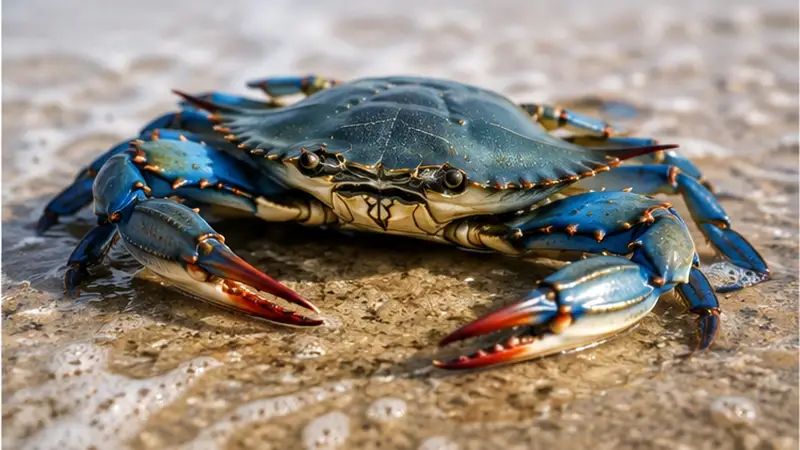
The blue crab is a swimming crab with a broad, flattened shell and five pairs of legs. The rear pair forms paddle-like swimming legs, allowing it to move efficiently through the water rather than remaining entirely on the bottom.
Its coloration is one of its most recognizable features. The shell usually ranges from blue-green to olive, while the claws can appear vividly blue. Mature females commonly have red-tipped claws. Blue crabs can reach roughly nine inches across the shell from point to point.
Several physical characteristics naturally invite symbolism.
The hard shell suggests protection.
The claws suggest boundaries and defensive power.
The swimming legs suggest mobility.
The blue coloration strengthens associations with water and coastal identity.
Most importantly, the crab periodically sheds its shell as it grows. For a short period after molting, the new shell remains soft before hardening.
That cycle gives the blue crab one of its strongest symbolic meanings: growth sometimes requires temporarily giving up old protection.
Blue Crab Symbolism: 7 Powerful Core Meanings
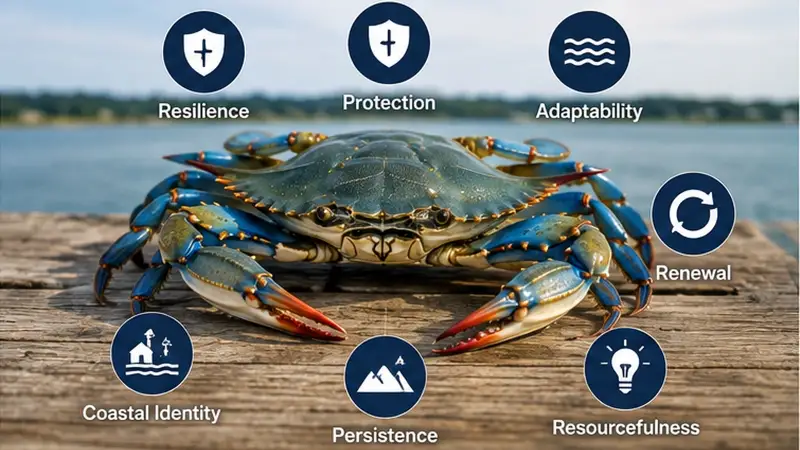
| Symbolic Meaning | Blue Crab Trait | Modern Interpretation |
|---|---|---|
| Resilience | Survives changing estuarine conditions | Enduring difficult periods |
| Protection | Hard shell and claws | Strong personal boundaries |
| Adaptability | Uses habitats with different salinity levels | Adjusting to change |
| Renewal | Molts repeatedly while growing | Leaving an old stage behind |
| Resourcefulness | Eats varied foods and uses varied habitats | Making use of what is available |
| Persistence | Migrates and survives demanding life stages | Continuing through uncertainty |
| Coastal identity | Strong Chesapeake cultural connection | Home, heritage, and regional pride |
These meanings are mostly contemporary interpretations rooted in recognizable biology and regional culture rather than a single ancient belief system.
Blue Crab Symbolism of Resilience
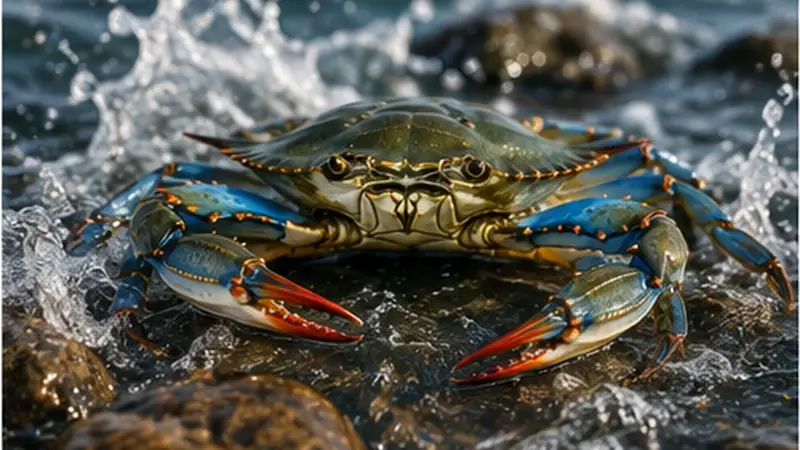
Resilience is one of the easiest meanings to connect with the blue crab.
Blue crabs live in estuaries where environmental conditions are constantly changing. In the Chesapeake Bay, they occupy habitats ranging from shallow brackish water to deeper, saltier areas. Distribution also changes according to age, sex, season, and water temperature.
Young crabs pass through multiple vulnerable stages before becoming adults. Adults face predators, fishing pressure, temperature changes, habitat limitations, and competition from other crabs.
That life history creates a useful metaphor for continuing despite unstable surroundings.
Someone may use blue crab imagery to represent:
- recovering after hardship
- adapting to a new home
- surviving financial or career uncertainty
- continuing after personal loss
- functioning when circumstances keep changing
The symbolic message is not that resilience makes life easy.
It is that survival often depends on responding to changing conditions instead of expecting those conditions to remain comfortable.
Protection, Claws, and Personal Boundaries
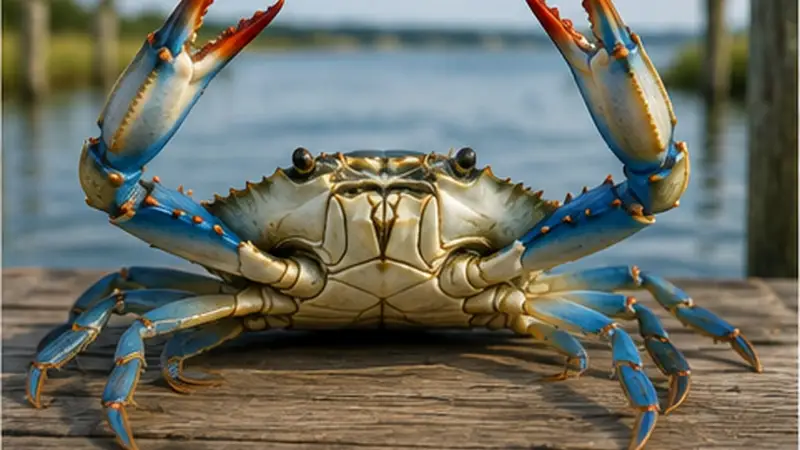
Crab symbolism has long been easy to connect with defense because the animal carries its protection with it.
A blue crab’s hard outer shell protects vulnerable tissues, while its claws can deter predators or competitors. Crabs may raise their claws when threatened, making the warning unmistakable.
That behavior creates a natural symbol of personal boundaries.
A blue crab can represent:
Self-protection. Recognizing when vulnerability needs limits.
Assertiveness. Making discomfort clear instead of silently tolerating everything.
Courage. Being willing to defend yourself despite limited size.
Discernment. Knowing when to withdraw and when to stand your ground.
This symbolism does not require interpreting the crab as aggressive.
Protection and aggression are different things.
A healthy version of blue crab symbolism suggests being approachable when conditions are safe while still having a clear response when a boundary is crossed.
Molting, Growth, and the Meaning of Renewal
Blue crabs must molt in order to grow.
During molting, the crab sheds its old exoskeleton. The new shell beneath it initially remains soft, producing what people in the Chesapeake region know as a soft-shell crab. The shell gradually hardens afterward.
This biological process provides a remarkably direct metaphor for transformation.
Growth requires the crab to leave behind a structure that once protected it.
For humans, that can symbolize:
outgrowing an old identity,
leaving familiar routines,
changing relationships,
moving into adulthood,
starting a new career,
or rebuilding after major life changes.
The most interesting part of the metaphor is vulnerability.
Immediately after shedding its shell, the crab is less protected.
Personal growth can feel similar. Leaving an old role or familiar environment may create a period when a person feels exposed before new confidence develops.
Blue crab symbolism therefore suggests that temporary vulnerability can be part of genuine growth.
Adaptability and Moving Between Different Worlds
The Chesapeake Bay is an estuary, meaning freshwater from rivers mixes with saltwater from the ocean.
Blue crabs are remarkably suited to this environment. Different sexes and life stages use different parts of the Bay, and females migrate toward saltier waters when preparing to spawn. Larvae develop in high-salinity coastal waters before later stages return toward the estuary.
This gives the blue crab a particularly strong symbolism of adaptability.
It does not survive by insisting that one environment remain unchanged.
It moves.
It adjusts.
It uses different habitats at different stages of life.
As a human metaphor, that can represent being able to function in more than one social, professional, or cultural environment.
Someone may feel connected with blue crab symbolism after:
moving between countries,
changing careers,
joining a new community,
learning unfamiliar responsibilities,
or balancing several identities at once.
Adaptability here does not mean losing identity.
The crab remains the same species while navigating very different conditions.
Sideways Movement and Unconventional Progress
Crabs are famous for moving sideways.
Blue crabs can move in several directions, but their flattened bodies and leg structure make lateral movement particularly natural.
That distinctive motion has inspired one of the more playful modern interpretations of crab symbolism: progress does not always have to be direct.
Human culture often imagines success as a straight line:
start,
move forward,
arrive.
Real life is rarely that simple.
People change careers, pause education, relocate, recover from setbacks, return to old goals, or take indirect routes toward something important.
The blue crab provides a useful metaphor for that kind of movement.
Going sideways is still movement.
Changing approach is not necessarily failure.
Sometimes the most practical path toward a goal does not look like direct progress from the outside.
Resourcefulness and Making Use of What Is Available
Blue crabs are opportunistic feeders.
They eat a wide variety of material, including clams, oysters, mussels, smaller crustaceans, fish, plant material, detritus, and even other blue crabs.
That flexible diet supports modern symbolism involving resourcefulness.
Resourcefulness means working effectively with what is actually available rather than waiting indefinitely for ideal conditions.
A blue crab can therefore symbolize:
using limited resources intelligently,
finding another solution when the first fails,
making opportunities from imperfect circumstances,
and developing practical rather than glamorous strengths.
This interpretation fits the animal particularly well because estuarine life itself involves fluctuation.
Food, temperature, water conditions, and habitat can change.
The crab survives partly because it is capable of responding to variety.
Blue Crab Symbolism in Chesapeake Bay Culture
Few American animals are more closely identified with one regional landscape than the blue crab is with Chesapeake Bay.
The Chesapeake Bay Program calls it the Bay’s signature crustacean and one of the most recognizable animals in the watershed. NOAA’s scientific literature has likewise described the blue crab as a regional symbol as well as an economically important seafood species.
That cultural position gives the blue crab meanings that extend well beyond biology.
In Maryland and Virginia, blue crab imagery can evoke:
summer,
waterfront communities,
crab houses,
family gatherings,
working boats,
commercial watermen,
recreational crabbing,
and life around the Chesapeake.
For someone raised near the Bay, a blue crab image may mean home more strongly than resilience or transformation.
Symbols do not always need spiritual meanings.
Sometimes geography, food, family memory, and cultural identity create stronger symbolism than mythology.
Maryland Identity and the Blue Crab
Maryland has an especially close relationship with the blue crab.
The species is officially recognized as Maryland’s state crustacean, reflecting its cultural, ecological, and economic importance.
Blue crab imagery appears widely in Maryland culture on clothing, signs, souvenirs, artwork, sports-related designs, restaurants, festivals, and coastal decor.
This gives the crab a civic meaning similar to the way certain animals become associated with particular states.
For Marylanders, the blue crab can symbolize:
Regional pride. A recognizable marker of where someone comes from.
Tradition. Family meals, crabbing trips, and seasonal rituals.
Livelihood. Generations of commercial fishing communities.
The Chesapeake. A landscape central to the state’s identity.
A Maryland flag combined with a blue crab strengthens that meaning even further.
In this context, the crab is not primarily a mystical object.
It is a cultural emblem.
Blue Crab Symbolism of Home and Belonging
Because the crab is so strongly associated with Chesapeake life, it can also symbolize belonging.
Someone who moves away from Maryland may wear blue crab jewelry, display crab artwork, or choose a crab tattoo as a reminder of home.
This kind of symbolism works through memory.
The crab can evoke:
the smell of salt and marsh water,
summer gatherings,
wooden picnic tables,
waterfront towns,
boats,
family recipes,
or childhood trips to the Bay.
That emotional symbolism is highly personal.
Two people may see the same blue crab and interpret it differently.
One sees resilience.
Another sees a seafood industry.
Someone else sees their hometown.
This demonstrates an important feature of modern symbolism: objects gain meaning from repeated human experience as much as from ancient stories.
Blue Crab Symbolism in Tattoos
Blue crab tattoos can carry several distinct meanings.
A realistic blue crab may symbolize Chesapeake heritage, coastal identity, or love of marine life.
A crab with raised claws can emphasize protection, courage, and boundaries.
A molting crab or split-shell design can represent transformation and starting again.
A blue crab with the Maryland flag strongly signals state pride and regional identity.
A crab surrounded by waves or marsh grass can represent attachment to coastal environments.
A memorial design may reference a relative who worked on the water, loved crabbing, or shared family traditions centered around Chesapeake seafood.
The crab’s symmetrical shape also makes it visually effective in tattoo art.
Because blue crab tattoos do not have one standardized meaning, the wearer’s personal connection usually matters more than any generic symbolism list.
Spiritual Meaning of Blue Crab Symbolism
In contemporary spiritual interpretation, blue crabs are sometimes associated with emotional protection, adaptability, intuition, renewal, boundaries, and movement through changing circumstances.
The water connection contributes significantly to these meanings.
Modern symbolism frequently uses water as a metaphor for emotion, uncertainty, memory, or change. Because blue crabs live in estuaries where freshwater and saltwater mix, they fit especially well with the idea of navigating emotionally complicated situations.
A grounded spiritual interpretation might use the blue crab as a reminder to:
protect emotional boundaries,
accept necessary change,
remain flexible,
or understand that growth can involve temporary vulnerability.
These ideas can be personally meaningful without claiming that seeing a blue crab objectively predicts future events.
Blue Crab Symbolism and the Meaning of Color
The word blue naturally adds another layer to the animal’s symbolism.
In modern American culture, blue often carries associations with:
calm,
water,
trust,
sadness,
distance,
stability,
and reflection.
Blue crabs are not uniformly bright blue, the shell is generally blue-green or olive, but the vivid blue coloration of their claws and legs gives the species its familiar name.
When artists exaggerate those blue tones, they can strengthen meanings of water, peace, emotional depth, or coastal life.
The color should not be treated as an ancient spiritual code attached specifically to this species.
It is better understood as an additional modern visual association layered onto the crab’s existing symbolism.
Ecology, Interdependence, and Environmental Meaning
Blue crabs occupy an important position in the Chesapeake Bay food web.
They are predators of bottom-dwelling animals while also serving as prey for fish, birds, and sea turtles. NOAA identifies them as a keystone species within the Bay ecosystem.
That ecological role supports another modern meaning: interdependence.
A blue crab does not exist separately from its environment.
Its survival is tied to:
underwater grass beds,
water quality,
prey populations,
predators,
salinity,
temperature,
and human harvest.
That makes the species an effective symbol of systems in which every participant affects others.
For modern environmental symbolism, the blue crab can represent the idea that protecting one species often means protecting an entire habitat.
Conservation Has Changed Blue Crab Symbolism
Blue crab abundance naturally changes from year to year, but fishing pressure, habitat loss, water quality, climate conditions, and ecological change all affect the population.
The 2026 Chesapeake Bay winter dredge assessment estimated approximately 349 million blue crabs in the Bay. That was higher than the previous year but still below the long-term 1990–2025 average. The adult female population was also below the management target, leading scientists to recommend continued caution in fishery management.
This adds a modern conservation layer to blue crab symbolism.
The animal now represents not only abundance and livelihood but also responsibility.
A valuable natural resource can support culture and commerce only if ecological limits are respected.
The blue crab therefore becomes a symbol of balance between:
harvesting and protecting,
tradition and science,
economic use and long-term sustainability.
That meaning is especially important in Chesapeake communities whose identity and livelihoods depend on a healthy Bay.
Positive and Negative Meanings of Blue Crab Symbolism
Blue crab symbolism can be interpreted in more than one direction.
Positive meanings
Resilience: enduring environmental change.
Protection: maintaining firm boundaries.
Adaptability: adjusting to different circumstances.
Renewal: growing by leaving an old shell behind.
Resourcefulness: using available opportunities effectively.
Belonging: maintaining connection with home and community.
Persistence: continuing through complicated life stages.
Negative meanings
Defensiveness: treating every situation as a threat.
Emotional armor: protecting yourself so strongly that connection becomes difficult.
Indirectness: avoiding a problem instead of addressing it directly.
Conflict: using defensive power unnecessarily.
Overattachment: refusing to leave an old shell after it no longer fits.
These interpretations show why symbolism depends on balance.
A protective shell is useful.
Permanent emotional armor can become limiting.
Taking an indirect path may be strategic.
Avoiding every direct conversation may not be.
Common Misunderstandings About Blue Crab Symbolism
The first misconception is that the blue crab has one universal ancient spiritual meaning.
It does not.
Most widely repeated ideas about resilience, boundaries, renewal, and adaptability are modern symbolic interpretations based on real crab behavior.
Another mistake is assuming the blue crab is unique to Chesapeake Bay.
Its native range extends along the Atlantic coasts of the Americas from Nova Scotia southward into South America, including Gulf waters. The Chesapeake is simply one of the places where the species has become especially culturally and economically important.
A third misconception is assuming the animal is truly blue all over.
Its shell is usually blue-green or olive, while the claws and portions of the legs display the most striking blue coloration. Mature females may have red claw tips.
Finally, “soft-shell crab” is not another species.
It is a blue crab that has recently molted and whose new shell has not yet hardened.
How Blue Crab Symbolism Has Evolved
Blue crab meaning developed through a combination of ecology, livelihood, regional culture, and modern personal interpretation.
At the biological level, molting, defensive claws, swimming ability, varied habitat use, and estuarine life provide natural metaphors for transformation, protection, and adaptability.
The Chesapeake added another layer.
Fishing and seafood traditions turned the blue crab into a recognizable cultural and economic icon. NOAA describes it as both a regional symbol and an important commercial species.
Maryland civic identity strengthened the association further by adopting the blue crab as the state crustacean.
Modern environmental awareness has added yet another meaning.
Today, sustaining blue crab populations requires cooperation among scientists, fisheries managers, watermen, recreational crabbers, conservation organizations, and governments.
The blue crab therefore now represents something broader than survival.
It can represent the relationship between people, place, culture, and a living ecosystem.
Frequently Asked Questions
What does a blue crab symbolize spiritually?
In modern spiritual interpretation, a blue crab commonly symbolizes resilience, protection, adaptability, emotional boundaries, and personal renewal. Its connection with water may also encourage associations with emotions and navigating changing circumstances.
What does a blue crab tattoo symbolize?
A blue crab tattoo can represent resilience, transformation, protection, coastal identity, or love of Chesapeake Bay. In Maryland, it often carries a particularly strong meaning of state pride, home, and regional heritage.
Why does the blue crab symbolize transformation?
Blue crabs grow by shedding their old exoskeleton through molting. Because the crab becomes temporarily soft and vulnerable before its new shell hardens, the process provides a natural metaphor for growth that requires leaving old protection behind.
Does a blue crab symbolize protection?
Yes, protection is a natural modern interpretation. Its hard shell and defensive claws provide an intuitive metaphor for personal boundaries, self-defense, and protecting vulnerable parts of oneself.
What does a blue crab symbolize in Maryland?
In Maryland, the blue crab represents Chesapeake Bay culture, regional pride, seafood traditions, commercial fishing, and coastal identity. It is officially designated as the state crustacean.
Is seeing a blue crab a good sign?
There is no scientifically established supernatural meaning to seeing a blue crab. Someone may personally interpret the encounter as a reminder to adapt, protect boundaries, accept change, or reconnect with a coastal place that matters to them.
Is blue crab symbolism positive or negative?
It is mostly positive when associated with resilience, adaptability, renewal, protection, and belonging. Negative interpretations can include excessive defensiveness, emotional withdrawal, indirect behavior, or refusing to change when an old form of protection no longer works.
Conclusion
Blue crab symbolism most naturally represents resilience, adaptability, protection, renewal, resourcefulness, and the ability to maintain boundaries while navigating changing conditions. Its life cycle gives those meanings a particularly clear foundation: the crab grows by abandoning an old shell, temporarily becoming vulnerable, and building protection again.
For Americans, especially around Chesapeake Bay, the symbol carries another layer that biology alone cannot explain. Blue crabs represent Maryland pride, working waterfronts, family food traditions, summer recreation, regional livelihood, and a Bay whose ecological health directly affects the communities around it.
Its most grounded modern message is simple: growth may require leaving familiar protection behind, but adaptability, strong boundaries, and connection to place can help carry you through the change.