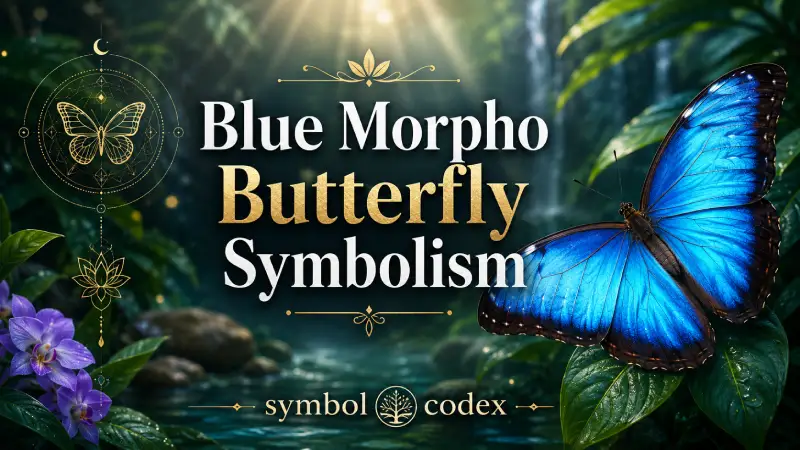
Blue morpho butterfly symbolism commonly represents transformation, hope, renewal, freedom, individuality, changing perspective, and hidden beauty. These meanings combine the familiar life-cycle symbolism of butterflies with the blue morpho’s extraordinary iridescent wings, which can appear intensely blue in one moment and far darker when viewed from another angle.
Blue morphos are tropical American butterflies rather than native symbols of the United States. Several species and subspecies are commonly called blue morphos, with the best-known forms living from Mexico through Central America and into South America. Americans most often encounter them in butterfly conservatories, museums, nature documentaries, photography, jewelry, tattoos, and tropical-themed art.
Their appearance also provides an unusually fitting metaphor for perspective. The spectacular blue is largely structural color created when microscopic features of the wing scales interact with light. The color therefore depends partly on how light reaches the wing and how the observer sees it.
Quick Answer
Blue morpho butterfly symbolism most commonly represents transformation, hope, renewal, freedom, individuality, and gaining a new perspective on life. Its metamorphosis makes it a natural symbol of major personal change, while its shifting blue wings suggest that beauty, identity, and understanding can look different when circumstances or perspectives change.
TL;DR
- Blue morphos symbolize transformation, hope, renewal, freedom, and individuality.
- Their changing iridescence suggests perspective and hidden complexity.
- Metamorphosis represents major transitions and personal growth.
- Blue adds associations with calm, reflection, and emotional depth.
- Tattoos often symbolize recovery, freedom, or a new life chapter.
- Most familiar meanings today are modern rather than universal ancient beliefs.
What a Blue Morpho Butterfly Really Is
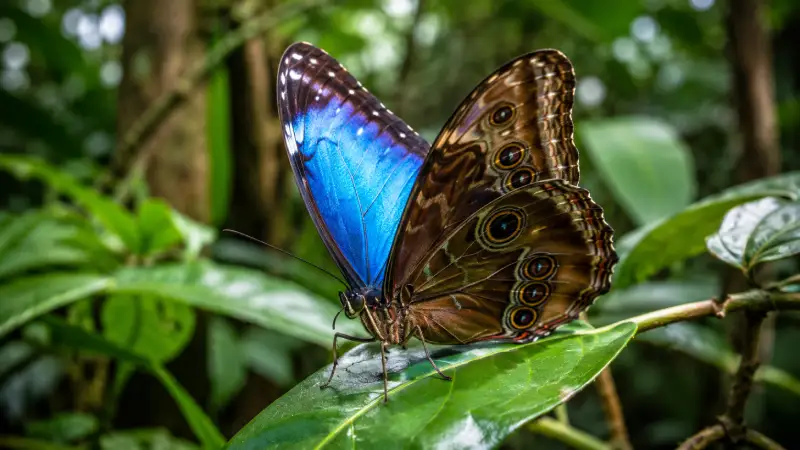
The name blue morpho does not refer to only one butterfly.
Several members of the genus Morpho display striking blue coloration. One particularly familiar form is Morpho helenor peleides, historically also called Morpho peleides in many collections and publications.
These butterflies belong to the family Nymphalidae and are native to the Neotropics. The common blue morpho occurs across parts of Mexico, Central America, and South America, where it inhabits tropical forest environments.
Blue morphos are large butterflies. Depending on the form being discussed, their wingspan may reach approximately five to eight inches.
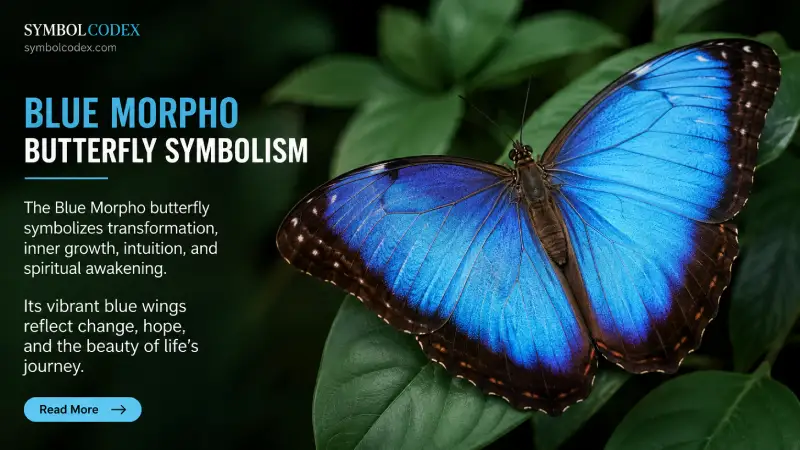
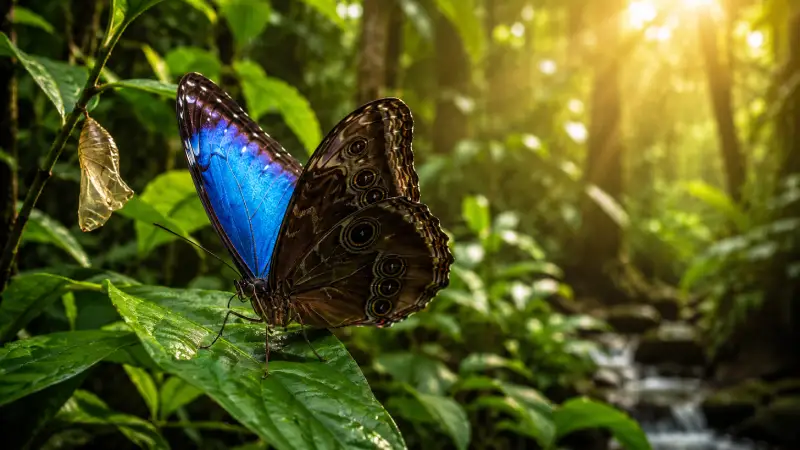
The upper wings of males can appear brilliantly blue, while females of familiar blue morpho forms generally show more brown with smaller areas of blue. The underside provides an even greater contrast: it is predominantly brown and patterned with conspicuous eyespots.
This gives the butterfly two dramatically different visual identities.
With its wings open, it can look almost electric.
With them closed, it can resemble dry vegetation or forest shadows.
That contrast explains much of its modern symbolism.
Blue Morpho Butterfly Symbolism: 7 Powerful Core Meanings
| Symbolic Meaning | Blue Morpho Trait | Modern Interpretation |
|---|---|---|
| Transformation | Complete metamorphosis | Becoming a different version of yourself |
| Renewal | Emergence as an adult butterfly | Beginning a new chapter |
| Hope | Brilliant flashes of blue | Finding possibility during difficulty |
| Freedom | Active flight | Release and personal independence |
| Perspective | Iridescence changes with viewing conditions | Seeing situations differently |
| Individuality | Extraordinary appearance | Accepting distinctive qualities |
| Hidden beauty | Brown underside contrasts with blue upper wings | Value that is not always immediately visible |
These meanings are mainly modern interpretations derived from butterfly biology, appearance, color symbolism, and personal use rather than one universal ancient blue morpho tradition.
Blue Morpho Butterfly Symbolism of Transformation
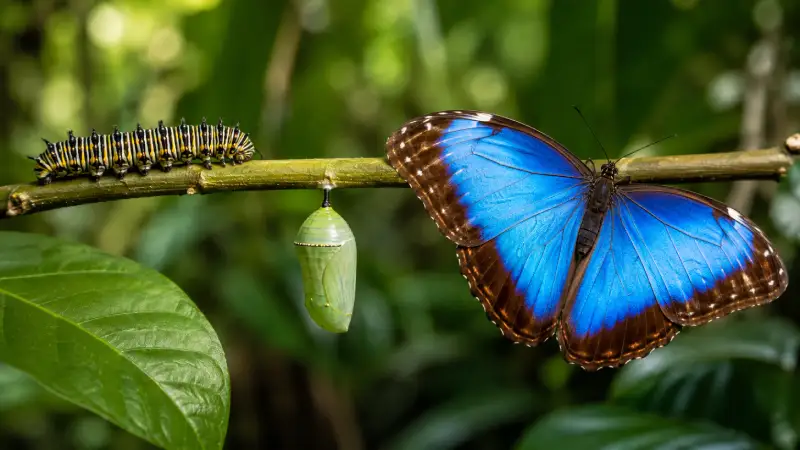
Transformation is the strongest and most familiar symbolic meaning.
Like other butterflies, blue morphos undergo complete metamorphosis:
egg → caterpillar → chrysalis → adult butterfly
The caterpillar and adult look so different that someone unfamiliar with insect development might not immediately recognize them as stages of the same animal.
That makes the butterfly one of the clearest natural metaphors for profound personal change.
A blue morpho may symbolize:
- recovering after hardship
- entering adulthood
- changing careers
- leaving an unhealthy relationship
- rebuilding confidence
- moving somewhere new
- developing a new identity
- beginning life after loss
Transformation is different from ordinary improvement.
It suggests that an experience has changed how a person understands themselves or moves through the world.
The caterpillar does not simply become a larger caterpillar. Its body is reorganized into something that lives differently.
For that reason, blue morpho imagery often fits turning points more naturally than routine progress.
Renewal, New Beginnings, and Starting Again
Transformation and renewal overlap, but they are not identical.
Transformation means becoming different.
Renewal means entering a fresh period after something has ended or become exhausted.
The adult butterfly emerging from the chrysalis naturally supports both ideas.
In modern personal symbolism, a blue morpho can represent the first stage of life after:
divorce,
graduation,
recovery,
relocation,
grief,
a major career change,
or the end of a difficult period.
The symbol does not imply that the past disappears.
A butterfly’s adult form exists because of everything that occurred before it.
This creates a more grounded meaning of renewal: a new beginning does not erase the earlier stages that made it possible.
Hope and Finding Color During Difficult Periods
The blue morpho’s visual impact often comes from contrast.
In a green or shadowed tropical forest, its moving wings can produce sudden flashes of bright blue. When the wings close, much of that brilliance seems to disappear.
Modern symbolism easily transforms this into an image of hope appearing within uncertainty.
The important point is that the surroundings do not need to become perfect.
The butterfly simply introduces a moment of color into them.
This makes blue morpho symbolism particularly appropriate for hope after:
grief,
loneliness,
failure,
illness,
uncertainty,
or emotional exhaustion.
The symbolism is less about guaranteeing a happy outcome and more about recognizing that difficult circumstances can still contain meaningful moments, opportunities, relationships, or reasons to continue.
Hope becomes a flash of possibility rather than denial of reality.
Iridescence and the Meaning of Changing Perspective
One of the blue morpho’s most fascinating traits is that its blue appearance is produced primarily by microscopic structure rather than ordinary blue pigment.
The wing scales contain nanoscale structures that reflect particular wavelengths of light. Their physical arrangement produces the brilliant blue associated with morphos.
This creates an unusually precise metaphor for perspective.
Move the butterfly.
Change the light.
Change the viewing angle.
Its appearance changes.
As personal symbolism, the blue morpho can therefore represent learning that a situation may look different when approached from another position.
A setback might later reveal a useful lesson.
A disagreement may make more sense after hearing another person’s experience.
Something initially perceived as weakness may become valuable in a different environment.
The butterfly does not physically become a different creature each time its color shifts.
What changes is the interaction between structure, light, and observer.
That makes the blue morpho a particularly strong symbol of the idea that perspective can change experience without rewriting reality.
Blue Color Symbolism: Calm, Trust, and Emotional Depth
The blue itself adds another layer of modern interpretation.
In American visual culture, blue frequently suggests:
calm,
trust,
reflection,
water,
open sky,
distance,
sadness,
and emotional depth.
Those associations vary according to shade and context.
The intense blue of a morpho can feel more energetic than a pale blue sky, while the metallic quality adds something unusual and almost unreal.
For that reason, blue morpho symbolism often combines two qualities that might otherwise seem contradictory:
calm and intensity.
Someone may choose the butterfly as a personal symbol because they identify with a quiet exterior and a highly expressive inner life.
Others may associate its color with emotional recovery, clarity, or finding calm after a turbulent period.
These color meanings are contemporary associations rather than universal spiritual rules.
Hidden Beauty and the Butterfly’s Two Different Sides
The underside of a blue morpho’s wings looks very different from the shimmering upper surface.
It is generally brown and patterned with prominent eyespots. This provides camouflage when the butterfly rests with its wings closed and can also help deter or confuse predators.
Visually, that produces a striking metaphor.
The same butterfly can look ordinary, earthy, or nearly hidden one moment and spectacularly blue the next.
Modern symbolism may interpret this as hidden beauty.
It can represent someone whose most interesting qualities are not immediately visible.
That may include:
private creativity,
emotional complexity,
intelligence,
humor,
strength developed through hardship,
or an identity revealed only around trusted people.
The interpretation can also work in reverse.
The brilliant outer appearance does not reveal everything about the animal.
Beauty itself is only one side.
The brown underside performs a practical survival function.
Blue morpho symbolism therefore suggests that identity can contain multiple valid sides without either one being false.
Freedom, Movement, and Letting Go
Butterflies commonly symbolize freedom because flight allows them to move through space in ways humans cannot.
The blue morpho strengthens this association because its color becomes especially conspicuous in motion.
Its symbolism can therefore represent:
leaving restriction,
choosing independence,
moving beyond an old identity,
allowing change,
or becoming willing to explore.
This meaning is particularly common in tattoo designs.
A blue morpho flying upward may symbolize release.
Several butterflies moving away from one point can represent leaving the past.
A butterfly shown with an open cage, broken chain, or fading background can intensify the theme of liberation.
Freedom does not always mean leaving people behind.
It can mean becoming free from:
fear,
self-doubt,
old expectations,
resentment,
or the need for constant approval.
Emotional Meaning: Becoming Visible Again
The blue morpho can have a particularly strong emotional meaning after periods in which someone has felt hidden.
Its brilliant color appears most dramatically when its wings are open and moving.
That creates a modern metaphor for allowing yourself to become visible again.
Someone recovering from rejection, grief, social isolation, or damaged confidence may identify with the idea of gradually returning to the world.
The symbolism can represent:
speaking more openly,
wearing expressive clothing again,
trying new experiences,
forming relationships,
sharing creative work,
or becoming comfortable receiving attention.
This is not the same as demanding visibility.
The blue morpho can close its wings and become visually subdued again.
Its symbolism therefore allows both expression and privacy.
A person can become more visible without giving up the right to decide what remains private.
Blue Morpho Butterfly Symbolism in Modern American Culture
Blue morphos are not native throughout the United States, but they are highly familiar to American audiences.
Live specimens are commonly displayed in butterfly conservatories and museum exhibits, including institutions such as the Florida Museum of Natural History and Smithsonian-associated collections.
Their size and color make them especially memorable in these environments.
As a result, American blue morpho symbolism is shaped more by encounter, imagery, and personal interpretation than by an old national tradition.
Today the butterfly appears in:
tattoos,
jewelry,
wall art,
fashion,
memorial designs,
wedding decor,
social media imagery,
wellness branding,
and nature photography.
Its meaning usually combines butterfly transformation with blue color symbolism and the remarkable visual effect of iridescence.
For an American audience, the strongest reading is usually personal rather than religious.
Cultural Meaning and Why Universal Claims Need Caution
Blue morphos are native to regions inhabited by many distinct Indigenous peoples and cultures.
That geographic fact does not establish one universal Indigenous blue morpho meaning.
Central and South America contain enormous linguistic, religious, and cultural diversity. Butterfly imagery can carry meaning within particular traditions, stories, artworks, or communities, but those meanings should not automatically be transferred to every blue morpho or every Indigenous culture.
This distinction matters because modern symbolism websites frequently make broad statements such as:
“the blue morpho universally represented the soul,”
or
“ancient tribes believed it guaranteed transformation.”
Claims like these need specific cultural and historical evidence.
Without that context, the most accurate approach is to distinguish documented traditions from newer spiritual symbolism.
The blue morpho does not need an invented ancient story to be meaningful.
Its real biology already provides unusually strong metaphors for change, perspective, visibility, and renewal.
Blue Morpho Butterfly Symbolism in Tattoos
Blue morpho tattoos are especially popular because the insect works visually and symbolically at the same time.
Common meanings include:
Transformation. A major change in identity or circumstances.
Recovery. Surviving emotional or physical hardship.
Freedom. Breaking away from restriction.
Hope. Continuing during an uncertain period.
Individuality. Becoming comfortable with standing out.
New beginnings. Marking a major life transition.
Perspective. Learning to view life differently.
Color is particularly important.
Bright electric blue emphasizes visibility, confidence, and wonder.
Turquoise may create a calmer or more ocean-like feeling.
Dark blue can make the design more reflective or serious.
A tattoo combining the brown underside and brilliant upper wing can emphasize two sides of identity.
Memorial blue morpho tattoos may represent someone whose influence continues after death, although that meaning comes from personal remembrance rather than a universal tradition.
Jewelry, Art, and Personal Style
Blue morpho imagery translates naturally into jewelry because of its symmetry and color.
Butterfly pendants, earrings, rings, brooches, and decorative objects often emphasize transformation and beauty.
In personal style, the butterfly can also communicate individuality.
The blue morpho is unmistakable without being aggressive.
It attracts attention through appearance rather than threat.
That makes it an appealing symbol for someone who wants to express confidence, creativity, or distinctiveness without using imagery associated with dominance.
In home decor, blue morpho imagery often creates a tropical, natural, or reflective atmosphere.
In memorial art, it can represent transition or continuing memory.
In wedding imagery, it may symbolize entering a new life stage.
The context determines which meaning is strongest.
Spiritual Meaning of Blue Morpho Butterfly Symbolism
In contemporary spiritual culture, blue morphos are often associated with transformation, intuition, hope, emotional healing, freedom, and spiritual growth.
These meanings can function effectively as personal metaphors.
They should not, however, be presented as scientifically proven messages.
Seeing a blue morpho does not objectively predict:
romance,
wealth,
pregnancy,
death,
good luck,
or a spiritual awakening.
Someone may still use the encounter meaningfully.
For example, seeing one during a difficult trip or important life transition could become personally associated with hope.
The symbolism belongs to the person’s interpretation rather than to a measurable supernatural property of the butterfly.
A grounded spiritual reading might be:
change is possible, perspective matters, and beauty can become visible under different conditions.
Life Cycle Symbolism: Growth Is Not Always Visible
Butterfly metamorphosis also provides a useful metaphor for changes that other people cannot see.
During the pupal stage, the animal may appear inactive from the outside.
Internally, however, enormous biological reorganization is taking place.
Human growth can work similarly.
Someone may spend months:
studying,
recovering,
planning,
learning,
grieving,
or reconsidering their priorities
without showing dramatic external results.
Blue morpho symbolism can therefore represent private development before visible change.
This is especially relevant in a culture that often rewards visible progress.
Not every meaningful stage produces something immediately impressive.
Sometimes the transformation occurs before anyone else can recognize it.
Ecology and the Meaning of Connection
Blue morphos do not exist independently from tropical forests.
Caterpillars depend on host plants. Adults interact with food sources and predators, while their survival depends on functioning habitat.
The common blue morpho is associated with tropical forests and forest-edge environments across its range. Adults are also known for feeding on fermenting or decaying fruit rather than depending only on flower nectar.
This ecological reality adds another modern meaning: connection.
Transformation may happen to an individual butterfly, but the individual still depends on a larger living system.
For humans, that can serve as a reminder that independence and connection are not opposites.
People transform partly through relationships, environments, opportunities, education, and communities.
The butterfly may look like a symbol of personal freedom, but its real life remains deeply connected to habitat.
Positive and Negative Meanings of Blue Morpho Butterfly Symbolism
Blue morpho symbolism is overwhelmingly positive, but it can have cautionary interpretations too.
Positive meanings
Transformation: becoming capable of living differently.
Hope: recognizing possibilities during difficulty.
Renewal: beginning again.
Freedom: releasing unnecessary restrictions.
Individuality: being comfortable with distinctive qualities.
Perspective: understanding that viewpoint affects experience.
Hidden beauty: recognizing value beyond first impressions.
Negative or cautionary meanings
Fragility: beautiful phases may be temporary.
Escapism: freedom can become avoidance of responsibility.
Appearance: visual beauty can distract from deeper qualities.
Restlessness: constant change can become difficulty committing.
Idealization: transformation symbolism can make real recovery seem easier than it is.
The most useful symbolism allows for both sides.
Change can be beautiful and difficult.
Freedom can be liberating and uncertain.
Becoming visible can feel exciting and vulnerable at the same time.
Common Misunderstandings About Blue Morpho Butterfly Symbolism
One common misconception is that blue morpho names one single species.
Several morpho butterflies are described by that common name, and taxonomic treatments can differ.
Another mistake is assuming their wings simply contain strong blue pigment.
The intense blue is primarily structural, produced by microscopic features that interact with light.
A third misconception is that both sides of the wings are brilliant blue.
The underside is largely brown and patterned with eyespots, giving a dramatically different appearance when the wings close.
It is also misleading to assign every modern spiritual interpretation an ancient origin.
Ideas involving “manifestation,” guaranteed luck, precise angelic messages, or predetermined relationship outcomes are modern beliefs unless tied to documented cultural evidence.
Finally, transformation does not mean a butterfly consciously chooses to reinvent itself.
Metamorphosis is biology.
The symbolic meaning comes from humans recognizing a useful metaphor in that biological process.
How Blue Morpho Butterfly Symbolism Has Evolved
The blue morpho’s modern symbolism developed from several layers.
The first is ordinary butterfly symbolism.
Metamorphosis naturally produced associations with transformation, renewal, and new beginnings.
The second is color.
Blue introduced modern associations involving calm, emotional depth, trust, and reflection.
The third is appearance.
The contrast between the brilliant upper wings and brown underside encouraged ideas about hidden beauty, multiple sides of identity, and the difference between appearance and reality.
Modern science added perhaps the most interesting layer.
Once researchers understood how microscopic structures produce morpho blue, the butterfly became an unusually fitting symbol of perspective itself. Its color is not simply painted onto the wing; its visual intensity emerges from physical structure interacting with light.
American museums, butterfly houses, photography, tattoos, and digital culture spread these meanings far beyond the butterfly’s native tropical range.
Today, blue morpho symbolism combines biology and human interpretation more naturally than many animal symbols.
Its strongest message is not simply “change.”
It is that change, perspective, and identity are often more complex than they first appear.
Frequently Asked Questions
What does a blue morpho butterfly symbolize spiritually?
In modern spiritual interpretation, a blue morpho butterfly commonly symbolizes transformation, hope, renewal, freedom, emotional growth, and changing perspective. These are contemporary symbolic meanings rather than one universal religious doctrine.
Is seeing a blue morpho butterfly a good sign?
There is no scientifically established supernatural meaning attached to seeing one. Someone may personally interpret the encounter as a positive reminder of change, hope, freedom, or a new beginning.
What does a blue morpho butterfly tattoo mean?
A blue morpho tattoo commonly represents transformation, recovery, individuality, freedom, hope, or entering a new stage of life. The exact meaning depends on the wearer and accompanying imagery.
Why does the blue morpho symbolize transformation?
Like other butterflies, it develops through complete metamorphosis from egg to caterpillar, pupa, and adult. Because the adult lives and looks dramatically differently from the caterpillar, its life cycle provides a natural metaphor for profound change.
What does the blue color of a morpho symbolize?
Modern color interpretation often connects blue with calm, reflection, trust, emotional depth, and openness. In the blue morpho specifically, its structural iridescence also supports symbolism involving perspective because its appearance changes with light and viewing conditions.
Does a blue morpho butterfly symbolize hope?
Yes, hope is a common modern interpretation. Its sudden flashes of intense blue and transformation from caterpillar to butterfly make it a fitting personal symbol for possibility after a difficult period.
Does the blue morpho represent a deceased loved one?
Some people personally use butterflies as memorial symbols and may interpret a blue morpho as representing remembrance, transition, or an enduring emotional bond. This is a personal or contemporary spiritual interpretation rather than a universal historical meaning.
Conclusion
Blue morpho butterfly symbolism most naturally represents transformation, renewal, hope, freedom, individuality, perspective, and beauty that is not always immediately visible. Its symbolism is unusually well supported by what the animal actually does and looks like: it changes dramatically through metamorphosis, displays two very different sides to its wings, and produces brilliant blue through microscopic structures interacting with light.
For a modern American audience, the blue morpho is primarily a symbol encountered through museums, butterfly conservatories, tattoos, jewelry, art, and nature imagery rather than an inherited national tradition. Its tropical American origins and real biology should remain separate from unsupported claims about universal ancient meanings.
The most grounded takeaway is simple: transformation can change how a person moves through life, and a change in perspective can reveal qualities that were present all along but difficult to see from the previous angle.