Beetle symbolism commonly represents resilience, transformation, protection, persistence, renewal, adaptability, and hidden strength. These meanings make sense for an extraordinarily diverse group of insects whose hardened wing covers, complete life-cycle transformations, varied survival strategies, and ability to occupy almost every terrestrial environment have made beetles symbols of endurance and change.
The beetle also has one of the most recognizable insect histories in ancient symbolism. In Egypt, the scarab beetle became closely associated with the rising sun, creation, regeneration, and rebirth. Modern Americans encounter beetle imagery differently, through tattoos, jewelry, gardens, museums, environmental conservation, insect photography, and species ranging from beneficial lady beetles to destructive invasive beetles.
Because there are hundreds of thousands of known beetle species, however, there is no single universal meaning shared by every beetle. Understanding the symbol requires separating ancient scarab traditions from broader modern interpretations.
Quick Answer
Beetle symbolism most commonly represents resilience, transformation, protection, persistence, adaptability, and renewal in modern culture. Historically, the Egyptian scarab gave certain beetles especially strong associations with creation, the rising sun, regeneration, and rebirth, while contemporary American meanings also draw from beetles’ ecological roles and remarkable diversity.
TL;DR
- Beetles commonly symbolize resilience, transformation, protection, and persistence.
- Their complete metamorphosis supports associations with personal change and renewal.
- Hardened wing covers inspire meanings of boundaries and hidden strength.
- Egyptian scarabs represented creation, solar renewal, and rebirth.
- American culture sees beetles as both beneficial wildlife and destructive pests.
- Tattoos often emphasize survival, transformation, individuality, or scarab imagery.
What Beetles Are and Why They Became Symbolic
Beetles belong to the insect order Coleoptera, one of the most diverse groups of animals on Earth. The Smithsonian lists roughly 350,000 described species and nearly 30,000 known kinds in the United States, while scientific estimates continue to change as new species are identified.
One of the beetle’s defining features is its pair of hardened front wings, called elytra. These protective covers lie over the softer flight wings and much of the abdomen.
That physical structure matters symbolically.
A beetle can appear heavily armored while protecting delicate working parts underneath. Humans easily turn that contrast into metaphors involving:
- emotional boundaries
- hidden vulnerability
- endurance
- self-protection
- inner strength
- surviving pressure
Beetles also display extraordinary diversity. Some are predators, some consume plants, some feed on fungi, and others use dung, carrion, or decaying wood. Their colors range from plain brown and black to brilliant metallic green, blue, gold, and red.
There is therefore no biologically typical “beetle personality.”
Modern beetle symbolism works best when it recognizes that variety.
Beetle Symbolism: 7 Powerful Core Meanings
| Meaning | Beetle Connection | Modern Interpretation |
|---|---|---|
| Resilience | Beetles thrive in remarkably varied habitats | Enduring difficult conditions |
| Transformation | Beetles undergo complete metamorphosis | Personal growth and new phases |
| Protection | Hardened elytra cover vulnerable wings | Boundaries and self-defense |
| Persistence | Many species navigate demanding environments | Continuing despite obstacles |
| Renewal | Adults emerge after larval and pupal stages | Beginning again |
| Adaptability | Beetles occupy highly diverse ecological niches | Adjusting successfully to change |
| Hidden strength | Small bodies can be highly specialized | Power that others may overlook |
These meanings are contemporary interpretations rather than universal ancient beliefs.
The major historical exception is the scarab, which developed specific religious and funerary meanings in ancient Egypt.
Beetle Symbolism of Transformation and Renewal
Transformation is one of the strongest modern beetle meanings.
Beetles undergo complete metamorphosis. Their lives move through four distinct stages:
egg → larva → pupa → adult
The larva may look so different from the adult that an unfamiliar observer would not immediately recognize them as the same species.
Complete metamorphosis creates a natural metaphor for major life changes. In symbolic language, the beetle can represent becoming something that the earlier version of yourself could not yet reveal.
That may include:
changing careers,
recovering after hardship,
leaving an old identity,
developing maturity,
or beginning again after loss.
The symbolism differs slightly from the butterfly.
Butterflies have become strongly associated with graceful, visible transformation. Beetle transformation can feel more grounded, private, and protective. Much of the change occurs away from public attention.
The beetle therefore suits the idea that important transformation does not always happen where other people can see it.
Protection, Armor, and Personal Boundaries
A beetle’s hardened outer structure creates an immediate impression of protection.
The elytra shield the functional flight wings beneath them, while the insect’s exoskeleton provides structural support and protection.
This makes beetle imagery particularly suited to personal boundaries.
Someone may choose the beetle as a symbol after learning to:
protect their emotional health,
become more selective about trust,
leave a harmful environment,
or defend their time and values.
The symbolism does not necessarily mean becoming emotionally closed.
A beetle’s protective exterior still contains functional wings.
That creates a more useful metaphor: protection should allow life to continue rather than prevent movement entirely.
Healthy boundaries preserve what matters while still allowing growth, relationships, and exploration.
Persistence, Survival, and Adaptability
Beetles are remarkably successful insects.
Their huge diversity reflects an equally broad range of survival strategies. Beetles occupy forests, deserts, grasslands, freshwater environments, farms, gardens, rotting wood, fungi, dung, and many other habitats. The Smithsonian describes representatives feeding on nearly every major type of terrestrial organic material.
This ecological flexibility supports modern meanings of adaptability and persistence.
The symbolic lesson is not that one strategy always works.
It is almost the opposite.
Different beetles survive because evolution has produced highly specialized solutions to very different problems.
For people, that can become a metaphor for changing methods when circumstances change.
A plan that worked five years ago may stop working.
A career may require new skills.
A difficult relationship may require stronger boundaries.
A setback may require a different route rather than more force.
Beetle symbolism therefore connects persistence with flexibility: keep going, but do not assume you must keep going in exactly the same way.
Scarab Beetle Symbolism in Ancient Egypt
No historical beetle symbol is more famous than the Egyptian scarab.
Ancient Egyptians observed dung beetles rolling balls across the ground and connected that movement with the sun’s daily journey across the sky. The scarab consequently became associated with the rising sun and the deity Khepri, as well as creation and regeneration.
The symbolism also reflected what Egyptians believed about the beetle’s life cycle.
Young beetles appeared to emerge from buried dung balls, encouraging an ancient interpretation that the creatures generated themselves. This apparent emergence from nothing strengthened associations with coming into being, renewal, and rebirth.
Scarabs became extremely popular as:
amulets,
seals,
jewelry,
funerary objects,
and decorative forms.
Some scarabs carried royal names or images of deities. Others emphasized protective or regenerative meanings.
Winged scarabs could strengthen the idea of protection, while funerary use connected scarab imagery with regeneration beyond death.
This is an important distinction: ancient Egyptian scarab symbolism belongs specifically to the scarab tradition, not automatically to every beetle species around the world.
Rebirth Versus Transformation in Beetle Symbolism
“Transformation” and “rebirth” are often used as though they mean exactly the same thing, but they can describe different symbolic ideas.
Transformation means changing form or identity.
The beetle’s biological metamorphosis supports this interpretation directly.
Rebirth suggests renewal after an ending.
That meaning is particularly strong in Egyptian scarab symbolism, where the beetle became connected with the sun’s repeated return and ideas of regeneration.
A modern tattoo can combine both.
Someone might choose a beetle after surviving a period that felt like the end of an earlier life. The insect can then represent both the internal process of change and the beginning that followed.
Keeping these meanings separate makes the symbol more precise.
Beetle Symbolism in the United States
Beetles do not have one dominant national symbolic role in the United States.
Americans encounter them through gardens, forests, farms, homes, wildlife education, museums, insect collecting, conservation, and pest management.
The experience can be positive or negative.
Lady beetles provide one positive example. Many species prey on aphids, scale insects, whiteflies, mites, and other agricultural or garden pests, which has made them valued biological-control insects.
Other beetles produce the opposite reaction.
The invasive emerald ash borer, first detected in North America in 2002, has killed or contributed to the decline of tens of millions of ash trees. As of 2026, USDA APHIS reported detections in 38 states and the District of Columbia.
These contrasting examples shape American beetle imagery.
Depending on context, a beetle can suggest:
a useful garden ally,
ecological diversity,
an invasive threat,
natural beauty,
or an insect quietly performing work people rarely notice.
The symbolism is therefore more complex than simply “good luck” or “strength.”
Beetles and the Meaning of Ecological Interdependence
Modern ecological knowledge has added an important meaning to beetle symbolism: interdependence.
Beetles participate in many ecological processes. Different species act as predators, scavengers, plant eaters, pollinators, decomposer-associated insects, seed feeders, and prey for larger animals.
Beetles were also among early pollinating insects, and relationships between flowering plants and beetles extend far back in evolutionary history. The Smithsonian notes that flowers such as magnolias retain characteristics that attract beetle pollinators today.
This gives the beetle a modern environmental meaning.
Small organisms can influence systems much larger than themselves.
A beetle moving pollen, consuming another insect, entering decaying material, or becoming food for a bird participates in relationships that extend beyond its own survival.
Symbolically, that can represent the idea that importance is not always visible.
A small contribution may influence an entire network.
Hidden Beauty and Beetle Symbolism
Not every beetle looks dark or plain.
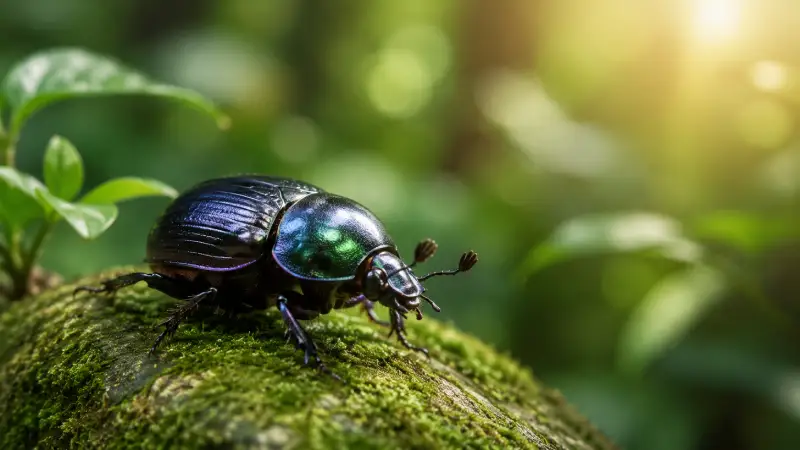
Jewel beetles and many other species possess brilliant metallic coloration in greens, blues, reds, golds, and purples.
Their appearance gives beetle symbolism another modern interpretation: beauty in overlooked places.
Many people instinctively associate beauty with flowers, birds, or butterflies while treating beetles simply as bugs.
A close view can overturn that assumption.
This makes colorful beetles useful symbols of:
individuality,
unconventional beauty,
being underestimated,
and finding value through closer observation.
The meaning is particularly suited to people who prefer unusual rather than conventional symbols.
A jewel beetle does not resemble a butterfly, yet its iridescence can be equally striking.
The symbolic message is not that everything must meet the same standard of beauty. It is that attention changes what we are capable of appreciating.
Emotional Meaning: Resilience Without Attention
Psychologically, beetle imagery can represent quiet survival.
Many familiar strength symbols are dramatic.
A lion roars.
An eagle soars.
A wolf appears against a mountain landscape.
A beetle’s strength is easier to miss.
It is small, close to the ground, and often unnoticed until someone deliberately looks for it.
That makes the beetle especially relevant to people who associate strength with:
enduring privately,
rebuilding without recognition,
working steadily,
or continuing without external praise.
The armored appearance can also symbolize emotional self-protection after difficult experiences.
Yet the wings beneath that armor provide an important counterbalance.
Protection does not have to become permanent withdrawal.
A useful emotional reading of the beetle is therefore protected but still capable of moving forward.
Beetle Symbolism in Tattoos
Beetle tattoos can carry dramatically different meanings depending on the species and design.
A scarab tattoo commonly emphasizes rebirth, protection, regeneration, or interest in ancient Egyptian art.
A jewel beetle can represent individuality, unusual beauty, transformation, or appreciation of nature.
A dark realistic beetle may emphasize resilience, mortality, endurance, gothic aesthetics, or connection with the earth.
A beetle with spread wings can suggest moving beyond restriction or revealing abilities that were previously hidden.
A design showing the life cycle can emphasize personal transformation.
Some tattoos have no spiritual meaning at all. Entomologists, insect collectors, gardeners, and nature enthusiasts may choose beetles simply because they admire the animals.
This is worth remembering whenever interpreting tattoos: personal meaning overrides generic symbolism lists.
Beetles in Jewelry and Modern Design
Beetles work especially well in jewelry because their symmetrical bodies, hard contours, and sometimes metallic coloration translate easily into decorative forms.
Modern jewelry frequently borrows from scarab shapes, while contemporary designers may also use jewel beetles or more naturalistic insect forms.
A beetle pendant can represent:
protection,
renewal,
personal transformation,
resilience,
or simply appreciation of insect beauty.
Scarab jewelry deserves special care.
Wearing a modern scarab-inspired piece does not reproduce all the religious meanings of an ancient Egyptian amulet. The original objects existed within specific systems of religion, kingship, death, protection, and regeneration.
Modern users can appreciate or personally reinterpret the form while still recognizing that historical context.
Spiritual Meaning of Beetle Symbolism
In contemporary spiritual culture, beetles are often associated with resilience, change, protection, persistence, grounding, or personal renewal.
These meanings can function effectively as personal metaphors.
For example, a person might use beetle imagery as a reminder to:
protect what matters,
adapt instead of breaking,
continue after setbacks,
or accept that change can happen privately before becoming visible.
However, claims that every beetle encounter predicts money, romance, spiritual awakening, or future events are not established facts.
The most responsible distinction is simple.
Symbolic interpretation can be personally meaningful.
Prediction requires evidence that symbolism does not provide.
The scarab is different in one respect: its religious meanings in ancient Egypt are historically documented. But even those meanings should not be automatically transferred to every modern beetle sighting.
Positive and Negative Meanings of Beetle Symbolism
Beetle symbolism contains both constructive and cautionary meanings.
Positive meanings
Resilience: enduring pressure and difficulty.
Transformation: moving into a different stage of life.
Protection: maintaining healthy boundaries.
Renewal: beginning again after an ending.
Persistence: continuing toward a worthwhile goal.
Adaptability: changing methods when environments change.
Individuality: valuing qualities others overlook.
Negative meanings
Defensiveness: becoming too emotionally armored.
Infestation: a small problem spreading when ignored.
Destruction: certain species can severely damage crops, forests, or stored materials.
Stagnation: protection becoming unwillingness to change.
Hidden problems: damage developing before it becomes visible.
The emerald ash borer provides a particularly clear American example of why beetles cannot be treated only as positive symbols: its larvae feed beneath ash bark, allowing serious damage to develop before infestations become obvious.
Context determines the symbolic reading.
Common Misunderstandings About Beetle Symbolism
The first mistake is treating every beetle as a scarab.
Scarabs are beetles, but the order Coleoptera contains hundreds of thousands of species with enormous biological differences. Egyptian scarab meanings cannot automatically be assigned to lady beetles, stag beetles, jewel beetles, or every beetle someone encounters.
Another misconception is assuming beetles are simply pests.
Many species are predators, pollinators, scavengers, or participants in important ecological relationships. Lady beetles, for example, can help suppress agricultural pests.
The opposite mistake is assuming all beetles are beneficial.
Some are serious agricultural, household, or forest pests, and invasive species can create enormous ecological and economic damage.
Finally, not every modern spiritual meaning is ancient.
Resilience, personal boundaries, and “hidden strength” are useful contemporary metaphors. They should not be presented as Egyptian teachings unless historical evidence actually supports that specific idea.
How Beetle Symbolism Has Evolved
Beetle symbolism has developed through several different layers.
The oldest famous layer comes from ancient Egypt.
Observation of scarab behavior became connected with the sun’s movement, creation, regeneration, and coming into being. Scarab-shaped amulets and seals carried those meanings across centuries of Egyptian history.
Modern biology created another layer.
Understanding metamorphosis, hardened elytra, extraordinary species diversity, ecological specialization, and beetle-plant relationships made transformation, protection, adaptability, and interdependence natural contemporary metaphors.
Modern American experience added still more complexity.
Gardeners may welcome lady beetles.
Forest managers battle emerald ash borers.
Artists photograph jewel beetles.
Museum visitors encounter Egyptian scarabs.
Tattoo wearers reinterpret the insect as a personal symbol of survival.
The beetle therefore no longer carries one simple meaning.
Its modern symbolism reflects a broader idea: something small, armored, and easily overlooked can contain extraordinary capacity for change and survival.
Frequently Asked Questions
What does a beetle symbolize spiritually?
In modern spiritual interpretation, a beetle commonly symbolizes resilience, transformation, protection, persistence, adaptability, and renewal. These meanings are mostly contemporary metaphors, while ancient Egyptian scarab symbolism has a specific documented connection with creation, solar renewal, and rebirth.
Is seeing a beetle a good sign?
There is no objective rule that makes seeing a beetle a supernatural good or bad omen. Someone may personally treat the encounter as a reminder to adapt, protect boundaries, or continue through a difficult period.
What does a beetle tattoo symbolize?
A beetle tattoo often represents resilience, transformation, protection, individuality, or survival. Scarab tattoos additionally draw from ancient Egyptian associations with creation, regeneration, and rebirth.
What does a black beetle symbolize?
Black beetles do not have one universal historical meaning based solely on color. In modern personal symbolism, a dark beetle may suggest protection, mystery, endurance, grounding, or hidden strength depending on the design and context.
Why does the scarab beetle symbolize rebirth?
Ancient Egyptians connected scarab behavior with the sun’s daily movement and interpreted the apparent emergence of young beetles from dung balls as a form of spontaneous creation. These observations helped make scarabs symbols of creation, regeneration, and rebirth.
Does a beetle symbolize protection?
It can. The hardened wing covers and armored appearance provide an intuitive modern metaphor for boundaries, defense, and protecting vulnerable parts of oneself.
Are beetles good or bad symbols?
They can be either. Beetles can symbolize transformation, resilience, ecological usefulness, and renewal, but they can also represent infestation, hidden damage, excessive defensiveness, or destructive persistence.
Conclusion
Beetle symbolism most commonly represents resilience, transformation, protection, persistence, adaptability, renewal, and strength that may initially go unnoticed. These meanings fit an insect group whose members survive through extraordinary diversity, specialized adaptations, protective bodies, and dramatic life-cycle changes.
History adds another important layer. The ancient Egyptian scarab turned one particular type of beetle into an enduring symbol of the sun, creation, regeneration, and rebirth. Modern American culture broadens the picture further, viewing beetles as garden allies, forest pests, ecological participants, artistic subjects, tattoo symbols, and examples of biodiversity.
The beetle’s most grounded modern message is simple: strength does not have to look dramatic. Survival often depends on protecting what matters, adapting when conditions change, and continuing long enough for transformation to become visible.