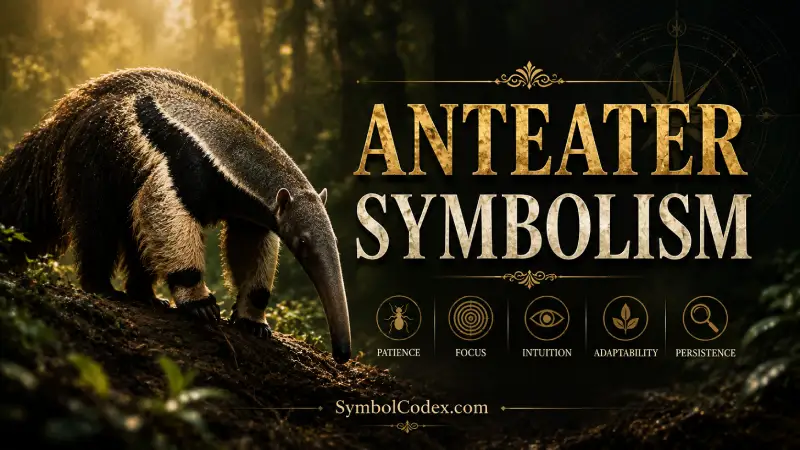
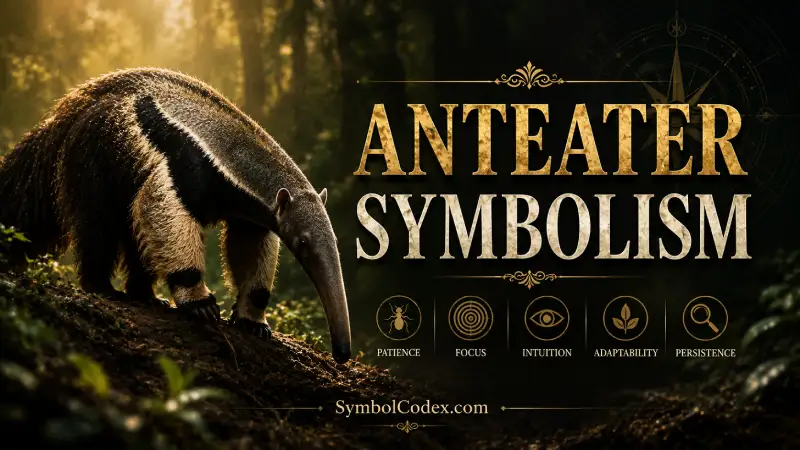
Anteater symbolism commonly represents patience, persistence, resourcefulness, independence, discernment, protection, and quiet strength. These meanings come largely from the animal’s unusual way of living: anteaters rely on specialized senses, powerful claws, long tongues, and deliberate foraging rather than speed or constant aggression.
For a United States audience, the anteater is primarily an animal encountered through zoos, wildlife documentaries, education, art, and popular culture rather than native wildlife. Giant anteaters live in Central and South America, while tamanduas and silky anteaters occupy different parts of the tropical Americas.
Its cultural story is more complicated than a simple list of spiritual meanings. Specific Indigenous South American traditions include anteaters in mythology, but these stories belong to particular peoples and should not be turned into a universal “ancient anteater meaning.” Modern symbolism is better understood as a combination of documented cultural traditions, observable animal behavior, and contemporary personal interpretation.
Quick Answer
Anteater symbolism most commonly represents patience, persistence, resourcefulness, independence, protection, and finding value where others overlook it. Its specialized feeding behavior also makes the anteater a modern symbol of focus and adaptability, while some Indigenous South American traditions give the animal culturally specific roles that cannot be reduced to one universal meaning.
TL;DR
- Anteaters commonly symbolize patience, persistence, independence, and resourcefulness.
- Their powerful claws add meanings of defense and personal boundaries.
- Specialized feeding suggests focus and making effective use of unique strengths.
- Solitary behavior supports associations with self-reliance and individuality.
- Mothers carrying young can symbolize caregiving and protective responsibility.
- Indigenous meanings vary by community and should remain culturally specific.
What an Anteater Looks Like and Why It Matters Symbolically
Anteaters are among the most distinctive mammals of the Americas. Depending on the species, they may have an elongated snout, small mouth, long sticky tongue, strong forelimbs, curved claws, and either a large bushy or grasping tail.
The giant anteater is the most visually dramatic. It has a long narrow head, no teeth, unusually powerful front claws, a striking dark shoulder pattern, and a large tail. Its tongue can extend roughly two feet and move extremely rapidly while feeding.
Those features create an animal that appears unusual by familiar mammalian standards. It does not rely on powerful jaws, prominent teeth, horns, or obvious speed.
Instead, almost everything about the anteater reflects specialization.
That physical uniqueness supports an important modern symbolic idea: success does not require having the same strengths as everyone else.
An anteater survives because its body suits the problems it actually encounters.
Anteater Symbolism: 7 Powerful Core Meanings
The most useful modern meanings grow naturally from the animal’s real behavior.
| Symbolic Meaning | Animal Trait | Personal Interpretation |
|---|---|---|
| Patience | Methodical foraging | Progress without rushing |
| Persistence | Searches repeatedly for food | Continuing despite setbacks |
| Resourcefulness | Specialized feeding tools | Using available strengths well |
| Independence | Mostly solitary lifestyle | Self-reliance |
| Discernment | Strong reliance on smell | Looking beyond appearances |
| Protection | Formidable defensive claws | Maintaining boundaries |
| Adaptability | Lives across varied habitats | Adjusting strategy when needed |
These meanings are interpretations rather than scientifically measurable spiritual properties. Their value comes from the way human observers translate animal behavior into metaphor.
Anteater Symbolism of Patience and Deliberate Action
The anteater is well suited to symbolism about patience without passivity.
A giant anteater spends much of its active time searching for insect colonies. Rather than consuming everything in one location, it typically feeds briefly before moving on. This helps it avoid the defensive ants or termites that respond after their nest is disturbed.
Symbolically, that behavior can represent knowing when enough is enough.
Patience does not always mean remaining in one place indefinitely. Sometimes it means taking what is useful, recognizing when conditions are changing, and moving forward before unnecessary conflict begins.
This interpretation can apply to work, relationships, long-term goals, and personal decisions.
The anteater suggests a measured approach:
observe first,
act purposefully,
avoid wasting energy,
and move on when the reward no longer justifies the cost.
That is a more practical form of patience than simply waiting.
Persistence and the Search for Opportunity
Ants and termites are abundant, but finding productive colonies still requires constant searching.
Anteaters move through their ranges using smell to locate food. Giant anteaters have particularly well-developed olfactory abilities, while their eyesight and hearing are comparatively less important to foraging.
This gives the animal a natural connection with persistence.
An anteater does not depend on one mound, one trail, or one opportunity. It keeps searching.
As a personal symbol, that can represent continuing after disappointment without repeatedly attacking the same failed approach.
There is an important distinction here.
Persistence is not stubbornness.
Stubbornness repeats the same action regardless of results. Anteater symbolism suggests continuing toward the goal while remaining willing to change location, method, or timing.
That makes it particularly relevant to people rebuilding after setbacks.
Resourcefulness and Using Unusual Strengths
One of the strongest anteater meanings comes from its remarkable specialization.
Giant anteaters do not have teeth. Instead, their feeding system relies on a narrow snout, highly mobile tongue, sticky saliva, strong forelimbs, and claws capable of opening insect nests. Anatomical research shows how extensively the skull, tongue, and supporting structures are adapted to this feeding method.
From a human perspective, that makes the anteater a symbol of resourcefulness.
The lesson is not “be good at everything.”
It is almost the opposite.
An anteater succeeds because it is extraordinarily effective at a particular way of living.
In personal symbolism, this can mean:
- developing specialized skills
- solving problems differently
- refusing to compare strengths unfairly
- making limitations less important through adaptation
- finding a niche where unusual abilities become useful
That gives anteater imagery special relevance to individuality.
What appears strange in one context may be exactly right in another.
Anteater Symbolism of Independence and Solitude
Giant anteaters are generally solitary animals. Adults usually spend much of their lives alone except during reproduction or while a mother is raising her young.
That behavior naturally supports modern associations with independence and self-reliance.
An anteater symbol may appeal to someone who:
values personal space,
works effectively alone,
does not need constant social approval,
or prefers a small number of meaningful relationships.
Unlike wolf symbolism, which often focuses on packs and group loyalty, anteater symbolism is much more individual.
The animal does not suggest social rejection so much as comfort with functioning independently.
There is also a cautionary side.
Independence can become isolation when a person refuses support even when it would help. Healthy solitude restores energy; chronic disconnection can create unnecessary difficulty.
The anteater therefore works best as a symbol of self-sufficiency without emotional withdrawal.
Discernment, Instinct, and Looking Beyond Appearances
Anteaters depend heavily on smell.
Giant anteaters use their highly developed sense of smell to identify insect colonies and even distinguish potential food before breaking into a nest.
That behavior provides a grounded basis for modern symbolism involving discernment.
Humans cannot literally smell opportunities the way an anteater detects ants, but the metaphor is clear: valuable information is not always obvious on the surface.
An anteater can therefore represent:
careful judgment,
noticing subtle evidence,
trusting informed instincts,
and investigating before acting.
This is sometimes described spiritually as intuition.
A more grounded interpretation is attentive perception.
Experience often teaches people to recognize small signals before they consciously explain them. The anteater can serve as a reminder to investigate those signals rather than judge only by appearances.
Protection, Claws, and Personal Boundaries
The anteater looks unusual and relatively peaceful, but it should not be confused with helplessness.
Giant anteaters usually avoid threats when possible. When forced to defend themselves, however, they can rise on their hind legs, use the tail for balance, and strike with formidable front claws. Those claws evolved primarily for feeding but can also provide serious protection.
This contrast creates one of the animal’s strongest symbolic messages:
peacefulness does not require defenselessness.
Modern anteater symbolism can therefore represent boundaries.
A person does not need to be confrontational to be strong. They can prefer avoiding conflict while still being capable of responding when necessary.
That interpretation may appeal to people who value:
calm confidence,
self-protection,
restraint,
and knowing when to say no.
The anteater is not an obvious aggression symbol.
Its defensive meaning is closer to do not mistake quiet behavior for weakness.
Motherhood, Caregiving, and Carrying Responsibility
Giant anteater mothers usually give birth to a single offspring.
The young animal climbs onto its mother’s back and can ride there for many months while developing toward independence. Its markings help visually blend with the adult’s coat when carried. Smithsonian information notes that young may remain closely associated with their mother for an extended period before becoming independent.
This behavior gives the anteater an additional symbolism of caregiving and responsibility.
A mother carrying a pup can represent:
protecting someone vulnerable,
carrying responsibility willingly,
guiding a child toward independence,
or supporting another person without permanently controlling them.
It is particularly suitable for parent-child symbolism because the relationship eventually changes.
The goal of care is not permanent dependence.
The young anteater grows until it can function independently, making the image as much about preparing someone to stand alone as protecting them.
Anteater Symbolism in Indigenous South American Traditions
Anteaters belong to the Americas, so their deeper cultural meanings are most appropriately explored through specific Indigenous South American traditions rather than generalized claims about worldwide mythology.
One documented Bakairi narrative from Brazil features a jaguar and an anteater. Scholarship on Bakairi language and cosmology explains that the story places the two animals within a culturally specific contrast involving Bakairi and non-Indigenous identities. The anteater therefore has meaning within that particular narrative rather than functioning as a universal symbol of one personality trait.
Another documented account comes from collaboration with Sateré-Mawé source communities. A story associated with an object made using giant anteater hair describes the giant anteater within a narrative involving a harpy eagle, a festival, jealousy, and transformation.
These examples reveal something important.
There is no single Indigenous anteater meaning.
The animal appears within different stories, relationships, and cosmologies according to the community telling them.
Modern articles should therefore avoid claims such as “South American tribes believed the anteater always symbolized patience.” That reduces living and historically distinct cultures to a generic symbolism list.
Anteater Symbolism in Modern American Culture
Anteaters do not naturally inhabit the United States, so their American cultural meaning developed primarily through education, zoos, entertainment, and institutional identity.
One of the clearest examples is the University of California, Irvine.
Students selected the anteater as UCI’s official mascot in 1965 after a student campaign inspired by the anteater character in Johnny Hart’s B.C. comic strip. Today, Peter the Anteater remains closely tied to UCI identity, school spirit, and the university’s deliberately unconventional character.
That history adds individuality and nonconformity to American anteater symbolism.
Students chose an unusual animal rather than a conventional fierce mascot such as an eagle or similar athletic emblem. UCI itself describes Peter as expressing the institution’s culture and individuality.
For Americans familiar with UCI, the anteater can therefore represent being memorable precisely because one refuses to be ordinary.
The Meaning of Being Unconventional
Anteaters rarely appear on traditional lists of “majestic” animals.
They have elongated faces, unusual proportions, prominent claws, unusual walking posture, and feeding behavior unlike most familiar mammals.
That visual difference has become part of their modern appeal.
Anteater symbolism can represent comfort with being unconventional.
Someone drawn to the animal may identify with being:
different without embarrassment,
specialized rather than broadly conventional,
quiet rather than attention-seeking,
or memorable for qualities that initially seem unusual.
This interpretation is particularly appropriate in contemporary tattoo and personal-symbol culture.
The anteater does not need to become a lion to succeed.
Its unusual characteristics are the reason it survives.
Anteater Symbolism in Tattoos
Anteater tattoos remain relatively uncommon, which itself reinforces their association with individuality.
A realistic giant anteater tattoo can symbolize patience, persistence, independence, quiet strength, or resilience.
A mother carrying a young anteater can emphasize family responsibility and protection.
Large claws may shift the symbolism toward boundaries and hidden defensive strength.
A long snout and tongue depicted during feeding can highlight specialization, resourcefulness, or humor.
Some designs emphasize the animal’s striking black-and-white body pattern rather than assigning it a spiritual meaning at all.
Because anteaters lack one standardized Western tattoo tradition, the wearer’s own reason matters greatly.
For some people, choosing an animal rarely seen in tattoo culture is itself the message: individuality does not require explanation.
Spiritual Meaning of Anteater Symbolism
In contemporary spiritual interpretation, the anteater is sometimes associated with intuition, patience, persistence, protection, and searching beneath the surface.
These meanings can be useful as personal metaphors, but they should not be presented as scientifically proven forces or universal ancient beliefs.
The symbolism works especially well around three ideas.
Search carefully. The anteater relies strongly on sensory information to locate resources.
Protect your energy. It feeds briefly at individual colonies rather than remaining until defensive insects overwhelm it.
Use your own strengths. Its extreme specialization demonstrates that an unusual strategy can be highly effective in the right environment.
A person may use anteater imagery as a reminder of these principles without claiming that an encounter predicts the future.
Positive and Negative Meanings of Anteater Symbolism
Like most animal symbols, the anteater can carry both constructive and cautionary meanings.
Positive meanings
Patience: proceeding without unnecessary urgency.
Persistence: continuing to search after disappointment.
Resourcefulness: using specialized abilities effectively.
Independence: functioning confidently without constant approval.
Protection: maintaining boundaries without seeking conflict.
Discernment: noticing information that others overlook.
Individuality: accepting unusual qualities rather than hiding them.
Negative meanings
Isolation: becoming too disconnected from other people.
Overdefensiveness: treating every challenge as a threat.
Narrow focus: becoming so specialized that alternatives are ignored.
Withdrawal: using independence as a reason to avoid healthy relationships.
The context determines which interpretation fits.
An anteater tattoo celebrating personal independence carries a different message from an image intended to symbolize emotional distance.
Conservation and the Modern Meaning of the Giant Anteater
Modern symbolism also needs to account for the animal’s conservation story.
The giant anteater has suffered local disappearances across parts of its historical range. Habitat loss, fire, road mortality, dietary specialization, low reproductive rates, and other human pressures contribute to conservation concerns. Research has documented significant contraction in parts of its range, while conservation programs continue working to maintain populations.
That reality adds a modern meaning of ecological vulnerability beneath physical strength.
An animal can possess enormous claws and still be unable to defend itself against habitat fragmentation or vehicles.
This gives giant anteater imagery a useful conservation message.
Strength at the individual level does not guarantee security at the species level.
The animal can therefore represent not only resilience but also the importance of preserving the environments that specialized species require.
Common Misunderstandings About Anteater Symbolism
The first mistake is assuming that every anteater meaning comes from ancient mythology.
Most familiar meanings such as patience, independence, focus, boundaries, and resourcefulness are modern interpretations built largely from observed animal behavior.
Another mistake is referring to “the anteater” as though every species behaves identically.
Giant anteaters are primarily terrestrial, while tamanduas spend considerable time climbing and silky anteaters are highly adapted to life in trees. The name covers animals with meaningful differences in size, habitat, and behavior.
A third mistake is claiming a universal Indigenous meaning.
Documented traditions demonstrate culturally specific anteater stories, not one shared definition across Indigenous South America.
Finally, anteaters should not be confused with aardvarks or pangolins.
All three may eat ants and termites, but they belong to very different mammalian lineages. Similar diets produced some similar adaptations without making the animals closely related.
How Anteater Symbolism Has Evolved
The meaning of the anteater has developed through several different channels.
For Indigenous peoples living within its natural range, anteaters could appear within specific stories, material culture, ecological knowledge, and relationships with local landscapes. These meanings vary by community.
Modern biological knowledge added another layer.
Understanding the animal’s tongue, claws, sensory abilities, solitary habits, maternal care, and specialized diet makes it easy to build metaphors around resourcefulness, patience, independence, and adaptation.
American popular culture contributed still more.
UCI transformed the anteater into an emblem of institutional individuality and school identity, demonstrating how a species can acquire completely new symbolic meanings far beyond its native range.
The modern anteater therefore carries no single message.
Its strongest meanings come from the same quality that makes the animal biologically distinctive: it succeeds by being unusually well suited to its own way of life.
Frequently Asked Questions
What does an anteater symbolize spiritually?
In modern spiritual interpretation, an anteater commonly symbolizes patience, persistence, intuition, independence, protection, and resourcefulness. These meanings work best as personal metaphors rather than universal religious teachings.
Is seeing an anteater a good sign?
There is no objective rule that makes an anteater encounter a supernatural omen. Symbolically, someone may interpret it as a reminder to slow down, investigate carefully, protect personal boundaries, or use an overlooked strength.
What does an anteater tattoo symbolize?
An anteater tattoo can represent individuality, patience, persistence, independence, adaptability, or quiet strength. A mother carrying her young may add meanings of protection, responsibility, and parenthood.
Why does the anteater symbolize patience?
The association comes from its deliberate foraging behavior. Giant anteaters search for insect colonies, feed briefly, and continue moving rather than depending on one food source, making them a natural metaphor for patient but persistent effort.
Does an anteater symbolize protection?
It can in modern symbolism. Giant anteaters generally avoid unnecessary confrontation but possess powerful claws they can use defensively, creating a natural metaphor for peaceful behavior backed by firm boundaries.
What does a baby anteater symbolize?
A young anteater riding on its mother’s back can represent caregiving, trust, protection, and gradually preparing a dependent person for independence. Giant anteater mothers provide prolonged care before their offspring separate.
Is anteater symbolism positive or negative?
It is mostly positive when associated with patience, self-reliance, resourcefulness, and persistence. Its cautionary meanings can include isolation, excessive defensiveness, or becoming too narrowly focused.
Conclusion
Anteater symbolism most naturally represents patience, persistence, independence, resourcefulness, discernment, protection, and confidence in unconventional strengths. These meanings are grounded in an animal that survives through specialization rather than conventional displays of speed, teeth, or social dominance.
Its cultural history requires more care. Specific Indigenous South American communities have their own anteater narratives, while American culture has created newer meanings through zoos, education, media, and the distinctive UCI mascot tradition.
The anteater ultimately offers a practical symbolic lesson: you do not need every possible strength when you understand your environment, develop the abilities that matter, and use them with patience and purpose.