
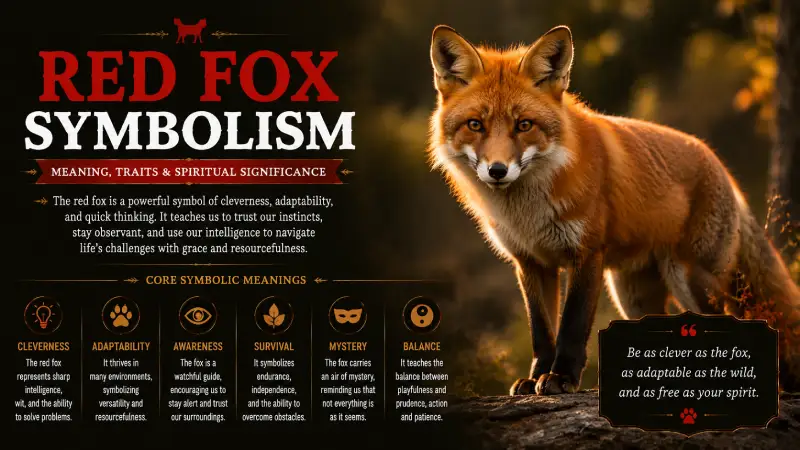
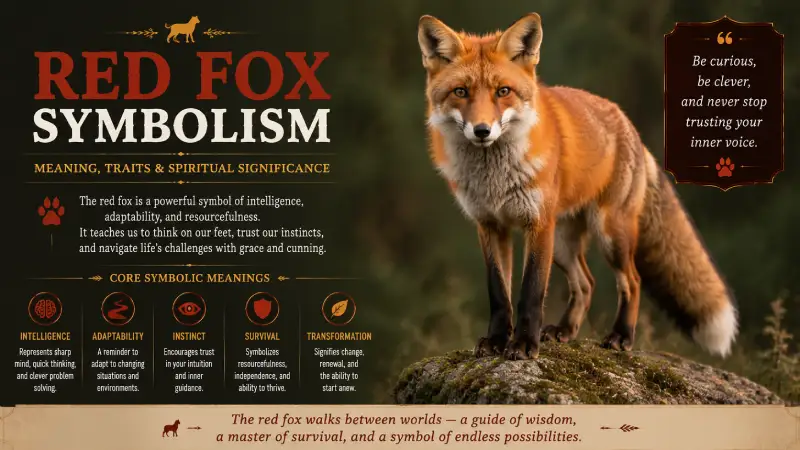
Red fox symbolism often centers on cleverness, adaptability, independence, awareness, patience, protection, resourcefulness, mystery, and resilience. These meanings are not all ancient spiritual rules. Many developed from the animal’s real behavior: red foxes have excellent hearing, strong senses, flexible diets, and the ability to live in habitats ranging from forests and grasslands to areas close to cities.
The fox also has a long symbolic history in storytelling. In Aesop’s fables and medieval European tales of Reynard the Fox, the animal became a character associated with cleverness, deception, and the ability to outwit stronger opponents.
In other traditions, the meaning is different. In Japan, for example, foxes are strongly connected with Inari and appear as messengers in documented religious art. That tradition should not be treated as proof that every fox encounter has a supernatural message.
Today, Americans may see the red fox as a symbol of thinking strategically, staying adaptable, protecting what matters, and finding a way forward without relying on brute strength.
Quick Answer
Red fox symbolism commonly represents cleverness, adaptability, independence, awareness, resourcefulness, patience, protection, mystery, and resilience. These meanings are strongly connected to the fox’s real senses, flexible behavior, solitary hunting style, and ability to survive in many environments. Historical stories also reinforced the image of the fox as clever and sometimes deceptive.
TL;DR
- Cleverness: Foxes became symbols of intelligence partly through their hunting behavior and centuries of storytelling.
- Adaptability: Red foxes can live in forests, grasslands, wetlands, tundra, and human-modified environments.
- Independence: They commonly forage alone outside family and breeding periods.
- Awareness: Their hearing, smell, and sight are highly developed for locating prey.
- Resourcefulness: Their omnivorous diet lets them use many available food sources.
- Historical caution: European fables often portray the fox as sly or deceptive, but that is literary symbolism rather than proof of the animal’s moral character.
- Spiritual meaning: Modern spiritual interpretations are personal beliefs, not scientifically proven predictions.
Red Fox Symbolism: 9 Core Meanings
| Meaning | Real/Visual Connection | Modern Interpretation |
|---|---|---|
| Cleverness | Strong senses and flexible hunting methods | Think before acting |
| Adaptability | Lives in many different habitats | Adjust when circumstances change |
| Independence | Often hunts and travels alone | Trust your own judgment |
| Awareness | Excellent hearing, sight, and smell | Pay attention to subtle signals |
| Resourcefulness | Eats many types of food | Use what is available |
| Patience | Can wait and listen before striking | Timing can matter more than speed |
| Protection | Parents provide food and care for pups | Protect family and boundaries |
| Mystery | Often active when humans are less active | Keep some things private |
| Resilience | Survives across diverse environments | Recover and adapt after setbacks |
What Red Fox Really Means
The red fox does not have one universal symbolic meaning.
Its symbolism is better understood as a combination of natural characteristics, human observation, literature, religion, art, and modern personal interpretation.
A useful way to understand it is:
Real behavior → human observation → stories and cultural associations → modern symbolism.
For example, a red fox’s ability to locate rodents through sound can reasonably inspire associations with awareness and careful listening. Its ability to use different habitats can inspire adaptability. Its solitary hunting style can inspire independence.
But the animal itself is not deliberately “teaching” these lessons. The meaning comes from the way humans interpret its characteristics.
The National Park Service describes red foxes as widespread and adaptable, with strong hearing, sight, and smell. They can hunt using multiple senses and may live close to human settlements without being easily noticed.
That makes adaptability, awareness, and resourcefulness especially strong modern interpretations.
Red Fox Symbolism of Cleverness
Cleverness is probably the best-known red fox meaning.
The connection has both a natural foundation and a powerful literary history.
In the wild, red foxes use several senses to locate prey. They may listen for rodents under grass or snow and then leap toward the location. Their hunting behavior requires careful positioning, timing, and rapid adjustment.
Human storytelling strengthened this image.
Aesop’s fables repeatedly used fox characters to explore human weaknesses such as vanity, greed, overconfidence, and deception. Medieval European stories about Reynard the Fox developed the fox into a particularly famous trickster character.
So when a red fox symbolizes cleverness, the meaning is not simply “foxes are smart.” It reflects a long human habit of seeing the fox as an animal that succeeds through strategy rather than size.
Modern lesson: Be observant, think several steps ahead, and do not assume that the strongest person always has the advantage.
Red Fox Symbolism of Adaptability
Adaptability is one of the strongest meanings that can be connected to actual red fox ecology.
Red foxes occur across a remarkably broad range of habitats. In the United States, they can live in forests, grasslands, wetlands, tundra, and other mixed environments. Some populations also live near towns and cities.
Their diet is also flexible. Red foxes eat small mammals, birds, insects, carrion, fruits, and other available foods.
This makes the fox a useful symbol of adjustment rather than stubbornness.
A red fox interpretation might therefore ask:
- Where do I need to become more flexible?
- What resources am I overlooking?
- Can I change my approach without abandoning my goal?
The symbolism is grounded in observable ecology rather than a supernatural claim.
Red Fox Symbolism of Independence
Red foxes are often associated with independence because they commonly forage alone.
That does not mean red foxes are completely solitary. Their social behavior changes with breeding and family life, and parents can work together to raise young. The National Park Service notes that males may bring food to females and pups, while older offspring can sometimes help with younger siblings.
This creates a more useful interpretation of fox independence.
It is not necessarily “I need nobody.”
Instead, it can mean:
I can function independently while still understanding the value of family and cooperation.
That distinction makes red fox symbolism more realistic.
Red Fox Symbolism of Awareness
The fox’s sensory abilities strongly support symbolism related to awareness.
Red foxes use hearing, smell, and sight when hunting. Their hearing can detect rodents moving beneath vegetation or snow, helping them locate prey that may not be visible.
This is why a fox can symbolize noticing what other people miss.
In modern life, awareness may mean:
- listening carefully before responding
- noticing changes in your environment
- recognizing subtle social signals
- avoiding unnecessary risks
- gathering information before making a decision
The symbolic lesson is not mystical. It comes from observing how the animal actually survives.
Red Fox Symbolism of Resourcefulness
Resourcefulness is closely related to adaptability, but the two are not identical.
Adaptability means changing your approach.
Resourcefulness means making effective use of what you already have.
A red fox’s varied diet provides a strong natural example. Rather than depending on one food source, it can consume a range of prey and plant foods depending on what is available.
This has made the fox a useful modern symbol for people who solve problems creatively.
A resourceful person may not have the most money, power, or equipment. They simply know how to work with the resources available.
Red Fox Symbolism of Patience and Timing
A fox is not always represented as a fast-moving animal.
Some of its hunting behavior depends on waiting, listening, locating, and then acting.
The National Park Service describes red foxes waiting for sounds from rodents before pouncing. Their hunting can involve carefully locating prey before making a sudden movement.
This creates a useful symbolic contrast:
Patience first. Action second.
For modern readers, the fox can represent the idea that good timing may be more valuable than constant activity.
Sometimes the best move is to gather information and wait until the situation becomes clear.
Red Fox Symbolism of Protection and Family
Protection is another meaningful interpretation, especially when the fox is shown with kits.
Red fox parents provide food for their young, and the young remain around the den while they develop. The National Park Service also documents parental cooperation in raising pups.
A fox with babies can therefore symbolize:
- parental care
- responsibility
- family loyalty
- protection
- teaching
- preparing the next generation
This is more biologically grounded than claims that a fox automatically represents a supernatural guardian.
A fox tattoo with several kits may therefore be chosen to represent a parent’s relationship with children or a commitment to protect family.
Red Fox Symbolism of Mystery
Mystery comes partly from the fox’s appearance and partly from its behavior.
Red foxes are often active during periods when people are less active, although activity varies by season and location. In Yellowstone, for example, red foxes are generally nocturnal and may become more visible around dawn and dusk.
Their quiet movement, pointed face, bushy tail, and ability to move through forests and human environments without always being noticed add to the mysterious image.
Modern symbolism often turns this into:
- privacy
- hidden knowledge
- intuition
- secrecy
- curiosity
- the unknown
However, “mystery” is an interpretation of human experience, not evidence that foxes possess supernatural knowledge.
Red Fox Symbolism of Resilience
The red fox can also represent resilience because of its ability to function across varied environments.
It is found throughout much of the Northern Hemisphere and is widespread in the United States. Different populations have adapted to different climates and habitats.
That does not mean every fox has an easy life. Red foxes face predators, food shortages, competition, disease, and human-related threats.
The symbolism therefore works best when it means:
survival through flexibility.
The fox does not need to overpower every challenge. It survives by adjusting to conditions.
Red Fox Biology: Why the Animal Shapes Its Symbolism
Understanding the real animal helps prevent exaggerated symbolism.
The red fox is a small member of the canine family with a distinctive reddish coat, pointed ears, slender body, and long bushy tail. Color variations can include black, silver, and mixed forms.
It is an omnivore with a broad diet.
It can live in different habitats.
It uses multiple senses while hunting.
It can live alone but forms family groups during reproduction and pup-rearing.
It also uses dens and may store excess food.
These facts explain why symbolism around the fox tends to cluster around cleverness, flexibility, independence, awareness, and survival.
They do not prove that foxes are morally “cunning,” spiritually magical, or destined to deliver messages.
Red Fox Symbolism in Aesop’s Fables and European Literature
The fox has one of the strongest literary symbolic identities in Western culture.
Aesop’s fables frequently use animals as representations of human behavior. In “The Fox and the Crow,” for example, the fox uses flattery to manipulate the crow. The story turns the fox into a figure of clever persuasion.
Medieval European literature developed this image further through Reynard the Fox.
The Reynard stories began appearing in medieval Europe and presented a fox who survives through cunning, deception, and manipulation. Later versions gave the character moral and satirical dimensions.
This history matters because the modern idea that “fox = sly” did not arise solely from observing wild foxes.
It was also created and reinforced by literature.
The negative side of this symbolism is therefore deception, manipulation, selfishness, and dishonesty.
Red Fox Symbolism in Japanese Culture
Japanese fox symbolism requires careful distinction.
In Japanese religious and artistic traditions, foxes are strongly associated with Inari, a deity connected with rice and agriculture. Museum collections document foxes as messengers of Inari and show fox imagery at Inari shrines.
The Smithsonian’s National Museum of Asian Art documents an Edo-period print showing foxes gathering at Ōji Inari Shrine, while the British Museum records fox figures associated with Inari.
This provides clear historical evidence for fox symbolism involving messengers, agriculture, prosperity, and religious devotion in specific Japanese contexts.
But it would be inaccurate to say that every Japanese person traditionally sees every fox as a supernatural messenger.
It is also important not to equate every modern image of a red fox with Inari symbolism. Japanese fox traditions include broader ideas about kitsune, spirits, transformation, and folklore that are not interchangeable with the biological species Vulpes vulpes.
Red Fox Symbolism in Indigenous North American Traditions
Indigenous North American traditions should not be reduced to one universal “fox meaning.”
There are documented archival records of fox-related stories and traditions among specific peoples. The Smithsonian’s National Anthropological Archives, for example, contains Meskwaki and Sauk & Fox materials involving fox folklore, narratives, and traditions.
However, the existence of a fox story does not automatically establish one universal symbolic meaning for an entire Indigenous population.
This is an important distinction because online symbolism articles often make broad statements such as “Native Americans believed the fox represented…” without naming a nation or providing evidence.
A responsible article should instead identify the specific community and source when making a cultural claim.
Spiritual Meaning of Red Fox
In contemporary spiritual interpretation, a red fox may represent cleverness, adaptability, awareness, independence, protection, or a need to approach a situation more strategically.
These are symbolic readings, not scientifically established messages.
If someone repeatedly notices fox imagery or has a memorable encounter with one, a grounded reflection might be:
- What situation requires more flexibility?
- Am I acting too quickly?
- What am I failing to notice?
- Where do I need stronger boundaries?
- Am I relying too much on force when strategy would work better?
- What part of my life needs more independence?
The value of the symbol can come from reflection rather than prediction.
A fox sighting does not scientifically prove that money, romance, danger, or another event is about to happen.
Is Seeing a Red Fox a Good Sign?
For many modern symbolic interpretations, seeing a red fox can be viewed as a positive sign of adaptability, awareness, cleverness, or resilience.
But there is no scientific evidence that encountering a fox predicts good or bad fortune.
The actual event may simply mean that a wild animal was moving through suitable habitat.
If you want to use the encounter symbolically, its meaning can depend on your circumstances.
For example, seeing a fox while facing a difficult decision might inspire the question:
“Can I solve this through patience and strategy instead of force?”
That is a personal interpretation, not a supernatural prediction.
Red Fox Dream Meaning
Dreams are subjective. There is no scientifically reliable dictionary in which a fox always means one particular thing.
A red fox dream may be interpreted through the emotions, setting, and behavior in the dream.
Dreaming of a Calm Red Fox
A calm fox may symbolize quiet observation, independence, or the need to watch a situation before acting.
Dreaming of an Aggressive Red Fox
An aggressive fox may reflect feelings about mistrust, conflict, manipulation, competition, or someone whose intentions seem unclear.
The interpretation depends heavily on the dreamer’s real-life circumstances.
Dreaming of a Red Fox With Babies
A fox with kits may bring themes of family, protection, responsibility, or nurturing into focus.
Dreaming of Several Red Foxes
Several foxes might symbolize social complexity, competition, cooperation, or multiple people whose motives you are trying to understand.
Dreaming of a Dead Red Fox
A dead fox can be interpreted as an ending involving a particular strategy, relationship, habit, or period of independence.
It does not reliably predict death or disaster.
Dreaming of Being Protected by a Red Fox
This may represent a desire for protection, confidence, clever problem-solving, or stronger personal boundaries.
The most useful question is often not “What will happen?” but “What emotion did the fox bring out in me?”
Red Fox in Tattoos
A red fox tattoo can carry several meanings depending on its design.
A single fox often works well for independence, cleverness, mystery, or self-reliance.
A fox with kits can emphasize family, parenthood, protection, or love.
A pair of foxes may represent partnership or loyalty.
A fox beneath the moon can emphasize mystery, nighttime, intuition, or the unknown.
A fox with flowers can combine the animal’s cleverness and adaptability with themes such as beauty, growth, remembrance, or renewal.
A geometric fox often gives the design a modern, intellectual feel and may emphasize order, balance, or individuality.
A memorial fox tattoo may represent a personal memory rather than a traditional cultural meaning.
Ultimately, the wearer’s intention matters more than any universal tattoo dictionary.
Red Fox Color and Form Symbolism
Red foxes naturally occur in multiple color phases, so color should not automatically be treated as a fixed spiritual code. The National Park Service documents red, black, silver, and cross color phases.
Still, artists and tattoo wearers may use colors symbolically.
Red Fox
The natural red-orange coat can emphasize vitality, warmth, energy, confidence, and connection with the natural world.
Black Fox
A black fox design may be used to emphasize mystery, power, secrecy, or the unknown. These are modern artistic interpretations rather than biological meanings.
White or Silver Fox
White or silver imagery may suggest purity, rarity, winter, wisdom, or transformation.
Fox With a Raised Tail
The bushy tail is one of the animal’s defining physical features, but there is no universal symbolic rule that one tail position always means a particular thing.
Positive and Negative Meanings of Red Fox
Red fox symbolism has both strengths and cautionary interpretations.
Positive meanings include:
- Cleverness
- Adaptability
- Resourcefulness
- Awareness
- Independence
- Patience
- Protection
- Resilience
Cautionary meanings include:
- Deception
- Manipulation
- Excessive secrecy
- Opportunism
- Distrust
- Overthinking
- Self-interest
This two-sided symbolism is useful because the same quality can help or harm.
Cleverness becomes manipulation when used dishonestly.
Independence can become isolation.
Privacy can become secrecy.
Adaptability can become a lack of firm principles.
The fox therefore represents not only intelligence, but the question of how that intelligence is used.
Red Fox vs. Gray Fox Symbolism
Red foxes and gray foxes are both foxes, but their biology and cultural associations should not automatically be merged.
Red foxes are widespread and highly adaptable, while gray foxes have a distinctive ability to climb trees. The National Park Service notes that gray foxes’ tree-climbing ability historically influenced how fox hunters viewed them.
Symbolically, a red fox is more commonly connected with cunning, adaptability, awareness, and resourcefulness.
A gray fox may lend itself more naturally to symbolism around agility and unusual climbing ability.
The difference illustrates why symbolism should begin with the actual species rather than treating every fox as identical.
Red Fox in Modern American Culture
In the United States, red foxes occupy an unusual space between wildlife and popular imagery.
They appear in:
- wildlife photography
- children’s books
- outdoor art
- tattoos
- jewelry
- home decor
- clothing
- logos
- social media
- nature education
- conservation imagery
The fox’s cultural identity is often shaped by both real wildlife encounters and older literary stereotypes.
Americans may recognize the phrase “sly as a fox” even without knowing much about red fox biology. That language shows how deeply the old cleverness stereotype remains embedded in everyday culture.
At the same time, modern wildlife photography often presents the fox less as a trickster and more as a beautiful, adaptable wild animal.
This creates a more balanced modern image: clever but not necessarily deceitful, independent but still family-oriented, and wild yet capable of living near people.
Red Fox Conservation and Real-World Context
Symbolism should not replace the real animal.
Red foxes are widespread and are not generally considered endangered or threatened as a species.
However, individual populations and subspecies can face local pressures. Habitat changes, vehicle collisions, disease, trapping, hunting, and competition with other predators can all affect foxes in particular environments.
The Sierra Nevada red fox, for example, is a much rarer high-elevation subspecies with specialized adaptations for cold, snowy environments.
This matters symbolically because the fox is often described as a universal survivor, yet real survival always depends on habitat, food, and ecological conditions.
Common Misunderstandings About Red Fox
“Red foxes are naturally dishonest.”
No. Dishonesty is a human moral concept. The association comes largely from fables and literature rather than fox psychology.
“All foxes are nocturnal.”
Not exactly. Activity varies with habitat, season, food availability, and local conditions. Yellowstone reports that red foxes are generally nocturnal but may be active during daylight at certain times.
“Every fox sighting has a spiritual message.”
There is no scientific evidence for this. A sighting can be personally meaningful without being a supernatural prediction.
“Native Americans all had the same fox symbolism.”
This is an inaccurate generalization. Indigenous nations have distinct cultures and traditions. Smithsonian archival collections demonstrate specific Fox, Meskwaki, and Sauk & Fox traditions, but those records should not be turned into a universal Indigenous belief.
“Red foxes are always red.”
No. Red foxes have several color phases, including black, silver, and cross forms.
“Fox symbolism is always positive.”
No. Western literature has long used the fox for both cleverness and deception.
How Red Fox Symbolism Has Evolved
Red fox symbolism has developed through several overlapping stages.
1. Real animal characteristics
People observed the fox’s senses, hunting methods, movement, diet, and ability to survive in different environments.
2. Folklore and fables
Stories transformed those observations into human traits such as cleverness, trickery, patience, and deception.
3. Medieval literature
Reynard the Fox made the cunning fox a major literary character in European culture.
4. Religious and cultural imagery
In Japan, foxes became strongly associated with Inari as messengers, producing a different symbolic tradition centered on agriculture, rice, prosperity, and religious devotion.
5. Modern spirituality and popular culture
Today, people often interpret the fox as a personal symbol of adaptability, independence, intuition, strategy, or protection.
The result is a symbol with several layers rather than one fixed definition.
In modern American culture, the strongest meanings are probably cleverness, adaptability, resourcefulness, awareness, independence, and resilience, with deception and secrecy forming the darker side.
Frequently Asked Questions
What does red fox symbolize spiritually?
In contemporary spiritual interpretation, a red fox may symbolize adaptability, cleverness, awareness, independence, protection, and strategic thinking. These are personal symbolic meanings, not scientifically proven messages.
Is seeing a red fox a good sign?
Many people interpret a fox sighting positively as a reminder to stay alert, flexible, and resourceful. However, science does not show that seeing a fox predicts good fortune.
What does a red fox tattoo mean?
A red fox tattoo can represent cleverness, independence, adaptability, mystery, resilience, or family protection. The surrounding design and the wearer’s personal intention can change its meaning.
What does dreaming about a red fox mean?
A red fox in a dream may relate to strategy, mistrust, independence, awareness, or adaptability. Dream interpretation is subjective and should not be treated as a reliable prediction of future events.
Why does the red fox represent cleverness?
The association comes partly from the fox’s careful hunting behavior and strong senses, but centuries of Aesop’s fables and Reynard stories greatly strengthened the literary image of the clever or deceptive fox.
What does a red fox represent in Japanese culture?
In specific Japanese religious and artistic contexts, foxes are associated with Inari and are represented as messengers of the deity. This is a documented cultural tradition and should not be generalized to every modern Japanese interpretation of foxes.
Is red fox symbolism always positive?
No. The fox can represent positive qualities such as adaptability and intelligence, but it can also symbolize deception, manipulation, secrecy, or opportunism. Its meaning depends on context.
Conclusion
Red fox symbolism is strongest when it is connected to the real animal rather than treated as a collection of supernatural rules. The fox’s adaptable habitat use, flexible diet, sharp senses, careful hunting, family behavior, and ability to live near humans help explain associations with cleverness, awareness, resourcefulness, independence, patience, protection, and resilience.
History adds another layer. Aesop and the medieval Reynard tradition helped make the fox a symbol of cunning and deception, while Japanese traditions surrounding Inari developed a distinct religious association between foxes and divine messengership.
The most useful modern lesson is not simply that a fox is “clever.” It is that strength does not always have to look powerful. Sometimes resilience means paying attention, choosing the right moment, adapting to changing conditions, and finding a smarter path when force is not the answer.


