
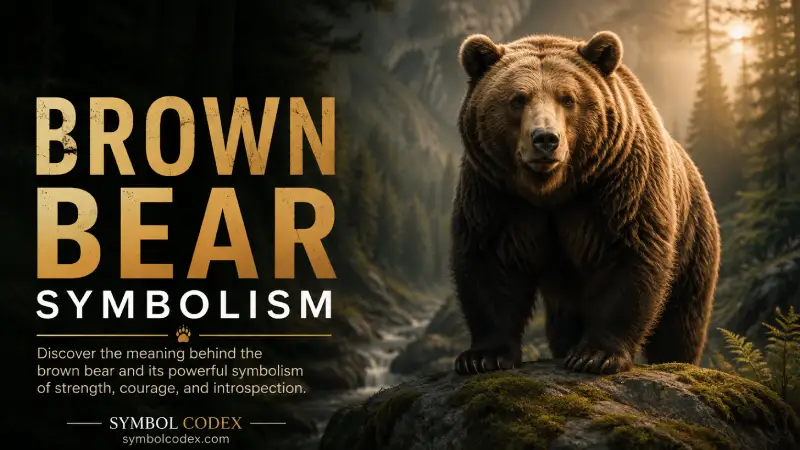
Brown bear symbolism commonly represents strength, protection, resilience, courage, independence, motherhood, and renewal. These meanings grow naturally from an animal capable of remarkable physical power while also showing behaviors associated with seasonal adaptation, maternal care, patience, and survival.
For Americans, brown bear imagery has several distinct cultural layers. Brown bears are central to Alaska’s wildlife identity, grizzlies remain defining animals of the Yellowstone region, and the extinct California grizzly still appears on California’s state flag and serves as its official state animal.
The cultural history deserves careful treatment. Indigenous peoples living alongside brown bears have developed their own relationships, teachings, hunting practices, and beliefs about them. There is no single universal “Native American bear meaning,” and specific traditions should be attributed to the communities from which they come.
Quick Answer
Brown bear symbolism most commonly represents strength, protection, resilience, independence, courage, motherhood, and renewal. In modern American culture, the brown bear also symbolizes wilderness and survival, while specific Indigenous traditions and regional histories give the animal additional meanings connected with respect, relationships with the land, and responsibility.
TL;DR
- Brown bears commonly symbolize strength, resilience, protection, and independence.
- Mother bears add meanings of caregiving, courage, and family defense.
- Winter denning encourages modern associations with rest and renewal.
- Alaska gives brown bears strong meanings of wilderness and regional identity.
- California’s grizzly remains an enduring symbol despite its extinction there.
- Indigenous bear traditions vary and must be understood community by community.
What a Brown Bear Really Is
The brown bear, Ursus arctos, is one of the world’s largest terrestrial carnivores, although much of its diet can consist of plant material.
In North America, the words brown bear and grizzly bear can create confusion. They refer to members of the same species. In Alaska, “brown bear” is commonly used for bears living along productive coastal areas where salmon and other rich foods can support especially large body sizes, while “grizzly” is often used for interior populations. Kodiak bears are an isolated brown bear subspecies found in the Kodiak Archipelago.
Brown bears have a prominent shoulder hump, long claws adapted partly for digging, a powerful build, and coats ranging from very dark brown to blond. Color alone cannot reliably distinguish a grizzly from an American black bear because both species show considerable color variation.
Their physical presence naturally encourages symbolism involving strength, but their behavior gives the symbol much more depth.
Brown Bear Symbolism: 7 Powerful Core Meanings
| Symbolic Meaning | Brown Bear Connection | Modern Interpretation |
|---|---|---|
| Strength | Massive body and physical capability | Confidence and personal power |
| Protection | Mothers strongly defend cubs | Guardianship and boundaries |
| Resilience | Survives demanding seasonal conditions | Enduring hardship |
| Independence | Adults are generally solitary | Self-reliance and autonomy |
| Renewal | Seasonal denning followed by spring activity | Rest and beginning again |
| Resourcefulness | Uses many different foods | Adapting to available resources |
| Courage | Powerful but not constantly confrontational | Strength used when necessary |
These are broad contemporary interpretations. Specific historical and religious traditions may assign the bear different meanings.
Brown Bear Symbolism of Strength and Grounded Power
Strength is probably the most immediate meaning people associate with a brown bear.
Large coastal brown bears can reach extraordinary sizes. Alaska wildlife authorities report that exceptionally large Kodiak males may weigh as much as 1,500 pounds, although size varies greatly by sex, location, season, genetics, and available food.
Yet strength is only part of the symbolism.
A bear does not spend every moment fighting. Much of its life involves feeding, traveling, resting, investigating its environment, avoiding unnecessary conflict, or preparing for seasonal changes.
That creates a useful distinction between possessing power and constantly displaying power.
In modern personal symbolism, a brown bear can represent confidence that does not need approval. Someone may identify with the bear because they want to remain steady under pressure, trust their capabilities, and respond forcefully only when circumstances truly require it.
This is grounded power rather than theatrical dominance.
Protection, Motherhood, and Family
Motherhood adds one of the most emotionally recognizable meanings to brown bear symbolism.
Female brown bears give birth in winter dens, commonly to twins, although litters can vary. Cubs remain dependent on their mother after emerging and families typically stay together for two or three years. Alaska wildlife authorities describe mothers as strongly protective of their young.
This naturally makes a mother bear a symbol of protective love.
In human symbolism, the image can represent a parent who is gentle with family but formidable when that family faces danger.
It may also signify responsibility rather than aggression. Raising young requires far more than defending them. Mothers guide cubs through feeding areas, changing seasons, environmental hazards, and the gradual transition toward independence.
A brown bear mother with cubs can therefore symbolize caregiving, courage, family loyalty, and helping someone vulnerable become capable of standing on their own.
Resilience and Surviving Difficult Seasons
Brown bears inhabit environments where food availability and weather can change dramatically throughout the year.
Their diet is highly flexible. Depending on location and season, brown bears may consume grasses, berries, roots, salmon, ground squirrels, carrion, and young ungulates. Coastal Alaska can provide especially rich food resources, while bears living in less productive interior environments may range more widely to meet their needs.
That adaptability supports brown bear symbolism of resilience.
Resilience does not mean being unaffected by difficulty.
It means responding to changing conditions well enough to continue.
Someone may connect with brown bear imagery after unemployment, illness, grief, relocation, family upheaval, or another period when familiar resources disappeared.
The bear metaphor suggests using what is available, conserving strength when necessary, and recognizing that different seasons require different strategies.
Winter Denning, Rest, and Renewal
Brown bears spend part of the year in winter dens throughout much of their range.
In colder northern regions, denning can last many months. During this period bears dramatically reduce their activity and survive on energy accumulated earlier in the year. Pregnant females give birth while denned and typically emerge later with their cubs.
This seasonal cycle has encouraged modern symbolic associations with rest, withdrawal, reflection, and renewal.
Human life does not operate like bear physiology, so the comparison should remain metaphorical.
Still, the image provides a useful counterpoint to constant-productivity culture.
Not every meaningful stage of life needs to look active from the outside.
A period spent recovering, reconsidering goals, grieving, learning privately, or rebuilding energy may still be part of forward movement.
Symbolically, the brown bear suggests that retreat is not automatically defeat. Sometimes strength includes recognizing when restoration must come before action.
Independence Without Complete Isolation
Brown bears are generally solitary rather than pack-living animals.
Individuals may spend large portions of their lives alone, although they can gather in considerable numbers where food becomes highly concentrated, such as salmon streams. Brown bears use social signals and hierarchy to reduce unnecessary conflict when they share these productive areas.
That behavior makes the bear an effective symbol of healthy independence.
A person may use brown bear imagery to represent self-reliance, privacy, confidence in solitary work, or the ability to make decisions without constant validation.
But the biology also provides a useful correction to the romantic idea of total isolation.
Even solitary animals sometimes share space and respond socially to others.
The balanced symbolic meaning is therefore not “I need nobody.”
It is I can stand on my own without treating every relationship as a loss of independence.
Resourcefulness and Knowing What the Season Requires
Brown bears are remarkable dietary generalists.
Rather than relying on one food source, they adjust according to place and season. Spring vegetation, summer berries, spawning salmon, roots, carrion, and animal prey may all contribute to the diet depending on the population.
That gives the bear an especially practical form of symbolism: resourcefulness.
A rigid strategy works only when the environment remains predictable.
The bear represents another approach.
Pay attention to what is available now.
Use opportunities when they appear.
Prepare when resources are abundant.
Change behavior when conditions change.
For people, that can mean learning new skills, changing financial habits, adjusting career plans, or recognizing that a strategy that once worked may no longer fit current circumstances.
The central metaphor is not simply strength. It is intelligent adaptation.
Brown Bear Symbolism in Alaska
No U.S. state is more closely associated with living brown bears than Alaska.
Brown bears occur across most of the state, and Alaska continues to support healthy and productive populations. Coastal areas such as the Alaska Peninsula and Kodiak can support particularly high bear densities because of rich food resources.
For many Americans, an Alaska brown bear therefore represents wilderness, scale, wild abundance, and landscapes where human beings are not automatically the dominant presence.
The symbolism can also communicate respect.
Alaska wildlife agencies emphasize that bears tend to avoid or ignore people but remain potentially dangerous wild animals. Living and traveling safely in bear country requires managing food carefully, avoiding surprising bears, respecting their space, and responding appropriately during encounters.
That reality gives brown bear symbolism a grounded message: respecting power means understanding it rather than merely admiring it.
Brown Bear Symbolism in Alutiiq Culture
Kodiak brown bears have longstanding importance to Alutiiq/Sugpiaq people, but their cultural meaning cannot be reduced to a single word such as “strength.”
Historically, bears provided Alutiiq communities with food and materials. Bear hides were used for bedding, while gut, bone, teeth, fat, and other parts could serve practical purposes. The relationship included detailed hunting knowledge and cultural rules governing how animals should be treated.
Alutiiq Museum materials also document beliefs emphasizing respect for bears. Kodiak Elders describe bears as beings capable of understanding human speech, and traditional hunters avoided boasting about plans to hunt them. A hunter approaching a bear was expected to address the animal and explain the need for taking its life.
Animal hides could also possess meaning beyond practical use in Alutiiq traditions. Museum documentation describes hides as retaining aspects of the animal and contributing physical and spiritual protection to garments.
These examples show why broad statements about “Native American bear symbolism” are inadequate. The respectful approach is to identify the specific people, place, and tradition being discussed.
The Grizzly as a Symbol of California
One of the most striking American examples of bear symbolism comes from a place where wild grizzlies no longer survive.
The California grizzly is the state animal and appears prominently on California’s flag. The modern state flag developed from the Bear Flag associated with the 1846 Bear Flag Revolt and was officially adopted in 1911; its present standardized form retains the walking grizzly as its central figure.
California’s grizzly population disappeared through habitat loss and intensive killing, with the state describing the animals as extinct there by the 1920s. The grizzly nevertheless became the official state animal in 1953.
This creates an unusual symbolism of strength mixed with absence.
The bear represents California identity, ruggedness, and wildlife even though the animal depicted no longer walks wild within the state.
Its image therefore carries a modern conservation lesson as well: a symbol can remain culturally powerful after the living population that inspired it has been lost.
Brown Bears, Wilderness, and American Identity
American attitudes toward brown bears have changed considerably.
Grizzlies were historically viewed as competitors, threats, hunting trophies, and obstacles to settlement. Large portions of their range in the contiguous United States disappeared as human settlement expanded.
Today, the animal also functions as an emblem of remaining wilderness.
Yellowstone, Glacier, Alaska, and the Northern Rockies have made grizzlies recognizable symbols of landscapes where large native predators still survive.
The symbolism is complicated because these same landscapes are shared with ranchers, hunters, Indigenous nations, rural communities, recreationists, and conservation organizations whose priorities do not always align.
That makes the brown bear an unusually relevant symbol of a modern American question: how much space are people willing to share with genuinely powerful wildlife?
Conservation and the Modern Meaning of Brown Bears
Conservation has added another layer to brown bear symbolism.
Alaska continues to support large and generally healthy brown bear populations, but grizzly bears in the contiguous United States remain federally protected as threatened.
The regulatory picture is also changing. In July 2026, the U.S. Fish and Wildlife Service published revised proposed regulations that would alter some management rules while leaving the grizzly’s threatened listing in place. As of August 15, 2026, those changes remain proposed rather than final.
This makes the brown bear a symbol not only of wild strength but also of coexistence and responsibility.
A powerful animal can still be vulnerable to habitat fragmentation, human-caused mortality, and political decisions.
Modern bear symbolism therefore works best when strength and vulnerability are allowed to exist together.
Brown Bear Symbolism in Tattoos
Brown bear tattoos commonly represent strength, protection, resilience, independence, family, and survival.
The pose changes the message considerably.
A standing or roaring brown bear emphasizes power and defiance. A walking bear can suggest steady confidence and persistence. A mother with cubs shifts the focus toward parenthood, caregiving, and protection.
A bear surrounded by mountains, salmon streams, or pine forest can emphasize Alaska, wilderness, outdoor identity, or connection with a particular landscape.
California-inspired grizzly tattoos may represent state pride even though the historic California grizzly is extinct.
A bear paw can symbolize movement, personal direction, or leaving a lasting mark.
For memorial tattoos, a bear may also represent a specific person remembered as protective, dependable, physically imposing, or quietly strong.
Personal context matters more than any generic tattoo definition.
Spiritual Meaning of Brown Bear Symbolism
In contemporary spiritual interpretation, brown bears are often associated with grounding, courage, protection, healing, introspection, and personal strength.
These meanings can function effectively as personal metaphors, but they should not be presented as universal religious laws.
A person might use brown bear imagery as a reminder to remain steady during uncertainty, protect meaningful boundaries, restore energy before making a major decision, or become comfortable with personal independence.
The bear’s seasonal life provides particularly useful imagery here.
There are periods for gathering.
Periods for defending.
Periods for resting.
Periods for emerging again.
That symbolic framework can be meaningful without claiming that encountering a brown bear predicts a particular future event.
Positive and Negative Meanings of Brown Bear Symbolism
Brown bear symbolism has a strong positive side, but its characteristics can also become warnings.
Strength can represent confidence, yet unchecked strength can become intimidation.
Protection can express love, while excessive protection can become possessiveness.
Independence can build self-confidence, but taken too far it can become isolation.
Rest can support renewal, while withdrawal can become avoidance if it never ends.
A bear’s intimidating presence can also symbolize anger, danger, unpredictability, or territorial conflict.
The most useful interpretation therefore depends on balance.
The brown bear does not simply represent “be powerful.”
It represents understanding when strength, restraint, protection, adaptation, or withdrawal actually fits the situation.
Common Misunderstandings About Brown Bear Symbolism
One common mistake is treating brown bears and grizzly bears as completely separate species.
They are members of the same species, Ursus arctos. Regional terminology and population differences account for much of the distinction Americans make between “brown bear” and “grizzly.”
Another misconception is identifying bears by fur color alone. Brown bears can range from blond to nearly black, while American black bears can also be brown or cinnamon. Body shape, shoulder hump, claws, facial profile, and other features are more useful.
A cultural mistake is assuming all Indigenous peoples interpret the bear identically. Specific Alutiiq traditions alone demonstrate how complex one community’s relationship with brown bears can be. Other Indigenous nations have their own distinct histories and teachings.
Finally, modern phrases such as “bear spirit means money is coming” or other precise predictions should not be confused with documented cultural traditions.
Symbolism can offer reflection without becoming fortune-telling.
How Brown Bear Symbolism Has Evolved
Brown bear meaning has changed as relationships between bears and people have changed.
For Indigenous communities such as the Alutiiq/Sugpiaq people of Kodiak, bears existed within longstanding systems of subsistence, hunting knowledge, material use, respect, and cultural belief.
European and American expansion added different meanings. Grizzlies became feared predators, commercial resources, hunting trophies, and symbols of the supposedly untamed frontier.
California offers perhaps the clearest example of that contradiction. People eliminated the grizzly from the state, then elevated its image into one of California’s most recognizable emblems.
Modern conservation added yet another layer.
Today, brown bears can represent wilderness preservation, ecological coexistence, responsible wildlife management, and the challenge of living alongside animals powerful enough to impose limits on human behavior.
The brown bear therefore carries meanings that are sometimes contradictory: independence and family, danger and protection, physical strength and ecological vulnerability, solitude and coexistence.
That complexity is precisely why the symbol remains compelling.
FAQs
What does a brown bear symbolize spiritually?
In modern spiritual interpretation, a brown bear often symbolizes strength, grounding, protection, resilience, independence, and renewal. These meanings are best understood as personal metaphors unless they are tied to a specific documented religious or cultural tradition.
What does a brown bear tattoo symbolize?
A brown bear tattoo commonly represents strength, survival, family protection, courage, or independence. A mother-and-cub design usually emphasizes caregiving, while a solitary bear may emphasize self-reliance.
Does a brown bear symbolize protection?
Yes. Protection is one of the most natural modern interpretations, especially because female brown bears strongly defend dependent cubs.
What is the difference between brown bear and grizzly symbolism?
The meanings overlap because grizzlies are brown bears. “Brown bear” imagery may evoke Alaska and coastal wilderness more strongly, while “grizzly” often carries additional American associations with Yellowstone, the Rockies, frontier history, and California.
What does a brown bear symbolize in Indigenous culture?
There is no single Indigenous interpretation. Among Alutiiq/Sugpiaq people of Kodiak, documented traditions include practical reliance on bears, respectful hunting protocols, beliefs about bears understanding human speech, and culturally meaningful uses of bear hides. Other Indigenous nations have their own traditions.
Does a brown bear symbolize motherhood?
Yes, motherhood is a strong contemporary interpretation. Brown bear mothers raise dependent cubs for several years and can defend them forcefully, making the animal a natural symbol of protective parenting.
Is brown bear symbolism positive or negative?
It can be both. Positive meanings include strength, protection, renewal, courage, resilience, and independence, while darker interpretations include aggression, danger, isolation, possessiveness, or uncontrolled anger.
Conclusion
Brown bear symbolism most naturally represents strength, protection, resilience, independence, motherhood, renewal, and the ability to adapt to changing seasons. Its symbolism works because those ideas can be connected with a real animal that combines enormous physical ability with seasonal restraint, flexible feeding, solitary living, and intense maternal care.
American history adds deeper layers. Alaska’s living brown bears remain icons of wild landscapes, specific Indigenous communities maintain longstanding relationships with bears, Yellowstone grizzlies embody ongoing coexistence and conservation, and California continues to display a grizzly on its flag generations after eliminating the animal from the state.
The brown bear’s most grounded message is therefore not simply be strong. It is to understand that real strength also involves protecting carefully, adapting when conditions change, resting when restoration is necessary, and respecting forces larger than yourself.