
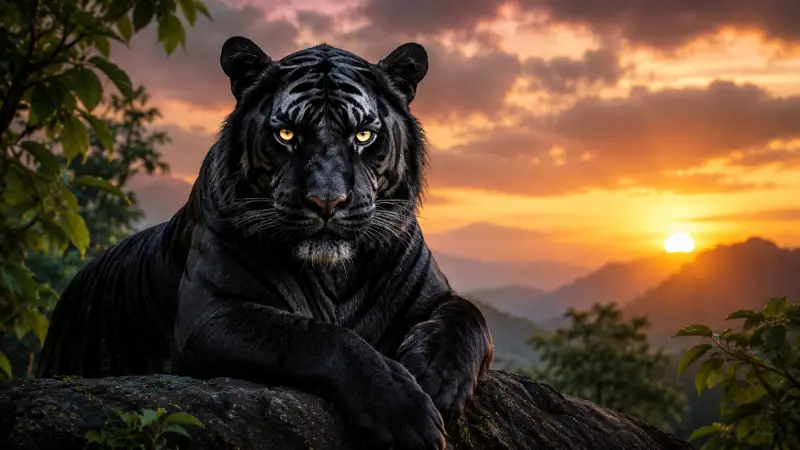
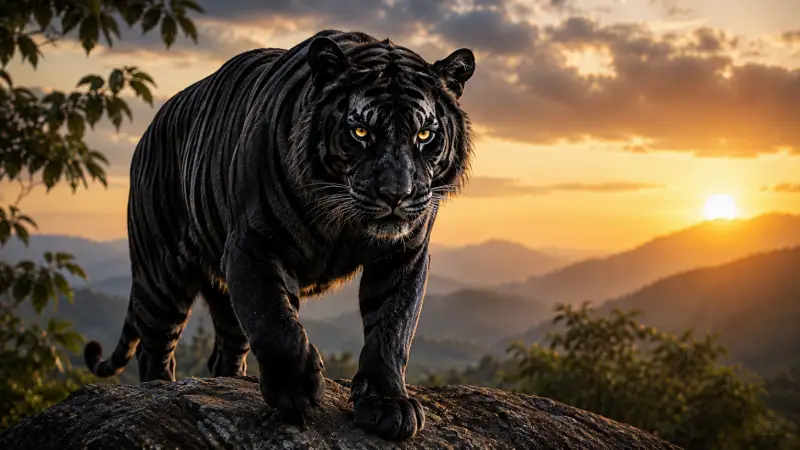
Black tiger symbolism commonly represents power, mystery, protection, individuality, resilience, controlled aggression, and strength that remains hidden until needed. The image combines the tiger’s familiar associations with courage and authority with the darker visual qualities Americans often connect with black, secrecy, seriousness, independence, and the unknown.
A real “black tiger,” however, is not a separate tiger species. The rare animals commonly given that name are pseudo-melanistic Bengal tigers whose black stripes have become unusually wide and fused together, leaving much less orange visible. Modern wild examples are strongly associated with India’s Similipal Tiger Reserve in Odisha. Genetic research links this striking pattern to a mutation affecting the Taqpep gene.
That biological rarity makes black tiger imagery especially effective as a modern symbol of being exceptional, difficult to overlook, and strong without conforming to an ordinary pattern.
Quick Answer
Black tiger symbolism most commonly represents rare strength, mystery, protection, courage, independence, and resilience in modern culture. Historically, black tigers also appear in specific Chinese religious imagery as protective animals, while real pseudo-melanistic tigers add contemporary associations with rarity, genetic uniqueness, and wildlife conservation.
TL;DR
- Black tigers symbolize rare strength, mystery, protection, and individuality.
- Their unusual coloration adds meanings of uniqueness and hidden power.
- Tiger behavior supports courage, independence, patience, and controlled action.
- Chinese religious art includes protective black tiger imagery.
- American meanings are mostly modern, especially in tattoos and visual culture.
- Conservation adds vulnerability and rarity to the symbol today.
What a Black Tiger Really Is
The phrase black tiger can sound as though it describes a completely black species similar to a black panther.
That is misleading.
The best-documented wild black tigers are Bengal tigers with pseudo-melanism. Their normal stripe pattern becomes dramatically expanded, causing dark stripes to merge across large portions of the body.
The result can look almost black from some angles, especially in shade.
Researchers studying Similipal tigers identified a mutation in the Taqpep gene associated with this unusual pattern. The same general gene is involved in coat-pattern variation in other cats. Geographic isolation, a relatively small tiger population, genetic drift, and inbreeding likely contributed to the high frequency of the unusual pattern in Similipal.
This real biology matters symbolically.
The black tiger is rare not because it belongs to another species, but because an unusual genetic pattern changes the appearance of an otherwise recognizable tiger.
That makes difference within identity one of its strongest modern meanings.
Black Tiger Symbolism: 7 Powerful Core Meanings
| Meaning | Why It Fits | Modern Interpretation |
|---|---|---|
| Power | Tiger strength and predatory ability | Confidence and authority |
| Mystery | Dark coloration and rarity | The unknown and hidden identity |
| Protection | Tigers have protective roles in some traditions | Defending people or boundaries |
| Individuality | Pseudo-melanistic appearance is extremely uncommon | Standing apart naturally |
| Resilience | Tigers survive demanding environments | Endurance through hardship |
| Independence | Tigers are largely solitary | Self-reliance and autonomy |
| Controlled strength | Tigers conserve energy before acting | Power used selectively |
The symbolic meaning depends heavily on context. A black tiger tattoo emphasizing protection can communicate something very different from an image designed to appear threatening.
Rare Strength and the Meaning of Individuality
Rarity changes the emotional impact of the black tiger.
A typical tiger is already visually striking. A pseudo-melanistic tiger looks even more unusual because its enlarged stripes interrupt the pattern people expect to see.
This makes it an intuitive symbol of individuality without deliberate rebellion.
The animal does not choose to be different.
It simply is.
That distinction can make black tiger symbolism appealing to people who identify with being unusual, misunderstood, unconventional, or difficult to place within ordinary categories.
The meaning may include:
- accepting unusual qualities
- standing apart without apology
- refusing unnecessary conformity
- recognizing strength in difference
- becoming comfortable with visibility
Unlike symbols that celebrate reinvention, the black tiger often works better as a symbol of owning an identity that was already there.
Power Without Constant Display
Tigers are formidable predators, but they do not spend every moment demonstrating strength.
Much of hunting involves observation, positioning, concealment, patience, and choosing the right moment to move.
That behavior supports an important symbolic distinction between having power and displaying power.
Black tiger imagery can represent someone who remains calm because they already understand their abilities.
They do not need to dominate every conversation or respond to every challenge.
Symbolically, this can mean:
confidence without boasting,
strength without unnecessary confrontation,
and restraint without weakness.
The dark appearance reinforces the idea of power held beneath the surface.
For that reason, black tiger imagery often feels more controlled and private than bright, roaring tiger imagery.
Mystery, Darkness, and the Unknown
Black carries many associations in modern American visual culture.
Depending on context, it can suggest:
mystery,
formality,
authority,
secrecy,
mourning,
danger,
elegance,
or independence.
When those associations are combined with a tiger, the result is naturally more mysterious than ordinary tiger imagery.
A black tiger can symbolize what cannot immediately be understood.
This does not have to mean something supernatural.
A person may use the symbol to represent a private personality, unexplored abilities, hidden emotions, or simply a preference for revealing less about themselves.
The strongest interpretation is often not darkness as evil.
It is darkness as what remains unseen.
That makes black tiger imagery particularly popular in dramatic art, fantasy-style designs, tattoos, logos, gaming imagery, and other contexts where mystery is desirable.
Protection, Courage, and Personal Boundaries
The tiger has a long history as a protective image in parts of Asia.
In Chinese culture more broadly, tigers have appeared as guardians capable of warding off harmful forces. Historical art also placed tiger imagery on architecture and objects associated with protection.
This protective meaning translates easily into modern symbolism.
A black tiger can represent:
Guardianship. Protecting family or vulnerable people.
Boundaries. Making it clear when another person has gone too far.
Courage. Facing danger rather than avoiding every difficult situation.
Deterrence. Possessing enough visible strength that conflict becomes unnecessary.
The symbol works especially well when the tiger is shown alert rather than attacking.
Protection is not the same thing as aggression.
In the most balanced interpretation, black tiger symbolism means being capable of force without looking for excuses to use it.
Black Tiger Symbolism in Chinese Religious Imagery
A genuine historical black tiger tradition does exist in Chinese popular religion and Daoist-influenced imagery.
The deity Zhao Gongming, widely associated with wealth and protection, is often depicted riding a black tiger. Museum records and historical artworks show the black tiger accompanying him, and the animal could function as a protective force capable of warding off evil.
This is one of the most important culturally documented meanings of the black tiger.
However, it should not be confused with another famous Chinese symbol: the White Tiger of the West.
Traditional Chinese cosmology associates the White Tiger with the western direction, alongside the Azure Dragon of the east, Vermilion Bird of the south, and Black Tortoise-Snake of the north. The black tiger connected with Zhao Gongming belongs to a different religious and artistic context.
That distinction prevents two separate traditions from being incorrectly merged.
Resilience and Surviving Difficult Conditions
Tigers require large landscapes, adequate prey, and functioning ecosystems.
Their continued survival depends on navigating competition, injury risk, territorial conflict, changing habitat, and human pressures.
The black tiger adds another dimension because the best-known wild pseudo-melanistic population is geographically restricted.
India’s government reported that, in the 2022 tiger-estimation cycle, Similipal recorded 16 individual tigers, 10 of which were melanistic or pseudo-melanistic. The reserve has consequently become especially important for conserving this unusual genetic pattern.
That conservation reality gives black tiger symbolism a grounded meaning of resilience combined with vulnerability.
Something can be strong and still need protection.
This is an important correction to simplistic strength symbolism.
Physical power does not make a species immune to habitat fragmentation, poaching, genetic isolation, or ecological change.
Independence and Solitary Strength
Tigers generally live much more solitary lives than lions.
Adults establish and use territories, communicate through scent and other signals, and usually hunt individually.
That behavior has made the tiger a common modern symbol of independence.
The black tiger strengthens that interpretation because its unusual appearance adds individuality to an already solitary animal.
As personal symbolism, it can represent someone who:
works effectively alone,
values privacy,
does not need constant approval,
or protects personal autonomy.
This meaning should not be interpreted as complete emotional isolation.
Independence becomes healthier when it means the ability to function without excessive dependence, not refusing every relationship or form of help.
The black tiger therefore fits the idea of choosing connection rather than requiring constant validation.
Patience, Focus, and Controlled Action
Tiger symbolism is sometimes reduced to aggression.
That misses an important part of how large predators survive.
Hunting requires attention, concealment, timing, and energy conservation. Acting too early can waste effort or cause prey to escape.
Symbolically, that gives the tiger a connection with focused patience.
Black tiger imagery can represent:
watching before speaking,
planning before acting,
waiting for the right opportunity,
and refusing to waste energy on meaningless conflict.
This form of patience is not passive.
It is preparation.
The black tiger therefore works as a symbol for people who prefer deliberate decisions over impulsive reactions.
Black Tiger Symbolism in Modern American Culture
The black tiger does not have a longstanding traditional symbolic role specific to the United States.
Its American meaning is largely modern and composite.
Americans generally encounter black tiger imagery through wildlife photography, tattoos, digital art, fantasy imagery, clothing, gaming culture, social media, documentaries, and conservation stories.
As a result, U.S. interpretations often combine three elements:
Tiger symbolism: strength, courage, independence, danger.
Black color symbolism: mystery, authority, sophistication, secrecy.
Rarity: individuality, exclusivity, and being unusual.
This creates a symbol particularly suited to contemporary personal identity.
For an American wearer or artist, a black tiger may communicate “strong and different” more readily than a specific religious tradition.
Context remains important when Asian cultural motifs are incorporated into the design.
Black Tiger Symbolism in Tattoos
Black tiger tattoos work especially well because tiger stripes already translate naturally into black ink.
The most common meanings include:
Strength. Confidence developed through experience.
Protection. Defending family, identity, or personal boundaries.
Individuality. Refusing to disappear into expectations.
Survival. Continuing after hardship.
Mystery. Keeping parts of oneself private.
Independence. Remaining capable without constant support.
Transformation. Becoming more comfortable with personal power.
Pose changes the meaning.
A resting tiger can emphasize controlled strength.
A stalking tiger suggests patience and focus.
An open-mouth tiger communicates aggression, danger, or defiance.
A mother tiger with cubs shifts attention toward protection and family.
Heavy blackwork can intensify mystery, while realistic pseudo-melanistic stripes emphasize rarity and natural history.
Spiritual Meaning of Black Tiger Symbolism
In contemporary spiritual culture, the black tiger is often interpreted as a symbol of courage, protection, intuition, confidence, personal power, and moving through uncertainty.
These interpretations can function well as personal metaphors.
They should not, however, be treated as universal spiritual laws.
Seeing an image of a black tiger does not scientifically predict money, relationships, danger, or personal transformation.
A grounded spiritual interpretation would be to use the animal as a reminder to:
protect important boundaries,
remain calm when circumstances feel uncertain,
trust abilities developed through experience,
or use strength carefully.
Historical Chinese black tiger imagery can carry specific religious meaning, but modern personal interpretations should be distinguished from those traditions.
Positive and Negative Meanings of Black Tiger Symbolism
Black tiger imagery is usually admired, but it can carry darker meanings too.
Positive meanings
Strength: confidence and capability.
Protection: defending people and principles.
Resilience: surviving demanding circumstances.
Individuality: standing apart naturally.
Patience: waiting for the right moment.
Independence: maintaining autonomy.
Mystery: keeping a private inner life.
Negative meanings
Intimidation: using strength primarily to frighten others.
Aggression: reacting violently rather than strategically.
Isolation: turning independence into emotional withdrawal.
Secrecy: hiding information that should be communicated.
Dominance: treating relationships as contests for control.
The same trait can move from positive to negative depending on degree.
Confidence can become arrogance.
Privacy can become avoidance.
Protection can become possessiveness.
That duality makes the black tiger a more psychologically interesting symbol than simple “power.”
Conservation and the Meaning of Rarity
The real pseudo-melanistic tiger adds a conservation meaning that fantasy versions cannot provide.
Genetic research indicates that Similipal’s unusual tiger pattern became relatively common within a small, isolated population. That makes the black appearance fascinating, but it also directs attention toward population connectivity and genetic diversity.
Symbolically, this transforms rarity into something more complicated than exclusivity.
Rare does not automatically mean superior.
It can also mean vulnerable.
For modern wildlife symbolism, the black tiger can therefore represent:
biodiversity,
genetic variation,
wildlife protection,
and the responsibility to preserve functioning habitats.
That meaning is especially appropriate when the animal appears in conservation photography rather than fantasy art.
Common Misunderstandings About Black Tiger Symbolism
The biggest misunderstanding is that black tigers are a separate tiger species.
They are not.
The best-documented examples are pseudo-melanistic Bengal tigers whose unusually broad stripes create a much darker appearance.
Another mistake is confusing a black tiger with a black panther.
“Black panther” usually refers to melanistic leopards or jaguars. The genetics and coat appearance involved are different.
A third misconception is assuming that every black tiger symbol comes from ancient mythology.
Many meanings, such as individuality, hidden power, emotional resilience, and outsider identity, are contemporary interpretations.
Finally, Chinese traditions should not be merged carelessly.
The protective black tiger associated with Zhao Gongming is not the same symbol as the White Tiger of the West in the Four Symbols system.
How Black Tiger Symbolism Has Evolved
Black tiger symbolism developed through several distinct paths rather than one continuous universal tradition.
Traditional Chinese religious art provides one historical path. Black tigers appear with protective figures such as Zhao Gongming, where the animal could represent protective force and the ability to repel harmful influences.
Tiger symbolism more broadly supplied meanings of strength, courage, authority, and guardianship.
Modern science added something entirely different.
Research confirmed that unusual dark tigers were not simply legends or artistic inventions. The pseudo-melanistic pattern has a genetic basis, and Similipal became famous for its rare population.
Contemporary tattoos, photography, fashion, and digital imagery then blended these older and newer associations.
Today, a black tiger can simultaneously represent cultural protection, personal independence, biological rarity, artistic mystery, and conservation.
The meaning depends on which story the image is being used to tell.
Frequently Asked Questions
What does a black tiger symbolize spiritually?
A black tiger commonly symbolizes protection, courage, hidden strength, mystery, independence, and resilience in modern spiritual interpretation. Specific Chinese religious imagery also connects black tigers with protective power.
Is a black tiger a real animal?
Yes, but it is not a separate species. The best-documented “black tigers” are pseudo-melanistic Bengal tigers whose unusually wide and merged stripes make their coats appear much darker than usual.
What does a black tiger tattoo symbolize?
A black tiger tattoo often represents strength, protection, independence, survival, mystery, and individuality. The meaning can change according to the tiger’s pose, surrounding imagery, and the wearer’s personal story.
Does a black tiger symbolize protection?
Yes, protection is a reasonable meaning. Tiger imagery has protective traditions in parts of Asian culture, and black tigers specifically appear with protective Chinese religious figures such as Zhao Gongming.
What does the color black add to tiger symbolism?
In modern American visual culture, black can add associations with mystery, seriousness, authority, privacy, danger, and sophistication. Combined with tiger imagery, it tends to make the symbol feel more secretive and controlled.
Is the black tiger the same as the Chinese White Tiger?
No. The White Tiger is the traditional western guardian within the Chinese Four Symbols system. Black tiger imagery occurs in other religious contexts and should not be treated as another name for the White Tiger.
Is black tiger symbolism positive or negative?
It can be either. Positive meanings include courage, resilience, individuality, protection, and controlled strength, while negative interpretations can involve intimidation, aggression, isolation, secrecy, or domination.
Conclusion
Black tiger symbolism most naturally combines rare strength, mystery, protection, resilience, independence, and individuality. Its meaning is especially compelling because a real black tiger is not a fantasy species but an unusual expression of the familiar Bengal tiger pattern.
Historical Chinese imagery contributes a genuine tradition of the black tiger as a protective animal, while modern biology adds meanings of rarity, genetic variation, and conservation. Contemporary American tattoo and visual culture adds another layer by combining tiger strength with the mystery and authority associated with black.
The result is a symbol with a grounded central message: being different can make strength more visible, but real power is defined by how carefully that strength is used.