Meta Description: Discover cecropia moth symbolism, from transformation and renewal to intuition, beauty, life cycles, tattoos, and modern spiritual meaning.
Cecropia moth symbolism most commonly represents transformation, renewal, intuition, hidden potential, purposeful living, resilience, and the temporary beauty of life. These meanings grow naturally from the moth’s dramatic metamorphosis, months spent protected inside a cocoon, enormous patterned wings, highly sensitive antennae, and remarkably brief adult stage.
The cecropia moth, Hyalophora cecropia, is a giant silk moth native to North America. It is the continent’s largest native moth, with adults reaching roughly 4 to 6 inches across the wings. Its dramatic reddish, gray, black, and cream patterning makes an adult cecropia look almost unreal compared with the bright green caterpillar from which it develops.
Unlike animals with long-established religious traditions, there is no single widely documented ancient system of cecropia moth symbolism. Most meanings associated with the species today come from its real life cycle, nighttime behavior, appearance, modern moth symbolism, tattoos, personal spirituality, and encounters with the species in North American nature.
Quick Answer
Cecropia moth symbolism commonly represents transformation, renewal, intuition, resilience, hidden growth, purpose, and appreciating limited time. Its months-long transformation inside a cocoon suggests development that happens out of sight, while its short-lived adult stage creates a powerful modern reminder to use the time and abilities available to you.
TL;DR
- Cecropia moths symbolize transformation, renewal, and hidden growth.
- Their cocoon stage suggests patience and unseen development.
- Sensitive antennae inspire meanings of intuition and awareness.
- Their brief adult lives emphasize purpose and impermanence.
- Large patterned wings represent individuality and unexpected beauty.
- Tattoos often mark recovery, change, resilience, or a new identity.
What Is a Cecropia Moth?
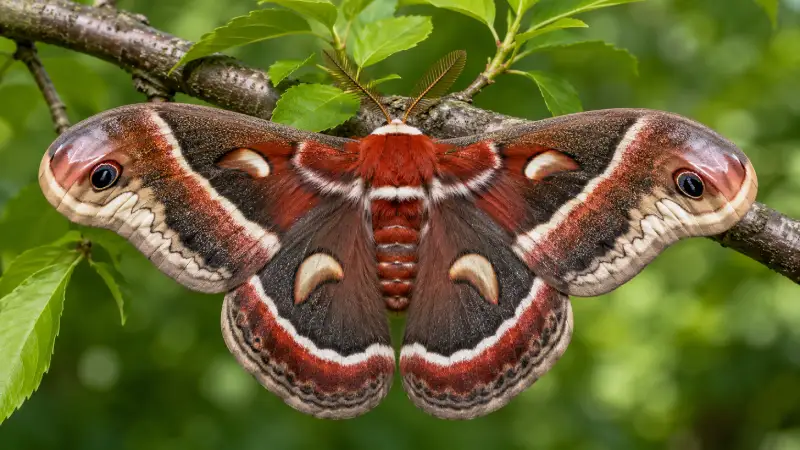
The cecropia moth belongs to the Saturniidae family, commonly called the giant silk moths or giant silkworm moths.
Adults are unmistakable.
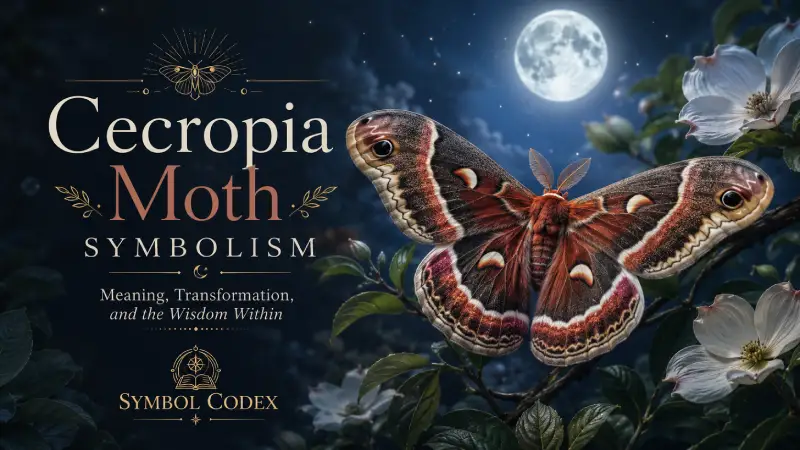
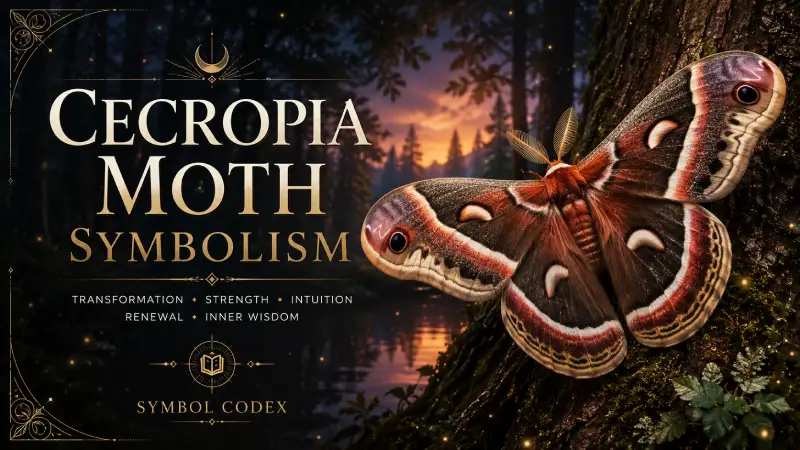
Their large wings are usually dark gray or reddish brown, bordered with bands of cream, red, black, and white. Each wing contains a pale crescent-shaped mark, and the forewing tips have patterns that can resemble eyes or animal heads. Wingspans commonly reach about 3¾ to 6 inches.
The caterpillar looks completely different.
Mature cecropia caterpillars can reach around four inches long. They are usually pale or bluish green with large reddish-orange, yellow, and blue tubercles along the body. Despite their dramatic appearance, those colorful projections are not harmful to people.
Caterpillars feed on many deciduous trees and shrubs, including maple, birch, cherry, willow, apple, elm, poplar, oak, and basswood. In northern areas they typically produce one generation per year, forming cocoons in late summer or fall and overwintering as pupae before emerging as adults the following spring.
This extreme visual and biological transition explains why transformation sits at the center of cecropia moth symbolism.
Cecropia Moth Symbolism: 7 Powerful Core Meanings
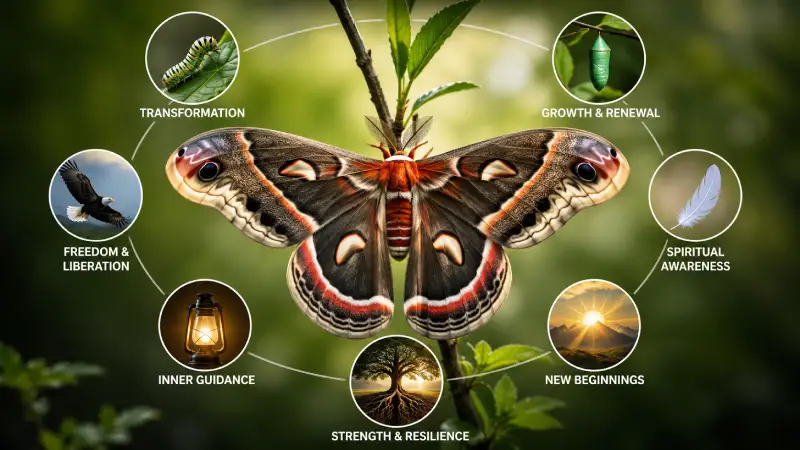
| Meaning | Cecropia Moth Trait | Modern Interpretation |
|---|---|---|
| Transformation | Caterpillar becomes a dramatically different adult | Major personal change |
| Renewal | Adult emerges after overwintering | A new phase beginning |
| Hidden potential | Development happens inside a cocoon | Growth others cannot yet see |
| Intuition | Males detect tiny amounts of female pheromone | Sensitivity and awareness |
| Purpose | Adults have little or no ability to feed | Focusing on what matters |
| Resilience | Survives winter protected as a pupa | Endurance through difficult periods |
| Impermanence | Adult life lasts only a short time | Valuing limited time |
These are modern interpretations inspired by biology rather than scientifically measurable messages carried by the moth.
Cecropia Moth Symbolism of Transformation
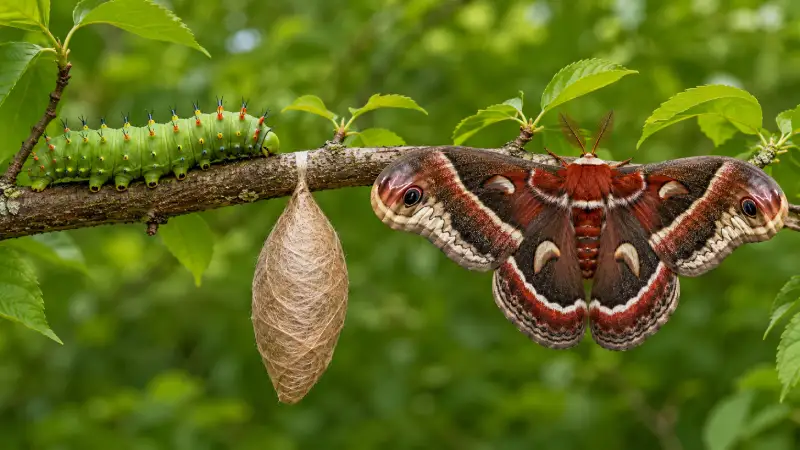
Transformation is the strongest cecropia moth meaning.
The contrast between caterpillar and adult is extraordinary.
A large green caterpillar spends summer feeding on leaves. Later, it produces a tough silk cocoon attached securely to a branch or trunk. Inside, it becomes a pupa and eventually develops into an enormous winged moth.
Humans naturally turn that process into a metaphor for life-changing experiences.
A cecropia moth may symbolize:
- rebuilding after hardship
- changing careers
- recovering from loss
- becoming more confident
- entering adulthood
- leaving an old identity behind
- beginning again after failure
Its transformation is particularly useful as a symbol because the finished adult looks so different from the caterpillar.
The message is not simply improve yourself.
It is closer to allow yourself to become something your earlier circumstances could not yet reveal.
Cocoon Symbolism and Hidden Growth
The cocoon gives cecropia moth symbolism a meaning that butterflies do not always emphasize as strongly.
Cecropia caterpillars spin substantial silk cocoons attached along branches or other protected surfaces. In much of their range, they spend the winter inside as pupae and emerge the following spring.
From the outside, the cocoon appears inactive.
Inside, development continues.
That makes it a powerful modern symbol of progress that is temporarily invisible.
Someone may appear to be standing still while they are actually:
learning,
recovering,
planning,
grieving,
building confidence,
or preparing for a major decision.
Not every important period produces immediate visible results.
The cecropia moth therefore offers a useful metaphor for people who feel pressure to constantly display progress.
Sometimes development needs protection before it needs attention.
Renewal and Emerging After a Difficult Season
Cecropia moths also symbolize renewal because their yearly cycle includes a long winter pause followed by spring emergence.
In northern regions, caterpillars generally complete their feeding and cocoon formation during late summer or fall. The pupae remain protected through winter, and adult moths emerge when warmer conditions return.
This makes the species especially fitting as a symbol of return after hardship.
Winter becomes a natural metaphor for difficult periods:
grief,
loneliness,
financial pressure,
illness,
uncertainty,
or emotional exhaustion.
Emergence does not mean the difficult season never happened.
The moth’s adult stage exists because it successfully passed through that period.
That distinction gives renewal more depth.
Starting again does not require pretending the past was meaningless.
Intuition, Awareness, and the Cecropia Moth’s Antennae
The enormous feathery antennae of male cecropia moths are among their most striking features.
They are specialized for detecting pheromones released by females.
Smithsonian material notes that male cecropia moths can respond to extraordinarily small concentrations of pheromone molecules in the air. This chemical sensitivity helps males locate potential mates even when visual information is limited at night.
Biologically, this is smell and chemical detection, not mystical intuition.
Symbolically, however, the trait provides a natural metaphor for noticing subtle information.
Cecropia moth imagery may therefore represent:
paying attention to small signals,
trusting carefully developed instincts,
becoming more observant,
or noticing something others overlook.
This is a more grounded interpretation of intuition than treating the moth as a supernatural messenger.
Sometimes what people call intuition is simply sensitivity to patterns, experience, body language, or environmental clues that are easy to miss consciously.
Purpose and the Cecropia Moth’s Brief Adult Life
One of the most unusual facts about cecropia moths is that adults essentially do not eat.
Like other giant silk moths, their adult mouthparts are reduced or nonfunctional. The energy needed for adult life comes from resources stored during the caterpillar stage. Adult cecropias generally live only around two weeks, during which their primary biological tasks involve finding a mate and reproducing.
That creates one of the species’ most distinctive symbolic meanings:
purpose within limited time.
The cecropia moth does not spend its adult stage accumulating more resources.
It uses what was already gathered.
As a human metaphor, this can encourage reflection on questions such as:
What am I saving my abilities for?
Which goals genuinely deserve my limited time?
Am I constantly preparing but never beginning?
The biology should not be interpreted as advice to rush through life.
The more useful lesson is that preparation eventually needs to become action.
Cecropia Moth Symbolism of Impermanence
The short adult lifespan also gives the cecropia moth a powerful relationship with impermanence.
An adult may have wings spanning several inches and look spectacular enough to become one of the most memorable insects someone has ever seen.
Yet that adult phase lasts only a small portion of the animal’s entire life cycle.
That contrast naturally suggests:
mortality,
temporary beauty,
limited opportunities,
and the value of the present.
The symbolic message does not need to be gloomy.
Many meaningful experiences are temporary.
Spring flowers disappear.
Children grow.
Trips end.
Relationships change.
Stages of life eventually become memories.
Their temporary nature does not make them less valuable.
The cecropia moth can therefore symbolize appreciating something precisely because it cannot remain unchanged forever.
Beauty That Appears After an Unseen Process
The adult cecropia moth is visually dramatic.
Its wings combine dark gray, reddish brown, cream, white, and black, while its body carries striking red and white markings. The pale crescents on all four wings and unusual forewing-tip patterns make it easily recognizable.
But none of this beauty is visible while the insect is inside its cocoon.
This creates a modern symbolic theme of results appearing after private preparation.
Someone may spend years developing a skill before others notice it.
A business may require months of invisible work before launching.
Recovery may occur gradually before confidence becomes visible.
Art may look effortless after hundreds of hours of practice.
The cecropia moth fits all of these experiences.
Its beauty is not separate from the hidden stage.
It is partly the result of that stage.
Eyespots, Protection, and Facing Fear
Cecropia moth wings contain bold markings, including patterns near the forewing tips that can appear eye-like or even resemble the heads of larger animals.
Missouri conservation educators note that the markings may startle predators by creating the impression of a more threatening creature, buying the moth time to escape.
This provides another useful symbolic meaning: protection without direct confrontation.
The cecropia moth is not equipped with claws, teeth, or venom.
Its defense relies partly on appearance.
As a personal metaphor, that can represent:
setting visible boundaries,
appearing confident even when vulnerable,
using intelligence rather than force,
or discouraging conflict before it begins.
Protection does not always require overpowering an opponent.
Sometimes the best defense is making danger think twice.
Night, Darkness, and Finding Direction
Cecropia moths are nocturnal.
Adults are active largely at night, and mating activity takes place during nighttime or predawn hours. They can also be attracted to artificial lights.
This nighttime life gives cecropia moth symbolism a natural connection with uncertainty and moving without complete visibility.
Human beings often want certainty before making decisions.
Life rarely provides it.
Someone may need to move forward without knowing:
whether a new career will work,
how a relationship will develop,
where a move will lead,
or whether a difficult period will improve quickly.
The cecropia moth becomes a metaphor for functioning when everything cannot yet be clearly seen.
Darkness does not automatically symbolize evil.
It can simply represent limited information.
Cecropia Moth Symbolism in Modern American Culture
The cecropia moth is especially relevant to American symbolism because it is native to North America rather than an imported exotic species.
It occurs across much of the eastern and central part of the continent and can live wherever suitable host trees occur, including woodland edges, parks, yards, and other landscapes containing deciduous trees.
Because adults are nocturnal and short-lived, many Americans can live within the species’ range for years without seeing one.
That makes an encounter feel unusual.
Finding a cecropia resting near an outdoor light or discovering its enormous cocoon on a tree can feel very different from seeing a familiar butterfly in daylight.
This rarity of encounter, even where the species itself occurs naturally, adds modern associations with:
unexpected beauty,
hidden wildlife,
attention,
and noticing what usually goes unseen.
Cecropia Moth Symbolism in Tattoos
Cecropia moth tattoos work particularly well because the moth has strong natural symmetry, distinctive crescents, bold coloration, and unmistakable antennae.
Common tattoo meanings include:
Transformation. Becoming substantially different after a major experience.
Renewal. Beginning another chapter after a difficult period.
Hidden growth. Honoring progress that occurred privately.
Resilience. Surviving a personal “winter.”
Intuition. Paying attention to subtle signals.
Purpose. Remembering that time and energy are limited.
Impermanence. Appreciating life because no stage lasts forever.
A cecropia moth shown emerging from a cocoon strongly emphasizes transformation.
A moth surrounded by branches or leaves can emphasize nature and life cycles.
Stars or moon imagery can strengthen nighttime and mystery themes.
A design emphasizing the antennae may focus more heavily on awareness or sensitivity.
Dates, initials, or flowers can turn the moth into a memorial tattoo.
As with most tattoo symbolism, the wearer’s personal story is more important than any fixed dictionary definition.
Spiritual Meaning of Cecropia Moth Symbolism
In contemporary spirituality, cecropia moths may be interpreted as symbols of transformation, intuition, spiritual awakening, hidden growth, surrender, or trusting an uncertain process.
These interpretations can function as meaningful personal metaphors.
They should not be presented as scientifically proven supernatural messages.
There is no evidence that seeing a cecropia moth automatically predicts:
money,
marriage,
death,
pregnancy,
good luck,
or a future spiritual event.
A grounded spiritual interpretation might instead treat the encounter as an invitation to reflect.
Perhaps you are preparing for change.
Perhaps something needs patience rather than immediate action.
Perhaps you have spent long enough preparing and now need to use what you have learned.
The moth does not provide the answer.
It can provide the metaphor.
Is Seeing a Cecropia Moth a Sign?
Seeing a cecropia moth can certainly feel significant.
Adults are large, beautiful, nocturnal, and relatively short-lived. Even people living within their range may encounter them infrequently.
But there is no scientifically established supernatural meaning attached to an encounter.
Its significance depends on the observer.
Someone facing a major life transition might see transformation.
A person emerging from isolation may interpret it as renewal.
Someone grieving may focus on impermanence.
A gardener may simply appreciate encountering one of North America’s most spectacular native insects.
All of these reactions are understandable.
Symbolism becomes most useful when it encourages reflection without turning coincidence into certainty.
Cecropia Moth Symbolism and Resilience
Cecropia moth resilience is easy to overlook because the adult appears delicate.
The species spends much of its yearly cycle in earlier stages.
In regions such as Minnesota and Missouri, the caterpillar feeds during summer, spins its cocoon, and then survives winter as a pupa before emerging months later.
That life cycle creates symbolism involving endurance.
But resilience here does not look like constant action.
The moth survives partly by becoming inactive and protected.
That is an important distinction.
Human resilience is often described as pushing harder.
The cecropia moth suggests another possibility:
sometimes resilience means protecting energy,
waiting,
recovering,
and allowing difficult conditions to pass before becoming active again.
Cecropia Moths and Environmental Meaning
Cecropia caterpillars feed on a wide variety of native and ornamental deciduous trees and shrubs. Although individual caterpillars can consume substantial leaves, they are rarely numerous enough to seriously damage healthy trees.
The species is also part of a larger food web.
Caterpillars, pupae, and adults provide food for predators and parasites. Missouri conservation authorities note that cecropia populations may be declining in parts of their range because of factors including habitat loss, pesticides, and parasitism by an introduced tachinid fly originally released against the invasive spongy moth.
This adds a modern environmental meaning to the species.
The cecropia can symbolize hidden biodiversity.
A suburban maple, cherry, willow, or apple tree may be more than landscaping. It can be habitat supporting part of an insect’s entire life cycle.
That makes appreciation of the moth inseparable from appreciation of the environment that produces it.
Positive and Negative Meanings of Cecropia Moth Symbolism
Cecropia moth symbolism is mainly positive, but its themes can also have cautionary interpretations.
Positive meanings
Transformation: allowing genuine personal change.
Renewal: emerging after a difficult period.
Patience: accepting that growth takes time.
Intuition: noticing subtle information.
Purpose: using time and ability intentionally.
Resilience: surviving periods of difficulty or withdrawal.
Beauty: allowing hidden qualities to become visible.
Negative or cautionary meanings
Impermanence: recognizing that opportunities can disappear.
Isolation: remaining hidden longer than necessary.
Delay: endlessly preparing without acting.
Over-sensitivity: reacting too strongly to every small signal.
Obsession with transformation: feeling pressured to constantly reinvent yourself.
The balance matters.
A cocoon protects development.
Remaining inside forever would prevent the next stage.
Common Misunderstandings About Cecropia Moth Symbolism
One common mistake is claiming that the cecropia moth has one ancient universal spiritual meaning.
There is little basis for that idea.
The cecropia is a North American species, and most symbolism widely attached specifically to it today is modern.
Another misunderstanding involves its name.
The scientific name Hyalophora cecropia ultimately references Cecrops, a figure from Greek mythology, but that taxonomic naming does not mean ancient Greeks developed religious symbolism around the North American cecropia moth. Missouri conservation materials specifically trace the name to the mythical Athenian king Cecrops.
Another mistake is assuming adult cecropias feed on flowers like many butterflies.
They essentially do not feed at all. Their reduced mouthparts mean adult survival depends on energy stored during the caterpillar stage.
Finally, an encounter should not be treated as a guaranteed omen.
A cecropia moth can inspire reflection without predicting the future.
How Cecropia Moth Symbolism Has Evolved
Modern cecropia moth symbolism begins with biology.
Its dramatic metamorphosis encouraged transformation imagery.
The overwintering cocoon added patience, protection, renewal, and hidden development.
Its huge wings contributed beauty and individuality.
Its short adult life introduced mortality, purpose, and impermanence.
Its extraordinary chemical sensitivity provided a modern metaphor for intuition and awareness.
Scientific history adds another interesting layer.
Research on cecropia moth larvae contributed to major discoveries about insect development. Missouri conservation materials note that studies reported in the 1950s helped scientists isolate and understand what became known as juvenile hormone, a key regulator of insect development and metamorphosis.
That makes the species symbolically appropriate in an unexpected way.
The cecropia moth did not merely become an icon of transformation because people admired its life cycle.
It also helped scientists understand how insect transformation actually works.
Today, tattoos, photography, nature education, gardening, and contemporary spirituality have expanded those meanings.
The cecropia moth has become a modern symbol of the extraordinary result that can emerge from an ordinary-looking branch, a quiet cocoon, and enough time.
Frequently Asked Questions
What does a cecropia moth symbolize spiritually?
A cecropia moth commonly symbolizes transformation, renewal, intuition, hidden growth, resilience, and purposeful living in modern spiritual interpretation. These meanings come mainly from its biology and contemporary symbolism rather than one universal ancient spiritual tradition.
Is seeing a cecropia moth a good sign?
There is no scientifically established omen connected with seeing one. Many people interpret an encounter positively because the moth’s life cycle naturally suggests transformation, patience, emergence, and new beginnings.
What does a cecropia moth tattoo mean?
A cecropia moth tattoo often represents transformation, survival, personal growth, renewal, intuition, or accepting the temporary nature of life. A cocoon or emerging moth can strengthen the meaning of personal change.
Why does the cecropia moth symbolize transformation?
It changes from a large green caterpillar into a pupa inside a silk cocoon before emerging as an enormous patterned adult moth. The striking difference between stages makes transformation an intuitive modern interpretation.
Does the cecropia moth symbolize death?
It can symbolize mortality or impermanence because adults live only a short period, typically about two weeks. It more often represents making meaningful use of limited time than death itself.
What does the cecropia moth cocoon symbolize?
The cocoon commonly represents protection, patience, unseen growth, recovery, and preparation. Cecropia moths can remain inside their cocoons through winter before emerging as adults in spring.
Are cecropia moths rare?
They are established native moths across a broad North American range, but adults are nocturnal and short-lived, so encounters may seem rare. Some populations may also be declining locally due to environmental pressures.
Conclusion
Cecropia moth symbolism most naturally represents transformation, renewal, hidden potential, intuition, resilience, purpose, and the temporary beauty of life. Few North American insects illustrate these ideas as dramatically: a colorful caterpillar disappears into a silk cocoon, survives through winter, and later emerges as one of the continent’s largest native moths.
Its short adult life adds an important second message. The cecropia has little time as a winged adult and does not spend that period gathering more food; it relies on resources accumulated earlier and focuses on completing the next stage of its biological cycle.
The most grounded meaning is therefore simple: not all growth needs to be visible, but preparation eventually has a purpose. There is a time to remain protected, a time to transform, and a time to emerge and use what you have become.