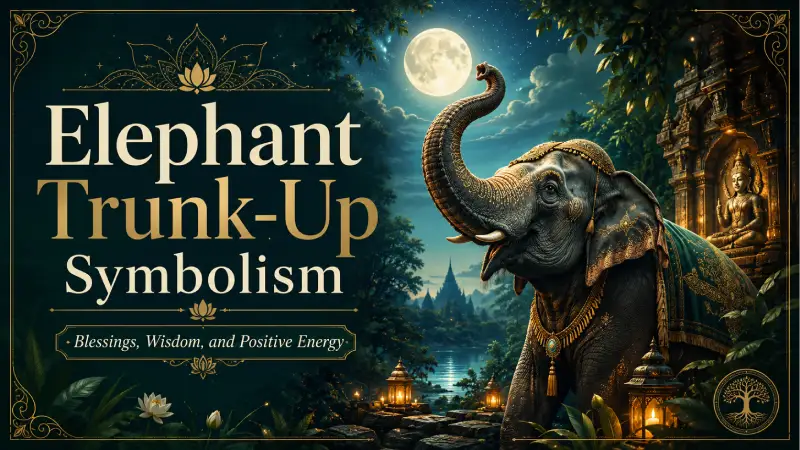
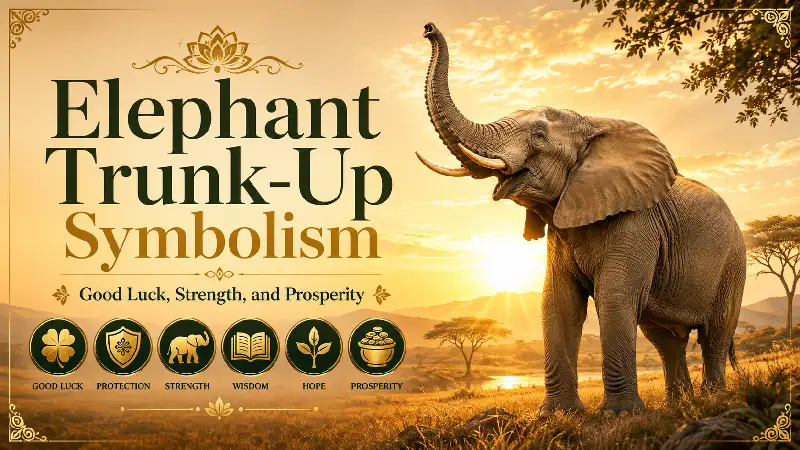
Elephant trunk-up symbolism most commonly represents good luck, strength, confidence, protection, prosperity, optimism, awareness, celebration, and positive forward energy in contemporary art, jewelry, tattoos, and home decor. The upward-reaching trunk creates an especially energetic version of broader elephant symbolism because it visually suggests rising, reaching, greeting, or confidently meeting the world.
There is an important distinction, however: an elephant holding its trunk up does not have one universal ancient meaning. Real elephants raise and move their trunks for many practical reasons, including smelling, communicating, touching, feeding, drinking, exploring, and responding to their surroundings. Smithsonian describes the trunk as a highly sensitive organ used for smell, touch, communication, lifting, feeding, drinking, defense, and many other tasks.
Historical art does provide genuine positive elephant traditions. In Indian Gaja-Lakshmi imagery, elephants raise their trunks to pour life-giving water over Lakshmi, goddess of fortune and prosperity. This imagery is associated with abundance, fertility, auspiciousness, and good fortune, but that is a specific religious tradition, not proof that every upward elephant trunk universally means luck.
Quick Answer
Elephant trunk-up symbolism most commonly represents good luck, optimism, strength, protection, prosperity, confidence, and positive momentum in modern symbolism. Historically, uplifted elephant trunks also appear in Indian Gaja-Lakshmi imagery connected with abundance and good fortune. However, trunk position itself has no single universal spiritual meaning; real elephants raise their trunks for smelling, communication, exploration, and other normal behaviors.
TL;DR
- An elephant with its trunk up commonly symbolizes good luck and optimism.
- The upward movement adds confidence, strength, and positive momentum.
- Elephants naturally lift their trunks to smell, communicate, explore, and interact.
- Gaja-Lakshmi art provides genuine historical links among elephants, abundance, fertility, and good fortune.
- Trunk-up decor is usually a modern positive symbol rather than a universal ancient rule.
- Tattoos can represent strength, protection, prosperity, family, or overcoming hardship.
- A raised trunk can also suggest awareness because elephants use their trunks to investigate scents.
- Seeing an elephant with its trunk raised is not scientifically a supernatural prediction.
Elephant Trunk-Up Symbolism: 9 Core Meanings
| Meaning | Why the Image Fits | Modern Interpretation |
|---|---|---|
| Good luck | Upward elephant imagery is widely used positively | Welcoming favorable circumstances |
| Strength | The elephant is already a symbol of physical power | Confidence and resilience |
| Prosperity | Elephants appear in auspicious Gaja-Lakshmi imagery | Abundance and well-being |
| Protection | Elephants combine size, social bonds, and power | Safety and guardianship |
| Optimism | The trunk reaches upward | Looking toward better possibilities |
| Awareness | Elephants lift trunks to investigate scent | Paying attention to your environment |
| Celebration | Raised trunk can appear energetic or triumphant | Joy and achievement |
| Confidence | Upright posture creates a commanding image | Self-assurance |
| Positive momentum | Upward direction implies movement and elevation | Progress after difficulty |
These are symbolic interpretations. They should not be confused with a fixed biological meaning for trunk position.
What Elephant Trunk-Up Symbolism Really Means
The basic symbolism comes from combining two ideas.
First, there is the elephant.
Elephants commonly evoke strength, social bonds, intelligence, endurance, memory, and protection in modern symbolism.
Then there is the upward trunk.
Visually, an upward line feels very different from a downward one. It suggests elevation, movement, reaching, energy, and confidence.
Together, the two create an especially positive image:
power directed upward rather than inward or downward.
That explains why trunk-up elephants appear so frequently in:
- jewelry
- home decor
- tattoos
- wedding gifts
- figurines
- business decorations
- garden ornaments
- spiritual imagery
But modern popularity does not automatically make every interpretation ancient.
The most accurate approach is to separate documented cultural history from contemporary symbolic convention.
Does an Elephant With Its Trunk Up Mean Good Luck?
Yes, in contemporary symbolism, a trunk-up elephant is widely treated as a good-luck image.
However, saying that requires an important qualification.
There is strong historical evidence that elephants can belong to traditions of auspiciousness and good fortune, especially in Indian art. Gaja-Lakshmi depicts Lakshmi with elephants pouring water over her from vessels held in their uplifted trunks. The Met describes Gaja-Lakshmi as a bringer of good fortune and well-being, while the elephants are associated with monsoon rain and successful crops.
The British Museum similarly explains that Gaja-Lakshmi imagery connects elephants with fertility, good fortune, prosperity, and life-giving rain.
What the historical evidence does not prove is a universal rule that:
trunk up = good luck
trunk down = bad luck.
That simple formula is better understood as a modern decorative convention.
So if someone places a trunk-up elephant figurine in a home as a symbol of luck, the symbolism is perfectly understandable, but it should not be described as one ancient belief shared by every culture.
Elephant Trunk-Up Symbolism of Strength
Elephants are among the most physically imposing land animals, so strength is already central to their modern symbolic personality.
Raising the trunk intensifies that impression.
A lowered or relaxed elephant can look calm and grounded.
An elephant with its trunk lifted appears more active and commanding.
Symbolically, that can represent:
Physical strength , the ability to endure pressure.
Emotional strength , remaining functional after difficulty.
Confidence , being willing to take up space.
Resilience , continuing after setbacks.
Inner power , knowing your capabilities without constant proof.
The raised trunk makes strength feel expressive rather than merely stored.
Optimism and Looking Upward
Direction matters strongly in visual symbolism.
Upward movement commonly feels hopeful because people associate “rising” with:
improvement,
recovery,
success,
and progress.
That makes a trunk-up elephant a natural symbol of optimism.
It may represent someone deciding:
- to rebuild after a setback
- to expect better possibilities
- to become more confident
- to stop defining themselves by a difficult period
- to move toward a larger goal
This symbolism does not mean optimism guarantees success.
A healthier interpretation is:
look upward while remaining strong enough to handle what actually happens.
That balance fits elephant imagery particularly well because elephants symbolize grounded physical presence as much as aspiration.
Awareness, Smell, and Reading the Environment
One of the most biologically grounded meanings of an upward trunk is awareness.
An elephant’s sense of smell is extraordinarily important. Smithsonian explains that elephants use their trunks to investigate scents and gather information about other elephants, reproductive status, resources, and possible danger. Wind-borne scents can provide information from a distance.
Smithsonian also notes that elephant smell is exceptionally developed and that trunks help elephants understand the world around them.
An elephant raising its trunk may therefore literally be investigating the air.
This creates a strong modern metaphor:
before moving forward, understand what is around you.
As human symbolism, this may mean:
pay attention,
gather information,
notice subtle signals,
and avoid making decisions blindly.
So the raised trunk can symbolize more than luck.
It can represent alert confidence.
Elephant Trunk-Up Symbolism of Prosperity
Prosperity is one of the strongest culturally grounded positive meanings associated with elephants in Indian imagery.
Gaja-Lakshmi is especially important.
The Met describes Lakshmi as a goddess of fortune, with elephants bathing her in water associated with life-giving monsoon rains and successful agriculture. Lotus and cornucopia imagery reinforces abundance.
The British Museum similarly describes Lakshmi as a goddess of fertility and good fortune and explains that elephants with uplifted trunks pour water over her. Their dark bodies were likened to rain-filled monsoon clouds that bring the land to life.
That gives elephants genuine historical connections with:
- prosperity
- fertility
- rain
- abundance
- well-being
- auspiciousness
But again, the meaning belongs to a specific religious and artistic context.
A generic trunk-up elephant on a shelf is inspired by a much broader modern symbolism and should not automatically be labeled a Gaja-Lakshmi object.
Gaja-Lakshmi and Uplifted Elephant Trunks
Gaja-Lakshmi deserves its own section because it is often indirectly responsible for modern claims connecting elephants with prosperity.
In Gaja-Lakshmi imagery, Lakshmi sits or stands centrally while elephants flank her.
The elephants use their trunks to pour water over the goddess.
The imagery has ancient roots. The Met notes that recognizable Gaja-Lakshmi imagery appeared by around the first century BCE.
In one British Museum painting from around 1780, elephants hold vessels in their uplifted trunks and pour water over Lakshmi. The museum identifies her with fertility and good fortune.
The symbolism is therefore not merely “elephant trunk pointing upward.”
It is a complete sacred composition involving:
Lakshmi,
water,
elephants,
lotus imagery,
fertility,
monsoon rain,
prosperity,
and auspiciousness.
That context should be preserved.
Protection and Guardianship
Elephants also make intuitive symbols of protection.
Their enormous bodies communicate physical security, while their complex social relationships add emotional and collective dimensions.
The Smithsonian describes elephant communication as including warning signals and protective herd responses. When danger is detected, older elephants can warn the herd, which then gathers together for protection.
A trunk-up elephant can therefore symbolize protection combined with alertness.
This may represent:
protecting family,
watching over a home,
maintaining strong boundaries,
or remaining aware of danger without becoming consumed by fear.
That makes the image especially popular in entryway decor and protective-themed tattoos.
The symbolic message is not necessarily aggression.
It is:
strong enough to protect, alert enough to notice.
Confidence and Personal Power
A raised trunk creates a tall, open silhouette.
It makes the elephant appear even larger.
That visual effect naturally suggests confidence.
As modern symbolism, a trunk-up elephant can represent someone who has stopped shrinking themselves for other people’s comfort.
It may mean:
- accepting leadership
- trusting your ability
- becoming more assertive
- recovering confidence after failure
- refusing unnecessary intimidation
The elephant is useful here because its confidence does not need speed or aggression.
Its presence is enough.
That produces a type of symbolism different from a tiger or cobra.
The trunk-up elephant represents power that can remain composed.
Celebration, Joy, and Triumph
Raised trunks can also appear celebratory to human observers.
An upward trunk resembles:
a salute,
a cheer,
or an arm raised after victory.
That visual similarity has made trunk-up elephants popular in celebratory decor.
The meaning can include:
joy,
achievement,
success,
and reaching an important milestone.
There is even historical Indian art showing an elephant with its head and trunk raised in what the Met describes as a seemingly joyful expression while playing and bathing in dust.
That does not establish a universal biological “joy posture.”
Elephant behavior is more complex than one trunk position.
Still, the artistic impression reinforces why humans naturally read an upward trunk as energetic and positive.
Elephant Trunk-Up Symbolism of Positive Momentum
A trunk pointing upward can also symbolize moving beyond a low point.
This interpretation is especially useful for:
recovery,
career growth,
financial rebuilding,
education,
or personal development.
The symbolism combines grounding and aspiration.
Four enormous feet remain on the ground.
The trunk reaches upward.
That creates a useful visual message:
reach higher without losing your foundation.
This differs from symbols of escape.
The elephant is not flying away.
It remains firmly connected to the earth while directing attention upward.
That makes trunk-up symbolism unusually suited to ambition with stability.
Raised Trunk vs. Lowered Trunk Symbolism
Modern decor guides sometimes present these positions as opposites:
Trunk up: luck, success, celebration.
Trunk down: bad luck or negative energy.
That second claim is overly simplistic.
A lowered elephant trunk is perfectly normal behavior.
Elephants use their trunks constantly for feeding, touching, smelling, drinking, exploring, and interacting with objects.
Therefore, a trunk-down elephant should not automatically be treated as a bad symbol.
In modern visual interpretation, a lowered trunk can just as easily suggest:
grounding,
calmness,
stability,
rest,
or connection with the earth.
So the most accurate distinction is:
Trunk up feels more energetic and aspirational.
Trunk down feels more grounded and calm.
Neither is biologically “good” or “bad.”
Elephant Trunk-Up Symbolism in Indian Culture
Elephants have profound cultural and religious importance across India, but their symbolism varies by context.
Gaja-Lakshmi provides one of the clearest auspicious examples. Elephants bathing Lakshmi symbolize life-giving monsoon rains, prosperity, fertility, abundance, and good fortune.
Elephants also appear in royal imagery, court paintings, religious art, festival imagery, and stories.
However, it would be inaccurate to summarize all Indian elephant symbolism as simply:
“trunk up means luck.”
For example, a nineteenth-century British Museum painting shows an elephant raising its trunk because it is agitated during a tiger attack, not because the artist was depicting luck.
Context determines meaning.
This is one of the strongest reasons to avoid rigid trunk-position dictionaries.
Ganesha and Trunk-Up Elephant Symbolism
Modern websites frequently connect every elephant image with Ganesha, the Hindu elephant-headed deity.
That requires caution.
Ganesha is not simply a generic elephant-luck symbol.
He is a major Hindu deity with complex theological, ritual, artistic, and regional traditions.
The direction and form of Ganesha’s trunk can matter within particular iconographic or devotional traditions, but those meanings should not be automatically transferred to ordinary elephant statues.
Similarly:
an elephant figurine with its trunk raised is not automatically an image of Ganesha.
Keeping those categories separate prevents living religious traditions from being reduced to generic interior-design symbolism.
Elephant Trunk-Up Symbolism in African Contexts
Africa does not have one universal elephant symbolism.
Different societies have distinct histories and interpretations.
One specific documented example comes from the Ga people of Ghana.
The British Museum holds an elephant-shaped coffin with its trunk raised. Museum commentary explains that elephants could be associated with strength and faithfulness, and people celebrated for loyalty could be buried in elephant-shaped coffins.
This is a valuable example because it provides a culturally specific meaning:
strength and loyalty.
It does not establish a universal African rule about upward elephant trunks.
The raised trunk is part of the coffin’s visual design, while the documented symbolic meaning relates more broadly to the elephant.
Ancient Elephant Images With Raised Trunks
Raised trunks appear in many historical images without always meaning the same thing.
The British Museum preserves ancient North African rock art showing an elephant with a curled-up trunk. Curatorial commentary suggests the pose may relate to excitement and reproductive behavior rather than luck.
Hellenistic elephant imagery could show elephants with raised trunks in battle contexts, where the pose communicated threatening or active behavior.
Indian art can depict a raised trunk during play or religious lustration.
These examples establish an important rule for symbolism research:
the same physical pose can acquire completely different meanings depending on what the elephant is doing.
Spiritual Meaning of Elephant Trunk-Up Symbolism
In contemporary spirituality, a trunk-up elephant commonly represents:
- good luck
- abundance
- optimism
- protection
- confidence
- positive energy
- overcoming obstacles
- spiritual awareness
Some of these meanings overlap with genuine historical traditions, especially the association among elephants, auspiciousness, prosperity, and Gaja-Lakshmi imagery.
Other meanings are contemporary interpretations.
There is no scientific evidence that seeing or owning a trunk-up elephant guarantees:
money,
marriage,
pregnancy,
promotion,
or protection from misfortune.
A grounded spiritual interpretation might instead ask:
What am I trying to raise or improve?
Where do I need more confidence?
Am I alert to opportunities around me?
What abundance already exists in my life?
The symbolism becomes useful without becoming fortune-telling.
Is Seeing an Elephant With Its Trunk Up a Good Sign?
Symbolically, yes, it is usually interpreted positively.
A raised trunk can evoke:
confidence,
celebration,
awareness,
good fortune,
and forward momentum.
In reality, the elephant may simply be smelling the air, communicating, reaching, exploring, or engaging in another ordinary behavior. Smithsonian documents the trunk’s extraordinary role in olfaction, touch, communication, feeding, and exploration.
So the safest answer is:
It can be a good personal symbol, but it is not an objective omen.
Elephant Trunk-Up Dream Meaning
Dreaming of a trunk-up elephant may reflect confidence, success, protection, or a desire to improve circumstances.
Dreams do not reliably predict future events, so context matters.
Dreaming of a Calm Elephant With Its Trunk Up
This may symbolize confidence, security, or optimism about a situation.
Dreaming of a Baby Elephant With Its Trunk Up
A calf can add meanings of new beginnings, growth, innocence, and future potential.
Dreaming of Several Trunk-Up Elephants
This may represent community support, abundance, or feeling surrounded by strength.
Dreaming of a White Elephant With Its Trunk Up
White adds modern associations of purity, rarity, peace, or spiritual significance.
Dreaming of an Angry Elephant Raising Its Trunk
This changes the meaning completely.
The image may reflect power, conflict, fear, or a situation that feels difficult to control.
This again demonstrates why trunk direction alone cannot determine meaning.
Elephant Trunk-Up Symbolism in Tattoos
Trunk-up elephant tattoos are popular because they combine a recognizable animal with a clear upward visual movement.
Common meanings include:
Good luck: welcoming a positive future.
Strength: surviving difficult experiences.
Protection: guarding family or personal boundaries.
Prosperity: hoping for stability and abundance.
Confidence: learning to trust yourself.
Family: honoring close relationships.
Triumph: celebrating recovery or achievement.
Awareness: remaining alert and perceptive.
A small trunk-up elephant can symbolize quiet optimism.
A mother and calf may emphasize family and protection.
An elephant with flowers can add growth and beauty.
An elephant with a lotus may suggest spiritual reflection, but lotus symbolism has its own cultural history and should be used thoughtfully.
A Gaja-Lakshmi-inspired tattoo has a more specific religious and cultural context than an ordinary elephant design.
Elephant Trunk-Up Symbolism in Home Decor
Trunk-up elephant statues are especially common in modern home decor.
People often use them to symbolize:
luck,
prosperity,
protection,
strength,
and positive energy.
Placement traditions differ widely, and many internet claims about exact rooms, directions, numbers of elephants, or door orientations combine feng shui, Vastu, modern commercial folklore, and personal belief.
Those claims should not automatically be presented as ancient rules.
If the goal is simply symbolic decor, the most defensible interpretation is straightforward:
a trunk-up elephant can serve as a personal reminder of strength, optimism, protection, and prosperity.
That does not require claiming that one exact shelf position controls fortune.
Elephant Trunk-Up Jewelry Meaning
Elephant necklaces, bracelets, earrings, and rings frequently show the trunk raised.
In jewelry, the symbolism usually emphasizes:
good fortune,
protection,
family,
strength,
and happiness.
Because jewelry is worn close to the body, the meaning may become especially personal.
Someone may wear an elephant pendant to remember:
a loved one,
a trip,
a period of recovery,
or a commitment to remain strong.
A gift of trunk-up elephant jewelry may similarly communicate:
“I wish you strength and good fortune.”
The personal intention is often more meaningful than any supposed universal rule.
White Elephant With Trunk Up Symbolism
A white elephant adds another symbolic layer.
Modern Western color symbolism associates white with:
peace,
purity,
innocence,
and new beginnings.
White elephants also have important historical royal and religious meanings in parts of South and Southeast Asia, though those traditions are more complex than a simple “white elephant equals luck” formula.
When combined with an upward trunk, modern imagery typically emphasizes:
rare opportunity,
positive change,
spiritual importance,
and favorable beginnings.
Again, this is an interpretive combination rather than one universal ancient definition.
Baby Elephant Trunk-Up Symbolism
A baby elephant with its trunk raised is an especially positive modern image.
The calf already suggests:
growth,
innocence,
family,
curiosity,
and future strength.
The upward trunk adds:
optimism,
confidence,
joy,
and positive momentum.
Together, the image can symbolize:
a small beginning moving toward something much bigger.
That makes it particularly appropriate for:
nurseries,
birth announcements,
family tattoos,
graduation gifts,
or new-business symbolism.
Elephant Trunk-Up Symbolism for Love and Relationships
A trunk-up elephant is not primarily a romantic symbol in the way paired swans or mandarin ducks are.
However, elephants more broadly can represent strong social bonds, reassurance, communication, and protection.
Smithsonian documents frequent trunk-based touching among elephants for greeting, reassurance, play, hierarchy, and social communication.
In relationship symbolism, a trunk-up elephant may therefore represent:
support,
loyalty,
protection,
and building a strong future together.
Two elephants can strengthen the partnership meaning.
A mother and calf shifts it toward parental love.
Positive and Negative Meanings of Elephant Trunk-Up Symbolism
Positive meanings
Good luck: welcoming favorable possibilities.
Strength: standing firmly through difficulty.
Prosperity: hoping for abundance and stability.
Protection: using power to create safety.
Confidence: trusting your abilities.
Awareness: paying attention to subtle information.
Optimism: looking toward improvement.
Celebration: recognizing success or recovery.
Negative or cautionary meanings
A raised trunk is overwhelmingly positive in modern symbolism, but the image can still carry cautionary meanings depending on context.
Pride: confidence becoming arrogance.
Dominance: strength becoming control.
Agitation: a real elephant may raise or move its trunk during tense situations.
Superstition: relying on an object instead of practical decisions.
Oversimplification: treating one trunk position as a universal ancient code.
Historical artworks themselves show raised trunks in playful, ritual, excited, and threatening contexts.
Common Misunderstandings About Elephant Trunk-Up Symbolism
One of the biggest misconceptions is:
“Trunk up always means good luck, and trunk down always means bad luck.”
There is no biological basis for that rule, and historical art shows elephants raising their trunks in many different contexts.
Another mistake is saying the good-luck rule is universal across India, Africa, China, or all of Asia.
Different cultures have distinct elephant traditions.
A third misconception is treating every trunk-up elephant as a representation of Ganesha.
Ganesha is a specific Hindu deity, not a generic elephant figurine.
Another error is ignoring what a real elephant is doing. Elephants use their trunks for smelling, touching, communication, drinking, feeding, lifting, defense, and exploration.
Finally, owning a trunk-up elephant statue does not scientifically alter wealth, health, or future events.
Its value is symbolic, artistic, cultural, religious, or personal.
How Elephant Trunk-Up Symbolism Has Evolved
Elephant trunk-up symbolism developed through several overlapping layers.
First came the animal itself.
Elephants raise and extend their trunks for ordinary biological reasons, including smelling, touching, communication, and investigation.
Historical cultures then used upward trunks in very different artistic contexts.
Indian Gaja-Lakshmi imagery connected uplifted elephant trunks, life-giving water, prosperity, fertility, and good fortune.
Other historical images showed elephants raising their trunks during battle, excitement, play, or other behaviors, demonstrating that the pose itself never had one fixed interpretation.
Modern jewelry and home decor simplified the image into a highly accessible positive symbol.
Today, a trunk-up elephant commonly communicates:
luck, strength, prosperity, protection, confidence, awareness, and optimism.
The most accurate modern interpretation preserves that positive meaning while acknowledging that it is symbolism, not a universal biological or ancient spiritual law.
Frequently Asked Questions
What does an elephant with its trunk up symbolize?
An elephant with its trunk up commonly symbolizes good luck, strength, prosperity, confidence, protection, optimism, and positive momentum in modern symbolism.
Is an elephant trunk up good luck?
It is widely treated as a good-luck symbol today. Historical Indian Gaja-Lakshmi imagery also provides genuine connections between elephants, uplifted trunks, abundance, fertility, and good fortune. However, there is no universal rule making every raised trunk a supernatural luck sign.
What does an elephant trunk up mean spiritually?
Spiritually, it may represent optimism, protection, prosperity, strength, awareness, or rising above difficulty. These interpretations can be personally meaningful but do not predict future events.
Why do real elephants raise their trunks?
Elephants use their trunks for many functions, including smelling, communication, touching, feeding, drinking, lifting, exploring, and defense. Raising the trunk can help them investigate scents carried through the air.
What does a trunk-up elephant tattoo mean?
A trunk-up elephant tattoo commonly represents good luck, strength, confidence, prosperity, protection, family, or overcoming hardship.
Is a trunk-down elephant bad luck?
No reliable universal rule says that. A lowered trunk is completely normal elephant behavior. Symbolically, it can be interpreted positively as grounding, stability, calmness, or connection with the earth.
What does a baby elephant with its trunk up symbolize?
It commonly represents hopeful beginnings, growth, joy, family, curiosity, and future strength. The calf emphasizes potential, while the upward trunk adds an optimistic tone.
Conclusion
Elephant trunk-up symbolism most commonly represents good luck, strength, prosperity, protection, optimism, confidence, awareness, celebration, and positive momentum. The visual meaning is easy to understand: the enormous elephant remains firmly grounded while its trunk reaches upward, creating an image of stability combined with aspiration.
Cultural history gives some of those positive meanings genuine depth. In Indian Gaja-Lakshmi imagery, elephants lift their trunks to pour life-giving water over Lakshmi, linking elephant imagery with fertility, abundance, auspiciousness, and good fortune.
At the same time, real elephant behavior prevents us from turning trunk position into a rigid spiritual code. Elephants raise their trunks to smell, communicate, investigate, interact, and perform many other everyday behaviors. Historical art likewise shows raised trunks in religious, playful, excited, and threatening situations.
The strongest modern meaning is therefore simple: keep your foundation strong while reaching upward. A trunk-up elephant can represent the confidence to seek better possibilities, the awareness to recognize opportunity, and the strength to remain grounded while your life moves in a positive direction.