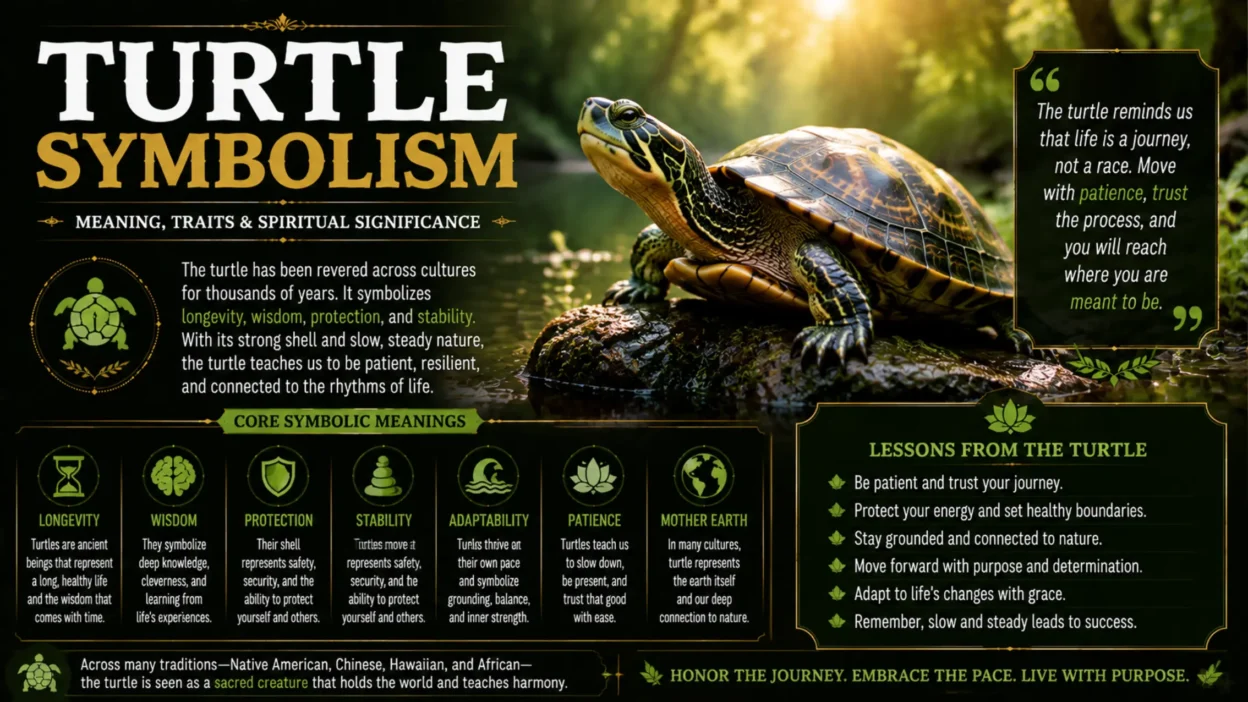
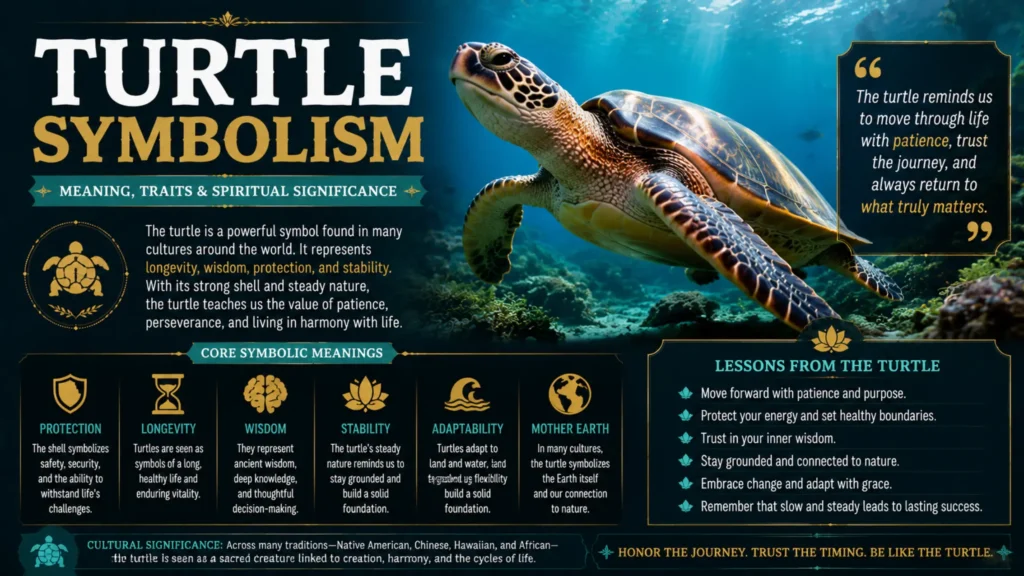
Turtles are among the most recognizable animals in the natural world. Their shells, slow movement, long lives, and ability to survive in different environments have made them familiar symbols of patience and endurance. Turtle symbolism commonly represents protection, patience, longevity, wisdom, stability, resilience, and connection with nature.
The turtle has also played important roles in mythology, folklore, Indigenous traditions, religion, literature, and modern environmental culture. However, its meaning is not identical everywhere. A turtle in an Indigenous creation story can carry a very different meaning from a turtle tattoo or a sea turtle conservation logo.
Today, Americans encounter turtle imagery in many places, from beaches and aquariums to jewelry, tattoos, children’s stories, artwork, gardens, and environmental campaigns. Its enduring appeal comes from a simple combination of qualities: the turtle moves slowly, carries its own protection, and continues forward.
Quick Answer
Turtle symbolism commonly represents patience, protection, longevity, and resilience in modern American culture, especially in tattoos, jewelry, nature imagery, and personal symbolism. Historically, turtles and tortoises have also represented stability, creation, wisdom, and the relationship between land and water in specific cultural and religious traditions.
TL;DR
- Turtles commonly symbolize patience, protection, longevity, and stability.
- Their shells represent safety, boundaries, and resilience.
- Slow movement represents patience and steady progress.
- Some Indigenous traditions connect turtles with creation and land.
- Sea turtles are strongly linked with conservation and ocean life.
- Modern tattoos often represent endurance, family, nature, or growth.
What Does a Turtle Symbolize?
The turtle’s main symbolic meanings come from characteristics people can easily observe.
Its shell represents protection because it provides a physical defense. Its slow movement encourages associations with patience and deliberate progress. Its long lifespan supports ideas about endurance, age, and continuity.
The turtle can therefore symbolize:
- Patience, taking time instead of rushing
- Protection, creating safety and personal boundaries
- Longevity, surviving and continuing over many years
- Wisdom, gaining perspective through time and experience
- Stability, remaining grounded during uncertainty
- Resilience, continuing despite obstacles
- Adaptability, living successfully in different environments
- Nature, maintaining a connection with the natural world
The strongest theme is steady progress. A turtle is rarely used as a symbol of instant success. Instead, it represents the idea that consistent movement can eventually lead somewhere meaningful.
Why Turtles Symbolize Patience
The turtle’s slow pace is one of its most familiar symbolic qualities.
The classic story of the Tortoise and the Hare helped make this association especially recognizable in American culture. Although the story features a tortoise rather than a typical turtle, many people use “turtle” as a general reference when discussing its lesson.
The story presents persistence as an advantage over speed without consistency.
That idea remains relevant today.
A turtle can represent someone who prefers to:
- work toward long-term goals
- avoid unnecessary competition
- improve gradually
- make careful decisions
- stay consistent
- keep moving despite slow results
The symbolism is not saying that being slow is always better. Instead, it suggests that speed has limited value if it is not supported by persistence.
A person may therefore choose turtle imagery as a reminder that progress does not need to be dramatic to be real.
The Turtle Shell as a Symbol of Protection
The turtle shell is probably the clearest physical basis for turtle symbolism.
For many turtles, the shell protects important parts of the body from predators and other dangers. The turtle also carries this protective structure wherever it travels.
This creates an obvious metaphor for safety and personal boundaries.
A turtle can symbolically represent someone who knows how to protect their space without constantly looking for conflict.
The shell may represent:
- personal security
- emotional boundaries
- privacy
- family protection
- resilience
- home
- self-preservation
There is also a less positive interpretation.
A person who constantly retreats into their “shell” may be avoiding communication or isolating themselves from others.
This gives the turtle a useful dual meaning. Protection can be healthy when it creates boundaries, but excessive protection can prevent connection.
Turtle Symbolism and Longevity
Turtles and tortoises are famous for their long lifespans.
Some turtle species can live for several decades, while certain tortoises can survive for well over a century. These unusually long lives have made shelled reptiles natural symbols of endurance and longevity.
The symbolism is particularly strong because the turtle seems built for persistence. Its shell provides protection, its movements conserve energy, and its life unfolds over a long period.
In personal symbolism, longevity can represent:
- lasting relationships
- family heritage
- endurance
- commitment
- generational knowledge
- long-term goals
- surviving difficult periods
A turtle image can therefore be meaningful during anniversaries, birthdays, family celebrations, or major life transitions.
It suggests a life measured over years rather than short moments.
Why Turtles Symbolize Wisdom
Wisdom is another common turtle association.
This meaning is largely cultural rather than biological. Turtles do not possess a special form of wisdom that humans can scientifically identify. Instead, their long lives and deliberate movements have made them useful metaphors for experience and thoughtful judgment.
The turtle does not appear hurried.
That creates an image of someone who takes time to observe before making a decision.
In this sense, turtle wisdom means:
- thinking before acting
- learning from experience
- avoiding unnecessary risks
- valuing perspective
- understanding that some things take time
This is different from the symbolism of an animal such as an eagle, which may represent sharp vision or decisive action.
The turtle suggests that good judgment can come from patience.
Ancient Turtle Symbolism Around the World
Turtles and tortoises appear in several major mythological and religious traditions.
In Chinese tradition, the tortoise has long been associated with longevity, endurance, and cosmic order. The Black Tortoise, one of the Four Symbols in Chinese cosmology, is connected with the north, water, and winter.
In Hindu tradition, the turtle appears in the story of Kurma, an incarnation of Vishnu. In the story of the churning of the ocean, Vishnu takes the form of a tortoise to support Mount Mandara.
These examples show that turtle symbolism is not limited to patience.
In different traditions, the animal can represent:
- stability
- cosmic support
- longevity
- creation
- endurance
- protection
- the relationship between earth and water
These meanings belong to specific traditions. They should not be combined into one universal religious definition.
Turtle Symbolism in Indigenous North American Traditions
Turtles have important cultural meanings in some Indigenous North American traditions, but there is no single “Native American turtle symbolism.”
Different Indigenous nations have distinct languages, histories, beliefs, and cultural practices.
One well-known example comes from Haudenosaunee tradition. In versions of the creation story, a turtle helps support the land that develops after Sky Woman falls into a watery world. This is connected with the concept commonly known as Turtle Island.
Turtle Island has become widely used in contemporary Indigenous and environmental discussions, but its meaning and use vary among Indigenous peoples.
This distinction matters.
It would be inaccurate to claim that every Indigenous nation considers the turtle a symbol of the earth in exactly the same way.
When discussing Indigenous turtle symbolism, the specific nation and tradition should always be considered.
What Turtle Island Symbolizes
Turtle Island is one of the most recognizable examples of turtle-related cultural symbolism in North America.
In the Haudenosaunee creation tradition, the turtle becomes part of the story through which land is formed.
In contemporary contexts, “Turtle Island” can also appear in conversations about:
- Indigenous identity
- land relationships
- cultural history
- environmental stewardship
- sovereignty
- responsibility toward nature
The turtle in this context represents much more than patience.
It can be connected with land, origin, relationship, responsibility, and cultural identity.
Because of this, Turtle Island should not be reduced to a generic spiritual slogan. Its meaning has specific cultural roots and continues to be used in different ways today.
What Turtles Represent in the United States
Turtle symbolism in the United States is shaped by several different influences.
Children encounter turtles in books, cartoons, school lessons, and outdoor environments. Adults may associate them with beaches, ponds, gardens, camping, wildlife photography, or conservation.
Sea turtles have an especially strong presence in American coastal culture.
They appear in:
- aquarium exhibits
- marine conservation campaigns
- beach artwork
- travel souvenirs
- jewelry
- environmental education
- photography
- tattoos
Freshwater turtles are also familiar across many parts of the country.
As a result, American turtle symbolism often includes:
- patience
- peacefulness
- protection
- family
- longevity
- environmental awareness
- resilience
- connection with nature
The turtle does not have the same national symbolism as the bald eagle. Instead, it tends to function as a personal, cultural, or environmental symbol.
Turtle Symbolism in Love and Relationships
In love, turtles commonly represent patience, stability, loyalty, protection, and lasting commitment.
The shell provides a natural metaphor for emotional safety.
A healthy relationship can create a place where both people feel secure enough to relax and be themselves. The turtle can therefore represent the idea of building a relationship that feels like home.
Its long lifespan also supports the idea of lasting commitment.
A turtle gift between partners may symbolize:
- staying together through change
- building a stable relationship
- emotional security
- patience
- loyalty
- creating a safe home
The turtle also has a useful negative interpretation in relationships.
Someone who constantly hides inside their shell may have difficulty communicating or becoming emotionally vulnerable.
For this reason, the healthiest turtle symbolism in love combines security with openness.
Protection should create trust, not isolation.
Turtle Symbolism in Family and Home
The turtle’s shell makes it a natural symbol of home and family.
A turtle carries its protection wherever it goes. This can be interpreted as carrying a sense of home within yourself.
Family-oriented turtle symbolism can represent:
- parental protection
- family unity
- belonging
- home
- safety
- continuity
- caring for younger generations
This meaning is common in decorative objects and gifts.
A turtle figurine may be given to someone moving into a new home or starting a family because the image can communicate security and stability.
It can also represent the idea that home is not simply a physical building. It is the place where a person feels protected and connected.
Turtle Symbolism in Tattoos
Turtle tattoos are popular because the animal has many positive meanings and a recognizable shape.
A turtle tattoo may symbolize patience, resilience, longevity, family, protection, personal growth, or a connection with nature.
Sea turtle tattoos often have an additional connection with beaches, travel, surfing, diving, and ocean conservation.
The design surrounding the turtle can change its meaning:
| Tattoo Design | Common Meaning in the USA | Main Association | Typical Interpretation |
|---|---|---|---|
| Turtle alone | Patience | Steady progress | Personal resilience |
| Sea turtle with waves | Freedom | Ocean life | Coastal identity |
| Turtle with flowers | Growth | Renewal | Personal development |
| Turtle family | Family | Protection | Family bonds |
| Turtle with compass | Journey | Travel | Long-term direction |
A realistic turtle can emphasize wildlife appreciation, while an artistic or geometric design may function more as a personal emblem.
There is no single correct meaning for a turtle tattoo. The story behind the tattoo usually matters most.
Turtle Symbolism in Dreams
A turtle in a dream can have different meanings depending on what happens in the dream.
A slowly moving turtle might represent patience or gradual progress.
A turtle hiding inside its shell could symbolize a desire for privacy, protection, or emotional distance.
A turtle coming out of its shell may suggest becoming more comfortable with vulnerability or returning to social life after a period of withdrawal.
A sea turtle swimming freely may be associated with freedom, emotional movement, travel, or a desire to reconnect with nature.
Dream interpretation is personal rather than predictive.
The dreamer’s emotional reaction can provide a better clue than any fixed dream dictionary.
If the turtle feels comforting, it may represent safety or stability. If its slow movement feels frustrating, it could reflect impatience with a real-life situation.
Turtle Symbolism in Spirituality
Modern spiritual practices often use turtles as symbols of grounding, patience, protection, longevity, and connection with nature.
Their ability to live in or around water and land makes them useful metaphors for balance.
The shell can represent maintaining an inner sense of safety while moving through changing circumstances.
Modern spiritual interpretations may connect the turtle with:
- staying grounded
- trusting gradual progress
- protecting personal boundaries
- respecting natural cycles
- remaining emotionally steady
- accepting change at a natural pace
These interpretations should be separated from specific religious and Indigenous traditions.
There is no universal spiritual meaning that applies to every turtle symbol.
A turtle can have one meaning in a personal spiritual practice and a completely different meaning within a particular cultural tradition.
Turtle Symbolism and Environmental Conservation
Modern turtle symbolism has gained another important meaning through environmental conservation.
Sea turtles face serious threats from habitat loss, pollution, fishing activity, artificial lighting near nesting beaches, and changes in marine environments.
As a result, sea turtle imagery is often used to promote awareness of ocean ecosystems.
In this context, the turtle can symbolize:
- environmental responsibility
- biodiversity
- ocean protection
- habitat conservation
- respect for wildlife
- long-term ecological thinking
This is an especially fitting modern interpretation because turtles themselves represent longevity.
Protecting a species for future generations becomes connected with the symbolic idea of thinking beyond the present.
A turtle on a conservation poster is therefore not simply a symbol of patience. It can represent the responsibility to protect an animal that may take many years to reach maturity and reproduce.
Positive and Negative Turtle Symbolism
Turtle symbolism is usually positive, but it can also represent less desirable traits.
Positive meanings include:
- patience
- protection
- longevity
- wisdom
- stability
- resilience
- family
- peacefulness
- adaptability
- environmental awareness
Negative meanings can include:
- excessive slowness
- isolation
- stubbornness
- fear of change
- emotional withdrawal
- excessive defensiveness
- avoiding difficult situations
The same characteristic can produce both interpretations.
The shell can represent healthy boundaries, but it can also represent hiding.
Slow movement can represent patience, but it can also suggest procrastination.
Stability can represent reliability, but too much attachment to stability can make change difficult.
This balance gives turtle symbolism more depth than a simple list of positive qualities.
Turtles, Tortoises, and Symbolic Differences
People often use “turtle” and “tortoise” interchangeably, but they are not identical.
Tortoises are primarily adapted for life on land, while many turtles are aquatic or semi-aquatic.
This distinction can affect symbolism.
A tortoise naturally suggests land, endurance, and long-term terrestrial survival. A sea turtle can suggest oceans, migration, navigation, and conservation.
The famous Tortoise and Hare story is therefore specifically about a tortoise, even though modern conversations sometimes call its lesson “turtle symbolism.”
Likewise, a cultural story involving a particular turtle species should not automatically be applied to every turtle.
Understanding the animal’s environment makes the symbolism more accurate.
Common Misunderstandings About Turtle Symbolism
One common misconception is that all Indigenous North American cultures share exactly the same turtle beliefs.
They do not.
Indigenous nations have different cultural traditions, and turtle symbolism varies among them.
Another misconception is that turtles universally symbolize good luck.
Some modern decorative traditions use turtles as lucky symbols, but luck is not a universal meaning across all cultures.
It is also misleading to claim that all turtles symbolize “Mother Earth.” Some specific traditions connect turtles with creation, land, or cosmology, but these meanings belong to particular cultural contexts.
Another common mistake is assuming that a turtle automatically represents wisdom because turtles are slow.
Wisdom is a human symbolic interpretation, not a biological trait that can be assigned to every turtle.
How Turtle Symbolism Has Changed Over Time
Turtle symbolism has developed through mythology, religion, storytelling, direct encounters with nature, and modern environmental concerns.
In some ancient traditions, turtles and tortoises represented longevity, cosmic stability, or support.
Specific Indigenous traditions connected turtles with creation, land, and cultural identity.
European storytelling helped establish the tortoise as a symbol of persistence through the Tortoise and Hare story.
Modern American culture has added meanings involving conservation, family, personal resilience, travel, and coastal identity.
The symbol has therefore expanded without losing its central themes.
The shell still represents protection.
Slow movement still represents patience.
Long life still represents endurance.
What has changed is the context in which people use those qualities.
A turtle once encountered primarily as a wild animal can now also appear as a conservation emblem, tattoo, piece of jewelry, classroom illustration, or personal reminder.
What Turtle Symbolism Means Today
Today, the turtle is best understood as a symbol of steady progress, protection, longevity, and resilience.
Its symbolism appeals to people who value consistency over speed and security without unnecessary conflict.
For Americans, the meaning can become more specific depending on the context.
A sea turtle may represent ocean conservation. A turtle tattoo may represent personal endurance. A turtle in an Indigenous tradition may carry a specific cultural meaning connected with land and creation. A turtle decoration may simply communicate peace, patience, or a love of nature.
The symbol does not need one universal definition.
Its strength comes from its flexibility while still being rooted in recognizable characteristics of the animal.
Frequently Asked Questions
What does a turtle symbolize spiritually?
A turtle commonly symbolizes patience, grounding, protection, longevity, and connection with nature in modern spiritual practices. Specific religious and Indigenous traditions can give the turtle additional meanings that should be understood within their own cultural contexts.
What does a turtle tattoo symbolize?
A turtle tattoo can represent patience, resilience, protection, longevity, family, personal growth, or a connection with nature. Sea turtle designs often add meanings related to ocean life, travel, and conservation.
What does a turtle symbolize in love?
A turtle can symbolize stability, patience, loyalty, emotional security, and long-term commitment in relationships. Its shell can also represent creating a safe space where both partners can feel protected.
What does seeing a turtle mean?
Seeing a turtle is often interpreted symbolically as a reminder to slow down, remain patient, and trust gradual progress. In everyday life, however, a turtle may simply be responding to its habitat, food sources, temperature, or seasonal behavior.
What does a turtle mean in a dream?
A turtle in a dream may symbolize patience, protection, stability, emotional withdrawal, or gradual progress. A turtle hiding in its shell can suggest a need for safety, while an active turtle may represent moving forward at a comfortable pace.
Why is the turtle important in Indigenous symbolism?
Turtles have specific cultural importance in some Indigenous North American traditions, including Haudenosaunee traditions involving Turtle Island. There is no single Indigenous turtle meaning because different nations have distinct histories and cultural traditions.
Are turtles symbols of good luck?
Turtles are sometimes used as symbols of good fortune, stability, and long life in modern decorative and cultural settings. However, luck is not a universal turtle meaning across every culture or tradition.
Conclusion
The meaning of turtle symbolism comes largely from the animal’s most recognizable characteristics. Its shell represents protection, its slow movement represents patience, and its long lifespan represents endurance and continuity.
The symbol becomes more complex when cultural context is considered. Indigenous traditions, Asian cosmology, European folklore, American conservation, coastal culture, and modern personal expression all give turtles different meanings.
Today, a turtle can represent a person moving steadily toward a goal, a family creating a safe home, a survivor who has endured difficult circumstances, or a commitment to protecting the natural world.
The turtle offers a simple and practical message: progress does not have to be fast, and protection does not have to prevent you from moving forward.