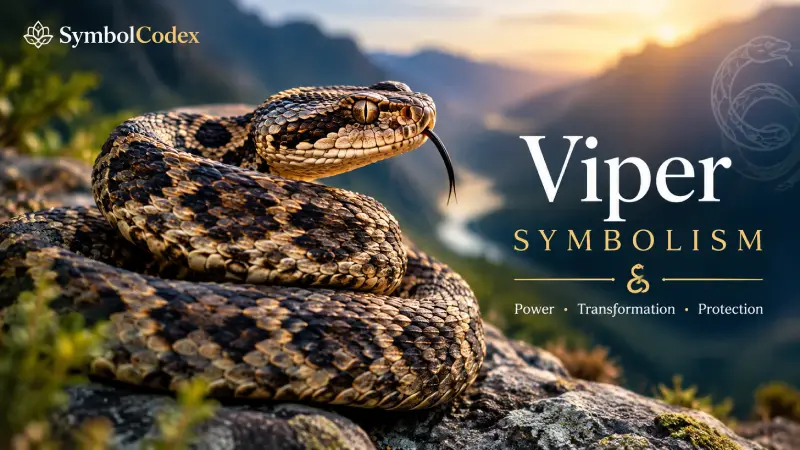
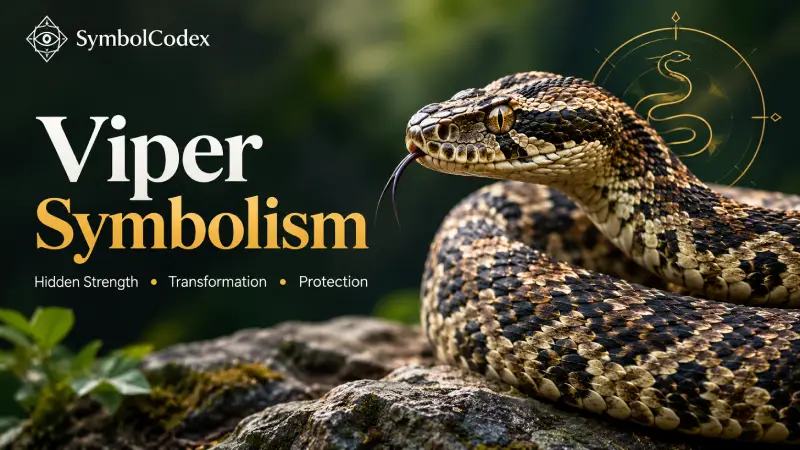
Vipers are venomous snakes known for their specialized fangs, heat-sensing abilities in many species, camouflage, and highly effective defensive behavior. Viper symbolism commonly represents danger, protection, transformation, instinct, hidden power, caution, and strategic action.
The viper has a complicated symbolic history because people have long viewed snakes with a mixture of fear, respect, curiosity, and fascination. A viper can represent a threat because its bite can be dangerous, but the same animal can also symbolize survival, awareness, patience, and the ability to defend itself.
In the United States, viper imagery appears in mythology, religious art, tattoos, military and sports designs, literature, horror, fashion, and modern nature culture. Its meaning depends heavily on context. A viper in a warning symbol communicates danger, while a viper tattoo may represent resilience, transformation, or personal strength.
Quick Answer
Viper symbolism commonly represents danger, protection, instinct, transformation, and hidden strength in modern American culture, especially in tattoos, art, literature, and cautionary imagery. Historically, vipers and other venomous snakes have also been associated with healing, death, rebirth, temptation, wisdom, and spiritual danger in different traditions.
TL;DR
- Vipers commonly symbolize danger, instinct, protection, and transformation.
- Their venom creates strong associations with death and healing.
- Camouflage represents patience, secrecy, and strategic awareness.
- Biblical traditions give vipers strong associations with deception and moral danger.
- Modern tattoos often represent survival, power, change, or protection.
- Viper symbolism can be positive, negative, or deliberately ambiguous.
What Does a Viper Symbolize?
The viper’s symbolic meaning comes largely from its biology and the way humans respond to venomous snakes.
The most common associations include:
- Danger, because many vipers possess medically significant venom.
- Protection, because venom and defensive behavior can deter predators.
- Transformation, because snakes shed their skin.
- Instinct, because snakes rely heavily on sensory information and rapid responses.
- Patience, because vipers may remain still while waiting for prey.
- Hidden strength, because a relatively motionless snake can still be highly dangerous.
- Caution, because an apparently quiet animal may become defensive when threatened.
- Rebirth, because shedding skin has long served as a metaphor for renewal.
- Secrecy, because camouflage allows many vipers to remain difficult to notice.
These meanings are not universal rules. A viper can symbolize completely different things depending on the culture, story, artwork, or individual using the image.
Why Vipers Symbolize Danger
Danger is perhaps the most straightforward viper association.
Many vipers have venom that they use to subdue prey or defend themselves. Their long, hinged fangs are especially adapted for delivering venom.
This makes the viper different from animals whose symbolic danger is mostly based on appearance.
A viper can genuinely pose a medical risk, which helps explain why venomous snakes have appeared in warning imagery and cautionary stories.
Symbolically, this creates ideas about:
- recognizing threats
- respecting boundaries
- avoiding unnecessary risks
- hidden consequences
- defensive power
- knowing when to retreat
The viper therefore does not always symbolize aggression.
In many situations, its message is closer to do not underestimate what you cannot immediately see.
The Viper as a Symbol of Protection
Protection is closely related to the viper’s dangerous reputation.
A venomous snake does not need to chase everything around it to be taken seriously. Its defensive capabilities can discourage predators or threats.
This makes the viper a useful metaphor for personal boundaries.
Someone may choose viper imagery to represent the ability to protect themselves without constantly seeking confrontation.
The symbolism can suggest:
- self-defense
- strong boundaries
- personal authority
- vigilance
- independence
- controlled strength
This interpretation is especially common in modern tattoo culture.
A viper wrapped around a symbol, weapon, flower, or object may communicate the idea that something valuable is being guarded.
Viper Symbolism and Transformation
Transformation is one of the most recognizable snake-related meanings.
Snakes periodically shed their outer layer of skin. This process, called ecdysis, is a normal part of growth and maintenance.
Humans naturally turned this physical process into a metaphor for renewal.
A viper shedding its skin can symbolize:
- leaving the past behind
- personal growth
- changing identity
- recovery
- renewal
- beginning again
- becoming stronger after difficulty
This symbolism is especially common in tattoos and spiritual artwork.
Someone who has gone through a major life change may choose a snake or viper design as a visual representation of leaving an earlier version of themselves behind.
The symbolism does not mean the snake is literally being reborn. Rather, its natural life process provides a metaphor for human change.
Why Vipers Represent Patience
Vipers can also symbolize patience because many snakes spend periods remaining still while waiting for suitable prey or responding to their surroundings.
Their hunting strategies vary by species, but stillness is an important part of how many snakes conserve energy and avoid unnecessary movement.
This creates a useful symbolic contrast with the viper’s reputation for sudden action.
The viper can remain quiet for a long time and then react quickly when the situation requires it.
Symbolically, that can represent:
- waiting for the right opportunity
- observing before acting
- conserving energy
- avoiding unnecessary conflict
- choosing timing carefully
The broader lesson is not simply “wait.”
It is know when waiting is useful and when action is necessary.
Viper Symbolism and Instinct
Snakes are often associated with instinct because they interact with their environment through highly specialized sensory systems.
Vipers are particularly notable because pit vipers have specialized heat-sensing organs that can detect infrared radiation from warm objects. Not every viper is a pit viper, so this characteristic should not be applied to the entire viper family.
For species that possess these pits, the ability contributes to their remarkable ability to detect warm prey.
Symbolically, this can inspire associations with:
- awareness
- instinct
- perception
- sensitivity
- reading the environment
- responding quickly
This is one reason the viper can represent trusting one’s instincts.
However, symbolic “intuition” should not be confused with supernatural perception. The real animal is using specialized biological senses.
Viper Symbolism in the United States
In the United States, viper symbolism is strongly influenced by the country’s real encounters with venomous snakes.
Several venomous snakes belonging to the viper family live in the United States, including rattlesnakes, copperheads, and cottonmouths.
Because these snakes are part of the American landscape, viper imagery can represent something more immediate than an abstract mythical creature.
Americans may associate vipers with:
- wilderness
- danger
- survival
- caution
- self-defense
- nature
- independence
- fear
- respect for wildlife
Rattlesnakes in particular have a strong place in American history and symbolism, although a rattlesnake is not simply interchangeable with every viper.
The distinction matters because “viper” refers to a broader biological group, while rattlesnake, copperhead, and cottonmouth identify particular snakes.
Vipers in Biblical and Christian Symbolism
Vipers have an important place in biblical language.
In the New Testament, John the Baptist and Jesus use the expression “brood of vipers” when condemning people for hypocrisy or moral wrongdoing. The imagery is deliberately negative and emphasizes danger, deception, and moral corruption.
The broader Christian tradition also inherited complex snake symbolism.
The serpent can represent temptation and evil in the story of Genesis, although the biblical text itself does not identify the serpent specifically as a viper.
This distinction is important.
A common modern mistake is to describe every biblical serpent as a viper. The texts use different terms and contexts, and the exact species should not be assumed.
Nevertheless, the phrase “brood of vipers” helped establish a strong cultural association between vipers and deception, hypocrisy, and moral danger in Christian-influenced societies.
This influence remains visible in Western literature and popular culture.
Viper Symbolism in Ancient Traditions
Venomous snakes have appeared in the symbolic traditions of many ancient societies.
In ancient Egypt, the cobra was especially important. The uraeus, typically represented as an upright cobra, was associated with royal authority and divine protection.
It is important not to confuse Egyptian cobra symbolism with viper symbolism in general.
The Egyptian cobra belongs to the cobra family rather than the viper family.
This example nevertheless shows how venomous snakes could symbolize both danger and protection at the same time.
Other ancient traditions also connected snakes with healing, fertility, death, renewal, and the underworld.
These meanings developed from specific cultural relationships with snakes and should not be combined into a single ancient “viper meaning.”
Viper Symbolism and Healing
The connection between snakes and healing is one of the most interesting parts of serpent symbolism.
The Rod of Asclepius, a staff with a single snake, became an enduring symbol associated with medicine and healing. It is commonly linked with Asclepius, the Greek figure associated with medicine.
However, the snake on the Rod of Asclepius is not specifically a viper.
The symbol demonstrates a broader cultural contradiction surrounding snakes: the same creature can represent danger and healing.
Modern medicine uses the Rod of Asclepius as an important emblem, while venomous snakes continue to be associated with injury.
This contrast helps explain why snake symbolism can never be reduced simply to “evil” or “danger.
A viper can represent a substance that harms, while snake imagery more broadly can represent knowledge of healing and medicine.
Viper Symbolism in Mythology and Folklore
Vipers and venomous snakes frequently appear in stories involving danger, forbidden knowledge, deception, transformation, and supernatural creatures.
Folklore often exaggerates their characteristics.
A snake that is already capable of delivering venom can easily become a symbol of betrayal or hidden danger in a story.
The animal’s ability to remain concealed also makes it useful in narratives where danger appears unexpectedly.
At the same time, snakes can represent wisdom or renewal.
This contradiction is one reason serpent imagery appears so often in mythology.
The viper’s symbolic power comes partly from its ability to occupy opposing roles: protector and threat, healer and poisoner, hidden creature and visible warning.
Viper Symbolism in Love and Relationships
In relationships, a viper can carry both positive and negative meanings.
On the positive side, it can represent protection, loyalty, passion, strong boundaries, and personal independence.
A viper design surrounding a heart, for example, could represent protecting love or defending an important relationship.
On the negative side, the viper can symbolize:
- jealousy
- betrayal
- manipulation
- distrust
- hidden motives
- emotional danger
This negative meaning is strongly influenced by Western stories that use snakes as metaphors for deception.
The context is therefore essential.
A viper wrapped protectively around a heart communicates something very different from a viper shown striking toward someone.
Viper Symbolism in Tattoos
Viper tattoos are often chosen for their combination of visual impact and layered symbolism.
A person may choose a viper to represent survival, transformation, danger overcome, self-defense, confidence, or independence.
The design can also communicate different ideas depending on the pose.
A coiled viper may suggest protection and readiness. A shedding viper can emphasize transformation. A striking viper can communicate aggression or warning.
Common combinations include:
| Viper Tattoo Design | Common Meaning in the USA | Main Association | Typical Interpretation |
|---|---|---|---|
| Coiled viper | Protection | Readiness | Strong boundaries |
| Shedding viper | Transformation | Renewal | Personal change |
| Viper with flowers | Contrast | Beauty and danger | Complex identity |
| Viper around a heart | Protection | Love | Defending relationships |
| Viper with a skull | Mortality | Danger | Survival and death |
Tattoo symbolism remains personal. The same design can mean something entirely different to two people.
Viper Symbolism in Dreams
A viper in a dream often produces strong emotional reactions because the animal is widely associated with danger.
A threatening viper may symbolize fear, distrust, conflict, or a situation that feels unsafe.
A viper hiding in grass could represent something the dreamer believes is difficult to detect.
A viper shedding its skin may suggest personal transformation or leaving an old situation behind.
A calm viper may have a different meaning. It could represent controlled power, awareness, or learning to respect something that once caused fear.
Dream interpretation is not a scientific prediction system.
The dreamer’s emotions, personal experiences, and circumstances are more useful than assigning one fixed meaning to the animal.
Viper Symbolism in Spirituality
Modern spiritual interpretations often connect vipers and snakes with transformation, intuition, protection, healing, and renewal.
Some contemporary spiritual systems interpret snakes as symbols of changing energy, personal awakening, or shedding old patterns.
These interpretations should be distinguished from documented historical religious traditions.
There is no universal spiritual doctrine stating that a viper always represents transformation or awakening.
For someone using viper imagery personally, however, the symbolism can serve as a reminder to trust observation, recognize change, and protect personal boundaries.
The most grounded interpretation comes from the animal itself rather than supernatural claims.
Viper Symbolism and Power
Power is another common modern association.
The viper’s small or moderate size compared with larger predators creates an interesting form of power symbolism.
It does not need to be enormous to be dangerous.
This can represent the idea that power does not always depend on size, status, or visibility.
A viper may symbolize:
- underestimated strength
- strategic power
- self-reliance
- confidence
- controlled aggression
- defensive capability
This interpretation works especially well for people who identify with being underestimated.
The viper becomes a metaphor for someone who does not need to appear intimidating to possess real capability.
Positive and Negative Viper Symbolism
Viper symbolism has a strong dual nature.
Positive meanings include:
- protection
- courage
- transformation
- instinct
- awareness
- patience
- resilience
- independence
- healing symbolism
- hidden strength
Negative meanings include:
- danger
- betrayal
- deception
- jealousy
- aggression
- fear
- poison
- manipulation
- hidden threats
This duality is not accidental.
The viper’s venom creates the negative associations, while its survival abilities create the positive ones.
Its stillness can mean patience or secrecy.
Its defensive bite can represent protection or aggression.
Its shedding can represent renewal or loss.
The surrounding context determines which interpretation makes the most sense.
Vipers and Misunderstood Snake Symbolism
One major misunderstanding is treating all snakes as if they belong to the same biological group.
Vipers are a specific family of snakes, Viperidae. They include many familiar venomous snakes, but not every venomous snake is a viper.
Cobras, mambas, coral snakes, and sea snakes belong to other snake families.
Another misconception is that every viper aggressively attacks humans.
Most snakes generally prefer to avoid people when possible. Defensive bites can occur when snakes are threatened, handled, cornered, or accidentally disturbed.
It is also inaccurate to assume that every viper bite is automatically fatal.
Venom composition varies significantly between species, and medical outcomes depend on the species, bite location, amount of venom delivered, treatment, and other factors.
Vipers deserve caution and respect, but exaggerated claims can create unnecessary fear.
Viper Symbolism and the Natural World
Modern environmental culture provides another interpretation of viper imagery.
Venomous snakes are predators that play roles in ecosystems by helping regulate populations of prey animals.
This makes the viper a useful reminder that animals people fear can still have ecological value.
Modern wildlife education increasingly emphasizes observation rather than unnecessary killing.
A viper encountered in nature is not simply a symbol of danger. It is also part of a functioning ecosystem.
This creates a more balanced modern interpretation:
respect the animal without romanticizing or demonizing it.
That approach is particularly relevant in the United States, where people may encounter venomous snakes while hiking, gardening, camping, or living near natural habitats.
Common Misunderstandings About Viper Symbolism
A frequent misconception is that vipers universally symbolize evil.
Western religious and literary traditions strongly influenced this interpretation, but other cultures have associated snakes with healing, renewal, fertility, protection, and wisdom.
Another mistake is assuming that all snake symbolism comes from the Bible.
Biblical imagery is influential in Western culture, but snake symbolism existed in many societies long before and outside biblical traditions.
It is also misleading to describe every snake in ancient art as a viper.
Artists often represented snakes without identifying a precise species, and many famous serpent symbols involve cobras or other snakes rather than vipers.
Finally, claims that vipers possess supernatural powers should be treated as folklore or spiritual belief, not biological fact.
How Viper Symbolism Has Evolved
Viper symbolism has changed as humans’ relationships with snakes have changed.
In some traditional stories, venomous snakes represented danger, death, or moral corruption.
Other traditions emphasized healing, fertility, protection, renewal, or divine power.
Western Christian culture contributed especially strong associations between vipers and hypocrisy or deception through biblical language such as “brood of vipers.”
Modern culture has expanded the symbol again.
Vipers now appear in tattoos, video games, fashion, logos, horror movies, fantasy stories, wildlife photography, and conservation education.
The meaning has become increasingly personal.
A viper tattoo may represent survival. A warning sign may represent immediate danger. A nature photograph may communicate respect for wildlife.
The same animal can therefore communicate completely different messages depending on where and why it appears.
What Viper Symbolism Means Today
In modern American culture, the viper is best understood as a symbol of controlled danger, protection, instinct, and transformation.
Its venom creates associations with risk and defense. Its ability to remain still supports ideas of patience and strategic action. Its shedding creates a natural metaphor for personal change.
Its historical associations add further complexity.
Christian symbolism contributed ideas about deception and moral danger, while broader serpent traditions demonstrate that snakes can also symbolize healing and renewal.
Today, the viper works particularly well as a symbol for someone who wants to communicate strength without relying on size or obvious aggression.
Frequently Asked Questions
What does a viper symbolize spiritually?
A viper can symbolize transformation, protection, instinct, renewal, and awareness in modern spiritual interpretations. These meanings are personal or tradition-specific and should not be treated as universal religious beliefs.
What does a viper tattoo symbolize?
A viper tattoo can represent protection, survival, transformation, independence, confidence, or controlled strength. The pose and surrounding imagery can make the meaning more positive, threatening, romantic, or personal.
What does a viper symbolize in love?
A viper can symbolize strong protection and boundaries in love, but it may also represent jealousy, betrayal, or distrust. The surrounding imagery usually determines whether the symbolism is protective or threatening.
What does a viper mean in a dream?
A viper in a dream may represent fear, hidden danger, distrust, transformation, or personal strength. A threatening snake often produces a different interpretation from a calm or shedding viper.
Why are vipers associated with deception?
Vipers became strongly associated with deception in Western culture partly because of biblical language describing certain people as a “brood of vipers.” Later literature and popular culture expanded the snake’s association with betrayal and hidden danger.
Are vipers symbols of healing?
Snake symbolism has important connections with healing, particularly through the Rod of Asclepius and ancient traditions involving snakes and medicine. However, the snake in these traditions should not automatically be identified as a viper.
Are all venomous snakes vipers?
No. Vipers belong to the family Viperidae, while many other venomous snakes belong to different families. Cobras, mambas, coral snakes, and many sea snakes are examples of venomous snakes that are not vipers.
Conclusion
Viper symbolism combines qualities that can seem contradictory. The animal can represent danger and protection, patience and sudden action, secrecy and awareness, death and renewal. Its venom explains much of its threatening symbolism, while its survival strategies and ability to shed skin support more positive interpretations.
In modern American culture, the viper often represents controlled strength, self-protection, instinct, transformation, and caution. Its meaning can shift dramatically depending on whether it appears in a tattoo, religious image, dream, warning sign, story, or wildlife setting.
The viper ultimately reminds us that strength does not always announce itself. Sometimes the most important form of power is knowing when to stay still, when to protect yourself, and when to change.