

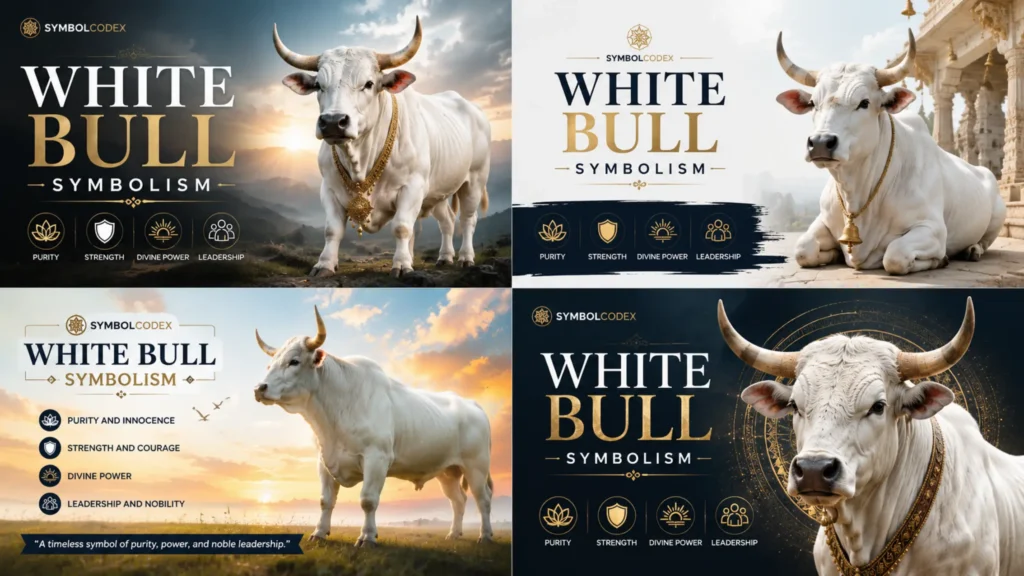
A white bull combines two strong visual symbols: the bull, often associated with strength and fertility, and the color white, commonly connected with purity, peace, and sacredness. White bull symbolism commonly represents strength, purity, leadership, fertility, determination, and renewal.
The bull has appeared in religious traditions, mythology, agriculture, art, and public imagery for thousands of years. Its physical power made it a natural symbol of authority and vitality, while its connection with farming gave it practical associations with prosperity and fertility.
Adding white changes the tone. Instead of focusing only on physical power, a white bull can suggest disciplined strength, spiritual importance, innocence, or a fresh beginning. Its meaning varies significantly depending on the culture and context.
Quick Answer
White bull symbolism commonly represents strength, purity, leadership, fertility, determination, and renewal, combining the traditional power of the bull with the symbolic associations of the color white. Historically, white bulls have also appeared in religious ceremonies and myths connected with sacrifice, divine favor, fertility, and authority.
TL;DR
- White bulls symbolize strength combined with purity and renewal.
- Bulls have ancient connections with agriculture, fertility, and authority.
- White coloring can give the animal a sacred or ceremonial meaning.
- American interpretations often emphasize power, leadership, and determination.
- Religious traditions sometimes connect white bulls with sacrifice or divine favor.
- Modern art and tattoos use the image for strength and identity.
What Does a White Bull Symbolize?
The symbolism of a white bull comes from two elements: the animal itself and its color.
Bulls are physically powerful animals. Historically, they were important to agriculture, breeding, transportation, and ceremonial traditions.
White, meanwhile, often communicates ideas such as purity, peace, cleanliness, innocence, and sacredness in Western cultures.
Together, these associations can create meanings such as:
- Strength
- Purity
- Leadership
- Fertility
- Determination
- Authority
- Renewal
- Prosperity
- Sacredness
- Confidence
The meaning can shift depending on whether the bull appears in a religious image, a dream, a tattoo, a painting, or a cultural tradition.
Why Bulls Symbolize Strength
The bull’s association with strength is closely connected to its physical characteristics.
Adult male cattle can be large, muscular animals with substantial horns. Their power is visible even when they are standing still.
For agricultural societies, cattle were also valuable working and breeding animals. Their physical strength had practical importance, not merely symbolic value.
This helped create a long-standing connection between bulls and:
- physical power
- endurance
- masculine vitality
- courage
- determination
- authority
The bull therefore became a natural metaphor for someone who can withstand pressure and continue moving forward.
When the bull is white, this strength can take on a more restrained or elevated quality.
Rather than representing uncontrolled aggression, the white bull may suggest strength guided by discipline.
White as a Symbol of Purity
The color white has many symbolic meanings in American culture.
It is commonly associated with:
- purity
- innocence
- peace
- cleanliness
- simplicity
- new beginnings
- sacredness
These associations appear in contexts such as weddings, religious clothing, memorial traditions, architecture, and visual design.
When white is applied to a powerful animal such as a bull, the contrast becomes important.
A black bull may visually emphasize mystery, danger, or darkness. A white bull can appear calmer, more ceremonial, or more sacred.
This does not mean white always symbolizes goodness.
Color symbolism changes between cultures and historical periods.
Still, in modern American visual culture, white often gives the bull a sense of clarity, dignity, and distinction.
White Bull Symbolism and Leadership
Bulls can symbolize leadership because of their size, confidence, and historical association with wealth and agricultural power.
In symbolic art, a standing bull with its head raised can communicate authority without requiring a human leader to be shown.
A white bull adds a sense of distinction.
This combination can represent:
- responsible leadership
- confidence
- authority
- courage
- independence
- disciplined power
The strongest interpretation is not necessarily “being dominant.”
A white bull can instead represent the ability to lead while remaining controlled and purposeful.
White Bull Symbolism and Fertility
Fertility is one of the oldest major associations connected with bulls.
In agricultural societies, cattle were directly connected with reproduction, food production, wealth, and the continuation of herds.
This gave bulls an important symbolic role in fertility traditions.
A white bull can therefore represent:
- fertility
- abundance
- prosperity
- growth
- family continuity
- productive energy
This symbolism is especially important in ancient Mediterranean and Near Eastern traditions, where bulls sometimes appeared in religious contexts associated with fertility and divine power.
Modern interpretations are generally less literal.
Today, a white bull may symbolize growth or abundance without necessarily referring to biological fertility.
White Bulls in Ancient Religion and Mythology
White bulls appear in several famous ancient traditions.
One of the best-known examples is the Cretan Bull from Greek mythology. According to the myth, King Minos received a magnificent bull from Poseidon, but failed to sacrifice it as promised. The bull later became associated with the story of Theseus and the Minotaur.
Another famous example is the Bull of Heaven in the Mesopotamian Epic of Gilgamesh. This creature was sent by the goddess Ishtar and is associated with divine anger and destruction.
Ancient Egyptian religion also placed enormous importance on sacred bulls. The Apis Bull was worshiped at Memphis and became associated with Ptah and later with Osiris.
These traditions demonstrate that bulls did not have one universal meaning.
They could represent:
- divine power
- fertility
- kingship
- strength
- destruction
- sacrifice
- cosmic order
The color white can appear in some ceremonial contexts, but it should not be assumed that every ancient bull symbol was specifically a white bull.
White Bulls in Greek Mythology
Greek mythology provides several important examples of unusual or sacred bulls.
The story of Europa involves Zeus transforming himself into a beautiful white bull to approach Europa.
This myth gave the white bull a particularly recognizable place in Western art.
The bull’s whiteness is important because it contributes to the animal’s beauty and extraordinary appearance.
But the story also carries a darker dimension: Zeus uses the bull’s attractive appearance to gain Europa’s trust before carrying her away.
This means the white bull can symbolize both beauty and deception in this particular mythological context.
It is a useful reminder that symbolic meaning should be connected to the story rather than generalized into one fixed definition.
White Bull Symbolism in Hindu Traditions
Bull symbolism has an important place in Hindu traditions, especially through Nandi, the bull associated with Shiva.
Nandi is commonly represented as a white or pale bull and is associated with strength, devotion, guardianship, and service.
Images of Nandi are traditionally placed facing Shiva’s shrine in many temples.
This gives the white bull a very different symbolic character from traditions where bulls represent uncontrolled aggression.
Nandi represents qualities such as:
- devotion
- patience
- strength
- loyalty
- guardianship
- disciplined service
This is one of the clearest examples of why white bull symbolism cannot be reduced to a single Western interpretation.
White Bull Symbolism in Judaism and Christianity
Bull imagery appears in biblical and Christian traditions, although the exact symbolism depends on the passage.
Bulls could be associated with strength, sacrifice, wealth, and agricultural life.
The Hebrew Bible includes regulations concerning cattle sacrifice, while later Christian traditions sometimes interpreted sacrificial animals in relation to broader theological themes.
However, there is no universal Christian doctrine stating that a white bull has one fixed symbolic meaning.
Modern Christian artwork may use white animals to communicate purity or sacredness, but those interpretations should not automatically be projected onto every biblical reference to cattle.
White Bull Symbolism in the United States
In the United States, white bull symbolism is influenced by agriculture, Western imagery, sports, branding, mythology, and popular culture.
The American West has given cattle and bulls a particularly strong cultural presence.
Ranching traditions associate cattle with:
- hard work
- land
- independence
- endurance
- livelihood
- self-reliance
Bull imagery also appears in rodeo culture and Western art.
A white bull can therefore represent a combination of traditional American toughness and visual distinction.
In modern design, it may communicate confidence and strength without requiring an explicitly religious interpretation.
White Bull Symbolism and the American West
The bull and cattle have an important place in American Western imagery.
Ranching helped shape communities, economies, and ideas about frontier life.
Western art often depicts cattle as part of a landscape involving ranchers, horses, open land, and hard physical work.
Within this context, a white bull can symbolize:
- endurance
- independence
- rugged strength
- leadership
- determination
- connection to the land
This interpretation differs from ancient religious symbolism but shows how older animal meanings can acquire new cultural associations.
The white bull becomes less about sacrifice or mythology and more about identity, resilience, and American rural culture.
White Bull Symbolism in Dreams
A white bull in a dream can have several possible interpretations.
A calm white bull may symbolize confidence, stability, strength, or a desire for peace.
A charging white bull may represent intense pressure, conflict, ambition, or a situation that feels difficult to control.
A white bull standing peacefully in a field may suggest stability, prosperity, or connection with nature.
A wounded white bull may represent concerns about lost strength, vulnerability, or an important part of life that needs attention.
Dream interpretation is personal.
The emotional response matters as much as the animal itself. Someone who fears bulls may experience the same dream very differently from someone who admires them.
White Bull Symbolism in Spirituality
Modern spiritual interpretations often connect the white bull with strength, purity, protection, renewal, and disciplined energy.
The combination of white and bull imagery can suggest balancing physical strength with calmness or moral purpose.
Some people may interpret seeing a white bull as a reminder to:
- remain strong during difficult periods
- act with confidence
- protect what matters
- maintain self-control
- begin a new chapter
- stay grounded
These are reflective interpretations rather than scientific predictions.
There is no universal evidence that encountering a white bull delivers a supernatural message.
The symbol can still have personal meaning without requiring a supernatural explanation.
White Bull Symbolism in Love and Relationships
In relationships, a white bull can symbolize loyalty, protection, stability, strength, and commitment.
The bull’s association with fertility can also give it a connection with family and long-term partnership.
The white color adds ideas of sincerity and renewal.
A white bull in relationship symbolism may therefore suggest:
- commitment
- emotional stability
- protective love
- trust
- family
- a fresh beginning
There is also a more challenging interpretation.
Because bulls can symbolize stubbornness and dominance, the image may represent possessiveness or excessive control in some contexts.
The meaning depends on the behavior shown.
A calm bull communicates something different from an angry or charging bull.
White Bull Symbolism in Tattoos
White bull tattoos can represent strength with a softer visual identity.
A person may choose the image to symbolize resilience, leadership, independence, fertility, renewal, or cultural heritage.
Common designs include:
| White Bull Tattoo Design | Common Meaning in the USA | Main Association | Typical Interpretation |
|---|---|---|---|
| White bull head | Strength | Power | Confidence and resilience |
| White bull with flowers | Renewal | Nature | Growth and balance |
| White bull with crown | Leadership | Authority | Personal power |
| White bull with moon | Mystery | Night symbolism | Inner strength |
| White bull in a landscape | Independence | Western imagery | Connection to land |
Tattoos are personal, so the same design can communicate different ideas for different people.
White Bull Symbolism in Art and Design
Artists often use the white bull because of its strong visual contrast.
A white animal can stand out against dark backgrounds, landscapes, or architectural settings.
This makes the white bull useful for communicating:
- purity against darkness
- strength against vulnerability
- calmness against aggression
- individuality
- visual authority
In contemporary design, the bull is also commonly used to represent financial confidence and market optimism.
However, a white bull should not automatically be interpreted as a financial symbol.
The surrounding design determines whether the focus is economic, spiritual, cultural, or personal.
Positive and Negative White Bull Symbolism
White bull symbolism can have both positive and negative interpretations.
Positive meanings include:
- strength
- purity
- leadership
- fertility
- prosperity
- confidence
- loyalty
- protection
- renewal
- determination
Negative meanings can include:
- stubbornness
- aggression
- domination
- uncontrolled anger
- excessive pride
- possessiveness
- destructive force
The bull’s physical power explains both sides.
Strength can become courage, but it can also become aggression.
Confidence can become leadership, but it can also become arrogance.
Determination can produce achievement, but it can also become stubbornness.
The white color often softens these meanings, but it does not erase them.
Common Misunderstandings About White Bull Symbolism
One common mistake is assuming that every white bull represents purity.
Color symbolism depends on cultural context. White can represent purity and peace in some societies while having different associations elsewhere.
Another misconception is that white bull symbolism has one ancient origin.
It does not.
Bulls appeared in many independent traditions, and their meanings developed differently across regions.
It is also inaccurate to treat all famous mythological bulls as the same symbol.
The Cretan Bull, Bull of Heaven, Apis Bull, Nandi, and the white bull in the Europa myth belong to very different cultural and religious contexts.
Understanding those differences makes the symbolism more accurate.
How White Bull Symbolism Has Evolved
The bull began as a practical animal with major importance to farming, food production, breeding, and labor.
Those practical roles helped create associations with fertility, wealth, endurance, and strength.
Religious traditions then gave bulls additional meanings.
They could become sacred animals, sacrificial offerings, divine creatures, or guardians.
Later, Western art and literature expanded the bull’s symbolism further.
In the United States, cattle and bull imagery became connected with ranching, the American West, competition, confidence, and independence.
The addition of white creates another layer, often shifting the visual message toward purity, distinction, peace, or renewal.
Modern interpretations therefore combine ancient animal symbolism with contemporary ideas about identity and strength.
What White Bull Symbolism Means Today
Today, the white bull is best understood as a symbol of strength guided by purity, confidence, determination, and renewal.
Its historical meanings are broad.
In some traditions, it represents fertility or divine power. In others, it can symbolize devotion, protection, sacrifice, or even deception.
Modern American interpretations often emphasize resilience, leadership, independence, and physical strength, particularly when the imagery is connected with Western culture or personal identity.
The symbol is strongest when its context is clear.
A white bull in a temple carries a different message from a white bull in a Western painting or tattoo.
Frequently Asked Questions
What does a white bull symbolize spiritually?
A white bull can symbolize strength, protection, purity, renewal, devotion, and disciplined power in modern spiritual interpretations. Its meaning varies considerably between religious and personal traditions.
What does a white bull symbolize in dreams?
A white bull in a dream may represent confidence, strength, stability, renewal, or a challenge that requires courage. Its behavior matters: a calm bull suggests a different theme from one that is charging.
What does a white bull symbolize in love?
A white bull can represent loyalty, stability, protection, commitment, and family. Its fertility symbolism can also suggest growth, while an aggressive bull may represent possessiveness or conflict.
What does a white bull tattoo mean?
A white bull tattoo can symbolize resilience, leadership, independence, renewal, strength, or cultural identity. Additional elements such as flowers, crowns, landscapes, or religious imagery can change the emphasis.
Is a white bull a symbol of good luck?
A white bull can have positive associations with prosperity, fertility, strength, and renewal in some traditions, but it is not universally considered a good-luck symbol. Its meaning depends on cultural and personal context.
Why are white bulls considered sacred in some cultures?
White animals can be visually distinctive and have been associated with purity or ceremonial importance in various traditions. Some cultures therefore incorporated white bulls into religious stories, rituals, or representations of divine power.
What does a white bull represent in American culture?
In the United States, a white bull can represent strength, determination, independence, leadership, and connection with Western or agricultural traditions. Modern art may also use it as a symbol of confidence and personal power.
Conclusion
The white bull combines the physical strength of the bull with the cultural associations of the color white. This creates a symbol that can represent strength, purity, leadership, fertility, protection, determination, and renewal.
Its history is not based on one universal tradition. Ancient Mediterranean myths, Egyptian religion, Hindu traditions, biblical imagery, and American Western culture have each given bulls different meanings. The white bull can therefore represent devotion in one context and authority or fertility in another.
In modern American culture, the image often works as a statement of resilience and controlled strength. It suggests that power does not have to mean aggression; it can also mean confidence, stability, discipline, and the ability to move forward with purpose.


