
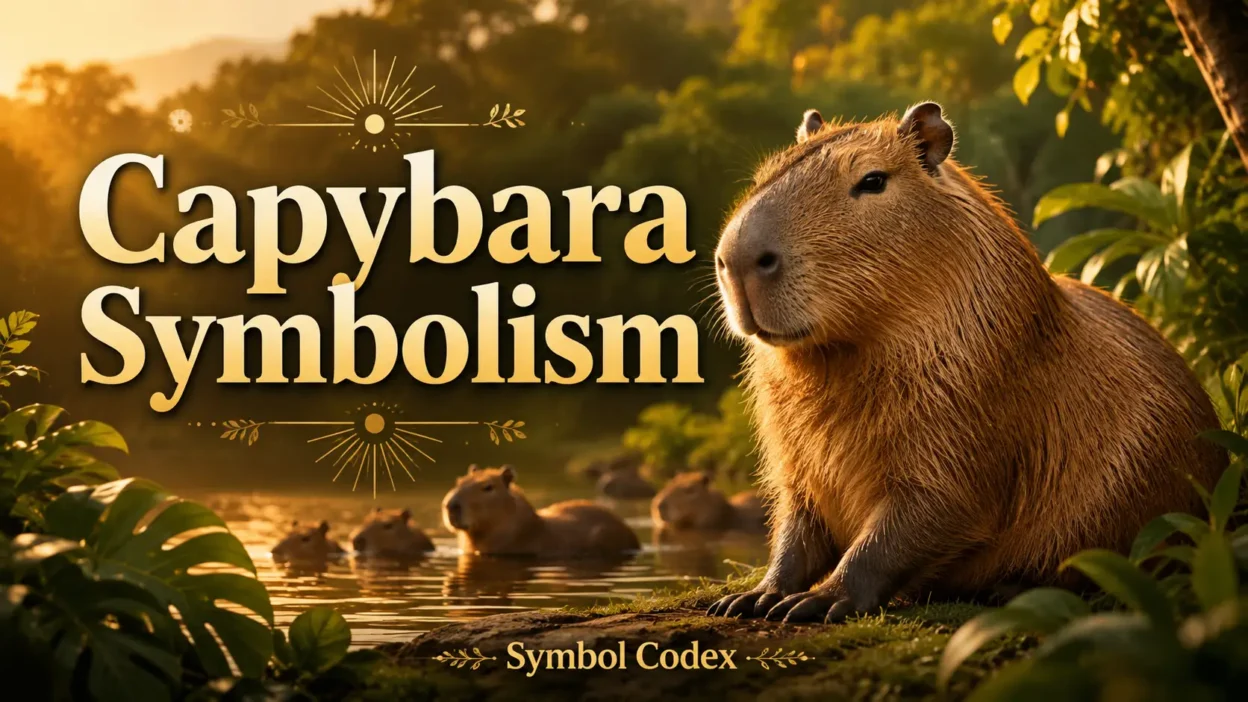

Explore capybara symbolism, including calm, friendship, community, adaptability, protection, spiritual meaning, tattoos, and modern cultural use.
Capybara symbolism most commonly represents calmness, community, friendship, adaptability, patience, emotional balance, and peaceful strength. These meanings fit an animal that is highly social, strongly associated with water, and often observed resting or feeding peacefully in groups rather than living as a solitary individual.
Capybaras are the world’s largest living rodents and are native to South America. They are semiaquatic mammals strongly associated with rivers, marshes, flooded grasslands, and other habitats where water is readily available. Their partly webbed feet, swimming ability, social groups, and tendency to retreat into water when threatened all help explain why modern symbolism often connects them with adaptability and staying composed under pressure.
In recent popular culture, capybaras have also developed an unusually friendly image. Photos of them resting beside birds and other animals, together with their sociable behavior in zoos, have helped create the familiar online idea of the capybara as the animal that somehow “gets along with everyone.” That reputation is exaggerated, but it reflects real aspects of their social biology.
Quick Answer
Capybara symbolism most commonly represents peace, emotional balance, friendship, community, adaptability, patience, and confidence without aggression. Their group living strengthens meanings of cooperation and belonging, while their close relationship with water adds modern associations with flexibility, emotional calm, and knowing when to move away from unnecessary conflict.
TL;DR
- Capybaras symbolize calm, friendship, patience, and emotional balance.
- Their social groups represent community, cooperation, and belonging.
- Water strengthens meanings of adaptability and emotional flexibility.
- Their relaxed image suggests confidence without constant confrontation.
- Group defense adds protection and awareness to the symbolism.
- Modern internet culture has made capybaras icons of peaceful coexistence.
What a Capybara Really Is
The capybara, Hydrochoerus hydrochaeris, is a large South American rodent closely associated with water.
Adults commonly weigh roughly 35 to 66 kilograms, or about 77 to 145 pounds, although individuals can vary. Their bodies are barrel-shaped, their fur is coarse and reddish brown, and their feet are partly webbed, an adaptation that helps them move through aquatic environments.
Capybaras are found across much of South America in habitats including flooded grasslands, marshes, river edges, forests, and savannas, provided suitable water is nearby. They spend the hottest periods of the day in or near water and are strong swimmers.
They are also highly social.
Typical groups may contain around 10 individuals, although groups can be considerably larger, especially when animals gather around limited water resources during dry periods. Their social structure includes communication, hierarchy, territorial behavior, and cooperative protection.
Those real behaviors provide a much stronger foundation for symbolism than invented mystical stories.
Capybara Symbolism: 7 Powerful Core Meanings
| Meaning | Capybara Trait | Modern Interpretation |
|---|---|---|
| Calm | Often rests and moves without unnecessary conflict | Emotional balance |
| Community | Lives in stable social groups | Belonging and cooperation |
| Friendship | Tolerates close social contact | Healthy relationships |
| Adaptability | Lives between land and water | Adjusting to change |
| Patience | Conserves energy and remains watchful | Thoughtful action |
| Protection | Groups warn and respond to danger | Caring for others |
| Peaceful strength | Large animal that often avoids confrontation | Confidence without aggression |
These are mainly modern symbolic interpretations based on observable capybara behavior and contemporary culture rather than one universal historical tradition.
Capybara Symbolism of Calm and Emotional Balance
Calmness is probably the quality most strongly associated with capybaras today.
Images often show them sitting quietly in shallow water, resting in groups, grazing, or appearing completely unbothered by their surroundings.
That visual impression has turned the animal into a natural symbol of remaining composed when circumstances become noisy.
The symbolism does not mean capybaras never experience stress or danger.
They remain alert to predators and can react rapidly when threatened. Capybaras use alarm calls, including bark-like vocalizations, that can send an entire group rushing toward the relative safety of water.
That makes their calmness more interesting.
Symbolically, calm does not have to mean being unaware.
It can mean:
- noticing danger without panicking
- refusing unnecessary arguments
- conserving emotional energy
- responding when action is actually required
- remaining steady around unpredictable people
The capybara therefore fits calm awareness better than complete passivity.
Capybara Symbolism of Community and Belonging
Capybaras are strongly social animals.
Group living is important enough that solitary individuals are relatively unusual. Stable groups use shared feeding and resting areas, and social membership can remain consistent for considerable periods.
That makes community one of the most biologically grounded capybara meanings.
A capybara can symbolize:
Belonging. Having a place within a group.
Cooperation. Sharing responsibilities rather than handling everything alone.
Social stability. Building relationships that survive changing circumstances.
Mutual support. Recognizing that safety can increase when people look out for one another.
This symbolism can apply to family, friendship groups, workplaces, neighborhoods, or any environment where individuals function better because they are connected.
The capybara does not symbolize losing individuality to the group.
Its stronger message is that independence and belonging do not have to be opposites.
Friendship and Peaceful Coexistence
One reason capybaras became so popular online is the large number of photographs showing them beside birds, monkeys, turtles, and other animals.
The idea that every species is naturally the capybara’s “friend” is an internet exaggeration.
Still, the image is not completely invented.
Wild capybaras have ecological relationships with birds that follow them while feeding or remove insects from their fur. Captive capybaras can also live successfully in carefully managed mixed-species exhibits. San Diego Zoo Wildlife Alliance has described capybaras as sociable and mild-mannered within such settings.
That behavior has produced a modern symbol of getting along without needing everyone around you to be exactly like you.
The capybara can therefore represent:
acceptance,
friendliness,
social ease,
tolerance,
and the ability to share space peacefully.
It is particularly suited to friendship symbolism because it does not suggest dramatic loyalty or sacrifice.
Instead, it represents something quieter:
being comfortable around others.
Adaptability, Water, and Going With the Flow
Capybaras are semiaquatic.
They feed and travel on land but depend heavily on water for cooling, safety, swimming, and escape from predators. Their anatomy includes partially webbed feet, and they can remain submerged for several minutes when necessary.
That ability to function comfortably in two environments creates a natural symbolism of adaptability.
As a personal metaphor, the capybara can represent moving between:
home and work,
different cultures,
social and private environments,
leadership and support roles,
or periods of activity and rest.
Water also carries strong emotional associations in modern symbolism.
A capybara entering water can therefore suggest letting a difficult emotional situation move around you rather than fighting every part of it.
“Going with the flow” can sound passive, but the capybara provides a better version of the idea.
Adaptability means changing behavior when conditions require it, not surrendering all control.
Patience and Knowing When Not to React
Many animal symbols emphasize action.
The eagle takes flight.
The tiger attacks.
The horse runs.
Capybara symbolism can represent something very different: not every situation deserves immediate action.
Capybaras spend considerable time grazing, resting, cooling in water, and maintaining social contact. When danger actually appears, however, their behavior can change quickly. Group members communicate alarm and move toward safety.
That contrast makes the animal an effective metaphor for patience.
It can represent:
waiting for more information,
choosing silence during pointless conflict,
allowing emotions to settle,
or deciding that walking away is more useful than proving a point.
In this interpretation, patience is not weakness.
It is the ability to separate situations that require a response from those that merely invite one.
Protection and Looking Out for the Group
Capybaras may appear relaxed, but social living requires awareness.
Individuals use vocal communication, and alarm barking can warn other group members when predators are detected. Young animals are especially vulnerable, making group protection important for survival.
Capybara parenting can also be cooperative.
Young may gather together, and females within social groups have been observed nursing young other than their own. San Diego Zoo Wildlife Alliance similarly notes that females in capybara family groups can help care for one another’s offspring.
This creates symbolism involving collective protection.
A capybara can represent:
looking after younger people,
sharing responsibility,
warning friends about genuine danger,
or helping someone even when their problem is not technically yours.
This differs from the fierce protection represented by bears or wolves.
The capybara symbolizes protection through community awareness and cooperation rather than intimidation.
Peaceful Strength and Confidence Without Aggression
Capybaras are not small animals.
They are the heaviest living rodents and can exceed 100 pounds, yet their popular image is not dominated by size or aggression.
That combination makes them useful symbols of gentle confidence.
Someone who identifies with capybara symbolism may value:
being physically or emotionally capable without intimidating others,
remaining approachable despite strength,
or knowing that confidence does not require constant competition.
This meaning provides an interesting contrast with many familiar animal symbols.
Strength is often visualized through teeth, claws, horns, or combat.
The capybara suggests another kind:
being secure enough that you do not need to demonstrate power constantly.
Capybara Symbolism and Cooperative Parenting
Family life adds another layer to capybara symbolism.
Capybara young are relatively well developed at birth and can begin moving soon afterward, but they still benefit greatly from the safety provided by their social group. Cooperative care can include protection and nursing from females other than the biological mother.
This can symbolize a broader idea of family.
Care does not always need to come from only one individual.
Human families frequently rely on:
grandparents,
siblings,
friends,
teachers,
neighbors,
and other trusted adults.
Capybara imagery can therefore represent shared caregiving and community support.
The meaning is especially fitting for people whose idea of family extends beyond a narrow biological definition.
Capybara Symbolism in South American Context
Capybaras are native South American animals, not symbols that originated in modern U.S. internet culture.
They live across a broad geographic range, including much of Brazil, Venezuela, Colombia, Uruguay, and Argentina, with populations associated strongly with wetlands and river systems.
They are known by different common names in different parts of the continent, including carpincho in areas such as Argentina.
In Argentina’s Nordelta area, capybaras became part of a highly publicized conflict involving suburban development on former wetland habitat. The animals returned to landscaped areas within the development, prompting debates over wildlife, habitat loss, urbanization, and coexistence.
That modern example gives the capybara a more serious meaning than internet cuteness alone suggests.
It can symbolize nature continuing to occupy landscapes that people have transformed.
Capybara Symbolism in Modern Internet Culture
Modern online culture has probably shaped American capybara symbolism more strongly than any ancient symbolic tradition.
Capybaras are widely portrayed as:
calm,
friendly,
unbothered,
social,
and comfortable around almost anyone.
Older viral imagery even centered on other animals sitting on capybaras, reinforcing their reputation as unusually tolerant members of the animal world. Smithsonian Magazine highlighted that internet phenomenon as early as 2014.
The resulting symbolic personality is often summarized as “chill.”
That modern image can represent:
not taking every inconvenience personally,
remaining socially comfortable,
accepting unusual friendships,
or refusing to turn small problems into major conflicts.
It is partly anthropomorphic, of course.
Real capybaras experience competition, territorial behavior, predators, and social hierarchies.
The online capybara is therefore an edited version of the real animal, but one built around genuine tendencies toward social living and comparatively peaceful behavior.
Capybara Symbolism in Tattoos
Capybara tattoos are usually lighter in emotional tone than tattoos of wolves, snakes, bears, or ravens.
Common meanings include:
Calmness. Staying composed during stressful situations.
Friendship. Valuing easy, dependable relationships.
Community. Feeling strongest when surrounded by trusted people.
Adaptability. Moving comfortably between changing environments.
Self-acceptance. Being comfortable with an unusual personality.
Peace. Avoiding unnecessary confrontation.
Humor. Not every tattoo needs a serious spiritual explanation.
A capybara sitting in water often emphasizes relaxation and emotional balance.
Several capybaras can symbolize friendship or family.
A capybara with birds can suggest peaceful coexistence.
A sleeping capybara may represent rest, contentment, or refusing unnecessary stress.
Because the animal has become an internet favorite, some people simply choose the design because it makes them happy.
That is also a legitimate symbolic meaning.
Spiritual Meaning of Capybara Symbolism
In modern spiritual interpretation, capybaras can represent peace, emotional regulation, community, flexibility, patience, and trust in supportive relationships.
These meanings are contemporary interpretations rather than one ancient universal spiritual system.
Seeing a capybara does not scientifically predict:
money,
romance,
good luck,
pregnancy,
or a specific future event.
A more grounded spiritual interpretation might use the animal as a reminder to ask:
Am I reacting to something that does not deserve my energy?
Do I have people around me whom I can trust?
Can I adapt instead of trying to control every condition?
Do I need rest rather than more effort?
In this way, capybara symbolism becomes a prompt for reflection rather than fortune-telling.
Capybaras, Water, and Emotional Symbolism
Water is central to capybara life.
They use it for temperature regulation, movement, and protection from predators. Capybaras can swim effectively and may retreat into water when threatened.
In modern symbolic language, water often represents emotion, transition, or uncertainty.
Combining those associations produces a useful metaphor:
feel emotions without allowing them to overwhelm your ability to function.
The capybara does not avoid water.
It enters it confidently.
That makes the animal especially suited to emotional symbolism involving comfort with feelings rather than constant avoidance of them.
Ecology and the Meaning of Interdependence
Capybaras occupy an important position within South American ecosystems.
They graze heavily on plants and also serve as prey for large predators such as jaguars, caimans, and anacondas. Some birds interact with capybaras by feeding on insects associated with their bodies or on small animals disturbed while the rodents graze.
This makes the capybara a useful symbol of interdependence.
No animal survives entirely by itself.
Plants support grazers.
Grazers support predators.
Water shapes movement.
Other species interact with the same habitat.
Human life is similarly interconnected.
The capybara can therefore symbolize acknowledging dependence without interpreting it as weakness.
Positive and Negative Meanings of Capybara Symbolism
Most capybara symbolism is positive, but even appealing traits have a cautionary side.
Positive meanings
Calm: staying emotionally steady.
Community: maintaining supportive relationships.
Adaptability: adjusting to changing circumstances.
Friendliness: allowing comfortable social connection.
Patience: knowing when to wait.
Protection: paying attention to the safety of others.
Confidence: possessing strength without intimidation.
Negative or cautionary meanings
Passivity: failing to act when action is genuinely necessary.
Conformity: following a group despite personal judgment.
Avoidance: escaping every uncomfortable situation.
Overdependence: becoming unable to function without social approval.
Complacency: confusing contentment with lack of ambition.
The distinction is important.
Calmness is useful when it improves judgment.
It becomes limiting when it prevents necessary action.
Common Misunderstandings About Capybara Symbolism
One common misconception is that capybaras are naturally “friends with every animal.”
They can be tolerant and social, and real cross-species interactions occur, but viral photographs do not mean capybaras form emotional friendships with every species they encounter.
Another mistake is assuming they are solitary animals because photos often show one capybara sitting alone.
Wild capybaras are strongly social and usually live in groups.
It is also misleading to call capybaras completely passive.
Groups contain dominance hierarchies, territorial behavior, and occasional aggression, particularly among males.
Finally, claims that ancient cultures universally regarded capybaras as spiritual symbols of peace or friendship need evidence.
Most of the familiar symbolism attached to the capybara today is modern and strongly influenced by observable behavior and internet culture.
How Capybara Symbolism Has Evolved
Capybara symbolism is a good example of a meaning system developing in real time.
The animal began with characteristics that naturally attract human interpretation:
social living,
strong dependence on water,
group communication,
cooperative care,
and an outwardly relaxed appearance.
Zoos and wildlife photography made those characteristics more visible to international audiences.
Images showing capybaras living beside other species strengthened their reputation for tolerance. San Diego Zoo Wildlife Alliance has highlighted both their sociability and their ability to function in mixed-species exhibits.
Internet culture then amplified the calmest parts of that personality.
The capybara became an informal symbol of being relaxed, friendly, and almost impossible to annoy.
At the same time, real conflicts such as those involving capybaras and development in Argentina have added another interpretation: peaceful animals can still become symbols of habitat, coexistence, and human responsibility when landscapes change.
Modern capybara symbolism therefore sits between biology, humor, emotional identification, and environmental awareness.
Frequently Asked Questions
What does a capybara symbolize spiritually?
In modern spiritual symbolism, a capybara commonly represents peace, emotional balance, friendship, community, patience, and adaptability. These meanings are contemporary interpretations rather than universal ancient spiritual beliefs.
Is seeing a capybara a good sign?
There is no scientifically established omen connected with seeing a capybara. Someone may personally interpret the encounter positively as a reminder to remain calm, value supportive relationships, or adapt to changing circumstances.
What does a capybara tattoo mean?
A capybara tattoo commonly represents calmness, friendship, community, adaptability, self-acceptance, or a relaxed attitude toward life. Some tattoos are chosen simply because the animal feels cheerful or humorous.
Why do capybaras symbolize friendship?
Capybaras are highly social mammals that normally live in stable groups, and they can show considerable social tolerance. Viral images of capybaras around other animals have strengthened the modern friendship association.
Do capybaras symbolize calmness?
Yes, calmness is one of their strongest contemporary meanings. Their relaxed resting behavior and popular online image support that interpretation, although real capybaras remain alert and respond quickly to danger.
What does water mean in capybara symbolism?
Because capybaras are semiaquatic and use water for cooling, movement, and safety, water can add symbolic meanings of adaptability, emotional balance, and moving through changing conditions.
Are capybaras really peaceful animals?
Capybaras are highly social and are often described as mild-mannered, but they are still wild animals with territories, dominance hierarchies, and defensive behaviors. Their peaceful reputation is partly accurate and partly simplified by popular culture.
Conclusion
Capybara symbolism most naturally represents calmness, community, friendship, patience, adaptability, emotional balance, and peaceful strength. These meanings fit a social semiaquatic animal that depends heavily on group relationships, communicates danger to others, uses water as refuge, and often avoids unnecessary confrontation.
Modern culture has added an unusually playful layer. Photos, zoo encounters, memes, and cross-species images transformed the capybara into an internet symbol of the person who remains relaxed and seems able to get along with almost everyone.
Its most useful message is simple: being calm does not require being weak, and belonging to a community does not require losing yourself. Sometimes strength is the ability to stay adaptable, protect your peace, and make room for others without turning every difference into a conflict.