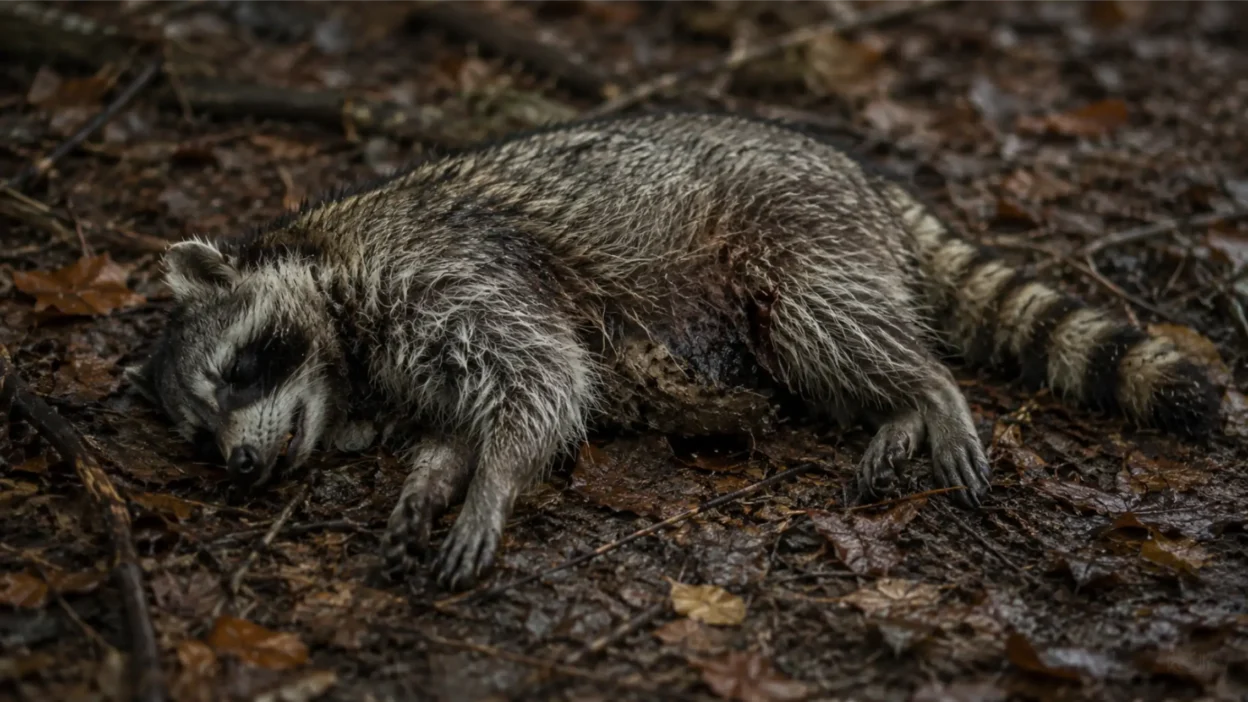
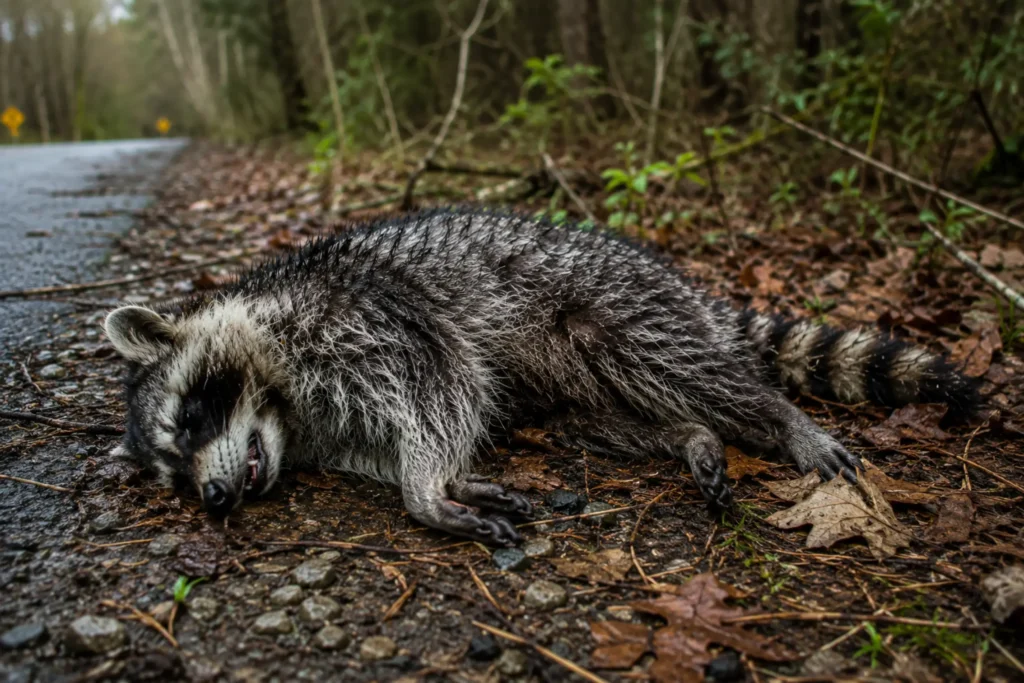
Dead raccoon symbolism most commonly represents the end of a survival pattern, lost adaptability, release, hidden truths becoming visible, mortality, exhausted resourcefulness, necessary change, vulnerability, and the closing of an old chapter. Because living raccoons are strongly associated with adaptability, dexterity, nighttime activity, problem-solving, and surviving near people, seeing one dead naturally reverses many of those familiar qualities.
A dead raccoon is not scientifically a prediction of death, bad luck, betrayal, or financial trouble. Most meanings attached specifically to a dead raccoon are modern personal or spiritual interpretations rather than one universal historical tradition.
Real raccoons, Procyon lotor, are highly adaptable North American mammals. They live in forests, wetlands, suburbs, cities, and other environments where food, shelter, and water are available. Their dexterous front paws, broad omnivorous diet, climbing ability, and willingness to use human-modified environments help explain why resourcefulness and adaptability dominate modern raccoon symbolism.
Quick Answer
Dead raccoon symbolism usually represents an ending, loss of an old survival strategy, release, vulnerability, hidden problems becoming visible, or the need to adapt differently. Since living raccoons are remarkably resourceful and adaptable, a dead raccoon can symbolically suggest that persistence alone is no longer enough and that an old approach, identity, or situation has reached its limit.
TL;DR
- Dead raccoons commonly symbolize endings, change, and release.
- They can represent an old survival strategy that no longer works.
- The raccoon’s masked appearance adds modern themes of secrecy and hidden truths.
- Its adaptability makes death a powerful symbol of exhausted resourcefulness.
- Specific Indigenous traditions should be named rather than generalized.
- A real dead raccoon should be treated as wildlife first, not as an omen.
Dead Raccoon Symbolism: 9 Core Meanings
| Meaning | Raccoon Connection | Modern Interpretation |
|---|---|---|
| Ending | A highly active animal becomes still | A chapter has closed |
| Release | Survival efforts have stopped | Letting go of a draining situation |
| Lost adaptability | Raccoons normally adjust extremely well | An old strategy no longer works |
| Hidden truths | Mask and nighttime habits inspire concealment imagery | Something overlooked becomes visible |
| Exhausted resourcefulness | Raccoons exploit many food sources and habitats | You cannot solve everything indefinitely |
| Vulnerability | A capable survivor is still mortal | Strength has limits |
| Transformation | An ending forces change | Building a different way forward |
| Mortality | Wildlife death makes impermanence visible | Valuing limited time |
| Environmental awareness | Raccoons share landscapes with people | Recognizing human-wildlife pressures |
These meanings are symbolic interpretations rather than supernatural rules.
What Dead Raccoon Symbolism Really Means
Understanding a dead raccoon starts with understanding the living animal.
Raccoons are among North America’s most adaptable mammals. They commonly inhabit wooded areas near water but can also thrive around towns, suburbs, campgrounds, farms, and cities. Their diet can include berries, nuts, seeds, insects, frogs, fish, birds, eggs, and other available foods.
They are also excellent climbers and possess highly dexterous front paws that allow them to manipulate food and objects. Their willingness to use different habitats and food sources explains much of their success near humans.
Modern raccoon symbolism therefore often centers on:
resourcefulness, adaptability, intelligence, curiosity, independence, and survival.
Death changes the image.
The adaptable animal can no longer adapt.
The searching paws stop working.
The nocturnal survivor becomes still.
That makes dead raccoon symbolism especially suited to situations where a once-successful way of coping has finally reached its limit.
Dead Raccoon Symbolism of Endings
An ending is the most direct interpretation.
A dead raccoon may symbolize something in life that has completed its course.
That could include:
- an unhealthy relationship
- an exhausting job
- a long-running conflict
- a defensive habit
- a period of constant survival
- an old identity
- a plan that no longer works
The meaning does not have to be negative.
Sometimes an ending is necessary precisely because a person has spent too long trying to keep something alive.
Raccoons are famous for adjusting to difficult conditions. That makes the symbolism particularly interesting: even adaptability has limits.
The dead raccoon can therefore communicate:
You do not have to keep adapting to something that should simply end.
When Survival Mode Has Reached Its Limit
One of the strongest modern interpretations involves survival mode.
Raccoons are exceptionally capable of exploiting whatever resources are available. In urban environments they may eat discarded human food, investigate garbage containers, use buildings for shelter, and adjust their behavior around human activity. NPS sources repeatedly describe their adaptability as a major reason they succeed in developed environments.
For human symbolism, that resembles someone who has learned to survive difficult circumstances by constantly adjusting.
Perhaps you became:
more guarded,
more independent,
more alert,
or more willing to accept less than you really wanted.
Those strategies may once have been necessary.
But survival strategies can remain long after the original danger disappears.
A dead raccoon can symbolically represent the end of living only in survival mode.
The question becomes not merely “How do I survive this?”
It becomes:
Do I still need to?
Dead Raccoon Symbolism and Lost Adaptability
Adaptability is normally a positive trait.
However, constantly adapting can become its own problem.
Someone may keep changing themselves to satisfy:
a difficult employer,
an unhealthy partner,
a demanding family,
or circumstances that never improve.
Raccoons demonstrate real ecological flexibility. Smithsonian research describes Procyon lotor as unusually versatile in habitat and climate compared with related procyonids, while NPS sources document their success across wild and human-modified environments.
A dead raccoon can reverse that strength symbolically.
It may represent the realization that adaptation is no longer the correct answer.
Sometimes the environment needs to change.
Sometimes you need to leave it.
That gives dead raccoon symbolism a useful distinction between resilience and endless accommodation.
The Raccoon Mask and Hidden Truths
The raccoon’s black facial markings are so distinctive that the animal is frequently called a “masked bandit.” NPS descriptions identify the black eye mask and ringed tail as its most recognizable features.
The association between a mask and secrecy is a human interpretation, not the biological purpose of the markings.
Still, visually, the mask naturally supports symbolism involving:
hidden identities,
privacy,
secrets,
deception,
and things that remain unseen.
A dead masked animal can therefore create an image of concealment ending.
Symbolically, a dead raccoon may suggest:
- discovering uncomfortable information
- finally understanding someone’s motives
- dropping a false identity
- admitting something to yourself
- ending secrecy
- seeing through an old illusion
This does not mean a dead raccoon predicts that someone will betray you.
The more grounded interpretation is that something previously difficult to see may deserve closer attention.
Resourcefulness, Burnout, and Knowing When to Stop
Raccoons are extraordinarily resourceful feeders.
They can eat plant and animal foods, investigate small hiding places with their sensitive paws, climb, forage near water, and exploit food introduced by humans.
That makes a dead raccoon a powerful symbol of resourcefulness reaching exhaustion.
People who are good at solving problems often develop a particular burden:
everyone expects them to solve the next one too.
They become the person who always:
finds the money,
fixes the problem,
makes the compromise,
works longer,
or figures out another workaround.
Eventually, constant resourcefulness can become burnout.
Dead raccoon symbolism can therefore represent a boundary:
being capable of solving a problem does not mean you are obligated to solve it forever.
That interpretation separates genuine resilience from self-exhaustion.
Vulnerability Behind the Clever Image
Popular culture often treats raccoons as almost comically clever.
Their dexterous paws and ability to raid containers reinforce the image of an animal that can escape almost any obstacle.
But real raccoons remain vulnerable wildlife.
They face predators, disease, vehicle collisions, and other environmental hazards. NPS notes that raccoons can thrive near people despite frequent conflicts with vehicles and other risks.
A dead raccoon therefore symbolizes a sobering idea:
cleverness does not eliminate vulnerability.
People can be intelligent and still make mistakes.
Independent people can still need support.
Highly adaptable people can still become overwhelmed.
Strong survival skills cannot prevent every loss.
That makes dead raccoon symbolism particularly relevant to people who feel pressure to appear capable at all times.
Death, Mortality, and Impermanence
Finding a dead mammal can feel more emotionally intense than finding a dead insect.
Its familiar eyes, paws, fur, and body make the reality of mortality more visible.
The raccoon adds another contrast.
An animal that normally explores, climbs, manipulates objects, and searches constantly for food is suddenly completely motionless.
That can inspire reflection on:
time,
mortality,
priorities,
and the temporary nature of every life stage.
Mortality symbolism does not have to become morbid.
It can ask practical questions:
What deserves your time now?
Which conflict has already consumed too much of it?
Which relationship matters enough to protect?
What are you endlessly postponing?
The dead raccoon can become a reminder that resourcefulness helps us use life, but it cannot make life unlimited.
Transformation After an Ending
A dead raccoon is not biologically transforming into another life stage.
So claims that raccoon death literally symbolizes rebirth should be treated as metaphor.
Human lives, however, often change because something ends.
Losing a job can lead to another career.
Leaving a relationship can expose patterns that need to change.
Moving away can create a different identity.
Stopping one survival strategy can force the development of another.
In this sense, dead raccoon symbolism can represent transformation caused by finality.
The meaning is not:
“Something died, therefore something better is guaranteed.”
It is:
The old way is over, so the next decision matters.
Dead Raccoon Symbolism and Indigenous Cultural Context
Raccoons have specific cultural roles within some Indigenous North American traditions, but there is no single universal “Native American raccoon meaning.”
One well-documented example comes from the Chickasaw Nation.
The Chickasaw Nation identifies Shawi’ Iksa’ as the Raccoon Clan. Its cultural description says leaders were chosen from this clan and associates its members with dancing, eating fish and fruit, cunning, being difficult to deceive, and strong faith in leaders and elders.
This provides real cultural context for meanings involving:
cleverness,
leadership,
discernment,
and community identity.
It should not be expanded into a claim that every Indigenous nation understands raccoons in the same way.
The National Museum of the American Indian also documents a Raccoon Dance performed by Choctaw dancers, demonstrating that raccoon imagery has a specific place within Choctaw cultural performance. The source records the dance but does not provide enough information to assign it a generic spiritual meaning.
That distinction matters.
For dead raccoon symbolism, there is no basis in these sources for claiming that Indigenous traditions universally interpret a dead raccoon as death, warning, transformation, or bad luck.
Those modern interpretations should remain separate from documented cultural traditions.
Dead Raccoon Symbolism in Dreams
Dreams involving dead animals can feel unusually vivid.
However, dream symbolism is not a reliable system for predicting future events.
A useful interpretation depends on what happened in the dream and what is happening in the dreamer’s life.
Dreaming of One Dead Raccoon
One dead raccoon may represent a survival strategy, secret, relationship, or problem that has reached its endpoint.
It can also suggest feeling less capable or adaptable than usual.
Dreaming of Many Dead Raccoons
Several dead raccoons may symbolize widespread exhaustion or the collapse of several coping strategies at once.
This could fit periods of burnout when many responsibilities become difficult simultaneously.
Dreaming of a Dead Raccoon in Your House
A house often represents personal or family life in modern dream interpretation.
A dead raccoon inside may therefore reflect a private problem, hidden conflict, or old defensive habit that needs to be addressed.
Dreaming of a Dead Raccoon Coming Back to Life
This could symbolize an old problem returning.
Alternatively, it may represent renewed resourcefulness after a period when confidence felt lost.
Dreaming of Moving or Burying a Dead Raccoon
This may represent closure.
The dreamer may be psychologically ready to stop revisiting something that has already ended.
Dream interpretations are most useful when treated as reflection rather than prophecy.
Spiritual Meaning of Dead Raccoon Symbolism
In contemporary spirituality, a dead raccoon may be interpreted as representing:
release,
ending a cycle,
dropping a mask,
changing survival strategies,
facing hidden truths,
or rebuilding after exhaustion.
These can be meaningful personal interpretations.
They are not scientifically verified supernatural messages.
Seeing a dead raccoon does not reliably predict:
death,
betrayal,
financial loss,
illness,
or bad luck.
A grounded spiritual approach might instead ask:
What am I still trying to survive that I should leave behind?
Where am I hiding my real feelings?
Am I adapting too much for other people?
Which problem has consumed enough of my energy?
What truth have I avoided because acknowledging it would require change?
The value lies in the reflection, not in treating the animal as a fortune teller.
Is a Dead Raccoon a Bad Omen?
There is no factual basis for declaring a dead raccoon an automatic bad omen.
Death imagery can understandably feel negative.
Raccoons are also nocturnal animals with dark facial markings, which can make the encounter feel mysterious or unsettling.
But those emotional associations do not prove supernatural danger.
Historically documented raccoon meanings can even be positive or socially important. Chickasaw cultural information associates the Raccoon Clan with leadership, cunning, discernment, dancing, and loyalty to leaders and elders.
Therefore, a more balanced interpretation is:
an ending, a change in survival strategy, or something hidden becoming visible.
What Does a Dead Raccoon on the Road Symbolize?
A raccoon killed by a vehicle can create particularly strong symbolism because roads themselves are often used as metaphors for direction and life choices.
A symbolic reading might involve:
a path becoming dangerous,
moving too quickly,
a journey being interrupted,
or realizing that one direction has reached its end.
But the practical explanation is more important.
Raccoons regularly occupy human-developed landscapes, forage near roads and neighborhoods, and experience collisions with vehicles. NPS specifically notes that they continue to thrive near humans despite frequent clashes with vehicles.
So a dead raccoon beside a road is first a wildlife mortality event, not evidence that your own path is cursed or dangerous.
The road metaphor is optional.
The biological explanation is real.
Dead Raccoon in Your Yard: Symbolism vs. Practical Meaning
A dead raccoon in a yard can feel much more personal than one beside a highway.
Symbolically, people may associate the home with:
family,
security,
privacy,
and personal boundaries.
That can make a dead raccoon near the home feel like a symbol of an old protection strategy, hidden household issue, or completed personal cycle.
Practically, however, do not approach or handle dead wildlife casually.
CDC guidance says people should keep their distance from wild animals that are injured, sick, or dead. Raccoons are among the major wildlife species associated with rabies in the United States, particularly in parts of the eastern U.S.
If a person or pet may have been bitten, scratched, or otherwise exposed before the animal died, contact the appropriate health or veterinary authority promptly for advice. Rabies is preventable when potential exposure is addressed before symptoms begin.
USDA guidance advises using gloves or a shovel rather than bare hands if a dead potentially rabid animal must be moved, and contacting local health authorities when testing may be necessary.
Safety comes before symbolism.
Dead Raccoon Symbolism and Environmental Awareness
A dead raccoon can also carry an ecological meaning.
Living raccoons participate in food webs as predators, scavengers, and seed dispersers.
At Canaveral National Seashore, for example, NPS describes raccoons as important predators that help control rodents and ghost crabs while also dispersing seeds through their droppings.
This makes the animal more than the familiar “trash panda” stereotype.
A dead raccoon may symbolically remind people that adaptable urban wildlife is still part of functioning ecosystems.
Road mortality, discarded food, unsecured garbage, habitat alteration, and conflict with people all shape how raccoons live alongside us.
The modern environmental meaning can therefore be:
coexistence requires responsibility from both sides of the human-wildlife boundary.
Dead Raccoon Symbolism in Tattoos
A dead raccoon tattoo would carry a very different tone from a playful living-raccoon design.
Possible meanings include:
Survival ending: leaving behind a period dominated by constant struggle.
Dropping the mask: becoming more honest about identity or emotion.
Mortality: remembering that intelligence cannot defeat time.
Burnout: recognizing the cost of endless adaptation.
Release: ending an unhealthy pattern.
Dark humor: using the raccoon’s modern “trash panda” reputation in unconventional art.
Transformation: allowing an old coping style to end so something healthier can develop.
A dead raccoon beside flowers may emphasize regrowth after loss.
A raccoon mask separated from the animal can symbolize dropping a false identity.
A road motif can represent an interrupted path or major redirection.
Because there is no standardized historic dead-raccoon tattoo tradition, the wearer’s story determines the meaning.
Positive and Negative Meanings of Dead Raccoon Symbolism
Positive meanings
Release: a draining problem is finished.
Truth: concealment is ending.
Redirection: a different strategy can now be chosen.
Freedom from survival mode: constant adaptation is no longer necessary.
Acceptance: an ending is acknowledged instead of resisted.
Transformation: life can develop differently after closure.
Negative or cautionary meanings
Exhaustion: resourcefulness has reached its limit.
Loss: something useful or meaningful has ended.
Vulnerability: capability cannot prevent every setback.
Deception: masks and concealment may be dominating a situation.
Stagnation: an old strategy has stopped producing results.
Neglect: an uncomfortable issue may have been overlooked.
The two sides can coexist.
An ending may involve genuine loss while also creating relief.
Common Misunderstandings About Dead Raccoon Symbolism
One common mistake is saying that a dead raccoon always predicts death or bad luck.
There is no evidence for that.
Another is assuming raccoons historically had one universal Indigenous meaning. Different Indigenous nations have distinct traditions. The Chickasaw Nation, for example, specifically documents a Raccoon Clan with particular cultural characteristics; this should not be generalized to every Native community.
Another misconception is treating the raccoon’s “mask” as evidence that the animal itself represents dishonesty. The dark facial markings are a biological feature. Secrecy and hidden-identity symbolism are human interpretations based on appearance.
It is also inaccurate to imagine raccoons as harmless cartoon scavengers. They are wild mammals and can defend themselves or carry diseases. CDC advises keeping distance from sick, injured, or dead wildlife.
Finally, finding a dead raccoon does not prove it had rabies. Raccoons are an important rabies reservoir in parts of the United States, but death can have many causes. Exposure risk should be assessed through public-health guidance rather than assumption.
How Dead Raccoon Symbolism Has Evolved
Modern dead raccoon symbolism combines several layers.
The first comes from raccoon biology.
Their dexterous paws inspire resourcefulness.
Their varied diet and habitats suggest adaptability.
Their nighttime activity contributes mystery.
Their recognizable mask encourages modern ideas about secrecy and identity.
Their ability to thrive around people creates associations with survival and making use of imperfect circumstances.
Specific cultural traditions add their own meanings. Chickasaw history includes the Raccoon Clan, whose official cultural description emphasizes traits such as leadership and cunning. NMAI documentation also preserves a Choctaw Raccoon Dance without reducing its meaning to a generic animal-symbol dictionary.
Modern popular culture then transformed the raccoon into the clever “masked bandit” or humorous “trash panda.”
Death reverses these familiar qualities.
Resourcefulness becomes exhausted.
Adaptation stops.
The mask becomes an image of something finally exposed.
Constant survival gives way to stillness.
That is why the strongest modern dead raccoon meaning is not simply death.
It is the end of a way of surviving.
Frequently Asked Questions
What does a dead raccoon symbolize spiritually?
A dead raccoon commonly symbolizes closure, release, hidden truths, exhausted survival strategies, vulnerability, and the need for a different approach. These are modern spiritual interpretations rather than universal supernatural rules.
Is seeing a dead raccoon a bad omen?
No evidence shows that seeing a dead raccoon predicts bad luck, death, or disaster. Symbolically, it can be interpreted as an ending, redirection, or the end of a difficult survival period.
What does a dead raccoon in your yard mean?
Symbolically, someone may connect it with home, boundaries, or an old problem ending. Practically, avoid direct contact with the carcass and keep pets away; CDC advises staying away from dead wildlife because raccoons can be associated with rabies.
What does dreaming about a dead raccoon mean?
A dead-raccoon dream may reflect burnout, an ending, a hidden problem, or a survival strategy that no longer works. Dreams are personal and cannot reliably predict future events.
What does a dead raccoon on the road symbolize?
Modern symbolism may interpret it as an interrupted journey, a dangerous path, or redirection. In reality, raccoons commonly live close to human development and can be killed in vehicle collisions.
Does a dead raccoon symbolize transformation?
It can metaphorically. The transformation comes from what happens after an ending rather than from death being a biological stage of raccoon development.
What does a dead raccoon tattoo mean?
A dead raccoon tattoo might represent mortality, burnout, leaving survival mode, dropping a false mask, ending an old identity, or dark humor. There is no single traditional meaning.
Conclusion
Dead raccoon symbolism most naturally represents endings, release, vulnerability, hidden truths, exhausted adaptability, mortality, and the realization that an old survival strategy no longer works. The meaning becomes especially powerful because the living raccoon represents almost the opposite: dexterity, resourcefulness, curiosity, adaptability, and an extraordinary ability to succeed in changing environments.
Cultural history adds nuance rather than one universal definition. The Chickasaw Nation documents a Raccoon Clan associated with leadership and cunning, while the National Museum of the American Indian records a Choctaw Raccoon Dance. These traditions should remain specific rather than being turned into generic claims about all Indigenous beliefs.
The most grounded message is simple: adaptability is powerful, but you do not have to adapt forever to circumstances that are hurting you. Sometimes the end of an old survival pattern is what finally makes a healthier direction possible.
If you encounter an actual dead raccoon, treat it as wildlife before treating it as a symbol: keep your distance, prevent pets from approaching it, and seek local public-health or animal-control guidance if human or pet exposure may have occurred.


