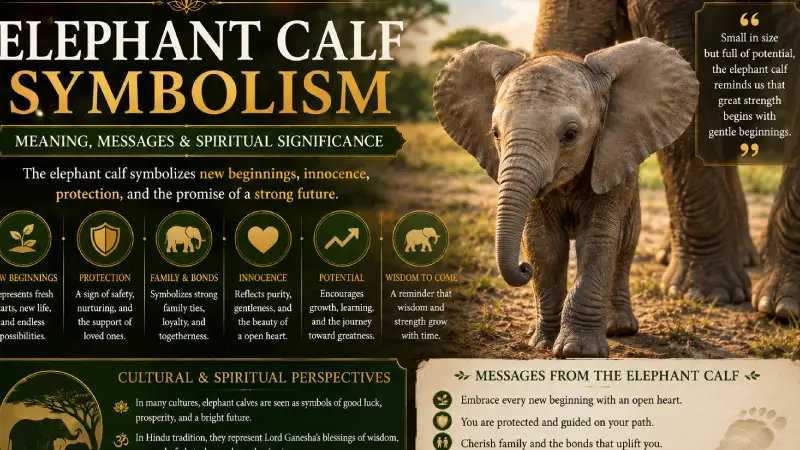
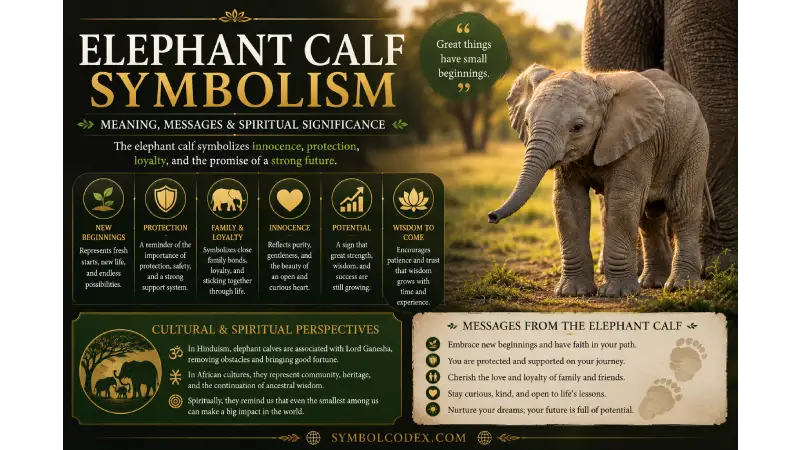
Elephant calf symbolism most commonly represents new beginnings, family bonds, protection, growth, learning, innocence, community, future strength, and hope. These meanings fit the real lives of young elephants, which enter highly social environments and gradually learn how to behave, communicate, find resources, and navigate relationships by interacting with older herd members.
An elephant calf also creates a striking contrast between present vulnerability and future power. A newborn depends heavily on adults, yet it belongs to one of the largest and most socially complex land mammals. That combination makes the calf a natural modern symbol of potential: being small, inexperienced, or dependent today does not determine what someone may eventually become.
Elephant symbolism itself has deep cultural histories across Asia and Africa. However, there is no single universal ancient system of elephant calf symbolism. Calf-specific meanings are best understood through elephant biology, family behavior, specific cultural artworks or stories, and contemporary symbolism rather than broad claims that every culture interpreted baby elephants in the same way.
Quick Answer
Elephant calf symbolism most commonly represents new beginnings, family, protection, learning, innocence, growth, community, and future strength. Young elephants depend on experienced herd members and learn by observing and interacting with mothers, older females, and other elephants, making the calf an especially fitting symbol of developing through guidance and belonging.
TL;DR
- Elephant calves symbolize new beginnings, growth, and potential.
- Their dependence on adults strengthens meanings of family and protection.
- Learning from older elephants represents mentorship and inherited wisdom.
- Their playful curiosity suggests discovery and openness to experience.
- A calf surrounded by adults can symbolize community and collective care.
- Their future size creates a strong image of small beginnings becoming great strength.
- Tattoos often represent children, family, parenthood, or personal growth.
- There is no universal ancient spiritual meaning specifically for elephant calves.
Elephant Calf Symbolism: 9 Core Meanings
| Meaning | Elephant Calf Connection | Modern Interpretation |
|---|---|---|
| New beginnings | A calf is at the start of life | Fresh chapters and opportunities |
| Family | Young elephants develop within social groups | Belonging and close relationships |
| Protection | Calves depend on adults | Safety and caregiving |
| Growth | A small calf develops into a massive adult | Future potential |
| Learning | Young elephants observe older herd members | Mentorship and wisdom |
| Innocence | Calves are inexperienced and developing | Openness and vulnerability |
| Community | Several adults may influence a calf | Shared responsibility |
| Curiosity | Young elephants explore and play | Discovery and learning |
| Hope | A calf represents another generation | Continuity and the future |
These are mainly contemporary symbolic interpretations grounded in observable elephant social behavior.
What Elephant Calf Symbolism Really Means
The deepest meaning of an elephant calf comes from a simple contrast.
The animal is small compared with the adults around it.
It is inexperienced.
It needs protection.
Yet it carries enormous future potential.
That gives elephant calf symbolism a different emotional tone from adult elephant symbolism.
An adult elephant more naturally represents:
strength,
memory,
authority,
stability,
and wisdom.
A calf emphasizes:
becoming.
It symbolizes the stage before mastery.
That makes it especially meaningful for children, students, new parents, young businesses, recovery journeys, or anyone beginning something that may eventually become much larger than it appears today.
Elephant Calf Symbolism of New Beginnings
A calf naturally represents the start of a life.
That makes new beginnings one of its clearest meanings.
An elephant calf can symbolize:
- the birth of a child
- beginning a marriage or family
- starting school
- launching a business
- moving somewhere new
- rebuilding after hardship
- entering a new stage of personal growth
The symbolism is hopeful without promising instant success.
A calf is not born knowing everything an adult elephant knows.
Development takes time.
That gives the new-beginning meaning an important second layer:
starting small is normal.
A beginning does not need to look impressive to contain great potential.
Family and Belonging
Elephants are highly social mammals.
Smithsonian describes Asian elephant herds as commonly including related females, their female offspring, and immature males. Members form complex relationships and cooperate in protecting the group and raising young.
That makes family one of the strongest biologically grounded meanings of elephant calf symbolism.
The calf exists within relationships.
It learns where to stand.
Whom to follow.
How to communicate.
What is safe.
How other elephants respond.
Symbolically, this can represent the importance of having people who provide:
security,
guidance,
encouragement,
and correction.
The deeper message is that individual growth often depends on social connection.
Independence may eventually develop, but it does not require pretending that nobody helped along the way.
Elephant Calf Symbolism of Protection
A young elephant is vulnerable despite belonging to a powerful species.
This makes the calf an especially strong image of protection.
Smithsonian notes that elephants form strong social relationships and that adults work together to protect their group and raise young.
A protected calf can therefore symbolize:
parental love,
guardianship,
safe childhood,
or creating conditions in which vulnerable people can grow.
This meaning differs from aggressive protection symbols such as a cobra or Doberman.
Elephant-calf protection is deeply relational.
The image is not simply someone standing against danger.
It is several individuals creating an environment where the youngest member can develop safely.
That makes it especially appropriate for parents, grandparents, teachers, foster families, mentors, and community caregivers.
Growth and Future Strength
Few animal images illustrate future potential as clearly as a baby elephant.
The calf may initially look small and uncertain beside an adult.
Yet it will grow into an extraordinarily large and capable animal.
That contrast supports symbolism involving:
potential,
development,
confidence,
and becoming stronger with time.
The meaning is especially useful for someone who feels underestimated.
A young person may not yet have experience.
A new business may have few customers.
A beginner may struggle with a skill.
A recovering person may feel weaker than they once did.
Elephant calf symbolism suggests that current size is not the same as final capacity.
Growth is allowed to take time.
Learning From Mothers, Aunties, and Elders
Learning is one of the most distinctive meanings associated with elephant calves.
Smithsonian’s 2026 coverage of its Asian elephant calf explains that young elephants gain their “herd smarts” through observing and mimicking mothers, aunties, and grandmothers.
This makes the calf a remarkably strong symbol of mentorship.
Human beings also learn through observation.
A child watches adults.
A new employee watches experienced coworkers.
An apprentice watches a craftsperson.
A young entrepreneur watches people who have built businesses before.
The symbolic lesson is not blind imitation.
It is recognizing that experience can shorten the distance between confusion and competence.
Elephant calf symbolism therefore honors both sides of mentorship:
the willingness to learn and the responsibility to teach.
Community and Shared Care
A calf may form relationships with adults beyond its mother.
Smithsonian’s recent elephant updates describe older females showing interest in a calf, remaining near her, touching her with their trunks, and influencing other elephants’ responses during social introductions.
That behavior supports a modern symbolic association with shared caregiving.
The idea is familiar in human communities.
A child may be supported by:
parents,
grandparents,
aunts and uncles,
siblings,
teachers,
neighbors,
and trusted family friends.
An elephant calf surrounded by adults can therefore symbolize the principle that care does not have to come from only one person.
This is especially meaningful in artwork showing a small calf beneath or between larger elephants.
The visual message is immediate:
you are not growing alone.
Innocence, Vulnerability, and Trust
A calf is inexperienced.
It has not yet learned every danger, social rule, or survival strategy that older elephants understand.
That creates symbolism involving innocence and trust.
But innocence should not be confused with weakness.
A calf’s vulnerability is temporary and developmental.
Human symbolism can use that distinction productively.
Someone beginning a new stage may be inexperienced without being incapable.
A child needs support without being powerless.
A beginner can ask basic questions without lacking intelligence.
Elephant calf symbolism therefore encourages a healthier view of vulnerability:
needing help while learning is part of development, not evidence of failure.
Curiosity, Play, and Discovery
Young elephants are often highly curious.
Smithsonian’s 2026 calf reports describe its young Asian elephant exploring, running through the habitat, splashing in water, vocalizing, and actively interacting with adults.
This gives elephant calves a lighter symbolic meaning: curiosity.
A calf can represent the willingness to:
explore,
ask questions,
test boundaries,
play,
and learn through direct experience.
Adults sometimes lose that quality.
Experience can create wisdom, but it can also create rigid expectations.
The elephant calf symbolizes the useful opposite:
approach something as though there may still be more to discover.
That makes calf imagery well suited to childhood, creativity, education, and new ventures.
Hope and the Next Generation
A newborn animal represents continuity.
There will be another generation.
That makes elephant calves powerful symbols of hope and the future.
This meaning becomes especially important because elephant conservation is a serious modern issue. Smithsonian describes Asian elephants as endangered and its conservation programs as working to support wild elephant populations across Asia.
In conservation imagery, a calf can therefore represent more than cuteness.
It can symbolize:
the future of a species,
successful reproduction,
habitat worth protecting,
and responsibility extending beyond one generation.
That gives modern elephant calf symbolism an environmental dimension:
the future depends partly on what the present generation chooses to protect.
Future Wisdom
Wisdom is traditionally associated more strongly with adult elephants than calves.
A calf has not yet accumulated decades of experience.
That distinction matters.
Calling a baby elephant a direct symbol of ancient wisdom can blur two different ideas.
A better interpretation is future wisdom.
The calf represents the stage in which experience is being collected.
Mistakes happen.
Relationships form.
Skills develop.
Social knowledge accumulates.
Eventually, what begins as curiosity can become judgment.
This makes elephant calf symbolism especially appropriate for education.
Wisdom is rarely something people simply possess from birth.
It develops through learning.
Elephant Calf and Mother Symbolism
A mother elephant with a calf is one of the strongest family images in wildlife symbolism.
The pair commonly represents:
maternal love,
protection,
guidance,
attachment,
and responsibility.
The calf changes the meaning of the adult elephant.
A solitary adult may symbolize strength or wisdom.
An adult standing beside a calf emphasizes strength used for care.
That distinction makes mother-and-calf imagery particularly popular for:
Mother’s Day art,
family tattoos,
nursery decor,
and memorial jewelry.
It can mean:
“My strength is connected with protecting the person I love.”
Elephant Herd With Calf Symbolism
A calf surrounded by several adults broadens the family meaning.
Instead of focusing on one parent-child relationship, the image represents:
community,
extended family,
belonging,
and collective protection.
Smithsonian notes that elephant relationships can involve mothers, grandmothers, and other socially connected females, while young elephants learn through observing those adults.
This makes herd-and-calf imagery especially appropriate for families that place strong value on grandparents, extended relatives, or chosen family.
The symbolism says:
growth happens within a network.
Elephant Calf Symbolism in Hindu Contexts
Elephants hold major religious significance in Hindu traditions, especially through Ganesha, the elephant-headed deity.
However, Ganesha should not simply be described as an “elephant calf symbol.”
He is a specific deity with his own complex religious traditions, iconography, stories, and devotional meanings.
Using Ganesha as evidence that all baby elephants universally symbolize luck or wisdom would therefore be misleading.
The broader cultural point is that elephants have deep sacred importance in South Asian traditions.
But elephant calf symbolism in modern imagery, family, youth, growth, innocence, protection, should be distinguished from the theological meanings of particular Hindu deities.
That distinction keeps cultural history accurate rather than reducing a living religion to an animal-symbol dictionary.
Elephant Calf Symbolism in Buddhist Contexts
Elephants also have important meanings in Buddhist art and literature, including stories involving the Buddha’s life and ideas associated with mental strength, discipline, and royalty.
Again, this should not be simplified into a claim that every elephant calf is automatically a Buddhist symbol.
Historical Buddhist meanings belong to particular texts, artworks, regions, and traditions.
The modern baby-elephant image of innocence or family may overlap emotionally with Buddhist themes of compassion, but overlap is not the same as historical proof.
For SEO and cultural accuracy, it is better to distinguish:
general elephant religious symbolism from modern elephant calf symbolism.
Elephant Calf Symbolism in African Contexts
African elephants are central to many landscapes, histories, and cultural traditions across the continent.
But “African elephant symbolism” is not one single belief system.
Africa contains thousands of cultural and linguistic communities.
Claims such as “Africans believe elephant calves symbolize family” are therefore too broad unless tied to a specific community and documented source.
Modern wildlife imagery of African elephant calves commonly communicates family, protection, continuity, and conservation because those ideas are visible in elephant social life.
Those modern interpretations can be valid without being mislabeled as universal ancient African beliefs.
Spiritual Meaning of Elephant Calf Symbolism
In contemporary spirituality, an elephant calf commonly represents:
new beginnings,
innocence,
protection,
family,
potential,
learning,
and hope.
A grounded spiritual interpretation might use the image as a prompt to ask:
What am I just beginning?
Who is teaching me?
Am I allowing myself to learn before expecting mastery?
Who needs my protection?
What potential am I underestimating because it still looks small?
These questions make the symbol personally meaningful without claiming supernatural certainty.
Seeing an elephant calf does not scientifically predict wealth, pregnancy, marriage, luck, or another future event.
Is an Elephant Calf a Good Sign?
Symbolically, elephant calves are usually interpreted positively.
Their strongest meanings involve:
birth,
growth,
family,
protection,
and hope.
That makes them natural good signs in contemporary art and personal symbolism.
But an encounter is not an objective supernatural omen.
If someone sees a calf at a zoo or in the wild, its emotional importance may come from what the animal evokes rather than a prediction about the future.
A person expecting a child may see family.
A student may see growth.
A parent may see protection.
A conservationist may see continuity.
The meaning depends on context.
Elephant Calf Dream Meaning
Dreaming of an elephant calf can represent development, family, responsibility, or something new that has not yet reached its full potential.
Dreams do not reliably predict future events, so personal circumstances matter most.
Dreaming of a Happy Elephant Calf
A playful calf may symbolize optimism, curiosity, or growing confidence.
Dreaming of a Mother Elephant and Calf
This may reflect parenting, protection, family attachment, or the need to feel supported.
Dreaming of a Lost Elephant Calf
A lost calf may symbolize vulnerability, lack of guidance, or concern that something important is developing without enough support.
Dreaming of Feeding an Elephant Calf
This can represent nurturing a child, relationship, business, skill, or project that still requires care.
Dreaming of a Herd Protecting a Calf
This may symbolize belonging, extended family, or the desire for a stronger support network.
Dreaming of a Baby Elephant Growing
This can represent potential becoming visible or a small project developing into something more significant.
These are reflective interpretations rather than supernatural predictions.
Elephant Calf Symbolism in Tattoos
Elephant calf tattoos often have strongly personal family meanings.
Common interpretations include:
Children: representing a son or daughter.
Motherhood or fatherhood: marking the experience of becoming a parent.
Protection: promising to care for someone vulnerable.
Growth: remembering your own journey from insecurity toward strength.
Family: honoring close bonds.
Hope: representing the future.
Pregnancy or birth: celebrating a new family member.
A mother and calf tattoo usually emphasizes parental love.
A herd with a calf can represent extended family.
A small calf beneath a large elephant can suggest protection or mentorship.
Several calves may represent siblings or children.
Names, dates, flowers, or birth symbols can make the design more personal.
There is no single universal elephant calf tattoo meaning; the family story usually matters most.
White Elephant Calf Symbolism
A white elephant calf can add meanings from broader white-elephant imagery and modern color symbolism.
White commonly suggests:
purity,
peace,
innocence,
and spiritual significance.
Historically, white elephants have held particularly important royal and religious meanings in parts of South and Southeast Asia.
However, a modern illustration of a white elephant calf should not automatically be labeled an ancient symbol of good luck without cultural context.
For contemporary symbolism, the safest interpretation is:
innocence, rarity, sacredness, or an unusually precious beginning.
Baby Elephant With Trunk Up Symbolism
An elephant with its trunk raised is frequently marketed in modern decor and jewelry as a sign of good fortune.
When the image is a calf, the interpretation often becomes:
joy,
optimism,
playfulness,
and hopeful beginnings.
However, trunk position is normal elephant behavior and does not carry a scientifically fixed spiritual meaning.
So a calf with its trunk up can work perfectly well as a modern good-luck image, as long as it is not falsely presented as a universal ancient rule.
Elephant Calf Symbolism and Conservation
Conservation gives the baby elephant one of its most important contemporary meanings.
Asian elephants face serious pressures in the wild, and Smithsonian conservation efforts focus on supporting elephant populations and reducing threats across their range.
A calf can therefore symbolize:
continuity,
species survival,
habitat protection,
and responsibility to future generations.
This interpretation is particularly powerful because the symbolism matches reality.
A healthy future for elephant populations depends on whether young animals can survive, learn, reproduce, and live within viable habitats.
The calf becomes an image of what conservation is trying to preserve.
Positive and Negative Meanings of Elephant Calf Symbolism
Positive meanings
New beginnings: life is starting.
Potential: small beginnings may develop into great strength.
Family: relationships help growth.
Protection: vulnerable individuals deserve safety.
Learning: experience develops gradually.
Community: several people can contribute to someone’s development.
Hope: another generation continues the story.
Curiosity: learning requires exploration.
Negative or cautionary meanings
Vulnerability: beginnings can be fragile.
Dependence: growth may require help.
Inexperience: potential is not the same as current ability.
Overprotection: care can become restrictive.
Fear of independence: remaining dependent longer than necessary can limit growth.
These cautionary meanings do not make the symbol negative.
They make it more realistic.
Elephant Calf vs. Adult Elephant Symbolism
The distinction is important for accurate symbolism.
Adult elephant symbolism commonly emphasizes:
strength,
wisdom,
memory,
stability,
authority,
and endurance.
Elephant calf symbolism emphasizes:
growth,
innocence,
family,
learning,
potential,
and protection.
An adult represents what has developed.
A calf represents what is developing.
That makes the calf especially suited to life stages involving learning and becoming rather than mastery.
Common Misunderstandings About Elephant Calf Symbolism
One common mistake is saying elephant calves universally mean good luck.
They may be used as positive symbols today, but there is no single worldwide ancient rule giving every baby elephant that meaning.
Another mistake is treating elephants as though every species has identical social structure. Smithsonian notes differences between Asian and African elephant societies; for example, it describes Asian herds as socially complex but not organized around a matriarch in exactly the same way commonly associated with African elephants.
Another misconception is claiming calves are simply miniature independent adults.
Young elephants learn extensively through social interaction and observation.
It is also misleading to use Ganesha as generic proof that all elephant calves symbolize wisdom or prosperity. Ganesha is a specific Hindu deity, not a universal baby-elephant symbol.
Finally, elephant calf imagery should not be separated completely from conservation. A calf’s hopeful symbolism becomes more meaningful when people understand the real challenges elephant populations face.
How Elephant Calf Symbolism Has Evolved
Elephant calf symbolism begins with the animal itself.
A calf is visibly vulnerable.
Adults surround it.
It learns.
It plays.
It gradually becomes capable.
Those behaviors naturally create meanings of family, protection, learning, curiosity, and growth. Smithsonian observations of elephant calves and herds provide especially clear examples of young elephants developing through social relationships.
Broader elephant traditions then add cultural depth, although specific religious and historical meanings should not automatically be transferred to calves.
Modern family art and tattoos made the calf especially popular as a symbol of children and parenthood.
Wildlife photography emphasized herd protection.
Conservation added another dimension:
the next generation matters because it carries the future of the species.
Today, elephant calf symbolism works best as an image of potential protected by community.
Frequently Asked Questions
What does an elephant calf symbolize spiritually?
An elephant calf commonly symbolizes new beginnings, family, protection, growth, learning, innocence, and hope in modern spiritual interpretation. These meanings fit the real dependence of young elephants on social relationships and experienced herd members.
Is an elephant calf a good sign?
It is usually interpreted positively because it represents birth, potential, family, and future strength. There is no scientifically established supernatural omen attached to seeing one.
What does a mother elephant and calf symbolize?
A mother-and-calf image commonly represents parental love, protection, guidance, family bonds, and responsibility for the next generation.
What does an elephant calf tattoo mean?
An elephant calf tattoo often represents a child, parenthood, family, protection, personal growth, hope, or a new beginning. A herd design can broaden the meaning toward extended family and community.
Why do elephant calves symbolize family?
Young elephants develop within highly social environments and learn from interactions with mothers and other experienced herd members. Smithsonian specifically describes calves learning through observing and mimicking mothers, aunties, and grandmothers.
What does dreaming of a baby elephant mean?
A baby elephant dream may symbolize a new responsibility, developing potential, family, vulnerability, or something that needs time and support to grow. Dream interpretations are personal rather than predictive.
What does an elephant calf with its trunk up symbolize?
In contemporary decorative symbolism, it commonly suggests happiness, optimism, good fortune, and a hopeful beginning. The interpretation is cultural and artistic rather than a scientifically fixed meaning of trunk position.
Conclusion
Elephant calf symbolism most naturally represents new beginnings, family, protection, growth, learning, innocence, community, curiosity, future strength, and hope. The symbolism has a strong behavioral foundation: young elephants develop within complex social relationships and learn by observing and interacting with experienced herd members.
The contrast between the small calf and the enormous adult it may become adds one of the symbol’s most powerful messages. Potential does not always look impressive at the beginning. Skill, confidence, judgment, and independence develop through time, experience, and support.
Modern conservation adds even greater significance. An elephant calf represents not only one young animal but another generation whose survival depends on healthy social groups, viable habitat, and continued conservation work.
The strongest message is simple: great strength can begin in a vulnerable form. Growth becomes possible when curiosity is protected, experience is shared, and the next generation is given enough safety and time to become what it is capable of becoming.


