
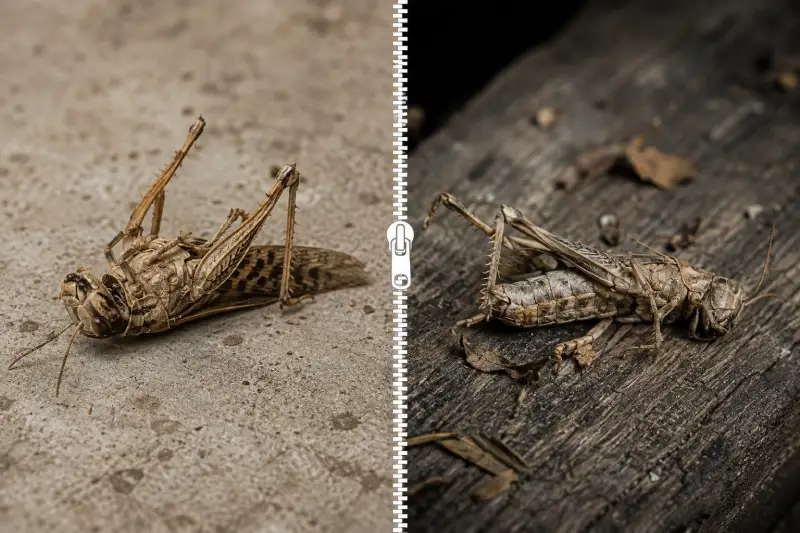
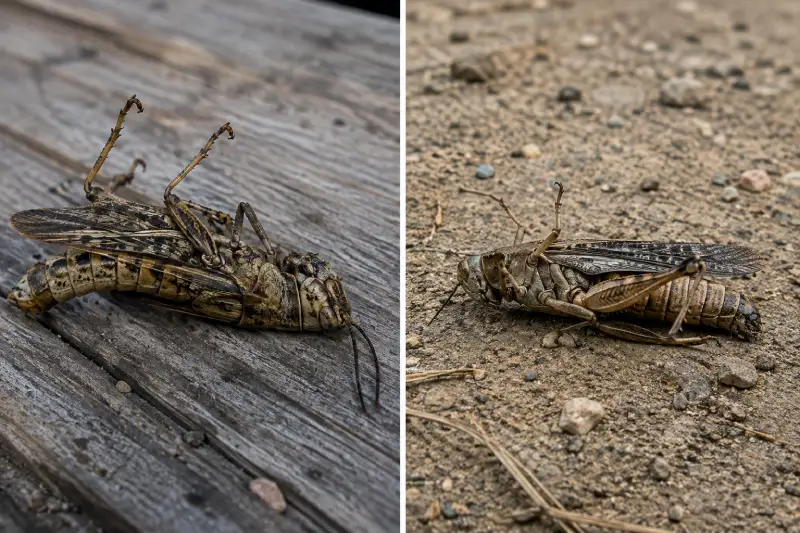
Dead grasshopper symbolism most commonly represents an ending, stalled progress, a missed opportunity, exhausted effort, necessary change, release, mortality, lost momentum, and the need to choose a new direction. A living grasshopper is defined visually by powerful hind legs, sudden movement, jumping, seasonal activity, and the ability to move quickly away from danger. When that active insect appears dead, its symbolism naturally shifts toward stillness, completion, interruption, or potential that can no longer be used in the same way.
A dead grasshopper is not scientifically a warning of death, bad luck, financial loss, or another future event. Most meanings attached to one today are modern personal or spiritual interpretations rather than universal ancient teachings.
Historical context also requires care. Grasshopper-shaped amulets existed in ancient Egypt, while grasshoppers appeared in Japanese art as part of seasonal nature imagery. The Bible mentions grasshoppers and closely related locusts, but it does not establish one universal spiritual meaning specifically for finding a dead grasshopper.
Quick Answer
Dead grasshopper symbolism most often represents the end of forward momentum, a missed chance, release from an old direction, or the need to stop repeating an approach that no longer works. Because living grasshoppers are associated with jumping, mobility, and seasonal growth, their death can symbolically reverse those ideas toward stillness, limits, closure, and reassessment.
TL;DR
- Dead grasshoppers commonly symbolize endings, stillness, and lost momentum.
- They may represent an opportunity that has passed.
- The image can also suggest releasing an unsuccessful direction.
- Biblical locust imagery concerns destruction and restoration, not a dead-grasshopper omen.
- Dreams often reflect stalled progress, regret, exhaustion, or transition.
- Real dead grasshoppers usually have ordinary biological or environmental causes.
Dead Grasshopper Symbolism: 9 Powerful Core Meanings
| Meaning | Why It Fits | Modern Interpretation |
|---|---|---|
| Ending | Movement and life have stopped | A chapter has closed |
| Lost momentum | A jumping insect becomes still | Progress has stalled |
| Missed opportunity | The ability to leap is gone | A chance may have passed |
| Release | Forward movement in one direction is finished | Letting go of an old plan |
| Exhaustion | Activity reaches its limit | Recognizing burnout |
| Mortality | A once-active creature becomes lifeless | Remembering that time is limited |
| Reassessment | The old route no longer works | Choosing another strategy |
| Transformation | Death marks a transition in natural cycles | Change after an ending |
| Awareness | A small dead insect attracts attention | Notice overlooked details |
These are symbolic interpretations, not scientifically measurable messages.
What Dead Grasshopper Symbolism Really Means
To understand a dead grasshopper, it helps to begin with the living insect.
Grasshoppers are members of the order Orthoptera and are immediately recognizable by enlarged hind legs adapted for jumping. Their life cycle generally includes egg, nymph, and adult stages rather than complete metamorphosis like butterflies. Nymphs grow through a series of molts before reaching adulthood.
That biology creates several intuitive human associations:
movement,
progress,
leaping,
adaptation,
and responding rapidly when conditions change.
Death reverses the image.
The legs remain, but they no longer jump.
The body capable of sudden movement becomes still.
Symbolically, that can represent a period when progress has stopped or one way forward has reached its limit.
The emphasis is less on doom than on transition.
Sometimes not moving forward is a sign that the direction itself needs to change.
Dead Grasshopper Symbolism of Endings
An ending is the clearest interpretation.
A dead grasshopper can symbolize something that has completed its useful life.
That might involve:
- a relationship
- a job
- an old goal
- a habit
- a friendship
- a personal identity
- an unsuccessful strategy
The symbolism does not mean that finding the insect caused or predicted the ending.
Instead, the image can become meaningful when someone is already dealing with closure.
There is an important distinction between something ending and something failing.
Not every finished stage should have lasted longer.
Some goals are completed.
Some relationships naturally change.
Some plans become outdated.
Dead grasshopper symbolism can therefore represent accepting finality without automatically labeling it defeat.
Lost Momentum and Feeling Stuck
Grasshoppers are strongly defined by movement.
Their large hind legs allow powerful jumping, and many species can also fly as adults.
A dead grasshopper removes the very quality people notice most.
That makes it an effective symbol of lost momentum.
Someone may identify with this meaning when:
a project stops progressing,
motivation disappears,
a career feels stagnant,
or repeated effort no longer produces results.
The image can feel negative, but it can also be useful.
Stalled progress often creates an opportunity to ask why movement stopped.
Perhaps more effort is needed.
Perhaps rest is needed.
Or perhaps continuing in the same direction no longer makes sense.
The dead grasshopper therefore represents not only stagnation but the need to diagnose the reason for it.
Missed Opportunities and the Leap That Did Not Happen
Living grasshoppers are often used in contemporary symbolism to represent taking a leap or moving quickly when an opportunity appears.
A dead grasshopper can reverse that metaphor.
It may represent:
a chance that passed,
hesitation,
regret,
or realizing that waiting indefinitely has consequences.
This interpretation is especially relevant when someone has been delaying a decision.
Not every opportunity returns.
A job opening closes.
A conversation becomes harder after years of silence.
A relationship changes.
A practical window for action disappears.
The symbolism should not encourage impulsiveness.
Grasshoppers jump because of biology, not because they follow motivational advice.
As a human metaphor, the more useful lesson is that patience and delay are not always the same thing.
Sometimes thoughtful waiting helps.
Sometimes waiting becomes avoidance.
Release and Choosing a Different Direction
A dead grasshopper can also carry a more positive meaning: release.
If living grasshopper imagery represents forward movement, a dead one may suggest that a particular route no longer deserves more energy.
This can apply to:
an unrealistic expectation,
an exhausting relationship,
a business idea that repeatedly fails,
or a version of success inherited from someone else.
Stopping can feel uncomfortable because modern culture often treats persistence as automatically admirable.
But persistence is valuable only when effort still serves a meaningful purpose.
Dead grasshopper symbolism can represent giving yourself permission to ask:
Do I need to try harder, or do I need to try differently?
That distinction can transform the symbol from defeat into redirection.
Exhaustion and the Limits of Constant Movement
Grasshoppers are highly active insects during the stages when adults and nymphs are visible above ground.
In many temperate U.S. species, females lay eggs in soil during late summer or early fall, those eggs overwinter, and new nymphs emerge the following spring.
This seasonal cycle makes a dead adult particularly compatible with the idea that activity has reached its natural limit.
As human symbolism, that can represent burnout.
Someone who has constantly been:
working,
solving problems,
supporting other people,
or pursuing the next opportunity
may eventually run out of useful energy.
Rest is different from failure.
So is recognizing when one cycle of effort has finished.
The dead grasshopper can therefore serve as a reminder that constant movement is not proof of progress.
Sometimes recovery is necessary before a new direction becomes possible.
Mortality and the Value of the Present
Any dead animal can bring mortality into focus.
A dead grasshopper does this in a particularly ordinary way.
It is small.
It may lie unnoticed on a sidewalk, porch, windowsill, or patch of soil.
Yet only recently it was capable of movement.
That contrast makes it a symbol of impermanence.
Human life is obviously far more complex and much longer than the life of an insect, but the metaphor remains understandable:
time changes things.
Opportunities are temporary.
Seasons pass.
Energy changes with age and circumstance.
The value of mortality symbolism is not that it encourages fear.
It can clarify priorities.
Someone may ask:
What deserves my limited attention?
What am I postponing unnecessarily?
What irritation am I giving too much importance?
A reminder that life is temporary can become a reason to live more deliberately rather than anxiously.
Dead Grasshopper Symbolism and Transformation
Death symbolism often overlaps with transformation.
But a dead grasshopper is different from a molting grasshopper.
During normal development, young grasshoppers molt several times while moving toward adulthood. This is genuine biological growth.
Death is not another developmental molt.
Therefore, claims that a dead grasshopper biologically represents “rebirth” should be treated as metaphor rather than literal life-cycle symbolism.
Symbolically, though, an ending can still create transformation in human life.
A career ending may lead to another profession.
A relationship ending may change how someone approaches future relationships.
A failed plan may reveal a better goal.
The dead grasshopper can therefore symbolize change produced by finality.
Sometimes transformation begins because the previous option is no longer available.
Dead Grasshopper Symbolism in the Bible
Biblical interpretation requires an important distinction between grasshoppers and locusts.
Locusts belong to the broader grasshopper group, but only certain grasshopper species can shift into highly gregarious forms and create destructive swarms. The Food and Agriculture Organization explains that locusts and grasshoppers are closely related acridids, with locust species distinguished by their ability to undergo major behavioral changes and swarm at high population densities.
The Bible frequently uses locust imagery.
In Exodus 10, a locust plague devastates Egyptian vegetation as part of the confrontation between Pharaoh and Moses.
In Joel 1, waves of locust-like insects consume crops and become part of a larger image of national disaster.
But Joel also contains restoration. Chapter 2 describes agricultural renewal and the restoration of what the locusts had consumed.
These passages support biblical themes involving:
destruction,
consequences,
scarcity,
judgment,
and later restoration.
They do not establish a biblical rule that finding one dead grasshopper predicts misfortune.
Are Grasshoppers Unclean in the Bible?
Another common misconception concerns Leviticus.
Leviticus 11 distinguishes certain jumping insects from other winged insects and specifically allows various kinds of locusts, crickets, and grasshoppers as food.
So it would be inaccurate to claim that biblical tradition universally treats grasshoppers themselves as evil or spiritually unclean.
This matters for symbolism.
Biblical locust-plague imagery is dramatic, but it should not automatically be applied to every ordinary grasshopper.
A single grasshopper in a garden is biologically and symbolically different from a devastating locust swarm.
Ancient Egyptian Grasshopper Imagery
Grasshopper imagery also appears in ancient Egyptian material culture.
The British Museum holds a small carnelian grasshopper-shaped amulet from Egypt.
Its existence confirms that grasshopper forms were used as amuletic objects.
However, the museum record does not provide a definitive symbolic interpretation for this particular piece.
That limitation is important.
It would be easy to claim that ancient Egyptians universally believed grasshoppers represented abundance, luck, immortality, or some other attractive theme.
The surviving object alone does not justify those claims.
For dead grasshopper symbolism, it is safest to say that grasshopper imagery had historical artistic and amuletic use, while most specific modern dead-grasshopper meanings are contemporary interpretations.
Grasshoppers in Japanese Art and Seasonal Imagery
Grasshoppers also appear prominently in Japanese art.
The Metropolitan Museum of Art holds a 1788 page by Kitagawa Utamaro featuring a grasshopper and cicada in a book devoted to insects and other small creatures.
Another Met object designed by Louis Comfort Tiffany under Japanese influence uses a grasshopper with clover and grasses as motifs associated with autumn.
An 1880s Japanese lacquer tray by Shibata Zeshin also places a grasshopper alongside harvested rice and an agricultural tea kettle, directly situating the insect within an autumn harvest environment.
This gives grasshopper imagery a grounded seasonal association with late summer, autumn, agriculture, and natural observation.
For a dead grasshopper, that seasonal context can reinforce a modern meaning of a cycle reaching completion.
Dead Grasshopper Symbolism in Dreams
Dream interpretation is personal rather than predictive.
A dead grasshopper dream may be especially relevant when the dreamer is thinking about progress, opportunities, or motivation.
Dreaming of One Dead Grasshopper
One dead grasshopper may represent a specific plan or opportunity that has ended.
It can also suggest feeling unable to make the next move.
Dreaming of Many Dead Grasshoppers
Many dead grasshoppers may symbolize widespread exhaustion, lost opportunities, or several problems reaching their endpoint at once.
It may also reflect anxiety about productivity or progress.
Dreaming of Stepping on a Dead Grasshopper
This could represent deliberately moving beyond an old problem.
Alternatively, it may reflect guilt about having ignored or damaged an opportunity.
Dreaming of a Dead Grasshopper Coming Back to Life
This image may symbolize a second chance, renewed motivation, or something previously considered finished returning to attention.
Dreaming of Cleaning Up Dead Grasshoppers
Cleaning them away can represent emotional closure and clearing the remains of problems that have already ended.
Dreams are most useful when connected with the dreamer’s actual circumstances rather than interpreted through a rigid omen dictionary.
Spiritual Meaning of Dead Grasshopper Symbolism
In contemporary spirituality, a dead grasshopper may be interpreted as a sign of:
ending a cycle,
releasing hesitation,
changing direction,
lost momentum,
or recognizing that an opportunity has passed.
These meanings can function as useful metaphors.
They should not be treated as guaranteed supernatural messages.
There is no evidence that a dead grasshopper predicts:
death,
betrayal,
poverty,
illness,
or bad luck.
A grounded spiritual reading might instead ask:
Where have I stopped moving?
Am I waiting wisely or avoiding action?
Which opportunity is no longer available?
What direction needs to change?
What completed stage am I refusing to release?
The insect does not answer those questions.
It simply provides an image through which someone can think about them.
Is a Dead Grasshopper a Bad Omen?
Not inherently.
The negative feeling usually comes from combining death imagery with modern ideas that grasshoppers represent movement or opportunity.
But no universal historical rule says that a dead grasshopper means disaster is coming.
Even biblical insect imagery is more complicated.
Locusts can represent destruction, but Joel also moves from devastation toward restoration.
Ancient Egyptian and Japanese evidence shows grasshoppers appearing in amuletic and artistic contexts rather than functioning only as negative creatures.
The most defensible symbolic reading is therefore not “bad omen.”
It is completion, interrupted progress, or reassessment.
Dead Grasshopper in Your House: Symbolism vs. Practical Meaning
A dead grasshopper indoors usually has an ordinary explanation.
Grasshoppers are outdoor insects, but individuals can accidentally enter through open doors, damaged screens, or other gaps.
Once trapped inside, the environment may provide little suitable food or water.
Seasonal timing also matters.
For many temperate grasshopper species, adults reproduce during summer or early fall while eggs remain underground through winter. Therefore, finding dead adults late in the growing season can be consistent with ordinary seasonal turnover rather than anything supernatural. This is an inference from documented grasshopper life cycles.
One dead insect rarely indicates anything unusual.
If numerous insects repeatedly appear dead in one area, practical possibilities such as pesticide exposure, weather, an entry point, or environmental conditions deserve investigation before spiritual explanations.
Dead Grasshopper Symbolism and Missed Chances
One of the most emotionally useful interpretations is regret.
Grasshoppers are so strongly defined by jumping that a dead one can easily become a symbol of the leap that was never taken.
This can apply to:
a job never applied for,
a relationship never pursued,
a business idea never tested,
or a truth never spoken.
Regret can be useful when it teaches something.
It becomes harmful when it turns into endless punishment for a past decision that cannot be changed.
Dead grasshopper symbolism can therefore carry a second message alongside missed opportunity:
the lost chance cannot be changed, but how you respond to the next one can.
That keeps the symbol forward-looking even while acknowledging an ending.
Dead Grasshopper Symbolism in Tattoos
A dead grasshopper tattoo can carry unusual and highly personal meanings.
Possible interpretations include:
Lost opportunity: remembering a chance that changed the wearer’s life.
Closure: a difficult period has ended.
Mortality: opportunities and time are limited.
Redirection: one path ended, forcing another.
Burnout: acknowledging the cost of constant movement.
Transformation: an earlier way of living is finished.
A dead grasshopper combined with new plants can create a contrast between ending and regrowth.
A broken or faded grasshopper may symbolize lost momentum.
A living grasshopper beside a dead one could represent past and future choices.
Because dead-grasshopper tattoos do not have a standardized traditional meaning, personal context matters far more than a generic definition.
Positive and Negative Meanings of Dead Grasshopper Symbolism
Positive meanings
Closure: a completed stage can be released.
Redirection: another route can now be considered.
Awareness: stagnation has become visible.
Rest: constant movement can stop temporarily.
Acceptance: missed opportunities can be acknowledged without controlling the future.
Transformation: an ending can force meaningful change.
Negative meanings
Missed opportunity: a chance has passed.
Stagnation: forward movement feels blocked.
Exhaustion: effort has reached its limit.
Regret: past hesitation remains emotionally powerful.
Loss: something once promising is gone.
Fear of change: staying still may feel safer than making the next leap.
The symbol becomes most useful when both sides are considered.
An ending can hurt and still create clarity.
Common Misunderstandings About Dead Grasshopper Symbolism
One common mistake is treating grasshoppers and locusts as completely unrelated insects.
Locusts are specialized grasshoppers capable of changing behavior and forming swarms under certain conditions. Most grasshopper species do not do this.
Another mistake is assuming every biblical mention of locust destruction applies directly to a single ordinary grasshopper.
It does not.
Biblical locust passages often concern agricultural devastation caused by enormous numbers of insects.
A third misconception is claiming ancient Egyptians had one clearly documented universal meaning for a dead grasshopper.
The British Museum confirms grasshopper-shaped Egyptian amulets existed, but the record does not establish a standard dead-grasshopper interpretation.
Finally, a dead grasshopper does not scientifically predict bad luck, death, or financial hardship.
Most meanings attached specifically to a dead individual are modern symbolic interpretations.
How Dead Grasshopper Symbolism Has Evolved
Modern dead grasshopper symbolism developed from several overlapping ideas.
First came the insect itself.
Large jumping legs made the grasshopper an obvious image of movement and sudden action.
Its seasonal life cycle created associations with summer, agriculture, growth, and changing seasons. In many temperate species, adults reproduce before eggs remain underground through winter and hatch the next year.
Historical cultures added their own imagery.
Ancient Egyptians created grasshopper-shaped amulets. Japanese artists featured grasshoppers in studies of insects and autumn agricultural scenes.
Biblical locust imagery added dramatic themes of agricultural destruction and eventual restoration, although locust swarms should not be confused with one ordinary dead grasshopper.
Modern personal symbolism then reversed the qualities of the living grasshopper.
Movement became stillness.
Opportunity became a missed chance.
Forward momentum became stagnation.
Jumping became the question of whether the next leap is still possible.
Today, dead grasshopper symbolism works best as an image of an ending that forces someone to reconsider how—and where—they move next.
Frequently Asked Questions
What does a dead grasshopper symbolize spiritually?
A dead grasshopper commonly symbolizes an ending, lost momentum, a missed opportunity, release, or the need to change direction in modern spiritual interpretation. These meanings are personal metaphors rather than universal supernatural rules.
Is seeing a dead grasshopper a bad omen?
No scientific evidence shows that a dead grasshopper predicts bad luck or disaster. A symbolic interpretation may focus on closure, stalled progress, or reassessing an opportunity rather than predicting future harm.
What does a dead grasshopper mean in the Bible?
The Bible does not establish a specific omen involving a dead grasshopper. It does discuss grasshoppers and locusts; locust swarms in Exodus and Joel symbolize devastating loss, while Joel later describes restoration after the destruction.
What does dreaming of a dead grasshopper mean?
A dead grasshopper dream may symbolize stalled progress, regret, burnout, a missed chance, or the completion of a life stage. Dream meanings depend on the dreamer’s circumstances and do not predict future events reliably.
What does a dead grasshopper in the house mean?
Symbolically, someone might associate it with blocked progress or closure. Practically, a grasshopper may simply have entered accidentally and died from normal seasonal, environmental, or indoor conditions.
Does a dead grasshopper symbolize transformation?
It can. The symbolism usually represents transformation caused by an ending rather than the insect literally transforming through death. Grasshopper nymphs genuinely transform through successive molts during normal development.
What does a dead grasshopper tattoo mean?
A dead grasshopper tattoo may represent missed opportunities, mortality, burnout, closure, or changing direction after a failed path. Because there is no standardized traditional meaning, the wearer’s personal story usually determines the interpretation.
Conclusion
Dead grasshopper symbolism most naturally represents endings, lost momentum, missed opportunities, exhaustion, release, mortality, and the need to reassess where life is going. The image is powerful because it reverses the most recognizable quality of a living grasshopper: an insect built for sudden movement has become completely still.
Historical context makes the symbolism more nuanced. Grasshopper-shaped amulets existed in ancient Egypt, Japanese artists used grasshoppers in seasonal nature imagery, and biblical texts use related locust imagery for both devastating loss and eventual restoration. None of these traditions establishes a universal rule that finding a dead grasshopper is a bad omen.
The most grounded message is simple: when forward movement stops, the answer is not always to force another leap in the same direction. Sometimes an ending is the signal to release what has passed, understand what stopped working, and choose the next move more carefully.


