
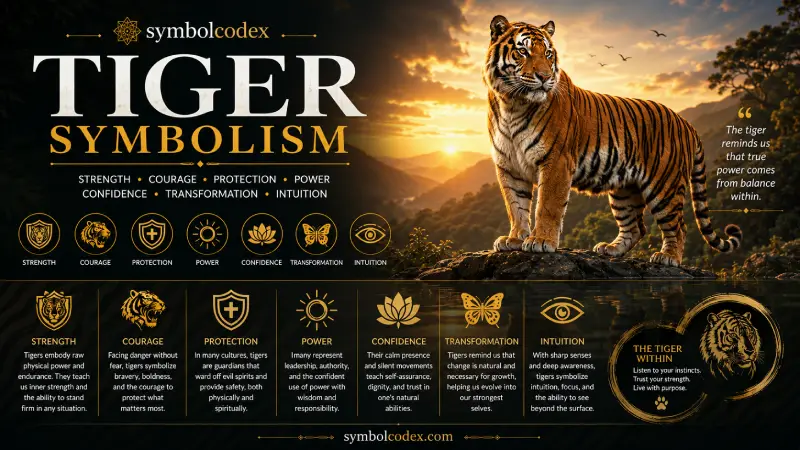

Tigers are among the most recognizable large cats, known for their strength, solitary behavior, striking appearance, and ability to adapt to different habitats. Tiger symbolism commonly represents strength, courage, independence, protection, confidence, passion, and determination. Across cultures, the tiger has also been associated with authority, danger, guardianship, and spiritual power.
Unlike symbols that depend mainly on color or appearance, tiger symbolism comes from a combination of physical power and behavior. Its hunting ability can suggest determination, while its solitary nature can represent independence. Its striking presence has also made it an important figure in mythology, art, religion, folklore, and modern popular culture.
Quick Answer
Tiger symbolism commonly represents strength, courage, independence, protection, confidence, and determination, especially in modern American culture. Historically, tigers have also been associated with royalty, guardianship, military power, and supernatural forces in several Asian traditions.
TL;DR
- Tigers commonly symbolize strength, courage, confidence, and independence.
- Their solitary nature represents self-reliance and personal power.
- Tiger imagery has strong roots in Asian art and mythology.
- Their hunting ability contributes meanings of focus and determination.
- Modern tattoos often represent courage, protection, identity, or transformation.
- Tigers can symbolize both authority and uncontrolled aggression.
What Does a Tiger Symbolize?
The tiger’s symbolism begins with its physical characteristics and behavior.
It is a large predator capable of hunting animals much larger than itself. Tigers are also territorial and generally solitary, although mothers spend extended periods raising their cubs.
These characteristics support several symbolic meanings:
- Strength
- Courage
- Independence
- Confidence
- Protection
- Determination
- Power
- Passion
- Leadership
- Resilience
The tiger can also represent danger.
Its symbolism is therefore not entirely positive. The same strength that represents courage can also represent aggression or uncontrolled power.
Why Tigers Symbolize Strength
Physical strength is probably the most immediate tiger association.
Tigers are powerful predators with muscular bodies, strong jaws, sharp claws, and considerable physical ability.
Human cultures have often used formidable animals as symbols of strength because their physical characteristics provide an obvious metaphor for human qualities.
A tiger can therefore represent:
- physical strength
- inner strength
- endurance
- confidence
- authority
- determination
In personal symbolism, someone may choose a tiger because they want to represent the ability to remain strong under pressure.
Tiger Symbolism and Courage
A tiger does not need to be fearless to represent courage.
Courage can mean acting despite danger.
Because tigers occupy the role of major predators in their ecosystems, they have long been associated with fearlessness and boldness.
Modern tiger symbolism can therefore represent the willingness to:
- face difficult situations
- defend personal boundaries
- take calculated risks
- overcome fear
- stand up for others
- pursue difficult goals
This is one reason tiger imagery is common in tattoos, sports branding, motivational artwork, and personal emblems.
Tiger Symbolism and Independence
Tigers are generally solitary compared with many other large mammals.
Adults usually maintain territories and spend much of their lives alone. Mothers and cubs form important family groups for a period, but young tigers eventually become independent.
This behavior creates a strong metaphor for self-reliance.
A tiger can symbolize someone who:
- trusts their own judgment
- enjoys independence
- protects personal space
- works toward goals without constant support
- values freedom
- feels comfortable standing alone
Tiger independence is different from isolation.
The animal’s solitary lifestyle is an ecological behavior, not a statement that social relationships are unimportant.
Tiger Symbolism and Protection
Tigers can also symbolize guardianship and protection.
This meaning is especially important in several Asian traditions, where tiger imagery has been used in protective art and religious contexts.
A tiger may represent a powerful force that protects a person, place, or community from danger.
In personal symbolism, this can translate into:
- defending loved ones
- protecting boundaries
- standing against threats
- courage under pressure
- parental protection
The protective tiger is often shown as alert and watchful rather than actively attacking.
Tiger Symbolism in Chinese Culture
The tiger has a particularly important place in Chinese cultural history.
It has been associated with military courage, authority, protection, and power.
In traditional Chinese culture, the tiger is also one of the Four Symbols associated with directional cosmology: the White Tiger represents the west.
Tiger imagery has appeared in paintings, textiles, decorative objects, architecture, folklore, and protective imagery.
The animal’s cultural meaning is therefore much broader than the modern Western idea of “strength.”
It can represent both physical force and protective authority.
Tiger Symbolism in Chinese Folklore and Art
Tigers have appeared in Chinese folklore as powerful creatures capable of defeating dangerous forces.
Their image has also been used in protective contexts, including depictions associated with children and households.
Tiger paintings became particularly important in East Asian art because the animal offered artists an opportunity to express movement, authority, nature, and controlled power.
A tiger painted calmly can communicate authority.
A tiger shown roaring can communicate aggression.
A tiger moving through a landscape can represent harmony between power and nature.
The visual context changes the message.
Tiger Symbolism in Hindu Traditions
Tigers also have an important place in Hindu religious imagery.
The goddess Durga is traditionally depicted riding a tiger or lion, depending on the artistic tradition and regional representation.
In this context, the animal is connected with courage, strength, and the ability to confront destructive forces.
The tiger is therefore not simply a symbol of aggression.
Under Durga’s control, it can represent powerful energy disciplined toward a purpose.
This provides an important symbolic distinction between raw power and controlled power.
Tiger Symbolism Across Asia
Tiger symbolism varies across Asian cultures and should not be treated as one unified tradition.
The animal has appeared in Korean, Japanese, Chinese, Indian, and other regional art and folklore.
Common themes include:
- courage
- protection
- strength
- authority
- nature
- bravery
- military power
In Korean art, for example, tigers have appeared frequently in folk paintings and popular imagery, sometimes with humorous or satirical qualities.
In Japan, tiger imagery became prominent through artistic traditions influenced by continental East Asia.
The specific meaning depends on the cultural and historical setting.
Tiger Symbolism in the United States
In the United States, tigers are commonly associated with strength, confidence, athleticism, courage, and individuality.
Unlike Asian traditions, where tiger symbolism can have centuries of religious and artistic context, American interpretations are often shaped by popular culture.
Tiger imagery appears in:
- sports team branding
- tattoos
- clothing
- advertising
- wildlife organizations
- movies
- children’s media
- home décor
- motivational art
American audiences may also associate tigers with exotic wildlife and conservation because the species is not native to the United States.
Tiger Symbolism and Personal Power
The tiger can represent personal power without necessarily meaning domination.
Personal power can mean having confidence in your own abilities and making decisions without constantly seeking approval.
A tiger symbol may therefore communicate:
- confidence
- self-respect
- assertiveness
- independence
- discipline
- determination
This interpretation is especially common in personal artwork and tattoos.
The tiger becomes a visual reminder to act with confidence rather than allowing fear to control every decision.
Tiger Symbolism and Passion
The tiger is often used to represent strong emotion.
Its intensity, physical presence, and dramatic appearance make it a natural symbol for passion and desire.
Depending on the context, this can include:
- ambition
- romantic intensity
- creativity
- competitiveness
- excitement
- emotional drive
However, passion can become destructive when it is uncontrolled.
This is why tiger symbolism sometimes carries a warning: strong emotions need direction.
Tiger Symbolism and Leadership
Tigers are sometimes described as symbols of leadership because of their physical dominance and territorial behavior.
But it is important not to confuse animal behavior with human leadership.
Tigers do not organize themselves into hierarchical societies like wolves or elephants.
Their symbolic connection with leadership comes primarily from human interpretation of their size, confidence, territorial behavior, and presence.
A tiger can therefore represent personal authority more accurately than conventional group leadership.
Tiger Symbolism in Dreams
A tiger in a dream can represent strength, fear, confidence, aggression, independence, or a situation that feels difficult to control.
A calm tiger may suggest confidence or controlled power.
An attacking tiger may reflect fear, conflict, anger, or perceived danger.
A tiger following you may represent an issue you have been avoiding.
A tiger that you successfully face may symbolize growing confidence.
The emotional tone of the dream matters more than a fixed symbolic dictionary.
Dreaming About a Tiger Chasing You
A tiger chasing you may symbolize a problem, fear, responsibility, or powerful emotion that you feel unable to escape.
The dream does not necessarily mean something bad will happen.
Instead, the tiger may represent the way a situation feels to you.
If you hide from the tiger, the dream may reflect avoidance.
If you confront it, the dream may suggest that you are becoming more willing to face difficult circumstances.
If the tiger stops chasing you, it may represent a growing sense of control.
Dreaming About a Calm Tiger
A calm tiger creates a very different image.
It may symbolize confidence, controlled strength, emotional stability, or respect for personal power.
A peaceful tiger can suggest that strength does not always need to be displayed.
The dream may be especially relevant if you are learning to become more confident without becoming aggressive.
In this interpretation, the tiger represents power under control.
Tiger Symbolism in Love and Relationships
In relationships, a tiger can represent passion, loyalty, protection, independence, and strong emotional attachment.
Its symbolism can be positive when it reflects confidence and protection.
It can become more complicated when it represents jealousy, possessiveness, anger, or control.
A tiger paired with a mate or cubs may emphasize family protection.
A solitary tiger may emphasize independence within a relationship.
A tiger and flowers may combine strength with affection or beauty.
The surrounding imagery determines the emotional message.
Tiger Symbolism in Spirituality
Modern spiritual interpretations often connect tigers with courage, confidence, personal power, protection, transformation, and disciplined strength.
Some people use tiger imagery as a reminder to:
- face fear
- protect personal boundaries
- trust their abilities
- become more assertive
- control strong emotions
- move forward with determination
These interpretations are personal rather than scientifically established spiritual facts.
There is no evidence that seeing a tiger predicts a supernatural event.
The symbolism can still function as a meaningful personal metaphor.
Tiger Symbolism in Tattoos
Tiger tattoos are popular because the animal offers many possible meanings.
A realistic tiger may represent strength and confidence.
A roaring tiger can emphasize courage and aggression.
A sleeping tiger may represent controlled power.
A tiger with flowers can combine strength with beauty.
| Tiger Tattoo Design | Common Meaning | Main Association | Typical Interpretation |
|---|---|---|---|
| Roaring tiger | Courage | Power | Fearlessness and confidence |
| Calm tiger | Controlled strength | Discipline | Emotional control |
| Tiger with cubs | Protection | Family | Loyalty and guardianship |
| Tiger with flowers | Strength and beauty | Contrast | Balanced identity |
| Tiger in a forest | Independence | Nature | Freedom and resilience |
Personal experience often determines the final meaning more than tradition.
Tiger Symbolism in Art and Fashion
Tiger imagery has long been popular because of its dramatic appearance.
The striped coat creates strong visual movement, while the animal’s face communicates alertness and intensity.
Artists may use tigers to represent:
- power
- beauty
- danger
- confidence
- nature
- individuality
- controlled aggression
Fashion frequently uses tiger patterns to create a bold appearance.
In this setting, the symbolism may be less about the actual animal and more about projecting confidence and attention-grabbing personal style.
Tiger Symbolism in Sports and Branding
American sports culture frequently uses powerful animals as mascots, and tigers are particularly common.
The tiger’s image can communicate:
- competitiveness
- strength
- speed
- determination
- courage
- team identity
A tiger mascot does not necessarily represent aggression in a literal sense.
Instead, it creates an identity around competitive confidence and physical performance.
This is one of the clearest examples of how animal symbolism has been adapted for modern American public life.
Positive and Negative Tiger Symbolism
Tiger symbolism can communicate admirable qualities, but it also has a darker side.
Positive meanings include:
- strength
- courage
- confidence
- protection
- independence
- determination
- resilience
- passion
- authority
- discipline
Negative meanings can include:
- aggression
- anger
- domination
- possessiveness
- recklessness
- intimidation
- uncontrolled emotion
- isolation
The difference often comes down to how power is used.
A tiger defending its territory can symbolize healthy boundaries.
A tiger attacking without restraint can represent uncontrolled aggression.
Common Misunderstandings About Tiger Symbolism
One common misconception is that all tiger cultures share exactly the same symbolism.
They do not.
Tiger meanings differ significantly across regions, religions, historical periods, and artistic traditions.
Another misconception is that tigers are simply symbols of aggression.
Their symbolism also includes protection, beauty, independence, discipline, and courage.
It is also inaccurate to describe every tiger encounter as a spiritual sign.
Tigers are real wild animals with specific ecological behaviors. Symbolic interpretations are cultural or personal meanings added by people.
Finally, the tiger should not be treated as a generic symbol of “dominance.” In many traditions, its power is connected with protection and controlled strength rather than social domination.
How Tiger Symbolism Has Evolved
Tiger symbolism began with the animal’s physical presence as a major predator.
Its strength and hunting abilities naturally contributed to associations with courage and power.
Asian cultures developed more specific interpretations involving protection, military courage, authority, religion, and artistic symbolism.
Later, Western popular culture introduced the tiger into advertising, sports, fashion, entertainment, and personal symbolism.
In the United States, this helped shift the tiger toward ideas of confidence, individuality, athleticism, and personal strength.
Modern tiger symbolism therefore combines ancient cultural meanings with contemporary ideas about identity and self-expression.
What Tiger Symbolism Means Today
Today, the tiger is best understood as a symbol of strength with direction.
It can represent courage when facing difficulty, independence when standing on your own, and protection when defending people or boundaries that matter.
Its historical meanings add another layer.
In Asian traditions, tiger imagery has been connected with religious figures, guardianship, military courage, authority, and protection. In modern American culture, the animal is frequently used to communicate confidence, competition, personal power, and individuality.
The tiger’s most useful symbolic lesson is not simply “be powerful.”
It is learn how to use strength with control.
Frequently Asked Questions
What does a tiger symbolize spiritually?
A tiger can symbolize courage, personal power, protection, confidence, transformation, and controlled strength in modern spiritual interpretations. These meanings are personal beliefs rather than scientifically established supernatural messages.
What does a tiger mean in a dream?
A tiger in a dream may represent strength, fear, independence, aggression, or a powerful situation. A calm tiger can suggest controlled confidence, while an attacking tiger may reflect conflict or anxiety.
What does a tiger tattoo symbolize?
A tiger tattoo commonly represents strength, courage, independence, protection, confidence, or determination. The design changes the emphasis, with a roaring tiger suggesting boldness and a calm tiger suggesting controlled power.
What does a tiger symbolize in love?
A tiger can symbolize passion, loyalty, protection, and strong emotional attachment in relationships. It can also represent jealousy or possessiveness when the imagery emphasizes aggression or control.
Why are tigers symbols of strength?
Tigers are physically powerful predators with strong bodies, jaws, and claws. Human cultures have used these observable traits as metaphors for courage, physical strength, authority, and determination.
What does a tiger symbolize in Chinese culture?
Tiger symbolism in Chinese culture includes courage, protection, authority, and military strength. The White Tiger is also one of the Four Symbols associated with traditional Chinese cosmology and the west.
Is tiger symbolism always positive?
No. Tigers can symbolize both positive strength and negative aggression. Context determines whether the image suggests courage and protection or anger, intimidation, and uncontrolled power.
Conclusion
The tiger is one of the clearest symbols of physical and personal strength, but its meaning extends far beyond aggression. Its solitary behavior supports independence, its physical abilities suggest courage and resilience, and its protective associations connect it with boundaries, family, and guardianship.
Across Asian traditions, tiger imagery has developed important religious, artistic, folkloric, and protective meanings. In modern American culture, it has become especially associated with confidence, competition, personal identity, tattoos, fashion, and sports.
At its core, tiger symbolism represents the ability to possess strength without being controlled by it. The most balanced interpretation is not simply power, but courage, discipline, protection, and knowing when that power should be used.