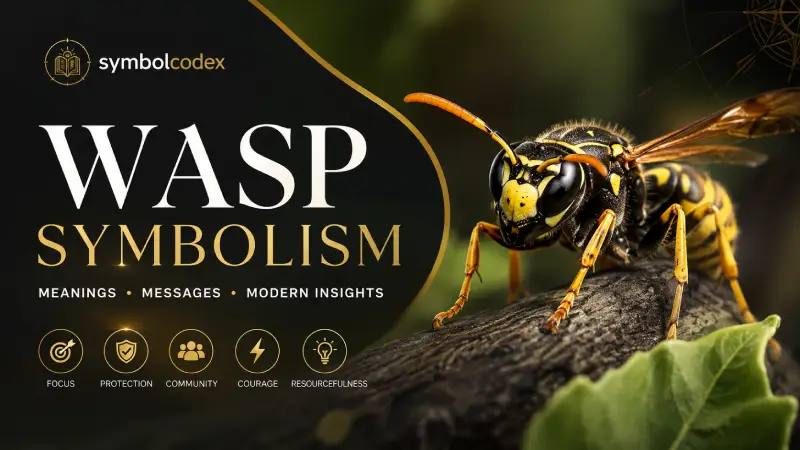
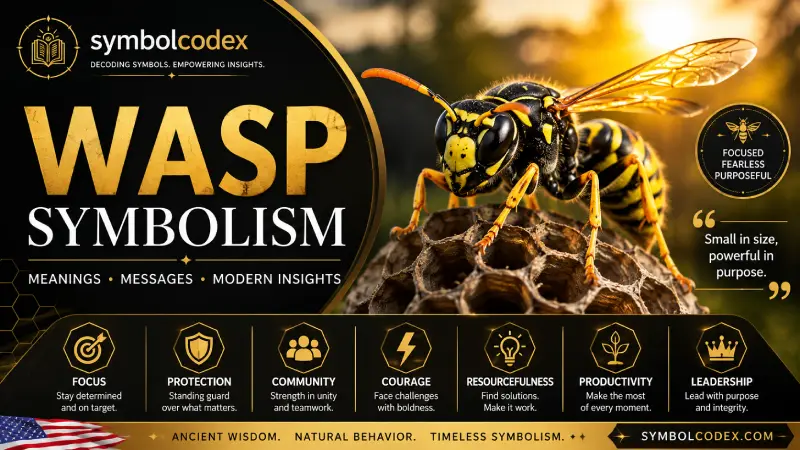
Wasps are familiar insects known for their slender bodies, powerful stings, social colonies, and important role as predators and pollinators. Wasp symbolism commonly represents protection, determination, defense, persistence, teamwork, aggression, and personal boundaries.
People often have mixed feelings about wasps. Their sting can make them seem threatening, yet their behavior reveals a highly organized animal that contributes to ecosystems by controlling insect populations and visiting flowers. That contrast gives the wasp a more complicated symbolic meaning than simply “danger.
In the United States, wasp imagery appears in tattoos, jewelry, artwork, folklore, nature education, fashion, and popular culture. The meaning can change depending on whether the wasp is being viewed as a solitary insect, a social colony, a warning, or a symbol of personal strength.
Quick Answer
Wasp symbolism commonly represents protection, determination, defense, teamwork, and persistence in modern American culture, while its sting can also give it associations with aggression, danger, and confrontation. In folklore and modern personal symbolism, the wasp can represent standing your ground, working toward a goal, and defending what matters.
TL;DR
- Wasps commonly symbolize protection, determination, defense, and persistence.
- Their sting creates associations with danger and boundaries.
- Social wasps can represent cooperation, organization, and collective effort.
- Solitary wasps can symbolize independence and self-reliance.
- Modern tattoos often represent strength, resilience, or personal protection.
- Wasps also play valuable roles in American ecosystems.
What Does a Wasp Symbolize?
The wasp’s symbolism comes from its appearance, behavior, social structure, and relationship with humans.
Its ability to sting creates one of its strongest meanings: defense. A wasp can respond to a perceived threat rather than simply escaping from it.
Its persistence also contributes to the symbolism. Wasps can repeatedly investigate food, nesting materials, or potential threats.
Social wasps add another layer. Species such as yellowjackets and paper wasps can live in organized colonies where individuals perform different roles.
Depending on the context, a wasp may symbolize:
- Protection, defending yourself or others
- Determination1, continuing despite obstacles
- Defense, responding when boundaries are crossed
- Persistence, refusing to abandon a goal
- Teamwork, cooperating within a colony
- Organization, functioning within a structured social system
- Independence, especially in solitary species
- Courage, confronting something larger or more threatening
- Aggression, when the symbol emphasizes its sting
- Adaptability, surviving in changing environments
The wasp therefore has both constructive and challenging meanings.
Why Wasps Symbolize Protection
A wasp’s sting is central to its symbolic identity.
Many wasps can sting as a defense mechanism. Female wasps have the structures needed for stinging because the sting evolved from an egg-laying organ.
This biological fact creates a natural metaphor for boundaries.
The wasp can represent someone who does not look for conflict but is prepared to respond when threatened.
In personal symbolism, this can mean:
- protecting yourself
- defending family
- setting boundaries
- refusing to tolerate mistreatment
- standing up for your values
- responding decisively to threats
This interpretation is different from celebrating aggression.
A protective wasp symbol can communicate “I know how to defend what matters to me” rather than “I want to fight.”
Wasp Symbolism and Determination
Wasps can also symbolize determination.
Their activities often involve repeated effort. Nest-building, feeding larvae, finding food, hunting prey, and maintaining a colony all require sustained activity.
Humans naturally interpret this persistence as a form of determination.
A wasp can therefore represent someone who:
- keeps working after setbacks
- focuses on a goal
- takes action rather than waiting
- protects important priorities
- refuses to give up easily
This meaning can be especially relevant when a person is facing a difficult project or transition.
The wasp becomes a reminder that progress can depend on repeated effort rather than one dramatic achievement.
The Wasp as a Symbol of Boundaries
One of the most useful modern interpretations of wasp symbolism is personal boundaries.
A wasp generally does not need to sting everything it encounters. Defensive behavior is more likely when the animal or its nest is disturbed.
This creates a strong metaphor for knowing when to respond and when to leave a situation alone.
The symbolic lesson can be:
Not every challenge requires confrontation, but important boundaries should still be defended.
This interpretation makes the wasp particularly relevant to modern discussions about confidence and self-respect.
A wasp tattoo, illustration, or piece of jewelry may therefore represent someone who has learned to protect their time, space, relationships, or principles.
Social Wasps and the Meaning of Teamwork
Not all wasps are social.
Many wasp species are solitary, while others live in colonies with complex social organization.
Social wasps can therefore symbolize cooperation and collective effort.
Colonial species may divide tasks among individuals, with workers contributing to nest maintenance, food gathering, defense, and care of developing young.
This creates associations with:
- teamwork
- organization
- shared responsibility
- community
- cooperation
- collective survival
The symbolism is particularly interesting because individual wasps may appear small and vulnerable, while a colony can become highly organized.
The larger message is that coordinated effort can accomplish more than isolated action.
Solitary Wasps and Independence
Solitary wasps provide a contrasting form of symbolism.
Many wasp species do not live in large colonies. Instead, individual females may construct nests, capture prey, lay eggs, and provide resources for their offspring.
These species can represent:
- independence
- self-reliance
- resourcefulness
- individual responsibility
- quiet determination
This distinction prevents wasp symbolism from becoming overly focused on teamwork.
A wasp can represent both collective cooperation and individual independence, depending on the species and the behavior being emphasized.
Wasp Symbolism in the United States
Wasps are common across the United States, making them a familiar part of everyday outdoor life.
Americans may encounter them around gardens, patios, parks, farms, forests, buildings, and picnic areas.
Because of this familiarity, wasp symbolism often has a practical rather than purely mythical quality.
The wasp can represent:
- caution around wildlife
- self-defense
- persistence
- hard work
- nature’s complexity
- cooperation
- irritation or conflict
Yellowjackets are especially associated with aggressive encounters around food and outdoor gatherings, while paper wasps are often recognized by their open-comb nests.
This means American interpretations can vary according to personal experience.
Someone who has been stung may associate a wasp primarily with pain and danger. Someone interested in entomology may see it as an important predator and pollinator.
Both reactions can influence symbolism.
Wasps as Predators and Symbols of Balance
One of the most overlooked aspects of wasp symbolism is predation.
Many wasps hunt other insects or spiders. Some species capture prey to feed their young, while others play important roles in controlling insect populations.
This gives the wasp a symbolic connection with ecological balance.
Rather than representing destruction alone, the wasp can symbolize:
- natural regulation
- survival
- competition
- ecological balance
- resourcefulness
- adaptation
This perspective challenges the common assumption that wasps are simply harmful pests.
Although certain wasps can be dangerous or troublesome around people, many species have valuable ecological functions.
Wasps and Pollination
Wasps can also contribute to pollination.
Some wasps visit flowers for nectar and may transfer pollen while doing so. Certain plants have particularly specialized relationships with particular wasps.
The most famous example is the relationship between fig trees and fig wasps.
Certain fig species depend on tiny wasps to pollinate their flowers inside the structure commonly called a fig, while the wasps depend on figs as part of their reproductive cycle.
This relationship gives wasp symbolism another possible meaning: mutual dependence.
The wasp can represent the idea that species that appear unrelated may depend on each other for survival.
Wasp Symbolism in Ancient and Cultural Traditions
Wasp symbolism is less standardized across major ancient religions than symbolism associated with animals such as snakes, lions, or eagles.
However, wasps and related stinging insects appear in folklore and historical imagery because people have long noticed their painful stings and organized behavior.
In ancient Egypt, insects such as bees and wasp-like creatures appeared in cultural and artistic contexts, although modern readers should be cautious about assuming that every ancient insect image represented the same species or carried one fixed meaning.
Across cultures, stinging insects have often become metaphors for:
- danger
- anger
- punishment
- industriousness
- defense
- persistence
The meanings generally developed from direct observation rather than from a single universal tradition.
Wasp Symbolism in Folklore
Folklore often uses small animals to represent human qualities.
The wasp’s ability to cause pain despite its small size makes it a natural metaphor for underestimated power.
A small creature capable of defending itself can represent someone who should not be dismissed because of appearance or size.
Wasp folklore can therefore support themes of:
- underestimated strength
- vigilance
- confrontation
- determination
- protection
- consequences
This interpretation remains relevant in modern storytelling.
A wasp appearing in a story can instantly communicate tension because most readers already understand that getting too close may have consequences.
Wasp Symbolism in Love and Relationships
In relationships, wasp symbolism can represent protection, loyalty, boundaries, passion, and determination.
The protective interpretation is particularly relevant when the wasp is associated with defending a nest.
A person may use wasp imagery to represent protecting their partner, family, or relationship.
However, the wasp also has a negative side.
It can symbolize:
- jealousy
- anger
- arguments
- emotional defensiveness
- resentment
- hostility
A wasp that appears repeatedly in relationship imagery may therefore suggest that love involves both closeness and boundaries.
The healthiest interpretation is not constant defensiveness.
Instead, it is the ability to protect a relationship without turning every disagreement into a fight.
Wasp Symbolism in Tattoos
Wasp tattoos can have several meanings depending on the design.
A person may choose a wasp to represent resilience, determination, independence, protection, or overcoming adversity.
The insect’s relatively small size can also make it a symbol of underestimated strength.
Common tattoo interpretations include:
| Wasp Tattoo Design | Common Meaning in the USA | Main Association | Typical Interpretation |
|---|---|---|---|
| Single wasp | Independence | Individual strength | Self-reliance |
| Wasp with flowers | Balance | Nature | Strength with beauty |
| Wasp nest | Community | Teamwork | Collective effort |
| Wasp with dagger | Defense | Protection | Readiness to respond |
| Wasp with skull | Mortality | Danger | Survival and risk |
A realistic wasp may emphasize an interest in insects or nature, while a highly stylized design can function primarily as a personal symbol.
The meaning ultimately depends on the wearer.
Wasp Symbolism in Dreams
A wasp in a dream may represent irritation, conflict, boundaries, anxiety, or a perceived threat.
Being chased by wasps could reflect a feeling of being overwhelmed by multiple problems or social pressures.
Being stung might symbolize a painful interaction, criticism, betrayal, or a situation that crossed a personal boundary.
A calm wasp may have a different interpretation.
It could represent awareness, controlled strength, or recognizing a potential threat without immediately reacting to it.
A wasp nest may symbolize a complicated social environment, family dynamics, workplace tension, or a group that feels difficult to approach.
Dream interpretation is personal rather than predictive. The emotional response to the wasp is usually more informative than any universal dream dictionary.
Wasp Symbolism in Spirituality
Modern spiritual interpretations sometimes associate wasps with determination, protection, courage, productivity, and boundaries.
Some people interpret an unexpected wasp encounter as a reminder to examine where they may need stronger boundaries or greater persistence.
These interpretations are personal rather than scientific.
There is no universal spiritual rule stating that seeing a wasp predicts an event or carries a supernatural message.
A grounded spiritual interpretation can instead use the wasp as a prompt for reflection:
- Am I protecting my boundaries?
- Am I avoiding an important confrontation?
- Am I working consistently toward my goals?
- Am I contributing to my community?
- Am I reacting too strongly to perceived threats?
This keeps the symbolism meaningful without treating ordinary animal behavior as a supernatural prediction.
Positive and Negative Wasp Symbolism
Wasp symbolism contains both constructive and challenging meanings.
Positive meanings include:
- protection
- determination
- persistence
- courage
- teamwork
- independence
- organization
- resilience
- resourcefulness
- environmental awareness
Negative meanings include:
- aggression
- anger
- conflict
- jealousy
- irritation
- hostility
- defensiveness
- danger
- revenge
The same characteristic can produce opposite interpretations.
A sting can symbolize protection or aggression.
A colony can represent cooperation or social conflict.
Persistence can represent determination or stubbornness.
Defense can represent healthy boundaries or excessive defensiveness.
The context determines which meaning fits.
Common Misunderstandings About Wasps
One of the biggest misconceptions is that all wasps are aggressive.
There are thousands of wasp species, and their behavior varies considerably. Many are solitary and pose little concern to humans unless handled or accidentally disturbed.
Another misconception is that all wasps build large colonies.
Many species live solitary lives and construct individual nests or use other nesting strategies.
It is also incorrect to describe wasps as simply “bad insects.”
Many wasps are predators that help control other insect populations, and some contribute to pollination.
Finally, bees and wasps should not be treated as identical.
They are related within the order Hymenoptera, but they have different body forms, behaviors, diets, and ecological roles.
How Wasp Symbolism Has Evolved
Wasp symbolism began largely with direct human experiences of stinging insects.
Their ability to defend themselves encouraged associations with danger and protection.
Their repeated work around nests and colonies supported ideas about persistence, organization, and cooperation.
Modern biology has added another layer.
Researchers and naturalists now recognize wasps as important predators, pollinators, and participants in complex ecological relationships.
Modern personal symbolism has taken these qualities into tattoos, jewelry, artwork, and fashion.
As a result, the wasp is no longer interpreted only as an insect to avoid.
It can represent a person who is small but capable, independent but cooperative, and peaceful until a boundary is crossed.
What Wasp Symbolism Means Today
Today, the wasp is best understood as a symbol of defense, determination, boundaries, persistence, and underestimated strength.
In American culture, it can also represent teamwork through social species or independence through solitary ones.
Its negative meanings remain strong because people understandably associate its sting with pain and danger. At the same time, ecological knowledge has made the insect easier to appreciate as part of natural systems.
This combination makes the wasp a useful modern symbol.
It can communicate strength without size, protection without constant aggression, and persistence without requiring dramatic action.
Frequently Asked Questions
What does a wasp symbolize spiritually?
A wasp can symbolize protection, determination, boundaries, courage, and persistence in modern spiritual interpretations. These meanings are personal rather than universal supernatural rules.
What does a wasp tattoo symbolize?
A wasp tattoo may represent resilience, independence, protection, determination, or underestimated strength. A nest design may emphasize teamwork, while a solitary wasp can emphasize self-reliance.
What does a wasp symbolize in love?
A wasp can symbolize loyalty, protection, strong boundaries, and determination in relationships. It can also represent jealousy or conflict when the imagery emphasizes the insect’s sting or defensive behavior.
What does a wasp mean in a dream?
A wasp in a dream may represent conflict, irritation, anxiety, personal boundaries, or a perceived threat. The meaning depends strongly on what the wasp was doing and how you felt during the dream.
Is a wasp a symbol of strength?
Yes, especially in the sense of underestimated strength. A relatively small insect can defend itself effectively, making the wasp a useful metaphor for confidence and the ability to protect personal boundaries.
Are wasps symbols of good luck?
Wasps do not have one universal association with good luck. Some modern symbolic interpretations view them positively because of their persistence and ecological importance, while others focus on danger and conflict.
Why are wasps associated with protection?
Wasps can sting when defending themselves or their nests, which gives them a natural association with defense and boundaries. Symbolically, this can represent protecting yourself, your family, or something important to you.
Conclusion
The wasp is a symbol of contrasts. Its sting creates associations with danger and aggression, while its nesting behavior can represent organization, cooperation, and persistence. Solitary species add another dimension by showing how independence and self-reliance can coexist with the broader ecological role of wasps.
In modern American culture, the wasp most often represents protection, determination, boundaries, persistence, and underestimated strength. Its meaning can become more specific when it appears in tattoos, dreams, relationships, spiritual practices, or environmental imagery.
The most grounded lesson from the wasp is simple: strength is not always about size, and protecting what matters sometimes begins with knowing where your boundaries are.