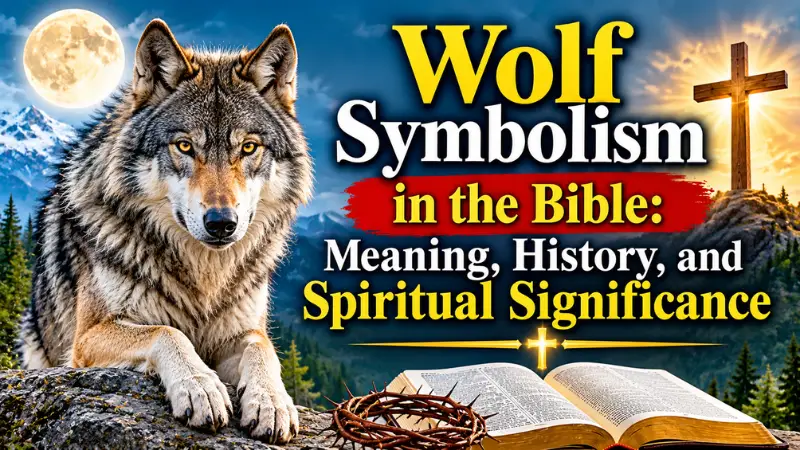
Wolves appear throughout biblical literature as symbols of danger, aggression, deception, and spiritual threats. Understanding wolf symbolism in the Bible requires looking beyond the animal itself because biblical writers frequently used wolves to describe people, leaders, and forces that threatened the vulnerable. In most passages, the wolf represents someone who takes advantage of others rather than protecting them.
However, the biblical picture is not limited to destruction. Genesis 49:27 describes the tribe of Benjamin as a ravenous wolf, an image associated with military strength and the ability to overcome enemies. Meanwhile, Isaiah presents a future in which wolves and lambs live peacefully together, illustrating God’s vision of restored harmony.
These different descriptions make the wolf an interesting biblical symbol. Its meaning depends on the passage, the people involved, and the spiritual lesson being communicated.
Quick Answer: What Does a Wolf Symbolize in the Bible?
A wolf in the Bible most commonly symbolizes greed, deception, aggression, false teaching, and people who exploit the innocent. Historically, it also represents predatory strength and military power, while the peaceful wolf-and-lamb imagery in Isaiah represents God’s promised restoration of harmony and peace.
TL;DR: Key Biblical Meanings of Wolves
- Deception: False prophets who appear trustworthy but intend harm.
- Aggression: People who attack and exploit vulnerable individuals.
- Greed: Corrupt leaders who use authority for personal gain.
- Strength: Benjamin’s comparison to a wolf represents military power.
- Peace: A wolf living with a lamb represents God’s restored creation.
- Spiritual caution: Believers are encouraged to recognize harmful influences.
1. The General Meaning of Wolves in the Bible
The wolf is primarily a negative symbol in biblical literature. Ancient communities understood wolves as dangerous predators that threatened sheep, goats, and other livestock. For people whose livelihoods depended on raising animals, a wolf could represent a serious physical and economic threat.
Biblical writers used this familiar danger to explain spiritual and moral problems.
A wolf could represent someone who:
- Takes advantage of innocent people.
- Uses deception to gain influence.
- Attacks individuals who cannot defend themselves.
- Places personal interests above the well-being of others.
- Destroys a community through selfish behavior.
This symbolism becomes especially clear when wolves are compared with sheep. Sheep represent vulnerability, innocence, and dependence on protection, while wolves represent the danger that threatens them.
The contrast communicates an important biblical lesson: people who appear strong, influential, or religious are not necessarily trustworthy.
2. Wolves as Symbols of False Prophets and Deception
One of the best-known biblical references to wolves appears in Matthew 7:15.
Jesus warns his followers to watch out for false prophets who approach in sheep’s clothing but are inwardly ravenous wolves.
This image communicates the difference between outward appearance and actual character.
The sheep’s clothing represents a harmless or respectable appearance. The wolf underneath represents destructive intentions hidden behind that appearance.
In this context, the wolf symbolizes religious deception, dishonesty, and manipulation.
The passage is particularly important because Jesus does not suggest that false teachers will always appear obviously dangerous. Instead, they may present themselves as caring, knowledgeable, or spiritually trustworthy.
The warning encourages believers to evaluate people by their actions and character rather than accepting their claims without examination.
In modern Christian understanding, this passage is often applied to religious leaders who use their positions to manipulate followers, demand unquestioning loyalty, or pursue personal benefits at the expense of their communities.
3. The Wolf as a Symbol of Greed and Corrupt Leadership
The Bible also uses wolves to describe leaders who exploit the people they are supposed to serve.
Ezekiel 22:27 compares Jerusalem’s officials to wolves that tear apart their prey. The passage condemns leaders who use violence and dishonesty to obtain wealth.
Zephaniah 3:3 uses a similar comparison when describing corrupt officials and judges who consume their victims like hungry wolves.
These passages reveal an important dimension of biblical wolf symbolism: the wolf is not simply an enemy attacking from outside. It can also represent someone inside a community who abuses authority.
A person responsible for protecting others becomes dangerous when that responsibility is replaced by greed.
This symbolism remains relevant in contemporary discussions about religious institutions, political authority, workplace leadership, and community responsibility.
The biblical criticism is directed at exploitation, not at leadership itself. Good leadership protects people, while the wolf-like leader uses people for personal advantage.
4. Genesis 49:27: Why Benjamin Is Compared to a Wolf
Genesis 49:27 contains one of the most unusual references to wolves in Scripture.
As Jacob gives his final words concerning his sons, he describes Benjamin as a ravenous wolf that consumes its prey in the morning and divides the spoil in the evening.
Unlike passages in which wolves represent corrupt leaders or false teachers, this comparison concerns the identity and character of a tribe.
Benjamin was associated with military ability and a reputation for fighting. The wolf image communicates aggression, determination, and success in battle.
The comparison also reflects the realities of the ancient Near Eastern world, where wolves were familiar predators associated with hunting and survival.
The passage demonstrates that biblical animal imagery must be interpreted within its immediate context. Although wolves generally appear negatively elsewhere, Genesis uses the animal to describe the fighting character of Benjamin.
It is therefore inaccurate to assume that every biblical reference to a wolf communicates exactly the same spiritual lesson.
5. Matthew 7:15 and the Meaning of Wolves in Sheep’s Clothing
The expression wolf in sheep’s clothing has become familiar in American English, but its origins are rooted in biblical teaching.
In Matthew 7:15, Jesus uses this comparison to warn against false prophets.
The image is straightforward:
- The sheep’s clothing represents an appearance of innocence.
- The wolf represents hidden harmful intentions.
- The contrast warns against trusting appearances alone.
The expression has gradually expanded beyond its original religious context.
Today, Americans commonly use it to describe someone who pretends to be friendly while secretly intending to deceive or exploit another person.
For example, a dishonest businessperson might present themselves as generous and helpful while taking advantage of customers.
Similarly, someone in a personal relationship might appear caring while repeatedly manipulating another person’s trust.
The biblical lesson remains recognizable: character is revealed through behavior, not simply through appearances.
6. Wolves Represent Spiritual Enemies and Threats to Faith
Wolves also symbolize spiritual dangers that threaten the Christian community.
In Acts 20:29, Paul warns the Ephesian elders that savage wolves will come among them and will not spare the flock.
The warning appears in Paul’s farewell address to the church leaders. He is concerned about what could happen after his departure, particularly when destructive teachers and influences attempt to divide the community.
The flock represents believers who need guidance and protection. The wolves represent people who could damage their faith through false teaching and manipulation.
This passage emphasizes the responsibility of spiritual leaders.
Their role is not merely to teach or organize a congregation. They must also recognize harmful influences and protect the people entrusted to their care.
For modern Christians, the passage encourages careful judgment, knowledge of Scripture, and responsible spiritual leadership.
7. The Wolf and the Sheep: A Biblical Contrast
The relationship between wolves and sheep is one of the most recognizable animal contrasts in the Bible.
The imagery works because the two animals represent very different characteristics.
| Symbol | Biblical Association | Spiritual Meaning | Main Context |
|---|---|---|---|
| Wolf | Aggression and deception | Threats to faith and vulnerable people | Matthew 7:15 |
| Sheep | Innocence and vulnerability | Believers who need guidance | John 10 |
| Shepherd | Care and responsibility | Protection and spiritual leadership | John 10:11 |
| Wolf and lamb | Restored harmony | God’s promised peace | Isaiah 11:6 |
| Benjamin’s wolf | Military strength | Determination and fighting ability | Genesis 49:27 |
In John 10, Jesus describes himself as the Good Shepherd who lays down his life for the sheep.
He contrasts this commitment with the hired worker who abandons the flock when danger approaches.
The wolf represents the threat that exposes the difference between genuine care and self-interest.
A good shepherd remains present when protection is needed. A selfish caretaker runs away when responsibility becomes difficult.
This comparison provides a broader lesson about loyalty, service, and accountability.
8. Isaiah 11:6: When the Wolf Lives With the Lamb
Not every biblical wolf image represents danger or destruction.
One of the most hopeful references appears in Isaiah 11:6, which describes a future in which a wolf lives with a lamb.
The passage presents a scene in which animals that would normally be enemies exist peacefully together.
Isaiah uses this extraordinary picture to communicate the character of God’s promised kingdom.
The wolf traditionally represents a predator, while the lamb represents an animal vulnerable to attack. Their peaceful relationship illustrates the removal of hostility and violence.
The imagery is often interpreted by Christians as a prophetic vision of the Messiah’s peaceful reign.
It communicates several connected ideas:
- The end of destructive conflict.
- The restoration of harmony in creation.
- The removal of fear and violence.
- The possibility of peace between former enemies.
- God’s ability to transform a broken world.
Isaiah 65:25 offers a related image, again describing the wolf and lamb feeding together.
These passages are especially important because they show that biblical symbolism can develop beyond an animal’s familiar characteristics.
The wolf that once represented danger becomes part of a picture of divine restoration.
9. Jeremiah 5:6: Wolves as Symbols of Judgment
Jeremiah 5:6 uses several dangerous animals to describe the consequences of persistent wrongdoing.
Among them is the wolf, which represents a destructive threat approaching a disobedient community.
The passage appears within a broader criticism of Judah’s moral and spiritual condition.
Jeremiah condemns dishonesty, rebellion, and the refusal to recognize wrongdoing. The wolf imagery reinforces the seriousness of these problems by presenting judgment as something dangerous and difficult to escape.
Unlike the warning about false prophets in Matthew, this passage focuses more broadly on the consequences of a society’s corruption.
The wolf is therefore associated with danger, destruction, and the vulnerability of people who abandon moral responsibility.
For readers today, the passage offers a reminder that harmful behavior can affect entire communities, not just the individuals who participate in it.
10. Historical Origins of Wolf Symbolism in Biblical Times
To understand why wolves became such strong biblical symbols, it helps to consider the environment of the ancient Near East.
Wolves were familiar predators in the region surrounding ancient Israel. People who raised sheep and goats had practical reasons to fear them.
Livestock represented food, clothing materials, wealth, and economic security. A wolf attacking a flock could create serious problems for a family or community.
This everyday experience shaped the way biblical writers used animal imagery.
Several characteristics made wolves especially useful symbols:
Predatory behavior: Wolves hunted other animals, making them natural representations of violence and aggression.
Threat to livestock: Their attacks on sheep created an obvious contrast between predators and vulnerable animals.
Hunting patterns: Their movement and hunting behavior contributed to associations with nighttime danger and sudden attacks.
Survival and strength: Their ability to hunt and survive also made them suitable images for military aggression and determination.
The biblical meaning developed from these recognizable characteristics rather than from an abstract belief that wolves possessed supernatural qualities.
Their symbolism was rooted in ordinary experiences of danger, protection, and survival.
11. Wolf Symbolism in Christianity Today
In contemporary Christianity, wolves are frequently used as illustrations in sermons, religious education, and discussions about spiritual responsibility.
The most common interpretation remains the warning against deception.
Church leaders may use the image of a wolf to discuss people who distort religious teaching, manipulate congregations, or exploit vulnerable believers.
The expression wolf in sheep’s clothing is also common in Christian discussions about recognizing dishonest behavior.
However, the Isaiah passages introduce a different emphasis.
When Christians discuss the wolf living peacefully with the lamb, the animal becomes part of a hopeful vision of reconciliation and God’s future kingdom.
This distinction matters because the Bible does not present one universal meaning for every appearance of a wolf.
Its interpretation depends on whether the passage emphasizes danger, military strength, judgment, or restoration.
12. How Americans Interpret Biblical Wolves in Modern Culture
In the United States, biblical wolf imagery appears in religious conversations, Christian artwork, books, films, and popular expressions.
The phrase wolf in sheep’s clothing is especially familiar. Many Americans understand it as a description of a dishonest person who hides harmful intentions behind a friendly personality.
In churches, the wolf is often used as a teaching illustration about false leadership and spiritual manipulation.
Christian artists may also use contrasting images of wolves and lambs to communicate the difference between danger and innocence.
Another common interpretation comes from Isaiah’s peaceful animal imagery.
In this context, the wolf and lamb may appear together in artwork representing hope, reconciliation, and the promised peace of God’s kingdom.
These interpretations show how an ancient biblical image continues to influence American religious language and visual culture.
Importantly, modern American ideas about wolves are also shaped by wildlife conservation, wilderness imagery, literature, and popular entertainment. Those broader associations should not automatically be treated as biblical meanings.
13. Emotional and Psychological Meaning of Wolves in Biblical Imagery
Biblical wolf symbolism also communicates recognizable human emotions and social experiences.
The wolf often represents the fear of being deceived or harmed by someone who has more power.
This makes the animal particularly effective in passages about vulnerable communities and dishonest leaders.
Several emotional associations stand out.
Fear and vulnerability: The wolf attacking a flock illustrates the anxiety of people who cannot protect themselves.
Distrust: The image of a hidden wolf encourages readers to question appearances and examine people’s behavior.
Anger and aggression: The wolf represents uncontrolled hostility and the desire to dominate others.
Protection and responsibility: The contrast between wolves and shepherds highlights the emotional importance of dependable leadership.
Hope and reconciliation: The peaceful wolf-and-lamb imagery offers an alternative to fear, suggesting a future without hostility.
From a psychological perspective, these images are understandable because people recognize the difference between a threatening individual and someone who genuinely offers protection.
The Bible uses familiar animal behavior to communicate these human concerns in a memorable way.
14. Common Misunderstandings About Wolf Symbolism in the Bible
Wolf imagery is sometimes oversimplified, especially when biblical passages are discussed without considering their surrounding context.
Several misunderstandings are worth avoiding.
Misunderstanding 1: Every wolf in the Bible represents evil.
Most biblical references are negative, but Genesis 49:27 uses the wolf to describe Benjamin’s fighting character. The passage has a different emphasis from warnings about false prophets.
Misunderstanding 2: A wolf always represents Satan.
The Bible does not establish a universal rule that wolves symbolize Satan. Depending on the passage, they can represent false teachers, corrupt officials, military strength, or destructive enemies.
Misunderstanding 3: Wolves always represent spiritual attacks.
Some passages use the animal to criticize political and social corruption rather than focusing specifically on religious deception.
Misunderstanding 4: The wolf and lamb passage means wolves become harmless animals in every biblical context.
Isaiah’s imagery communicates a vision of peace and restoration. Its central message is not a general statement about the behavior of wolves in nature.
Misunderstanding 5: Modern wolf tattoos automatically have biblical meanings.
A wolf tattoo may represent independence, loyalty, wilderness, or personal strength. Its meaning depends on the wearer’s intention and does not necessarily reflect Scripture.
Understanding these distinctions helps readers interpret biblical imagery more accurately.
15. How Biblical Wolf Symbolism Has Evolved Over Time
The meaning of wolves has developed through different historical and cultural settings.
In the Hebrew Bible, wolves are often associated with predators, aggressive individuals, and the destructive behavior of corrupt leaders.
The description of Benjamin introduces a military dimension, showing how the animal could also communicate strength and fighting ability.
In the New Testament, Jesus and Paul use wolves to illustrate the dangers of false teaching, spiritual deception, and threats against Christian communities.
Christian interpretation later emphasized the contrast between wolves and sheep as a lesson about protecting believers and recognizing dishonest religious influences.
In modern American culture, these meanings have expanded into everyday language.
The phrase wolf in sheep’s clothing now describes deceptive behavior in relationships, workplaces, politics, and other social settings.
At the same time, Isaiah’s peaceful wolf-and-lamb image continues to appear in Christian artwork and discussions about reconciliation.
The central symbolism has therefore remained recognizable while gaining additional applications in modern life.
1. Is seeing a wolf a good or bad sign in the Bible?
The Bible does not establish seeing a wolf as a supernatural sign of good or bad fortune. Its wolf imagery is usually connected with danger, deception, and aggression, although Genesis 49:27 associates the animal with Benjamin’s fighting strength.
2. What does a wolf represent spiritually in Christianity?
A wolf commonly represents false teaching, spiritual deception, destructive influences, and people who exploit vulnerable believers. Isaiah’s wolf-and-lamb imagery, however, represents peace and restoration under God’s kingdom.
3. What does a wolf in sheep’s clothing mean in the Bible?
It describes someone who pretends to be innocent, trustworthy, or spiritually sincere while secretly intending to cause harm. Jesus uses this image in Matthew 7:15 when warning against false prophets.
4. What does the wolf and lamb symbolize in Isaiah?
The wolf and lamb living peacefully together represent the removal of hostility and violence in God’s promised kingdom. The image communicates reconciliation, security, and harmony in restored creation.
5. Why does Genesis compare Benjamin to a wolf?
Genesis 49:27 describes Benjamin as a ravenous wolf to communicate the tribe’s aggressive and warlike character. Unlike most biblical wolf references, this comparison emphasizes military strength and the ability to overcome enemies.
6. Is a wolf tattoo a Christian symbol?
A wolf tattoo is not automatically a Christian symbol. Some Christians may associate it with biblical warnings about deception, while others choose it to represent strength, loyalty, courage, or personal independence.
7. Does the Bible say wolves are evil animals?
No. The Bible uses wolves as literary images to communicate moral and spiritual lessons, rather than declaring that the animal itself is morally evil. Most negative descriptions reflect the danger wolves posed to livestock and vulnerable communities in the ancient world
Conclusion
The wolf symbolism in the Bible is primarily associated with deception, aggression, greed, false teaching, and threats against vulnerable people. Through passages such as Matthew 7:15, Ezekiel 22:27, and Acts 20:29, the wolf becomes a recognizable image of individuals who use their strength or influence to harm others.
However, Genesis 49:27 and Isaiah 11:6 reveal important differences in interpretation. The wolf can represent military strength, while its peaceful relationship with the lamb illustrates God’s vision of a world without violence.
Ultimately, biblical wolf imagery encourages readers to recognize harmful intentions, value responsible leadership, and look toward a future defined by peace rather than exploitation.