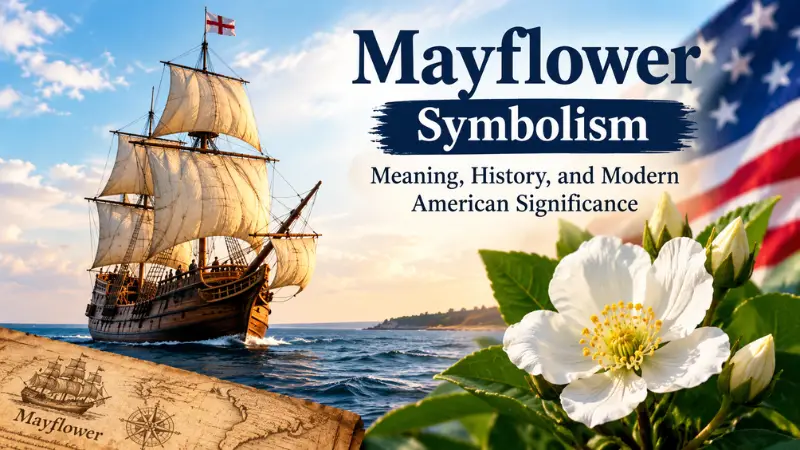
The Mayflower is one of the most recognizable symbols associated with early American history. The English sailing ship carried settlers across the Atlantic in 1620, eventually bringing them to the coast of present-day Massachusetts. Today, Mayflower symbolism evokes ideas of new beginnings, perseverance, religious conviction, migration, and the complicated origins of the United States.
For many Americans, the ship represents the courage to leave familiar surroundings and build a life in an unfamiliar place. Its image appears in history books, Thanksgiving displays, family ancestry research, museums, and commemorations of the colonial era. For some descendants of its passengers, it also represents a personal connection to family history.
Yet the Mayflower’s meaning is not limited to an inspiring story of settlement. The ship’s arrival marked a significant moment in the expansion of English colonial power into Indigenous homelands. The experiences of the Wampanoag people and other Native communities reveal a more complicated history than traditional Thanksgiving stories often suggest.
Understanding the Mayflower means looking at both its enduring appeal and its historical consequences. Its symbolism reflects not only what Americans remember about the past, but also how national identity changes as people reconsider that past.
Quick Answer
Mayflower symbolism commonly represents new beginnings, perseverance, religious freedom, and the pursuit of opportunity in American culture, especially through its connection to the country’s early colonial history and Thanksgiving traditions. Historically, the ship also symbolizes European migration, English settlement, and the complicated encounters between colonists and Indigenous peoples.
TL;DR
- The Mayflower represents migration, determination, and the hope of starting over.
- Its 1620 voyage became central to traditional stories of America’s beginnings.
- The Mayflower Compact is associated with collective agreement and colonial self-government.
- Thanksgiving connects the ship with gratitude, harvest traditions, and family gatherings.
- Indigenous perspectives highlight colonization, dispossession, and the limits of romanticized historical narratives.
- Today, the ship remains a recognizable emblem of ancestry, heritage, and American historical memory.
1. What the Mayflower Looks Like and Why It Became a Symbol
The Mayflower was a seventeenth-century English merchant sailing ship, a wooden vessel with tall masts, multiple sails, and a broad hull designed for ocean travel. It was not built as a national emblem. Its symbolic importance developed because of the people it transported and the historical events associated with their arrival in North America.
In 1620, the ship carried approximately 102 passengers, along with its crew, across the Atlantic. After reaching Cape Cod in November, the passengers eventually established a settlement at Plymouth, in present-day Massachusetts. The crossing was difficult, and the first winter brought severe hardship and substantial loss of life.
In modern illustrations, the ship often appears with billowing white sails, a dark wooden hull, and a cloudy Atlantic sky. These details suggest movement, uncertainty, and determination. A drawing of the vessel heading toward a distant shore can communicate hope, while an image of it battling rough seas can emphasize endurance.
The ship’s meaning therefore comes less from its physical design than from the story Americans have attached to its voyage.
2. The Core Symbolic Meanings of the Mayflower
The Mayflower carries several related meanings, but they do not all have the same historical foundation.
New beginnings are among its most familiar associations. The voyage is commonly presented as a departure from an established life toward an uncertain future. This makes the ship a natural emblem for migration, fresh starts, and the willingness to take risks.
Perseverance comes from the difficult Atlantic crossing and the settlers’ struggle to survive their first winter. The symbol reminds many Americans that building a new life can require cooperation, patience, and sacrifice.
Religious conviction reflects the beliefs of the English Separatists aboard the ship, some of whom sought greater independence from the Church of England. Their experience is often connected to the broader American ideal of religious liberty, although the later history of religious freedom in the United States developed through many different people and movements.
Community and shared responsibility connect the ship to the Mayflower Compact, an agreement made aboard the vessel before the settlers established their colony.
The Mayflower also symbolizes migration and colonization. These meanings are essential to understanding the ship as a historical object rather than simply an inspirational image.
3. How the Voyage of 1620 Shaped Its Meaning
The Mayflower sailed from England in September 1620 with passengers who had different reasons for making the journey. Some belonged to a Separatist religious community that had previously lived in the Netherlands. Others were merchants, workers, servants, or people seeking economic opportunities.
The ship was intended to take the group toward the northern part of the English colony of Virginia. Storms and navigational difficulties brought them to Cape Cod instead. Their eventual settlement was established at a place the English named Plymouth, on land that had been home to the Indigenous Patuxet community.
The voyage became a defining episode in American historical memory because it connected migration with the establishment of a lasting English settlement in New England.
However, the familiar story often leaves out the wider context. Indigenous peoples had lived across the continent for thousands of years, and European explorers, traders, and colonists had already been active along parts of the North American coast. Epidemics and earlier European violence had devastated Native communities before the Mayflower arrived.
The ship’s historical importance is real, but it does not represent the beginning of human history in America. It represents one consequential episode in the much longer history of the continent.
4. Religious Freedom and the Search for a New Life
Religious conviction is one of the strongest associations attached to the Mayflower. The Separatists among its passengers disagreed with the established Church of England and sought to practice their faith outside its authority.
Their experiences helped later generations tell a story about the search for religious independence. In popular American memory, the ship became a reminder that people may leave their homeland when their beliefs and circumstances conflict with the society around them.
Still, it is important to distinguish the original passengers’ goals from modern ideas about religious liberty. The settlers did not all share the same motivations, and their community did not establish universal freedom of religion in the modern sense.
Early colonial religious communities could impose strict rules and exclude people whose beliefs differed from their own. The wider American tradition of religious freedom emerged gradually through constitutional debates, political struggles, and the experiences of many religious groups.
Today, the Mayflower may symbolize the right to seek a place where one’s convictions can be practiced. Its history also reminds readers that freedom for one community does not automatically guarantee equal freedom for everyone else.
5. The Mayflower Compact and the Meaning of Self-Government
Before going ashore, the male passengers who signed the Mayflower Compact agreed to form a civil community and follow laws established for the colony’s common welfare.
The agreement was drawn up in November 1620 while the ship was anchored near Cape Cod. It helped address disagreements over authority and the settlers’ uncertain legal position after they arrived outside their intended destination.
Over time, Americans came to view the document as an early example of collective political agreement and self-government. Its importance grew beyond the immediate practical problem it was designed to solve.
The Compact did not establish a modern democracy. It reflected seventeenth-century English political assumptions, including loyalty to the king, and political participation was restricted. Women did not sign it, and the agreement did not represent the Indigenous peoples whose homelands the settlers occupied.
Nevertheless, the document became an important part of the country’s civic memory.
When the Mayflower appears alongside a written agreement, a historic courthouse, or a civics textbook, it can symbolize the idea that communities need shared rules and institutions. Its association with self-government is best understood as an early chapter in a much longer political history, not as proof that American democracy was fully formed in 1620.
6. What the Mayflower Represents in American Thanksgiving Traditions
For many Americans, the Mayflower is inseparable from Thanksgiving. School lessons, holiday decorations, and historical illustrations often place the ship at the beginning of a story that ends with a harvest meal shared by English settlers and Wampanoag people in 1621.
The gathering lasted several days and took place after the settlers’ first difficult year. Wampanoag leader Ousamequin, also known as Massasoit, attended with members of his community. The surviving historical record provides only limited details about the event, and it was not identical to the modern national holiday.
Thanksgiving traditions developed over many generations. The holiday became a national observance during the Civil War, when President Abraham Lincoln proclaimed a national day of thanksgiving in 1863. Its familiar customs later incorporated family dinners, seasonal decorations, parades, football, and images of colonial-era life.
The Mayflower’s role in this tradition is largely symbolic. It connects the holiday to a familiar origin story about hardship, harvest, and gathering together.
For some families, that story offers a welcome opportunity to reflect on gratitude and mutual support. For others, especially those attentive to Indigenous history, Thanksgiving is also a time to acknowledge dispossession and the consequences of colonization.
Both perspectives help explain why the ship remains so prominent in American holiday imagery.
7. Mayflower Symbolism in American Culture Today
The Mayflower occupies a recognizable place in American cultural identity, especially in New England and in representations of the colonial period.
| Context | Common American association | Important distinction |
|---|---|---|
| Thanksgiving | Gratitude, harvest, and family gathering | The modern holiday evolved over centuries |
| Family ancestry | Heritage and connections to earlier generations | Descent does not determine personal identity |
| Civics education | Self-government and collective responsibility | The Compact was not a modern democratic constitution |
| Religious history | Faith and the search for religious independence | Not every passenger shared the same beliefs |
| Indigenous history | Colonization and changes to Native homelands | The ship’s legacy extends beyond the settlers’ story |
In public spaces, the ship appears in historical reenactments, museum exhibits, educational materials, and commemorative artwork. The replica Mayflower II, displayed in Plymouth, Massachusetts, provides a tangible way for visitors to encounter the maritime history behind the familiar image.
The vessel also appears in books and documentaries about colonial America. Its recognizable outline can communicate a large historical story with very little explanation.
Its continuing significance comes from this combination of familiarity and debate. Americans recognize the ship immediately, yet what it represents depends on the historical context in which it appears.
8. Family Heritage, Genealogy, and Ancestral Identity
For people researching their family trees, the Mayflower can symbolize a connection between personal history and the wider American past.
Organizations devoted to Mayflower descendants preserve genealogical records and help people investigate whether their ancestors traveled aboard the ship. For some families, discovering a documented connection can create a sense of continuity across generations.
The ship can also represent the stories passed down through family photographs, handwritten records, inherited objects, and oral histories. These connections may encourage people to learn more about migration, settlement, and the lives of their ancestors.
However, ancestry is not a measure of personal worth or a guarantee of a particular national identity. Millions of Americans have family histories connected to different migration periods, Indigenous nations, enslavement, and communities that arrived long after 1620.
The Mayflower is one thread in a much larger American story. A documented connection may be meaningful to a family, but it does not make that family more authentically American than others.
9. Emotional and Psychological Meaning
The Mayflower can evoke several distinct emotions, depending on a person’s experiences and beliefs.
For people facing a major life change, the ship may suggest the courage to leave a familiar environment. Someone moving across the country, starting a new career, or beginning life in another nation might identify with the idea of crossing an uncertain distance toward a different future.
For descendants of passengers, it may represent continuity and belonging. For history enthusiasts, it can prompt curiosity about how ordinary people experienced an extraordinary journey.
The ship can also evoke anxiety and grief. Its crossing involved dangerous conditions, and the settlement’s first winter brought extensive suffering. Remembering these realities makes perseverance a more specific idea than simply celebrating bravery.
Its psychological meaning is therefore not universally positive. The same image may inspire one person, remind another of a family’s migration story, and lead someone else to question the historical narratives they learned as a child.
These varied responses show how historical symbols become personal without losing their connection to real events.
10. Mayflower Symbolism in Tattoos, Jewelry, and Home Decor
Although the Mayflower is not as common a personal motif as anchors, compasses, or modern sailing ships, its historical associations make it suitable for several forms of personal expression.
Tattoos: A small sailing ship can represent a fresh start, family ancestry, a difficult journey, or an interest in American history. The intended meaning becomes clearer when the design includes a meaningful date, a family name, or a geographical reference.
Jewelry: Pendants, commemorative coins, and historical reproductions can express an interest in genealogy or maritime history. Some pieces are designed specifically for people researching Mayflower ancestry.
Home decor: Framed ship illustrations, model vessels, and colonial-style decorations often appear in traditional or coastal interiors. In autumn, the ship may be incorporated into Thanksgiving displays or historical decorations.
Fashion and accessories: The vessel may appear on scarves, shirts, tote bags, and souvenir items connected to Plymouth or American history.
A Mayflower design does not have one universal personal meaning. Before choosing it as a tattoo or permanent emblem, consider whether you want to communicate migration, family history, religious heritage, or a broader interest in the country’s past.
11. Cultural Comparisons: Migration and Founding Stories
The Mayflower is particularly associated with the United States, but the themes attached to it have parallels in other cultures.
Many nations use ships, journeys, or arrival stories to represent migration and collective identity. In maritime cultures, a vessel can suggest exploration, trade, escape, or the difficult passage between an old home and a new one.
Religious communities also preserve stories about journeys undertaken because of faith. Such narratives can make travel a symbol of conviction and sacrifice, although their meanings depend on the specific tradition.
Within the United States, other migration stories are equally important. Immigration through Ellis Island, forced transportation during the Atlantic slave trade, the displacement of Indigenous nations, and later movements across the continent all reveal different experiences of movement and settlement.
These histories should not be treated as interchangeable. A voluntary voyage undertaken for religious or economic reasons differs significantly from forced migration or removal from ancestral lands.
Comparing these experiences helps clarify what makes the Mayflower distinctive: its symbolic role developed through a particular English colonial settlement and the later American decision to treat that settlement as part of a national origin story.
12. Indigenous Perspectives and the Controversy Surrounding the Mayflower
Any balanced explanation of the Mayflower must include the perspectives of the Indigenous peoples whose lives were affected by the arrival of English settlers.
The area where the colonists established Plymouth was the homeland of the Patuxet people, part of the broader Wampanoag world. Epidemics had devastated the region before the ship arrived, and the English settlement occupied land that was not an empty wilderness.
The 1621 harvest gathering is often portrayed as a simple moment of friendship. In reality, relations between the Wampanoag and the settlers involved diplomacy, practical cooperation, strategic decisions, and competing interests. The Wampanoag had their own political concerns, and the relationship changed substantially over subsequent decades.
As English settlement expanded, pressure on Indigenous lands increased. Conflict, disease, displacement, and colonial policies caused lasting damage to Native communities.
For many Indigenous people, the Mayflower consequently represents the beginning of a colonial process rather than an uncomplicated story of national achievement. Some participate in Thanksgiving observances, while others commemorate the National Day of Mourning, which began in Plymouth in 1970.
Recognizing these perspectives does not require ignoring the passengers’ hardships. It means acknowledging that the same historical event could produce very different consequences for different communities.
13. Common Misunderstandings About Mayflower Symbolism
Several familiar beliefs about the Mayflower deserve a closer look.
Myth: Everyone aboard the ship was seeking religious freedom.
The passengers had varied backgrounds and motivations. Religious dissent mattered to some, but the group also included people traveling for economic and other practical reasons.
Myth: The Mayflower began American history.
Indigenous societies had flourished in North America for thousands of years before European settlement. The ship marks an important moment in English colonial history, not the beginning of the continent’s history.
Myth: The Mayflower Compact established modern democracy.
The Compact helped organize a colonial community, but political participation was limited. Its later reputation as a foundation of American self-government developed over time.
Myth: The 1621 gathering was exactly like modern Thanksgiving.
The harvest celebration was a specific historical event with limited surviving documentation. Today’s national holiday developed through a much longer process and incorporates traditions that did not originate at that gathering.
Myth: The Mayflower has only positive symbolism.
The ship can represent courage and migration while also recalling colonial expansion and Indigenous dispossession. Its interpretation depends on whose experiences are being remembered.
Separating the documented history from later legends makes the symbol more meaningful, not less.
14. How the Mayflower’s Meaning Has Evolved Over Time
The Mayflower did not arrive in 1620 with a fixed meaning for future Americans. Its symbolic status grew through storytelling, public commemorations, political writing, art, education, and holiday traditions.
During the colonial period, the ship was primarily connected to the settlement at Plymouth and the people who lived through its early hardships. Later generations increasingly treated the settlement as an important example of the country’s beginnings.
The Mayflower Compact also acquired a larger political reputation as Americans searched for early examples of collective government. Meanwhile, Thanksgiving traditions helped popularize images of the settlers and the 1621 harvest gathering.
By the nineteenth and twentieth centuries, paintings, schoolbooks, public ceremonies, and holiday illustrations had turned the ship into a familiar emblem of American origins.
In the twenty-first century, historical interpretation has become more attentive to the difference between national mythology and documented experience. Museums and educators increasingly present the colonists’ stories alongside Wampanoag history and the consequences of European settlement.
This change does not erase the Mayflower’s historical significance. Instead, it expands the questions the symbol can raise about belonging, freedom, memory, and the way nations tell stories about themselves.
FAQs
1. What does the Mayflower symbolize spiritually?
The Mayflower may symbolize faith, conviction, hope, and the willingness to undertake a difficult journey for a deeply held purpose. These are personal interpretations of its history rather than an established universal spiritual meaning.
2. Is the Mayflower a symbol of freedom?
Yes, particularly in relation to the religious Separatists among its passengers and the later American emphasis on religious liberty. However, the passengers’ experiences should not be confused with the complete history of freedom and equality in the United States.
3. What does a Mayflower ship tattoo mean?
A Mayflower tattoo can represent a new beginning, family ancestry, perseverance, migration, or an interest in colonial history. Its meaning depends on the wearer’s intentions and any accompanying dates, names, or symbols.
4. Why is the Mayflower associated with Thanksgiving?
The ship carried the English settlers whose Plymouth colony held a harvest gathering with Wampanoag participants in 1621. Later generations connected that event to Thanksgiving traditions, although the modern holiday developed over time and differs from the original gathering.
5. Does the Mayflower symbolize democracy?
It is commonly associated with self-government because the Mayflower Compact organized the settlers into a civil community. The agreement was an early colonial governing document, not a declaration of universal political equality or a modern democratic constitution.
6. Why do some Native Americans view the Mayflower negatively?
For many Indigenous people, the ship represents the arrival of English colonial settlement and the subsequent loss of land, political autonomy, and community members. This perspective reflects the long-term consequences of colonization rather than denying the historical experiences of the passengers.
7. Is the Mayflower a symbol of immigration in America?
It can serve as a symbol of migration because its voyage is widely remembered as a journey toward establishing a new home. However, it represents one specific colonial migration and should not be treated as a universal model for the many different circumstances under which people have come to the United States.
Conclusion
The Mayflower symbolizes new beginnings, perseverance, religious conviction, and community in much of American historical memory. Its connection to the Mayflower Compact and Thanksgiving has made it a lasting emblem of the nation’s colonial past, while its role in family ancestry and public commemoration continues to give it personal meaning.
Yet the ship also represents the arrival of English colonial power in Indigenous homelands. A complete understanding of Mayflower symbolism recognizes both the hopes that motivated some passengers and the lasting consequences of the settlement that followed.
The Mayflower remains important because its story raises questions that still matter: who gets remembered, what freedom means, and how a nation can honor its past without overlooking the people who experienced it differently.