Introduction
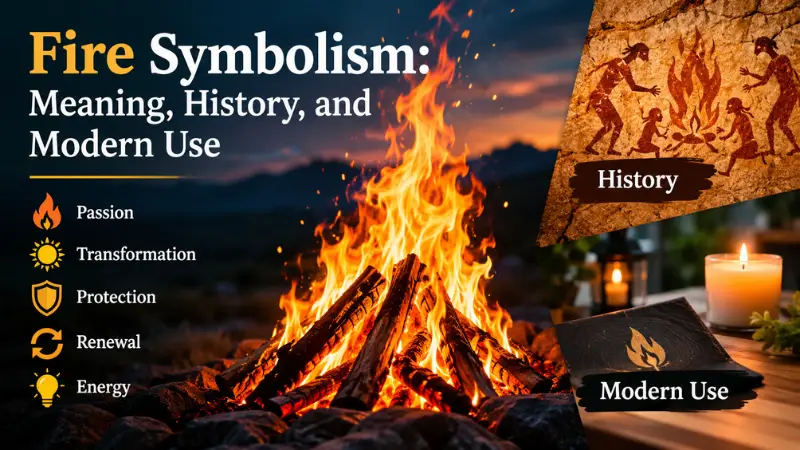
Fire symbolism connects one of humanity’s oldest discoveries with some of our most familiar experiences: warmth on a cold night, candles at a memorial, flames at a funeral, and bonfires shared with friends. Fire can protect and destroy, illuminate darkness, and turn one material into something entirely different. These contrasting qualities explain why fire symbolism carries so many meanings in American culture.
In the United States, fire often represents passion, courage, independence, renewal, and determination. It appears in expressions such as “fire in your belly,” in ceremonial candles, in Fourth of July celebrations, and in artwork that depicts personal change. Its meaning depends on the setting, the people involved, and whether the flames are controlled or threatening.
Fire also holds religious, cultural, and historical significance far beyond America. Ancient myths connect it with divine gifts and human ingenuity, while spiritual traditions use it to express purification, sacred presence, judgment, and transformation. Understanding these associations helps explain why fire remains such a recognizable symbol in everyday life.
Quick Answer
Fire symbolism most commonly represents passion, energy, transformation, courage, and renewal in modern American culture, especially in personal expression, celebrations, and spiritual imagery. Historically, fire has also symbolized divine power, purification, knowledge, protection, and destruction across different cultures and religious traditions.
TL;DR
- Fire represents passion, ambition, vitality, and emotional intensity.
- Ancient myths associate fire with divine gifts, knowledge, and human survival.
- American culture uses fire to express freedom, courage, remembrance, and celebration.
- Religious traditions interpret flames as sacred presence, purification, or spiritual testing.
- Fire tattoos often communicate resilience, personal change, or an independent spirit.
- Uncontrolled flames can symbolize anger, conflict, destruction, and irreversible loss.
1. The Core Meaning of Fire as a Symbol
Fire symbolizes opposing forces that exist side by side. It provides warmth and light, yet it can also destroy homes, forests, and entire communities. This dual nature gives fire a broader symbolic range than many familiar natural elements.
Its most common meanings include:
- Passion: Strong feelings, romantic desire, enthusiasm, and emotional intensity.
- Energy: Vitality, motivation, ambition, and the drive to act.
- Transformation: Change that alters a person, relationship, community, or situation.
- Purification: The removal of what is considered harmful, unwanted, or spiritually unclean.
- Knowledge: Light that makes understanding possible, often contrasted with darkness or ignorance.
- Destruction: Loss, danger, anger, violence, and the consequences of unchecked power.
- Renewal: The possibility of beginning again after a difficult ending.
These meanings are connected to fire’s physical properties. Heat suggests energy, light suggests awareness, and burning suggests a process that cannot always be reversed. A small candle and a raging wildfire are both flames, but they communicate very different ideas.
2. Ancient Roots: How Fire Became a Human Symbol
Fire became central to human life long before written records existed. The ability to maintain and control fire provided warmth, protection, cooking, and opportunities for social activity after dark. Over generations, these practical benefits helped establish fire as a symbol of survival, community, and human capability.
The hearth became an important gathering place in many societies. Families cooked, shared stories, and passed knowledge around the fire. Its steady presence could suggest hospitality and security, while the threat of an uncontrolled blaze reminded people of their vulnerability.
Fire also became associated with exceptional power because its behavior seemed difficult to explain without scientific knowledge. Flames appeared to consume objects, change their form, and rise toward the sky. Many communities incorporated fire into religious ceremonies, origin stories, and seasonal celebrations.
There was no single ancient meaning of fire. Some traditions emphasized its divine source, others its practical importance, and still others its capacity to purify or destroy. These interpretations developed independently and changed as societies changed.
3. Fire in Mythology and Folklore
Mythological stories frequently use fire to explore the relationship between humans, nature, and the divine.
In Greek mythology, Prometheus is remembered for bringing fire to humanity against Zeus’s wishes. His story links fire with knowledge, technological progress, human independence, and the consequences of challenging authority. Fire becomes more than a physical resource: it represents a gift that changes what people can accomplish.
In Roman tradition, Vesta was associated with the hearth and its sacred flame. The Roman Vestal Virgins maintained a public fire connected with the well-being of the state. This tradition illustrates how a household necessity could become a symbol of civic continuity and collective responsibility.
Other folklore traditions feature dragons that breathe fire, supernatural beings that wield flames, or fires that reveal hidden dangers. In these stories, fire may represent extraordinary power, a test of courage, or a force that humans must learn to respect.
In American storytelling, fire appears in frontier narratives, survival stories, and accounts of communities rebuilding after disasters. It can represent the harshness of nature as readily as the ingenuity required to live alongside it.
4. What Fire Symbolizes in the United States
In American culture, fire often expresses independence, determination, enthusiasm, and the ability to overcome obstacles. The familiar phrase “fire in your belly” describes a person with strong motivation, while calling someone “on fire” can mean they are performing exceptionally well.
Fireworks and bonfires add a social dimension. At Independence Day celebrations, fireworks create a dramatic display associated with national celebration and public festivity. At summer camps, beaches, and outdoor gatherings, a contained fire can represent friendship, shared stories, and a break from ordinary routines.
Fire also appears in American ideas about resilience. After a wildfire or a devastating building fire, communities may use images of flames and regrowth to discuss recovery. However, these images can be painful for people who have lost homes or loved ones, so the symbolism should not overshadow the real costs of disaster.
American interpretations also reflect regional experience. In areas affected by wildfires, fire may primarily suggest environmental risk, evacuation, and loss. For firefighters, it can represent professional duty, training, courage, and the responsibility to protect others.
The context determines whether fire feels celebratory, patriotic, inspiring, or frightening.
5. Religious and Spiritual Meanings of Fire
Fire has important roles in several religious traditions, although its meaning differs from one faith to another. It may represent divine presence, spiritual commitment, purification, judgment, or the relationship between human beings and the sacred.
In Christianity, flames are associated with the Holy Spirit, particularly in the account of Pentecost, when the apostles receive the Spirit and begin communicating with people in different languages. The burning bush in the biblical account of Moses also presents fire as a sign of divine presence without consuming the bush.
In Hindu traditions, Agni is the deity associated with fire and plays an important role in Vedic ritual. Sacred fire can serve as a medium through which offerings are presented to the gods. Fire also appears in Hindu wedding ceremonies, where it may witness vows and represent the sacred character of the marriage.
In Zoroastrianism, fire is treated with particular reverence as a symbol associated with purity, truth, and righteousness. Contrary to a common misconception, Zoroastrians do not simply worship fire as a god. It serves as a sacred focus within a religious tradition centered on the divine and the moral distinction between truth and falsehood.
Jewish traditions include the eternal light maintained in synagogues and ceremonial candles used for occasions such as Shabbat and Hanukkah. These lights carry meanings connected with remembrance, religious observance, and divine presence.
The important distinction is that fire does not have one universal spiritual meaning. Its significance comes from the beliefs, practices, and stories of the community using it.
6. Fire as a Symbol of Transformation and Renewal
Fire can change the appearance and structure of almost anything it consumes. This physical process helps explain its association with personal transformation.
In symbolic language, fire can represent a period when familiar habits, relationships, or beliefs no longer serve a person. The image of something burning away may communicate the decision to leave the past behind and build a different future.
This interpretation appears in literature, film, and personal storytelling. A character who survives a devastating experience may be described as having passed through fire. The phrase suggests that hardship has tested the person and changed their perspective.
Fire also appears in discussions of environmental renewal, although the relationship between fire and regrowth requires care. Some ecosystems depend on periodic fires for seed release, nutrient cycling, or the maintenance of particular plant communities. Other fires cause extensive ecological damage, especially when conditions are unusually hot, dry, or windy.
Symbolically, renewal does not mean that every loss is beneficial. A more realistic interpretation recognizes that recovery may follow destruction without making the destruction necessary or desirable.
7. Passion, Anger, and Emotional Intensity
Fire is one of the most recognizable metaphors for strong emotion. Americans use expressions such as “burning with desire,” “fired up,” and “a fiery temper” because the physical qualities of flames provide an understandable comparison for emotional intensity.
The meaning changes with the emotion being described.
- Romantic passion: A flame can suggest attraction, intimacy, desire, and excitement.
- Ambition: Fire can represent determination, enthusiasm, and the motivation to pursue a goal.
- Anger: A blazing fire can suggest a temper that escalates quickly or becomes difficult to control.
- Jealousy: Images of burning may describe the discomfort of envy or insecurity.
- Grief: A candle flame can represent continuing love, memory, and a life that is no longer physically present.
A controlled flame often communicates warmth and devotion. A spreading blaze suggests intensity that has become difficult to manage.
These associations are metaphors rather than psychological diagnoses. Someone who uses fire imagery is not necessarily angry, impulsive, or emotionally volatile. The intended meaning depends on the surrounding words, artwork, or personal circumstances.
8. Fire, Light, and the Search for Knowledge
Because fire illuminates darkness, it frequently symbolizes knowledge, discovery, awareness, and the ability to recognize what was previously hidden.
The Prometheus myth provides a familiar example. Fire gives humanity practical abilities and, in later interpretations, represents the benefits and risks of knowledge. The story can be read as a reflection on innovation, independence, and the responsibilities that accompany new capabilities.
In American education, science, and popular culture, the image of a flame sometimes represents an idea being sparked. A small light can suggest the beginning of an investigation, while a spreading flame can represent inspiration reaching other people.
Fire also appears in the phrase “keeping the flame alive,” which may refer to preserving a cultural tradition, maintaining an artistic practice, or protecting a cause from being forgotten.
This meaning is different from purification or destruction. Here, fire is not primarily about consuming something; it is about making something visible, sustaining interest, or carrying knowledge forward.
9. Fire Symbolism Across Different Contexts
The same flame can communicate different messages depending on where it appears. The following table summarizes common interpretations in contemporary American settings.
| Context | Common symbolic meaning | Typical association |
|---|---|---|
| Candlelight vigil | Remembrance and solidarity | Honoring people who have died |
| Campfire | Community and comfort | Friendship and shared stories |
| Fire tattoo | Passion or transformation | Identity and personal resilience |
| Religious ceremony | Sacred presence or purification | Faith and spiritual observance |
| Wildfire imagery | Destruction and vulnerability | Environmental danger and loss |
| Olympic-style torch relay | Continuity and shared purpose | Ceremony and collective participation |
These are common interpretations, not fixed rules. A flame in a memorial design may signify hope to one person and grief to another. The personal meaning often matters more than a general symbolic definition.
10. Why Fire Appears in Tattoos, Jewelry, and Fashion
Fire imagery remains popular in personal style because it communicates movement, intensity, and change with relatively simple visual elements.
8
A fire tattoo can represent several different ideas:
- Survival: The person has endured a difficult period and continued forward.
- Passion: The image reflects enthusiasm, romantic intensity, or a strong commitment.
- Independence: Flames may express a refusal to conform or a willingness to challenge expectations.
- Reinvention: The design marks a personal transition or the end of an earlier chapter.
- Memorial: A flame may honor a loved one whose memory remains present.
Design choices affect interpretation. A small, simple flame can feel understated and personal. Large flames surrounding a figure may communicate aggression, rebelliousness, or dramatic intensity. Blue flames may suggest controlled power or unusual energy in a fictional or artistic context, although blue fire has no universal symbolic definition.
Fire jewelry, embroidered flame motifs, and flame-inspired graphics also appear in streetwear, music merchandise, and alternative fashion. In these settings, the design may function primarily as a visual statement rather than a spiritual symbol.
Before assigning meaning to someone else’s tattoo or clothing, it is worth remembering that personal style does not always carry a hidden message. Sometimes the wearer simply likes the design.
11. Fire in American Holidays and Public Traditions
Fire has a visible place in American public life, particularly during celebrations and commemorations.
On Independence Day, fireworks mark the occasion with light, sound, and carefully timed displays. Their use connects fire with celebration and national festivity, although fireworks are not a direct representation of every meaning associated with the element.
Bonfires serve a different social purpose. At permitted community events, beaches, and campsites, a shared fire can create a focal point for conversation and collective experience. Its symbolic meaning often comes from the gathering rather than the flames themselves.
Candles have a quieter role. They may be placed at memorials, vigils, religious services, and public gatherings after a tragedy. Each small flame becomes part of a visible expression of remembrance and support.
Fire also appears in ceremonies that emphasize continuity. A torch passed from one person to another can symbolize the transfer of responsibility, a shared mission, or the continuation of an institution’s values.
These traditions demonstrate that fire can bring people together through a common focus. They also depend on practical safeguards: a symbol of celebration becomes a source of danger when its physical risks are ignored.
12. The Dark Side of Fire: Destruction, Conflict, and Misuse
Fire is not automatically a positive symbol. Its destructive capacity makes it a frequent image of war, revenge, uncontrolled anger, and social breakdown.
In literature and film, burning buildings can communicate the collapse of a community or the irreversible consequences of violence. A character who threatens to “burn everything down” may be expressing desperation, revenge, or a desire to destroy an existing system.
The phrase “trial by fire” illustrates another side of the symbolism. It refers to a difficult test that reveals someone’s abilities or character. Although the phrase can describe growth, it may also normalize unnecessary suffering if used to justify harmful treatment.
Fire imagery can also be misused in political propaganda or extremist messaging. Flames may be used to communicate aggression, intimidation, or destructive power. However, the appearance of a flame alone does not establish that a person, group, or design supports an extremist ideology.
Context matters, especially when interpreting historical emblems, fictional artwork, or contemporary clothing. It is more accurate to examine the complete image, its documented history, and how it is being used than to assign a fixed political meaning to every flame.
Finally, the symbolism of renewal should never minimize the consequences of real fires. Wildfires, arson, and accidental building fires can cause lasting physical, economic, and emotional harm.
13. How Fire Symbolism Has Changed Over Time
Fire’s practical role has changed substantially, and its symbolism has changed with it.
In early human societies, maintaining fire was closely connected with survival. It offered heat, helped prepare food, and provided light after sunset. These practical functions supported associations with home, protection, and communal life.
In ancient religious traditions, fire could become a sacred object, a divine gift, or a means of communicating with the gods. Mythological stories also used it to explain how humans acquired important skills and why knowledge might carry consequences.
Later cultural traditions developed additional associations. In religious art, fire could represent divine presence or judgment. In literature, it became an image of passion, destruction, purification, and dramatic change.
Modern American culture continues to use these older meanings while adding contemporary ones. Fire graphics may communicate energy in sports branding, individuality in tattoos, or excitement in entertainment. Environmental awareness has also made wildfire imagery more closely associated with climate risks, emergency response, and the vulnerability of communities.
The underlying symbol remains recognizable because its physical qualities have not changed. What changes is the cultural situation in which people encounter it.
FAQs
What does fire symbolize spiritually?
Fire may represent divine presence, purification, spiritual commitment, or judgment, depending on the religious tradition. In some practices, a sacred flame provides a focus for prayer and ritual rather than being treated as a deity itself.
Is fire a positive or negative symbol?
Fire can represent both positive and negative ideas. Warmth, knowledge, courage, and renewal are common positive associations, while uncontrolled flames can represent anger, destruction, and loss.
What does a fire tattoo mean?
A fire tattoo may express passion, resilience, independence, or a major personal transformation. Its meaning depends on the design and the wearer’s reasons for choosing it, so there is no single interpretation that applies to everyone.
What does a blue flame symbolize?
In art and popular culture, blue flames may suggest unusual power, precision, mystery, or supernatural energy. In real life, flame color can also reflect temperature and chemical composition, so its visual appearance does not establish a universal spiritual meaning.
Why is fire associated with rebirth?
Fire can destroy existing forms and create conditions for new growth in certain environments, making it a natural metaphor for change after loss. The association is symbolic as well as ecological; not every fire leads to renewal, and many cause lasting damage.
What does a candle flame symbolize at a memorial?
A candle flame often represents remembrance, continuing love, hope, and solidarity with people who are grieving. When many candles are lit together, they can also express a community’s shared commitment to remembering someone or honoring a cause.
What does fire symbolize in American culture?
Fire commonly represents passion, determination, celebration, and personal independence in the United States. Its meaning can also be solemn or frightening, particularly in memorials, firefighting traditions, and communities affected by wildfires.
Conclusion
Fire is an enduring symbol because it brings together experiences that seem contradictory: comfort and danger, destruction and renewal, emotional intensity and steady devotion. Its meaning depends on how it is used, the tradition it belongs to, and the circumstances surrounding it.
In modern America, fire symbolism often expresses passion, courage, transformation, and independence, while religious and historical traditions add meanings connected with sacred presence, knowledge, purification, and communal life. Recognizing these different interpretations makes it easier to understand fire in art, celebrations, tattoos, and spiritual practices.
Ultimately, a flame does not carry one fixed message. Its significance emerges from the relationship between the fire itself and the people who choose to give it meaning.