Introduction
Earth element symbolism represents the connection between the natural world and the qualities people depend on to build meaningful, stable lives. In earth element symbolism, the ground beneath our feet becomes more than a physical surface: it represents security, patience, nourishment, and the ability to grow through experience. From gardens and mountains to clay pottery and earthy interior designs, earth provides familiar images that communicate reliability and belonging.
In the United States, earth-related imagery appears in everyday life, including environmental movements, outdoor recreation, gardening, home design, and personal tattoos. A mountain can represent endurance, soil can suggest fertility and renewal, and a tree rooted in the ground can express family history or personal resilience.
Yet earth does not mean exactly the same thing in every tradition. Ancient Greek philosophy treated earth as one of four classical elements, while some Indian philosophical and spiritual traditions developed their own systems involving earth or the qualities of solidity. Modern wellness culture often uses earth as a metaphor for feeling grounded, but these interpretations should not be confused with scientific claims about human energy or personality.
Understanding the symbolism requires looking at its physical foundations, historical development, cultural variations, and contemporary uses.
Quick Answer
Earth element symbolism commonly represents stability, security, practicality, growth, and connection to nature in modern American culture, especially in gardening, home design, environmental awareness, and personal symbolism. Historically, earth has also represented fertility, material substance, nourishment, and the physical foundation of life in several philosophical and religious traditions.
TL;DR
- Earth commonly symbolizes stability, security, patience, and practical thinking.
- Ancient Greek philosophy classified earth as one of four classical elements.
- American culture connects earth imagery with nature, home, farming, and conservation.
- Soil, mountains, stones, and trees communicate different forms of resilience and growth.
- Spiritual traditions interpret earth differently, so meanings depend on cultural context.
- Modern tattoos, jewelry, and decor use earth imagery to express grounded identity.
1. What Does the Earth Element Look Like?
Unlike symbols such as a heart or a cross, the earth element does not have one universally recognized image. It is usually represented through natural materials and landscapes, including soil, rocks, mountains, tree roots, clay, and fields of crops.
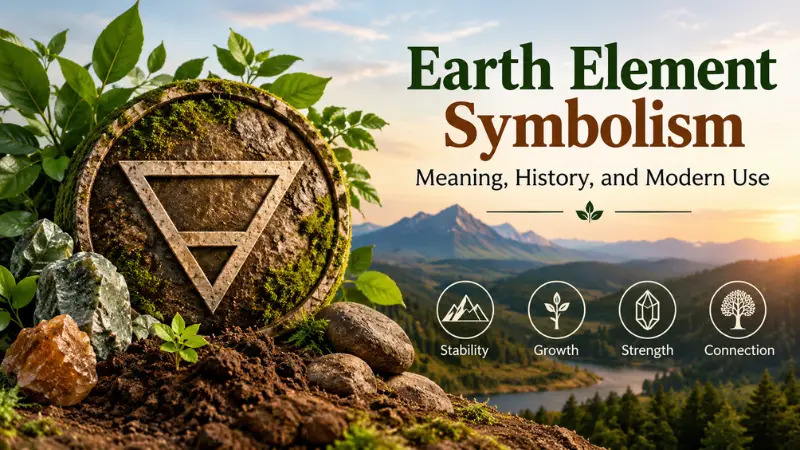
In classical Western elemental traditions, earth is sometimes represented by a downward-pointing triangle with a horizontal line across it. This geometric mark distinguishes earth from the other elements in certain alchemical and esoteric systems.
The imagery matters because each form communicates a slightly different idea. A mountain suggests endurance and permanence, while soil suggests fertility and the ability to support new life. Tree roots communicate connection and stability, and stones often suggest strength, age, and reliability.
In American homes, gardens, national parks, and outdoor spaces, these images are familiar even to people who have never studied elemental philosophy. Their meanings are often understood intuitively because they reflect experiences people have with the physical world.
2. The Core Meanings of Earth Symbolism
Earth has several closely related symbolic meanings, but they are not interchangeable. Understanding the differences makes it easier to interpret the element in art, spirituality, and everyday life.
- Stability: Earth provides a foundation. Symbolically, it represents dependable relationships, steady habits, and a secure place to stand.
- Practicality: Earth is associated with tangible results, physical work, and realistic decisions rather than abstract possibilities.
- Growth: Soil supports seeds, roots, and crops. This makes earth a natural symbol of development that requires time and care.
- Nourishment: Land provides food and materials, linking earth with abundance, sustenance, and the work required to maintain life.
- Belonging: A particular landscape can represent home, family history, cultural identity, or attachment to a place.
- Patience: Soil does not produce a harvest instantly. Earth therefore represents gradual progress and the value of consistent effort.
These meanings often overlap. A vegetable garden, for example, can represent nourishment, patience, responsibility, and personal independence at the same time.
Earth can also suggest limitations. Land has boundaries, natural resources are finite, and physical structures eventually deteriorate. In this sense, earth symbolizes not only what supports life but also the material conditions that shape it.
3. Ancient Roots of the Earth Element
One important historical source of earth symbolism comes from ancient Greek philosophy. The philosopher Empedocles, who lived during the fifth century BCE, described four fundamental elements: earth, water, air, and fire. He used these elements to explain how different forms of matter could combine and separate.
Plato later connected the element earth with the cube in his philosophical account of the physical universe. Aristotle developed a related system in which the elements were associated with qualities such as hot, cold, wet, and dry. Earth was understood as cold and dry within that framework.
These ideas influenced European philosophy, medicine, and natural thought for centuries. Earth came to represent material substance, heaviness, solidity, and the physical world.
Ancient Greek and Roman religious traditions also connected the earth with agricultural fertility. Figures such as Gaia, the Greek personification of Earth, and Demeter, associated with agriculture and the harvest, expressed different aspects of the relationship between land and life.
It is important to distinguish these historical beliefs from modern geology and chemistry. The classical elements were part of an older philosophical explanation of nature, not the modern periodic table or a scientific classification of matter.
4. Earth Symbolism in American Culture
In the United States, earth symbolism often has a practical and geographical character. It is connected to farmland, family homes, public lands, wilderness, and the idea that a landscape can help define a community.
American literature, painting, and photography frequently portray mountains, deserts, forests, and open fields as places of independence, renewal, or personal discovery. The landscape can represent freedom from crowded urban life, but it can also symbolize the effort required to survive and build a home.
Farms provide another important association. Soil is not simply scenery for agricultural communities; it is a resource that demands maintenance, knowledge, and long-term investment. Earth imagery can therefore suggest hard work, self-reliance, and responsibility for future generations.
The American relationship with land is also complicated by history. Indigenous nations have diverse relationships, teachings, and responsibilities concerning their ancestral territories. European settlement, land seizure, forced displacement, and changing land-use practices have shaped whose relationships with particular places are recognized or protected.
For this reason, earth symbolism in the United States should not be reduced to a single national interpretation. For one person, a landscape may represent recreation or property ownership. For another, it may carry memories of displacement, family heritage, stewardship, or a continuing cultural relationship with a homeland.
5. The Meaning of Earth in Spiritual Traditions
Earth appears in several religious and philosophical systems, but its role differs between them.
In some Hindu traditions, earth, or prithvi, is associated with solidity and the material basis of existence. It appears within a broader understanding of the elements that make up the experienced world. Particular meanings vary according to the philosophical school and religious context.
In Buddhist traditions, earth can be understood through the quality of solidity or hardness. In some teachings concerning the elements, earth describes the solid characteristics of physical experience rather than an independent spiritual force that controls a person’s fate.
Traditional Chinese thought includes earth as one of the five phases, alongside wood, fire, metal, and water. This system is different from the Greek four-element model. Earth can be associated with the center, nourishment, balance, and transitions between seasons, although interpretations vary by application.
In Western esoteric traditions, earth commonly represents the material world, physical foundations, and practical concerns. The downward-pointing triangle crossed by a horizontal line appears in some alchemical and related symbolic systems.
These traditions should not be treated as interchangeable. A symbol may look similar across different cultures while carrying a distinct philosophical or religious meaning.
6. Earth Symbolism in Nature, Gardening, and Conservati
Earth symbolism is particularly easy to understand through gardening. A seed planted in soil represents potential, but that potential depends on the right conditions and continued care. Growth becomes an image of progress that cannot always be rushed.
This association also helps explain why earth imagery fits environmental awareness. In the United States, the first Earth Day, held on April 22, 1970, helped make environmental protection a prominent public concern. The day drew attention to pollution, conservation, and the relationship between human activity and the natural world.
Earth Day imagery often features globes, leaves, seedlings, and landscapes. These images communicate the idea that the planet is a shared home requiring practical care.
However, earth symbolism should not be confused with environmental science itself. A picture of green leaves may communicate concern for nature, but protecting soil, restoring habitats, and reducing pollution require informed decisions and measurable action.
The symbolism is most useful when it encourages people to recognize their dependence on natural systems rather than treating the environment as an unlimited supply of resources.
7. What Earth Represents Emotionally and Psychologically
Earth is often used as a metaphor for emotional steadiness. When someone describes another person as grounded, they usually mean that the person is calm, realistic, dependable, or able to respond to difficulties without losing perspective.
This everyday expression draws on a simple physical comparison: something firmly planted in the ground is less likely to be displaced than something floating freely.
Earth imagery may also provide a sense of continuity. A familiar garden, a childhood home, or a mountain visited over many years can connect present experiences with earlier memories.
Natural environments can support relaxation and well-being for many people, but the symbolic association between earth and calm should not be treated as a guaranteed psychological effect. A rocky landscape might feel reassuring to one person and intimidating to another.
Earth can also carry less positive associations, including stubbornness, rigidity, possessiveness, or excessive attachment to material security. These meanings emerge when stability becomes resistance to change.
In personal reflection, earth can therefore raise a useful question: does a person’s need for security help them grow, or does it prevent them from adapting?
8. Earth Element Symbolism in Astrology
In Western astrology, earth is one of the four classical elements used to group zodiac signs. The earth signs are Taurus, Virgo, and Capricorn.
Taurus
Associated in astrological interpretation with steadiness, comfort, persistence, and appreciation for physical pleasures. Earth imagery here often emphasizes security and consistency.
Virgo
Commonly linked with organization, attention to detail, service, and practical problem-solving. Its earth association often emphasizes careful work and improvement.
Capricorn
Associated with discipline, responsibility, ambition, and long-term planning. The earth element reinforces themes of building something durable over time.
In astrology, the earth element is commonly contrasted with fire’s enthusiasm, air’s intellectual emphasis, and water’s emotional associations. These are interpretive frameworks rather than scientifically established personality categories.
For people who use astrology as a language for self-reflection, earth symbolism offers a way to describe practical priorities, preferred routines, and attitudes toward responsibility.
9. Common Earth Symbols and Their Meanings
Different natural forms communicate different messages. The context in which an image appears can change its interpretation.
| Earth symbolCommon symbolic meaning in the United StatesTypical context | ||
|---|---|---|
| Soil | Fertility, potential, hard work | Gardening, farming, growth imagery |
| Mountain | Endurance, challenge, achievement | Tattoos, outdoor brands, landscape art |
| Tree roots | Heritage, stability, belonging | Family art, jewelry, personal designs |
| Stone or rock | Reliability, strength, permanence | Memorials, architecture, jewelry |
| Green seedling | Renewal, hope, environmental care | Earth Day, gardens, sustainability campaigns |
| Clay | Craftsmanship, patience, creativity | Pottery, handmade objects, home decor |
These associations are common interpretations, not universal definitions. A stone in a memorial may represent remembrance, while the same stone used in a garden might simply convey natural texture and permanence.
10. Why Earth Appears in Tattoos and Personal Jewelry
Earth-inspired tattoos often communicate a relationship with nature, a preference for simplicity, or a personal commitment to staying grounded.
Mountains are popular visual choices for people who associate outdoor experiences with independence or overcoming challenges. Trees and roots may represent family connections, ancestry, or the importance of remembering one’s beginnings.
A minimalist earth-element symbol can express interest in astrology, alchemy, or elemental philosophy without depicting an entire landscape. Some people choose it because of its geometric simplicity; others connect it with a personal understanding of balance and physical reality.
Jewelry offers similar possibilities. Rings made from stone, pendants featuring mountains, and pieces incorporating natural textures can signal appreciation for the outdoors or handmade craftsmanship.
Before assigning meaning to someone else’s tattoo or jewelry, it is worth remembering that personal symbolism is individual. Two people may choose the same mountain design for entirely different reasons.
11. Earth Symbolism in Home Decor and Fashion
Earth-inspired design uses materials, textures, and colors that recall the natural landscape. Common choices include brown, ochre, muted green, sand, terracotta, stone, wood, and unpolished ceramics.
In American interiors, these choices often communicate comfort, simplicity, and a connection to the outdoors. Wood furniture may suggest durability, clay pottery may convey craftsmanship, and natural fabrics can create a relaxed atmosphere.
Earth tones also appear in outdoor clothing and lifestyle brands, where they can reinforce associations with hiking, camping, and practical use. Their appeal is not exclusively spiritual; many people simply enjoy the colors and materials.
An earth-inspired room does not need to contain literal symbols of the element. Natural textures, plants, stones, and muted colors can create the same general association.
The important distinction is between aesthetic preference and symbolic intention. A person might choose terracotta because it feels warm and welcoming, while another deliberately uses the color to represent the earth element.
12. Positive and Negative Interpretations of Earth
Earth is often treated as a positive symbol because it supports life and offers a foundation for growth. Yet its symbolism also includes the possibility of becoming too attached to what is familiar.
Positive associations
Stability, patience, reliability, nourishment, responsibility, perseverance, and belonging.
Challenging associations
Stubbornness, inflexibility, possessiveness, excessive materialism, and resistance to necessary change.
These contrasting meanings help explain why earth can represent both security and stagnation. A strong foundation makes it possible to build something new, but a refusal to change can turn stability into a limitation.
In a story, for instance, a character who remains loyal to their home may demonstrate courage and responsibility. If that loyalty prevents them from accepting necessary change, the same earth imagery may suggest rigidity.
Neither interpretation is inherent in the element. The surrounding story, image, or personal belief determines which meaning becomes most relevant.
13. Misunderstandings and Misuse of Earth Symbolism
Several common misunderstandings arise when different symbolic systems are blended together.
First, the classical element earth is not the same thing as the scientific Earth, the planet. The two ideas overlap in everyday language, but one belongs to a historical philosophical framework while the other refers to a physical planet studied through modern science.
Second, earth symbolism is not universal. A geometric symbol used in Western alchemy does not automatically carry the same meaning in Hindu philosophy, Buddhist teachings, or Chinese cosmology.
Third, popular wellness content sometimes presents grounding practices as if they guarantee emotional healing or alter invisible energies in scientifically established ways. Symbolic or spiritual value can be meaningful to individuals, but such claims should be distinguished from evidence-based health information.
There is also a cultural concern when Indigenous relationships with land are reduced to generic claims about being naturally spiritual or inherently connected to nature. Indigenous peoples are not a single cultural group, and their specific histories, beliefs, and land relationships deserve to be understood on their own terms.
A respectful interpretation acknowledges the origin of a symbol, avoids unsupported claims, and leaves room for people to explain what the image means to them personally.
14. How Earth Symbolism Has Changed Over Time
Earth symbolism has shifted as people’s explanations of nature and relationships with land have changed.
In ancient philosophy, earth was one of several proposed foundations of the physical world. In religious mythology, earth could be personified as a source of fertility or associated with agricultural cycles. In medieval and early modern European thought, the four-element system continued to influence natural philosophy and medicine.
With the development of modern science, the classical elements lost their role as a scientific explanation of matter. They remained culturally relevant, however, through art, literature, spiritual traditions, astrology, and symbolic systems.
In the United States, another shift came through conservation and environmental movements. During the nineteenth century, changing land use helped stimulate different approaches to protecting natural resources. By the late twentieth century, environmental activism had made the planet and its ecosystems increasingly prominent symbols of collective responsibility.
Today, earth imagery operates across several levels at once. It may refer to environmental protection, personal identity, spiritual practice, practical reliability, or the simple pleasure of spending time outdoors.
That variety is part of its continuing usefulness: earth can be interpreted through both concrete experience and abstract ideas without requiring every person to adopt the same belief system.
FAQs
1. What does the earth element symbolize spiritually?
Spiritually, earth commonly represents stability, physical existence, nourishment, and connection to the material world. The exact interpretation depends on the tradition, since Western elemental philosophy, Indian religious thought, and Chinese cosmology use different systems.
2. What does an earth element tattoo mean?
An earth element tattoo may represent reliability, patience, nature, personal growth, or a desire to remain grounded. A triangle-based design may specifically refer to Western alchemical symbolism, while a mountain or tree may carry a more personal meaning.
3. Is the earth element considered masculine or feminine?
There is no universal answer. Some Western esoteric traditions classify earth as feminine, often associating it with receptivity and material nourishment, but this is a culturally specific symbolic convention rather than a statement about actual gender.
4. What colors are associated with the earth element?
Brown, green, terracotta, ochre, and muted beige are commonly associated with earth. In some symbolic systems, other colors are used; for example, Chinese five-phase traditions connect earth with yellow.
5. What does earth represent in astrology?
In Western astrology, earth is associated with Taurus, Virgo, and Capricorn. These signs are traditionally linked with practicality, persistence, material concerns, and long-term goals, although astrology is not a scientifically validated method of determining personality.
6. Is earth symbolism always positive?
No. Earth can represent dependability and growth, but it can also suggest stubbornness, rigidity, or excessive attachment to material security. The interpretation depends on whether the context emphasizes a stable foundation or an unwillingness to change.
7. What is the difference between the earth element and the planet Earth?
The earth element belongs to historical philosophical, spiritual, and symbolic systems that classify aspects of nature. The planet Earth is the physical world studied by modern science, although images of the planet are also widely used to symbolize humanity’s shared home and environmental responsibility.
Conclusion
Earth symbolizes the foundations that make life possible: stability, nourishment, patience, growth, and belonging. Its meaning comes partly from direct experience with soil, stone, plants, and landscapes, and partly from the philosophical, religious, and cultural traditions that have interpreted these materials over time.
In modern American culture, earth imagery can communicate environmental responsibility, a love of nature, a connection to home, or a preference for practical living. Earth element symbolism remains useful because it connects abstract ideas with things people can see, touch, cultivate, and build.
Ultimately, earth offers a straightforward reminder that lasting growth depends on foundations, care, and the willingness to adapt when conditions change.