
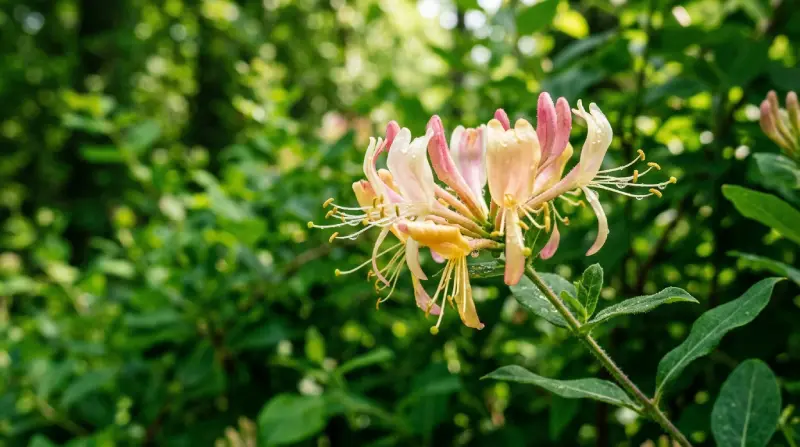
Honeysuckle is a flowering vine known for its sweet fragrance, delicate blossoms, and ability to climb along fences, trellises, and garden walls. Honeysuckle symbolism commonly centers on love, affection, devotion, happiness, and the lasting bonds between people. Its fragrant flowers and climbing growth have made it a familiar symbol in gardens, floral arrangements, literature, and personal gifts.
For many Americans, honeysuckle brings back memories of summer evenings, childhood gardens, and warm-weather walks. In other contexts, it represents romantic attachment, loyalty, or the wish to preserve a meaningful relationship. These associations are not universal rules; they develop through flower symbolism, personal memories, cultural traditions, and the plant’s physical characteristics.
Understanding honeysuckle’s symbolism also means looking beyond its pleasant scent. Some varieties spread aggressively, and their growth can suggest persistence or attachment that becomes difficult to manage. Both the attractive qualities and the challenges of the plant help explain why its meanings can range from enduring love to excessive attachment.
Quick Answer
Honeysuckle most commonly symbolizes love, affection, devotion, happiness, and lasting connection in modern American floral symbolism. Historically associated with affection and fidelity in some European flower traditions, it is also used today to express romance, nostalgia, and the desire to maintain close relationships.
TL;DR
- Love and affection: Expresses romantic feelings and emotional closeness.
- Devotion and fidelity: Represents commitment and lasting relationships.
- Happiness and sweetness: Reflects pleasure, warmth, and the joys of everyday life.
- Nostalgia and memory: Evokes childhood summers, familiar gardens, and cherished experiences.
- Persistence and attachment: Its climbing growth suggests determination and strong bonds.
- Modern use: Appears in gardens, floral gifts, tattoos, artwork, and personal keepsakes.
1. Love and Romantic Affection
Love is one of the most familiar meanings associated with honeysuckle. Its sweet fragrance and delicate flowers make it a natural choice for expressing tenderness, attraction, and the pleasure of being close to someone.
In American flower symbolism, honeysuckle can communicate affection without the formality often associated with red roses. It suits relationships built around shared experiences, everyday kindness, and a sense of emotional comfort.
The plant’s growth also contributes to this interpretation. Honeysuckle vines wind around supports and nearby structures, creating a visual image of two lives becoming intertwined. This is a symbolic interpretation of its physical form rather than evidence that the plant has one fixed romantic meaning.
Honeysuckle can therefore make a thoughtful gift for a partner, spouse, or someone whose presence makes ordinary moments feel special. Its message is often less about dramatic passion and more about affection that develops through time and familiarity.
2. Devotion, Loyalty, and Fidelity
Honeysuckle is also associated with devotion and fidelity in some European flower-language traditions. These meanings fit the idea of a relationship that continues through changing circumstances rather than depending only on temporary excitement.
Its climbing habit offers a useful visual comparison. A vine grows by attaching itself to available supports, suggesting the stability people seek in a trusted partnership. The image can represent mutual support, although healthy devotion involves respect and independence as well as closeness.
In modern American life, this interpretation can suit anniversary arrangements, wedding gardens, or gifts marking an important relationship milestone. Honeysuckle may communicate the intention to keep showing up for another person, even when life becomes complicated.
However, the meaning should not be treated as a universal floral code. Different flower guides and cultural traditions assign different associations to plants, and personal circumstances often matter more than any traditional definition.
3. Happiness, Sweetness, and Simple Pleasures
Honeysuckle can symbolize happiness because its fragrance and flowers are closely connected with the pleasant sensory experiences of warm weather. In many parts of the United States, blooming honeysuckle is a recognizable feature of late spring and summer.
The scent may bring a sense of ease or remind someone of sitting outdoors on a quiet evening. These experiences help explain the plant’s association with sweetness, contentment, and uncomplicated pleasure.
This meaning is especially appropriate when honeysuckle appears in a garden, a painting, or a gift intended to celebrate a happy occasion. Rather than representing achievement or status, it can stand for enjoying what is already present.
The sweetness associated with honeysuckle also has a metaphorical dimension. Just as the flowers have a pleasant scent, the plant can represent a kind person, a loving home, or a relationship that adds warmth to daily life.
4. Nostalgia, Childhood, and Cherished Memories
For some Americans, honeysuckle is strongly connected with nostalgia. Its seasonal fragrance can bring back memories of childhood neighborhoods, country roads, grandparents’ gardens, or evenings spent playing outside.
Smell is particularly effective at triggering autobiographical memories because the brain’s olfactory pathways connect closely with regions involved in emotion and memory. This helps explain why a familiar flower can bring back a specific person or place more vividly than a photograph might.
Honeysuckle does not automatically symbolize childhood for everyone. Someone who grew up in a different climate or environment may have no personal connection to the plant. Its nostalgic meaning emerges when its scent or appearance becomes associated with an experience.
In writing, art, and personal gifts, honeysuckle can represent a desire to remember where someone came from. It may also serve as a reminder that meaningful experiences can remain emotionally important long after the original moment has passed.
5. Persistence, Growth, and Determination
Honeysuckle vines grow along fences, trellises, shrubs, and other supports. Depending on the species, they may climb, trail, or spread through an area. This visible persistence makes the plant a useful symbol of determination and continued growth.
In a positive interpretation, honeysuckle represents the willingness to keep moving toward a goal. It can suggest adapting to circumstances, finding support, and making progress even when the path is not straightforward.
The same quality has a less favorable side. Some nonnative honeysuckle species, including Japanese honeysuckle, can spread aggressively in parts of the United States and outcompete native vegetation. In this context, vigorous growth may suggest excess, intrusion, or a refusal to respect boundaries.
These contrasting interpretations offer a more balanced understanding of the plant. Persistence can be valuable when it supports a worthwhile goal, but it can become harmful when it prevents change or crowds out other needs.
6. Hope, Renewal, and Seasonal Change
Honeysuckle’s flowering season can connect it with hope and renewal. New blossoms signal a changing landscape, while the return of familiar fragrance can mark the transition from spring into warmer weather.
For people who associate the plant with a particular place or relationship, its seasonal return may symbolize continuity after a difficult period. A garden that blooms again can become a personal reminder that change does not always mean loss.
This interpretation is a modern symbolic reading rather than a universal historical belief. Honeysuckle’s flowering times vary by species and region, and not every variety follows the same seasonal pattern.
In a home garden, honeysuckle can represent the decision to begin again, nurture a relationship, or make room for something positive. Its meaning is strongest when the plant is connected to a real experience of recovery or growth.
7. Protection, Comfort, and a Sense of Home
Honeysuckle sometimes acquires protective meaning through its association with familiar gardens, sheltered outdoor spaces, and memories of home. A vine growing around a porch or along a garden fence can become part of the setting in which a person feels safe and welcomed.
This association should be distinguished from a documented, universal protective tradition. There is no single established American belief that honeysuckle guarantees safety or wards off harm. Rather, its protective meaning often develops through family customs, folklore, and personal experience.
The plant’s intertwined growth can also suggest a network of relationships that supports a person during difficult times. In this sense, protection means emotional security, not supernatural defense.
Honeysuckle may therefore be meaningful in a housewarming gift, a garden dedicated to a loved one, or artwork representing a stable home. Its symbolism reflects the comfort people attach to familiar places and the people who make them feel welcome.
8. Honeysuckle Symbolism in American Culture
In the United States, honeysuckle’s meaning often comes from everyday experiences rather than formal religious or ceremonial rules. People encounter it along country roads, in residential gardens, around old fences, and in landscapes where its fragrance becomes associated with a particular season.
This familiarity gives honeysuckle a distinctly personal quality. A person might connect it with a childhood home, a grandparent who maintained a garden, or a place where an important relationship began. Someone else might simply associate the flowers with summer and the comfort of being outdoors.
Honeysuckle also fits the American appreciation for gardens that feel welcoming rather than overly formal. When trained over a trellis or planted near a seating area, it can suggest hospitality, warmth, and a relaxed home environment.
There is an important environmental distinction, however. Not every honeysuckle species is appropriate for every American landscape. Japanese honeysuckle, introduced from eastern Asia in the nineteenth century, is invasive in many parts of the country. Native alternatives, such as trumpet honeysuckle, can provide a more suitable choice in appropriate regions.
The plant’s cultural meaning therefore has two sides: it can represent a cherished connection to home, while responsible gardening requires attention to the species being planted.
9. Historical Origins: The Victorian Language of Flowers
Honeysuckle’s best-documented Western symbolic associations are connected with the language of flowers, also known as floriography. This tradition became especially fashionable in nineteenth-century Europe and North America, when flowers were arranged to communicate feelings that might be difficult to express directly.
Flower dictionaries assigned particular sentiments to individual plants. Bouquets could be selected to express affection, admiration, disappointment, or commitment. The meanings were not always identical between books, which means a flower’s historical symbolism should be understood as a tradition with variations rather than a universal code.
Honeysuckle became associated with devoted affection and the bonds of love. Its twining growth provided an obvious comparison with people whose lives become closely connected, while its fragrance contributed to its romantic appeal.
These meanings were particularly suitable for courtship and personal correspondence. A bouquet containing honeysuckle could suggest attachment that continued beyond a passing attraction.
The tradition also influenced how later generations interpreted flowers. Although most Americans no longer use an elaborate flower dictionary when selecting a bouquet, familiar associations between particular blooms and emotions remain part of modern floral culture.
Honeysuckle’s association with devotion is one example of how a nineteenth-century convention continues to shape the way people interpret a garden plant today.
10. Honeysuckle in Other Cultural Traditions
Honeysuckle belongs to the genus Lonicera, which includes many species native to different parts of the Northern Hemisphere. Because these plants have different histories and uses, their cultural associations should not be treated as interchangeable.
In Chinese botanical and cultural traditions, Japanese honeysuckle is known as jin yin hua, commonly translated as golden-silver flower. The name reflects the way its blossoms change from white to yellow as they age. The plant also has a long history in traditional Chinese medicine, where it is valued for uses distinct from its romantic symbolism in Western flower language.
This medicinal history should not be confused with a guarantee of health benefits or taken as advice to consume the plant. Species identification, preparation, and safety matter, and not all honeysuckle varieties are suitable for the same uses.
In European flower traditions, honeysuckle is particularly associated with affection and fidelity. Folklore and literary references have also connected climbing plants with desire, entanglement, and the relationships between people.
However, there is no single meaning shared by every European, Asian, or Indigenous tradition. Specific interpretations depend on the community, historical period, species, and context. It would be misleading to claim that all cultures view honeysuckle as a protective plant or assign it the same spiritual qualities.
For modern readers, the most useful approach is to appreciate these distinct histories without blending them into one supposedly universal meaning.
11. Honeysuckle in Dreams and Spiritual Interpretations
Some people interpret flowers in dreams as reflections of their emotions, relationships, or current life circumstances. Honeysuckle may be meaningful to someone who associates its fragrance with love, family, or a place from the past.
There is no scientifically established dream dictionary that proves honeysuckle predicts a particular event. Its interpretation is best approached through personal associations and the details of the dream.
Here are several possible interpretations:
- Blooming honeysuckle: May represent affection, happiness, or a relationship receiving attention.
- A fragrant honeysuckle vine: May bring attention to pleasant memories or emotional closeness.
- A vine growing around a fence: May suggest connection, persistence, or a question about personal boundaries.
- A withered honeysuckle plant: May reflect concern about a relationship, a changing phase of life, or the loss of something familiar.
- Planting honeysuckle: May represent an intention to nurture a relationship, create a welcoming home, or establish new roots.
The emotions felt during the dream matter more than any single interpretation. A flowering vine that brings comfort may carry a different meaning from one that feels overwhelming or impossible to remove.
Spiritual interpretations follow a similar principle. Some individuals view honeysuckle as a reminder to practice love, appreciate ordinary blessings, or remain connected to people who matter. These are personal or cultural interpretations, not universal spiritual facts.
12. Honeysuckle Color Symbolism
Honeysuckle flowers commonly appear in shades of white, cream, yellow, pink, orange, and red, depending on the species and variety. These colors can influence how people interpret the plant in floral arrangements and artwork.
Color meanings are flexible. They reflect broader cultural associations rather than a fixed historical code for every honeysuckle variety.
| Honeysuckle color | Possible symbolic meaning | Common context |
|---|---|---|
| White or cream | Sincerity, gentleness, and tenderness | Romantic gifts and peaceful garden designs |
| Yellow | Happiness, warmth, and optimism | Summer arrangements and cheerful artwork |
| Pink | Affection, sweetness, and appreciation | Personal gifts and expressions of care |
| Orange | Enthusiasm, vitality, and warmth | Decorative designs and energetic compositions |
| Red | Passion, desire, and strong affection | Romantic artwork and expressive floral arrangements |
A white honeysuckle flower does not automatically mean purity, nor does a red one necessarily communicate romantic passion. The intended meaning depends on the person choosing the flower, the recipient, and the setting.
For example, a gardener might choose yellow honeysuckle simply because it complements nearby flowers. Someone creating a memorial illustration might prefer white blossoms because they fit the desired atmosphere. In both cases, color contributes to the message without determining it entirely.
13. Why Honeysuckle Appears in Tattoos, Jewelry, and Art
Honeysuckle works well as a personal symbol because its winding stems and recognizable flowers offer several design possibilities. Unlike a single isolated bloom, a honeysuckle vine can be extended along an arm, shoulder, ankle, or other area of the body.
In tattoo culture, a honeysuckle design may represent:
- Lasting love: A relationship that remains important over time.
- Family connection: The bonds between relatives or generations.
- Personal growth: The determination to continue developing through life’s changes.
- Nostalgia: A place, person, or experience the wearer wants to remember.
- A meaningful home: A connection to a family garden or childhood setting.
These interpretations are personal choices rather than standardized tattoo meanings. Two people with similar designs may have entirely different reasons for choosing the flower.
Honeysuckle can also appear in jewelry, embroidered clothing, decorative prints, greeting cards, and home accessories. A small floral pendant might serve as a private reminder of a loved one, while a larger botanical illustration can evoke a traditional cottage garden.
For social media and digital art, the flower may be used to create a soft, romantic, or nostalgic atmosphere. Its symbolism is often communicated through the combination of the vine, colors, accompanying objects, and the caption or story attached to the image.
14. Misunderstandings and the Difficult Side of Honeysuckle Symbolism
Honeysuckle is often presented as an entirely positive symbol, but its meanings become more interesting when its less favorable associations are considered.
The most common misunderstanding is that the flower has one official meaning across all cultures and periods. In reality, floral symbolism varies between dictionaries, traditions, and individual experiences. Devotion is a well-established Western association, but happiness, protection, and renewal may be personal interpretations rather than equally documented historical meanings.
Another mistake is assuming that the plant’s climbing habit always represents healthy love. A vine can suggest closeness and support, but it can also provide a metaphor for attachment that becomes restrictive. A relationship is not necessarily healthy simply because two people remain connected.
The ecological behavior of some honeysuckle species offers a separate, practical perspective. Japanese honeysuckle can form dense growth and displace native plants in parts of the United States. This does not cancel out its historical romantic symbolism, but it demonstrates why the plant should not automatically be treated as a positive model of growth.
Finally, honeysuckle’s presence in a dream, garden, or piece of jewelry does not establish a supernatural message. People can use the plant meaningfully without believing that it predicts the future or changes their circumstances through hidden forces.
Recognizing these distinctions makes honeysuckle symbolism more useful. It allows the flower to represent affection and commitment while leaving room for personal experience, cultural differences, and practical reality.
Frequently Asked Questions
1. What is the main meaning of honeysuckle?
Honeysuckle most commonly represents devoted affection, love, and the bonds between people in Western flower symbolism. Its sweet fragrance and climbing growth also make it a natural symbol of happiness, attachment, and cherished memories.
2. Does honeysuckle symbolize true love?
Honeysuckle can symbolize enduring love and commitment, especially in the tradition of Victorian floriography. However, it is a symbolic expression of affection, not proof that a relationship is destined to last.
3. What does honeysuckle mean spiritually?
In personal spiritual interpretations, honeysuckle may represent gratitude, emotional connection, affection, or the importance of nurturing relationships. These interpretations vary by individual and culture, and there is no universal spiritual meaning that everyone must accept.
4. Is honeysuckle a symbol of good luck or protection?
Some folklore traditions associate honeysuckle with household protection or good fortune, but these beliefs are not universal. In modern use, people may give the plant a protective meaning because it reminds them of home, family, and emotional security.
5. What does a honeysuckle tattoo symbolize?
A honeysuckle tattoo can represent lasting affection, family bonds, personal growth, or memories of a meaningful place. The design’s significance depends on the wearer’s experiences and may be made more personal through names, dates, or other botanical elements.
6. What does honeysuckle symbolize in a dream?
A dream featuring honeysuckle may reflect love, nostalgia, or the state of a personal relationship, depending on the dreamer’s associations. Blooming flowers may suggest happiness, while a tangled or struggling vine could prompt reflection on attachment or boundaries.
7. Is honeysuckle symbolism always positive?
No. Honeysuckle often represents affection and devotion, but its persistent growth can also serve as a metaphor for excessive attachment or difficulty letting go. Its ecological behavior provides another reminder that something attractive can have unintended consequences in the wrong setting.
Conclusion
Honeysuckle symbolism centers on love, devoted affection, happiness, and lasting connection. Its association with the bonds of love developed through Western flower traditions, while its fragrance, seasonal blooms, and climbing growth continue to inspire personal interpretations in American gardens, gifts, artwork, and tattoos.
The flower can also represent nostalgia, hope, persistence, or the comfort of home. Its meaning depends on the cultural tradition and personal experience surrounding it, rather than a single rule that applies to everyone.
Ultimately, honeysuckle offers a useful reminder that relationships grow through attention and care. Like the vine itself, affection can create lasting connections, but the healthiest bonds leave room for balance, independence, and growth.


