
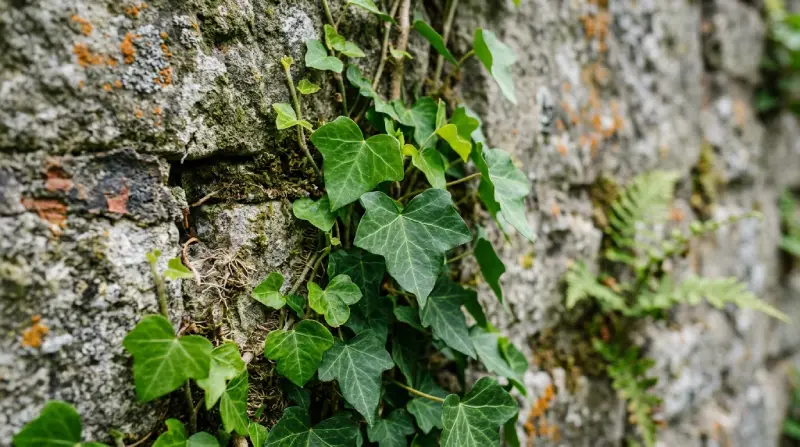
Ivy is an evergreen climbing plant known for its winding stems, distinctive leaves, and ability to grow across walls, fences, and trees. Ivy symbolism commonly centers on loyalty, enduring love, resilience, fidelity, and lasting connection. Because ivy stays green through much of the year and clings to the surfaces it climbs, it has become a familiar image of devotion, persistence, and relationships that withstand change.
In the United States, ivy appears in college traditions, garden design, wedding decorations, literature, and personal artwork. Its associations can be positive, suggesting commitment and determination, or more complicated, representing attachment that becomes difficult to escape. The meaning often depends on where the plant appears and what it represents to the people who encounter it.
Ivy also has a long cultural history. Ancient Mediterranean traditions connected it with Dionysus, a Greek god associated with wine, celebration, and altered states, while later European flower symbolism linked the plant with fidelity and affection. These historical associations help explain why ivy remains a meaningful botanical symbol today.
Quick Answer: What Does Ivy Symbolize?
Ivy most commonly symbolizes loyalty, enduring love, fidelity, resilience, and lasting connection in modern Western culture. Historically, it has been associated with Dionysus in ancient Greek traditions and with devotion and persistence in European symbolism, while its evergreen growth continues to suggest endurance and continuity.
TL;DR: Ivy Symbolism at a Glance
- Loyalty and fidelity: Represents relationships built on trust and commitment.
- Eternal love: Its evergreen leaves suggest affection that endures.
- Resilience: Symbolizes persistence through changing seasons and difficult conditions.
- Protection and security: Its dense growth can suggest shelter and enclosure.
- Attachment and dependence: Clinging vines can represent bonds that become restrictive.
- Modern use: Appears in college traditions, tattoos, weddings, gardens, and decorative art.
1. Loyalty and Fidelity
Loyalty is one of ivy’s most established symbolic meanings. The plant’s climbing stems attach themselves to walls, trunks, and other supports, creating a visual image of a connection that remains in place over time.
In Western flower symbolism, ivy has often represented fidelity and enduring affection. Its evergreen leaves reinforce this interpretation because they remain on the plant through much of the year rather than disappearing completely during winter.
This makes ivy a fitting symbol for relationships that depend on trust, patience, and consistent care. A small ivy motif in a card or piece of jewelry can communicate a commitment that is not based only on temporary excitement.
In modern American culture, this meaning may suit an anniversary gift, a wedding design, or artwork commemorating a long friendship. The plant can express the idea that loyalty is demonstrated through continued support, especially when circumstances change.
However, loyalty does not mean accepting every behavior or remaining in an unhealthy relationship. A balanced interpretation of ivy emphasizes mutual commitment rather than unquestioning attachment.
2. Eternal Love and Lasting Relationships
Ivy’s evergreen foliage makes it a natural symbol of love that continues through different seasons of life. While some plants lose their leaves during colder months, many ivy species retain their greenery, creating a visual association with continuity and endurance.
This quality has helped ivy appear in European decorative traditions, romantic imagery, and interpretations of faithful attachment. Its winding growth can also suggest two lives becoming intertwined.
In modern weddings, ivy may be used in bouquets, table arrangements, floral arches, and decorative garlands. These designs can express the hope that a relationship will continue to develop long after the wedding day.
Ivy can also symbolize a love that survives distance, illness, grief, or other changes. In such cases, the plant represents the persistence of affection rather than a promise that relationships will remain unchanged.
The important distinction is that evergreen growth provides the visual inspiration for the symbolism. It does not guarantee that a relationship will last forever, and different people may interpret the plant in different ways.
3. Resilience and Perseverance
Ivy is known for growing across surfaces and adapting to a range of conditions, depending on the species and environment. This persistence makes it a useful symbol of resilience and perseverance.
A vine spreading across an old stone wall can suggest the ability to continue growing despite obstacles. In personal symbolism, ivy may represent someone who has recovered from a setback, adjusted to a difficult situation, or continued working toward a long-term goal.
Its evergreen appearance adds another layer to the interpretation. Ivy can serve as a reminder that progress does not always need to be dramatic or immediately visible. Sometimes endurance consists of continuing through ordinary days and making gradual improvements.
For Americans, this meaning can fit graduation gifts, personal artwork, or tattoos marking a period of recovery or growth. Ivy may also appeal to people who value patience over quick success.
Still, persistence is not always beneficial. A plant that continues growing without control can damage structures or compete with other vegetation. Symbolically, ivy encourages determination while also raising a useful question: when should perseverance continue, and when is it time to change direction?
4. Growth, Knowledge, and Learning
Ivy has a distinctive place in American education because of its association with colleges and universities. The term Ivy League refers to an athletic conference of eight private universities in the northeastern United States, but the ivy plant has also become a broader visual emblem of academic tradition.
The connection between ivy and learning is reinforced by its presence on older campus buildings, where vines may grow along brickwork and stone walls. In popular imagery, ivy-covered architecture can suggest established institutions, intellectual ambition, and generations of students who have passed through the same halls.
Ivy is not an official symbol of education everywhere, nor does every school use it. Its educational meaning comes largely from historical associations, architectural imagery, and the cultural prominence of the Ivy League.
In modern design, ivy can represent a respect for learning, a connection to a school, or pride in an academic achievement. It may appear in graduation illustrations, university-inspired decorations, and artwork celebrating lifelong education.
The plant also suggests that knowledge develops gradually. Like a vine extending along a support, learning grows through continued effort, exposure to new ideas, and the accumulation of experience.
5. Protection, Shelter, and Security
Ivy’s dense foliage can cover walls, fences, and other surfaces, giving the plant a visual connection with shelter and enclosure. In symbolic interpretations, this can represent the desire for a safe home, emotional security, or a supportive environment.
The association is particularly easy to understand in older gardens and buildings where ivy creates a green covering over stone or brick. Such settings may look sheltered from the outside world, encouraging associations with privacy, stability, and familiarity.
However, the idea that ivy protects a person from harm is a symbolic or folkloric interpretation, not an established fact. Ivy does not automatically provide supernatural protection, and growing it on buildings can sometimes cause maintenance problems.
In personal artwork, ivy surrounding a doorway might represent a welcoming home or a protected family space. In a memorial design, it might symbolize the lasting bonds that help people feel connected to someone they have lost.
This meaning is strongest when ivy represents emotional security rather than the idea of shutting out every outside influence. A supportive environment offers protection while still allowing people room to grow.
6. Attachment, Dependence, and Boundaries
Ivy’s climbing habit has a less favorable symbolic side. Because the plant attaches itself to supporting surfaces, it can serve as a metaphor for emotional attachment, dependence, or difficulty separating from something familiar.
In a positive interpretation, attachment means staying close to people who provide support. In a negative interpretation, it can mean holding on to a relationship, habit, or identity even when it has become harmful.
The plant’s real growth behavior makes this contrast especially useful. Some ivy species can spread extensively, and unmanaged growth may cover structures or compete with other plants. This provides a practical comparison for relationships that begin with affection but gradually leave too little room for independence.
For example, ivy surrounding a tree might symbolize a close partnership in a piece of artwork. The same image could suggest an unhealthy relationship if the vine appears to overwhelm its support.
Neither interpretation is automatically correct. Context determines whether ivy communicates dependable closeness or restrictive attachment.
This dual meaning makes ivy more interesting than a symbol of loyalty alone. It reminds us that healthy commitment involves boundaries, respect, and the freedom for each person to develop independently.
7. Ivy in Ancient Greek and Roman Traditions
Ivy has a documented place in ancient Mediterranean religious and cultural imagery. In ancient Greece, it was associated with Dionysus, the god connected with wine, festivity, theater, and ecstatic religious experience. Ivy wreaths appear in artistic representations of Dionysus and figures associated with his worship.
The plant’s evergreen leaves made it suitable for wreaths and other forms of decoration. Its association with Dionysus also placed it within celebrations involving wine and communal festivities.
Ancient Roman culture inherited and adapted many Greek religious traditions. The Roman god Bacchus, closely identified with Dionysus, was likewise represented in connection with wine, celebration, and ivy imagery.
These associations differ from the modern emphasis on loyalty and enduring romantic love. They show that the plant’s symbolism developed in different directions depending on its cultural setting.
It would be misleading to assume that every ancient use of ivy represented fidelity or that every modern interpretation descends directly from Greek religion. Some meanings developed through later European flower symbolism, while others emerged from the plant’s physical appearance and practical uses.
The ancient connection remains important because it demonstrates that ivy has served as more than a decorative plant. It has also functioned as a recognizable attribute in religious art, ritual imagery, and cultural storytelling.
8. Ivy Symbolism in the United States
In the United States, ivy has several overlapping meanings, from academic achievement to romantic devotion and the atmosphere of established homes and institutions.
The best-known example is the Ivy League. Harvard, Yale, Princeton, Columbia, the University of Pennsylvania, Brown, Dartmouth, and Cornell belong to this athletic conference. In everyday American language, Ivy League can also evoke academic prestige, selective admissions, and long-standing educational traditions, although the term does not describe every excellent university.
Ivy-covered buildings have also become familiar features of American visual culture. On college campuses and in older residential neighborhoods, the plant can give brick and stone architecture an appearance of age and continuity.
In gardens, ivy is often associated with traditional landscaping, shaded walls, and established outdoor spaces. In weddings and floral arrangements, it may represent commitment or enduring affection.
These meanings are related, but they are not identical. Ivy on a university building usually communicates something different from ivy woven into a wedding arrangement.
| Context | Common American interpretation | Why it fits |
|---|---|---|
| Colleges and universities | Learning, tradition, academic prestige | Association with the Ivy League and historic campuses |
| Weddings and anniversaries | Fidelity, love, commitment | Evergreen foliage and climbing growth |
| Gardens and architecture | Continuity, age, established roots | Its ability to cover walls and other structures |
| Tattoos and jewelry | Loyalty, resilience, personal attachment | A flexible design with individual meaning |
| Memorials and keepsakes | Enduring bonds and remembrance | Evergreen leaves can suggest continuity after loss |
Ivy’s American symbolism is therefore shaped by both its botanical characteristics and the institutions, relationships, and places in which people encounter it.
9. Ivy in Weddings, Funerals, and Memorials
Ivy can be used in ceremonies because its greenery is visually versatile and its symbolism lends itself to relationships, continuity, and remembrance.
Weddings and anniversaries
At weddings, ivy may appear in floral arches, table decorations, bouquets, or garlands. Its evergreen foliage can suggest a lasting commitment, while its winding stems create a natural sense of connection.
For an anniversary, ivy may serve as a reminder of a relationship that has developed through many changes. These meanings are especially appropriate when the couple has a personal connection to the plant or prefers botanical designs over more traditional flowers.
Funerals and memorials
Ivy can also appear in memorial gardens, wreaths, cemetery plantings, and commemorative artwork. Its continued greenery may represent enduring love and the memories that remain after a death.
This does not mean ivy is a universal funeral flower. Customs differ by family, religion, and region, and many people choose flowers with more direct associations with mourning.
A memorial design featuring ivy may be especially meaningful when the person being remembered loved gardening, nature, or a particular place covered in vines.
Family traditions
For some families, ivy becomes symbolic through repeated use rather than a formal tradition. A vine planted near a home, for example, may gradually become associated with several generations of family memories.
In these situations, the plant’s meaning is personal. The history of the family gives it significance beyond the symbolism found in flower dictionaries.
10. Ivy in Dreams and Spiritual Interpretations
Dreams involving ivy can be interpreted through the dreamer’s own emotions and associations. Because ivy is known for climbing, attaching, and spreading, it can offer several possible images for thinking about relationships, responsibilities, and personal growth.
There is no scientific evidence that a particular ivy dream predicts the future or carries one universal message. The setting and the feelings experienced in the dream are more useful starting points than a fixed interpretation.
- Healthy green ivy: May represent continuity, support, or a relationship that feels secure.
- Ivy climbing a wall: May suggest persistence, ambition, or gradual progress toward a goal.
- Ivy covering a doorway: May prompt reflection on boundaries, access, or feeling restricted.
- Dead or damaged ivy: May reflect concern about a relationship, a changing identity, or the end of a familiar phase.
- Removing ivy: May represent a wish to establish independence or make room for change.
Spiritual interpretations vary in the same way. Some people view ivy as a reminder to remain faithful to their values, care for their relationships, or continue through difficult periods. Others may associate it with releasing attachments that no longer serve them.
These interpretations are personal or cultural rather than universal spiritual facts. A dream about ivy is not evidence that a supernatural force is directing someone’s decisions.
11. Ivy Color Symbolism
Most familiar ivy varieties have green leaves, but cultivated varieties may feature yellow, cream, white, or variegated patterns. In artwork and decorative settings, the colors used to depict ivy can influence the mood of the design.
Green ivy is the most recognizable form and is commonly associated with growth, continuity, and vitality. Other colors can draw on broader color symbolism, although they do not have established, universal meanings specific to ivy.
| Ivy color | Possible symbolic association | Common use |
|---|---|---|
| Deep green | Loyalty, stability, continuity | Traditional gardens and classic decorative designs |
| Light green | Fresh starts, renewal, growth | Spring arrangements and nature-inspired artwork |
| Yellow-green | Change, vitality, energy | Modern botanical illustrations |
| Cream or white variegation | Simplicity, balance, refinement | Minimalist decor and elegant floral designs |
These associations are interpretive, not fixed rules. A gardener may choose a variegated ivy simply for its appearance, while an artist may use dark green leaves to create a mood of age and permanence.
The meaning becomes more specific when color is combined with context. Green ivy on an old university building might emphasize tradition, whereas the same plant in a contemporary illustration could represent personal resilience.
12. Ivy in Tattoos, Jewelry, and Modern Art
Ivy is a popular subject for botanical artwork because its stems can curve around other elements and its leaves remain recognizable even in relatively simple designs.
In tattoos, ivy may symbolize loyalty to a partner, commitment to family, or the ability to endure difficult circumstances. A vine winding around a date, name, or meaningful object can make the design more personal.
Common design ideas include:
- Ivy around a heart: Romantic affection and lasting attachment.
- Ivy with a tree: Stability, support, and connection with nature.
- Ivy winding around a name: Loyalty or remembrance of a loved one.
- Ivy with a book: Education, intellectual curiosity, or academic achievement.
- A small ivy sprig: Personal growth, continuity, or a quiet connection to nature.
These meanings are not standardized. The same design may represent a relationship for one person and a period of personal recovery for another.
Ivy also appears in necklaces, engraved pendants, clothing patterns, stationery, and home decor. In digital art and social media, it can create an atmosphere of age, romance, nature, or academic tradition.
For some people, ivy represents permanence. For others, it represents the ability to adapt and keep growing. The flexibility of its form allows the plant to communicate either idea without requiring an elaborate design.
13. The Ecological Side of Ivy: When Growth Becomes a Problem
Ivy’s symbolism becomes more complex when its real-world behavior is considered. Some species are useful ornamental plants, while others can spread aggressively and cause ecological or maintenance problems.
English ivy (Hedera helix), which originated in Europe and parts of western Asia, is widely cultivated in the United States. In some regions, it has escaped gardens and formed dense ground cover that competes with native vegetation. When it climbs trees, heavy growth can add weight and reduce the amount of light reaching leaves and branches.
Not every ivy species behaves the same way, and its effects depend on climate, growing conditions, and management. Nevertheless, gardeners should check whether a variety is suitable for their area before planting it.
This ecological reality provides a useful contrast with ivy’s positive symbolism. Its persistence can represent determination, but uncontrolled persistence can become invasive. Its attachment can suggest loyalty, but attachment without boundaries can become harmful.
The distinction matters because symbolic meaning and practical impact are separate questions. A plant can remain beautiful in artwork or meaningful in a family tradition while still requiring careful management in a garden.
For American gardeners, native alternatives and regionally appropriate plants may offer similar visual benefits with fewer ecological risks.
14. How Ivy’s Symbolism Has Changed Over Time
Ivy’s symbolic history is not a single continuous tradition. Different communities have interpreted the plant according to its physical qualities, religious associations, and role in daily life.
In ancient Greek and Roman imagery, ivy was connected with Dionysus and Bacchus, particularly in contexts involving wine, festivity, and religious celebration. In later European flower symbolism, its evergreen leaves and climbing habit supported associations with fidelity and enduring affection.
As ivy became familiar in gardens and architecture, its physical appearance contributed to meanings involving age, continuity, and established places. Its association with older educational buildings helped strengthen the connection between ivy and academic tradition in American culture.
Modern personal uses have broadened its symbolism further. A tattoo may express loyalty, a memorial garden may represent remembrance, and a contemporary illustration may use ivy to explore the difference between healthy attachment and dependence.
These interpretations can coexist because symbols are shaped by context. The ivy on a university wall does not need to represent romantic love, just as ivy in a wedding arrangement does not need to reference ancient mythology.
Understanding this evolution helps separate documented historical associations from newer personal meanings. It also explains why ivy continues to be useful as a symbol: its appearance supports several related but distinct interpretations.
Frequently Asked Questions
1. What is the main symbolic meaning of ivy?
Ivy most commonly symbolizes loyalty, fidelity, enduring love, and resilience in Western cultural traditions. Its evergreen foliage and climbing growth help explain these associations with lasting connection and persistence.
2. Does ivy symbolize eternal love?
Ivy can represent lasting love because it remains green through much of the year and grows by attaching itself to supports. This makes it a suitable symbol for anniversaries and weddings, although it does not guarantee that a relationship will last forever.
3. What does ivy symbolize spiritually?
Some people interpret ivy as a symbol of continuity, devotion, protection, or perseverance. These meanings depend on personal beliefs and cultural context rather than a single universal spiritual rule.
4. Why is ivy associated with colleges?
Ivy is associated with academic tradition partly because of the Ivy League and the ivy-covered buildings found on some historic campuses. In modern American culture, the plant can suggest learning, institutional heritage, and academic prestige.
5. What does an ivy tattoo mean?
An ivy tattoo may represent loyalty, enduring affection, resilience, family ties, or personal growth. Adding a name, date, heart, or another symbol can give the design a more specific meaning based on the wearer’s experiences.
6. Is ivy a symbol of good luck or protection?
Some folk interpretations connect ivy with protection and good fortune, but these associations are not universal. Its more widely recognized Western meanings center on fidelity, endurance, and attachment.
7. Can ivy have a negative meaning?
Yes. Ivy’s ability to cling and spread can be interpreted as excessive attachment, dependence, or difficulty letting go. Its invasive behavior in some environments also provides a real-world example of how persistence can become harmful when it is not balanced by boundaries.
Conclusion
Ivy symbolism is most closely associated with loyalty, enduring love, fidelity, resilience, and lasting connection. From ancient Mediterranean religious imagery to European flower traditions and American college campuses, the plant has acquired meanings that reflect both its evergreen foliage and its climbing growth.
Today, ivy can represent commitment in a wedding arrangement, academic tradition in campus architecture, or personal strength in a tattoo. Its less favorable associations also remind us that attachment and persistence need balance, whether in relationships or in nature.
Ultimately, ivy is a symbol of connection that endures through change. Its most meaningful interpretation depends on the relationship, memory, place, or personal value it represents.


