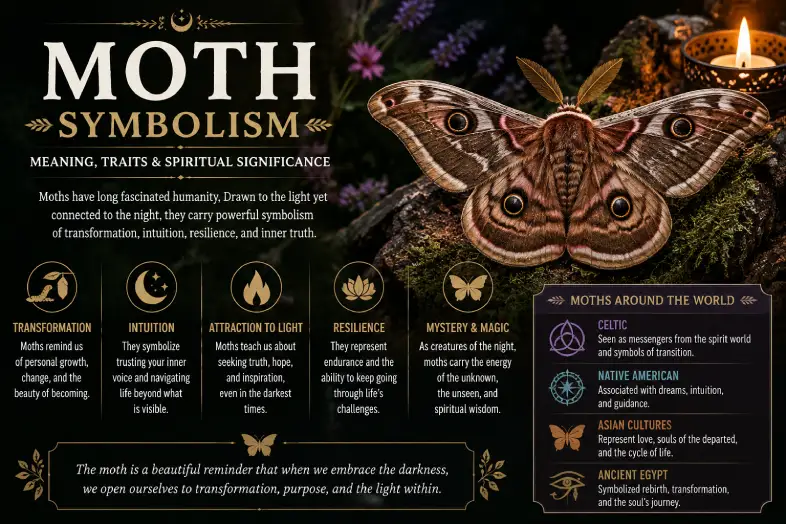
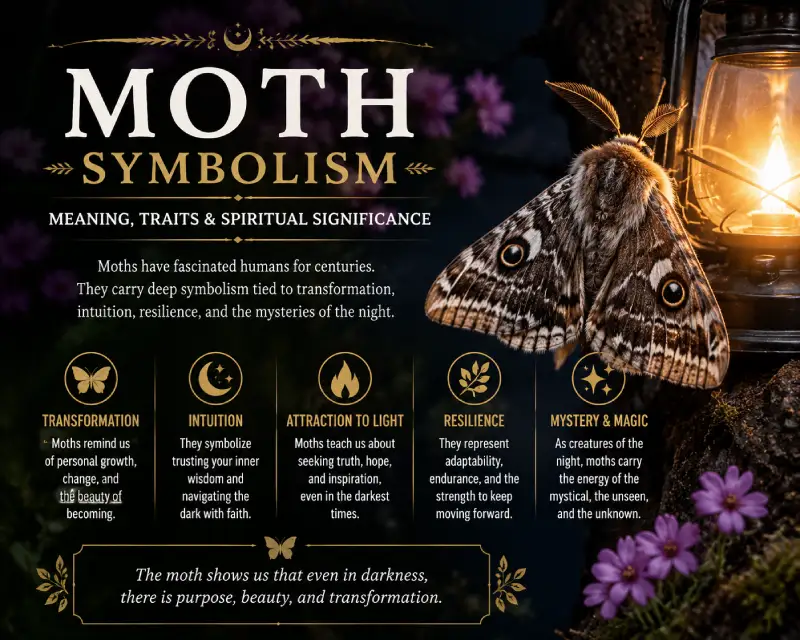
Moths have long attracted human attention because of their connection to darkness, transformation, and the natural world. Moth symbolism often represents change, intuition, resilience, and attraction to hidden knowledge in modern American culture. Unlike butterflies, which are commonly linked with daytime beauty and visible transformation, moths are often associated with nighttime experiences, quiet growth, and the ability to navigate uncertainty.
In the United States, moth imagery appears in tattoos, clothing designs, artwork, jewelry, and home decor. Many people choose moths because they represent personal journeys, adaptation, and finding direction during difficult periods. Their relationship with light also creates a strong metaphor for seeking hope, guidance, or purpose.
Understanding the meaning of moths requires looking beyond simple ideas of darkness or mystery. Across different cultures, moths have carried both positive and negative interpretations, from symbols of spiritual change to reminders of mortality. Today, their meaning depends greatly on personal experience, cultural background, and artistic context.
Quick Answer
Moth symbolism commonly represents transformation, resilience, intuition, and personal growth in modern American culture, especially in tattoos and art. Historically, moths have also been connected with nighttime, spiritual beliefs, change, and the relationship between darkness and light.
TL;DR
- Moths symbolize transformation and personal growth.
- Nighttime behavior shaped many moth meanings.
- Americans often use moths in tattoos and art.
- Some cultures connect moths with spirits and change.
- Moth imagery can represent attraction to light.
- Modern meanings depend on personal interpretation.
What Moths Represent in Modern American Culture
In the United States, moths are often viewed as symbols of adaptation and quiet transformation. Their life cycle, from caterpillar to winged insect, naturally connects them with change and personal development.
Many Americans associate moth imagery with overcoming challenges, accepting personal evolution, and embracing parts of life that are less visible. A moth does not represent transformation in the same way as a butterfly. Instead of a public display of beauty, it often suggests a more private process of growth.
Moth designs are especially popular among people who identify with themes such as independence, emotional strength, and finding their own path. The insect’s ability to survive in darkness makes it a fitting symbol for navigating uncertain situations.
The Physical Characteristics That Shape Moth Symbolism
Moths are flying insects closely related to butterflies. They typically have furry bodies, patterned wings, and antennae that help them sense their environment. Most moth species are active at night, which has strongly influenced the way humans interpret them.
Their nighttime behavior created associations with:
- mystery and hidden things
- dreams and imagination
- quiet observation
- independence
- adaptation
Unlike many animals that rely on strength or speed, moths survive through patience, camouflage, and sensitivity to their surroundings. These qualities have contributed to their symbolic connection with awareness and survival.
Ancient Roots and Early Symbolic Meanings of Moths
Historical interpretations of moths developed from human observations of their behavior. Because moths appeared after sunset and moved around sources of light, many societies created stories and beliefs around their unusual habits.
In some traditions, nighttime insects were connected with the boundary between the known and unknown. The moth’s appearance after darkness made it a symbol associated with hidden worlds, dreams, and unseen forces.
However, meanings were not always positive. Because moths could damage stored fabrics and crops, some cultures viewed them as signs of decay or unwanted change. These mixed interpretations show that symbols often develop from practical experiences as well as imagination.
Why Moths Are Connected With Light and Attraction
One of the most recognizable moth associations comes from their attraction to artificial lights. The image of a moth flying toward a flame or lamp has become a common metaphor for desire, curiosity, and risk.
In modern American culture, this idea can represent:
- following a dream despite uncertainty
- searching for truth or knowledge
- being drawn toward something meaningful
- the balance between passion and caution
The phrase “like a moth to a flame” is often used to describe strong attraction. Although the expression can suggest danger, artists frequently use moth imagery to represent determination and the pursuit of something important.
Moth Symbolism in Tattoos and Personal Identity
Moth tattoos have become increasingly popular in American tattoo culture because they allow people to express personal stories. A moth design can represent change after hardship, emotional survival, or a connection with nature.
Common meanings behind moth tattoos include:
| Context | Meaning in the USA | Common Associations | Notes |
|---|---|---|---|
| Tattoos | Transformation and resilience | Growth, survival, identity | Often personalized |
| Art | Beauty in darkness | Creativity, imagination | Common in alternative styles |
| Jewelry | Individual expression | Nature, uniqueness | Often paired with flowers |
| Home Decor | Natural connection | Vintage, botanical themes | Popular in artistic interiors |
| Fashion | Personal style | Mystery, originality | Used in prints and designs |
Different tattoo styles also influence meaning. A realistic moth may emphasize connection with nature, while a decorative or geometric moth may focus more on creativity and personal identity.
Emotional and Psychological Meanings of Moths
Moths often represent emotions connected with change, uncertainty, and self-discovery. Because they operate mainly at night, they are sometimes linked with experiences that happen privately rather than publicly.
Psychologically, moth imagery may appeal to people who value:
- patience during difficult transitions
- accepting imperfections
- finding beauty in overlooked places
- trusting personal instincts
The moth’s ability to exist in darkness gives it a symbolic connection with endurance. It suggests that growth does not always happen in obvious or visible ways.
Moth Symbolism in Literature, Art, and Popular Culture
Artists and writers have used moths to explore themes of attraction, vulnerability, and transformation. Their relationship with light creates a natural metaphor for human desire and curiosity.
In literature and visual art, moths may represent:
- longing for something distant
- fragile beauty
- obsession
- the passage of time
- the relationship between life and death
Modern designers often use moth imagery because it combines delicate appearance with deeper emotional themes. This contrast makes moths appealing in illustration, album artwork, fashion, and graphic design.
Spiritual and Religious Interpretations of Moths
Different spiritual traditions have interpreted moths in various ways. In some beliefs, flying creatures are connected with the soul, movement between worlds, or spiritual transformation.
Some interpretations view moths as reminders of:
- impermanence
- renewal
- inner reflection
- the search for guidance
At the same time, not every tradition gives moths spiritual meaning. Many modern Americans approach moth symbolism from a personal or artistic perspective rather than a religious one.
Cross-Cultural Meanings of Moths Around the World
Moth symbolism varies widely across cultures. In some places, moths are connected with ancestors or spiritual messages because they appear at night. In others, they may symbolize destruction because certain species damage clothing or stored materials.
Some cultural interpretations include:
- transformation because of the insect’s life cycle
- connection to nighttime and dreams
- reminders of mortality
- attraction toward knowledge or desire
These differences show that symbols are shaped by local experiences, beliefs, and traditions rather than having one universal meaning.
Positive and Negative Associations With Moths
Moths carry both favorable and unfavorable meanings. Their symbolism depends on the context in which they appear.
Positive associations include:
- adaptation
- creativity
- transformation
- persistence
- curiosity
Negative associations may include:
- destruction
- decay
- obsession
- vulnerability
For example, a moth tattoo chosen after overcoming hardship usually carries a positive meaning, while a moth damaging clothing may create a more negative association. The same symbol can communicate different ideas depending on the situation.
How Moths Are Used in Modern Design and Lifestyle
Moth imagery has become common in many areas of American design. Artists, brands, and individuals use moths because they combine natural beauty with unusual visual appeal.
Modern uses include:
- tattoo artwork
- posters and illustrations
- clothing patterns
- jewelry designs
- nature-inspired home decor
- digital artwork
Moths are especially popular in designs that mix botanical elements, insects, vintage styles, and dark aesthetic themes. Their detailed wings provide artists with many creative possibilities.
The Difference Between Moth and Butterfly Symbolism
Moths and butterflies are closely related, but their symbolic meanings often differ.
Butterflies are commonly associated with:
- visible transformation
- beauty
- freedom
- renewal
Moths are more often connected with:
- hidden growth
- nighttime experiences
- resilience
- seeking direction
Both insects represent change, but moth symbolism usually focuses more on the private and uncertain parts of transformation.
Common Misunderstandings About Moth Symbolism
One common misunderstanding is that moths only represent darkness or negative ideas. While their connection with night has influenced some interpretations, many modern meanings are positive.
Another misconception is that moths always symbolize death or bad luck. These associations come from specific cultural traditions and are not universal.
Today, many people choose moth imagery because it represents survival, curiosity, and personal evolution rather than something negative.
How Moth Meaning Has Changed Over Time
The meaning of moths has shifted as human relationships with nature have changed. Earlier interpretations were often based on practical concerns, such as moth damage to materials or their unusual nighttime behavior.
Modern interpretations are more focused on identity, creativity, and personal symbolism. Tattoos, artwork, and fashion have helped transform the moth from a simple household insect into a symbol of individuality and change.
FAQs
What does a moth symbolize spiritually?
A moth can symbolize transformation, reflection, and the search for guidance in some spiritual interpretations. However, spiritual meanings vary widely between cultures and personal beliefs.
What does a moth tattoo usually mean?
A moth tattoo often represents personal growth, resilience, change, or attraction toward something meaningful. Many people choose moth designs to symbolize overcoming challenges.
Are moths considered a good symbol?
Yes, many modern interpretations view moths positively. They are often connected with adaptation, creativity, persistence, and transformation.
Why are moths associated with light?
Moths are associated with light because of their natural attraction to bright sources. This behavior inspired metaphors about desire, curiosity, and searching for direction.
What is the difference between moth and butterfly symbolism?
Butterflies often represent visible transformation and beauty, while moths are more commonly linked with hidden growth, nighttime, and resilience.
Do moths have negative symbolism?
In some traditions, moths have been associated with decay or destruction because certain species damage fabrics. However, modern interpretations are often more positive and personal.
Conclusion
Moth symbolism represents transformation, resilience, curiosity, and the search for direction in many modern interpretations. While moths have carried different meanings across cultures, their connection with nighttime and change continues to influence how people understand them today.
In American culture, moth imagery appears in tattoos, art, fashion, and design because it reflects personal journeys and quiet forms of growth. Rather than representing only darkness, moths often remind people that change can happen in unseen ways.
The meaning of a moth ultimately depends on the person using the symbol. For many, it represents the ability to adapt, continue forward, and find purpose even in uncertain surroundings.