Introduction
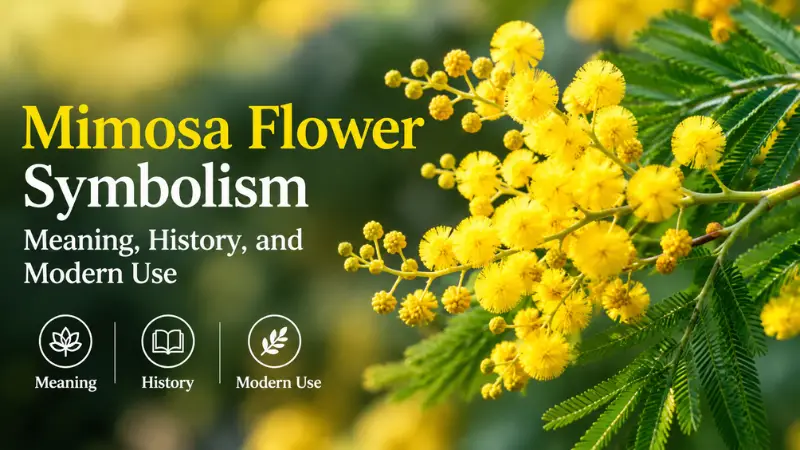
The bright yellow mimosa flower is often associated with joy, sensitivity, friendship, and the arrival of spring. Its small, rounded blossoms grow in clusters, creating a soft golden appearance that makes the flower stand out in gardens, bouquets, and floral arrangements. For people exploring mimosa flower symbolism, its appeal lies in the contrast between its delicate appearance and the resilience of the plant itself.
In modern American culture, mimosa flowers can express encouragement, appreciation, optimism, and affection without the stronger romantic associations often attached to red roses. Their cheerful color makes them suitable for spring celebrations, thoughtful gifts, and decorative arrangements.
However, the flower’s meaning depends on the plant being discussed and the cultural setting. The yellow-flowered plant commonly sold as mimosa in the floral trade is often silver wattle (Acacia dealbata), which originated in southeastern Australia. It is also important to distinguish this plant from the sensitive plant (Mimosa pudica), known for folding its leaves when touched.
Understanding these differences reveals why mimosa flowers can represent both cheerful renewal and quiet sensitivity, as well as why their meanings vary between American and European traditions.
Quick Answer
Mimosa flower symbolism commonly represents joy, sensitivity, friendship, resilience, and new beginnings in modern American floral use. Historically, yellow mimosa became associated with the arrival of spring in Europe, while its role in International Women’s Day celebrations in Italy connected it with women’s solidarity, strength, and recognition.
TL;DR
- Joy and optimism: Golden blossoms suggest happiness and a brighter outlook.
- Sensitivity: The flower can represent emotional awareness and gentleness.
- Resilience: Its delicate appearance contrasts with the adaptability of the plant.
- New beginnings: Seasonal flowering connects mimosa with spring and renewal.
- Women’s solidarity: In Italy, yellow mimosa is associated with International Women’s Day.
- Modern American use: Bouquets and floral designs communicate appreciation and encouragement.
1. What Does the Mimosa Flower Look Like?
The yellow mimosa commonly sold by florists has clusters of tiny, rounded flowers that resemble miniature golden pom-poms. Its foliage is finely divided and feathery, often appearing silver-green or gray-green. Together, the foliage and blossoms create a light, airy appearance.
The species most closely associated with the commercial mimosa flower is Acacia dealbata, commonly called silver wattle. Native to southeastern Australia, it is cultivated in other parts of the world for its ornamental flowers and fragrant blossoms.
The name can cause confusion because several plants are called mimosa. The sensitive plant, Mimosa pudica, has pinkish-purple flower heads and leaves that fold when touched. The yellow mimosa used in many European bouquets generally belongs to the acacia group instead.
This distinction matters when interpreting symbolism. Meanings associated with touch-sensitive leaves may refer to a different plant from the golden mimosa featured in floral arrangements.
2. The Core Symbolic Meanings of Mimosa
Mimosa does not have one universally accepted symbolic meaning. Its associations emerge from its appearance, flowering season, cultural traditions, and use as a gift.
| Symbolic meaning | Common association | Typical context |
|---|---|---|
| Joy | Happiness, warmth, optimism | Spring bouquets and celebrations |
| Sensitivity | Empathy, gentleness, emotional awareness | Personal gifts and reflective designs |
| Resilience | Adaptability and the ability to keep going | Encouragement and personal milestones |
| Renewal | Fresh starts and seasonal change | New beginnings and spring decorations |
| Solidarity | Recognition, equality, and women’s achievements | International Women’s Day traditions |
These meanings are interpretations rather than fixed botanical facts. A mimosa bouquet given to a friend might express appreciation, while the same flowers used in a public celebration could communicate collective recognition.
The sender’s intention, the recipient’s experiences, and the surrounding cultural context all help determine what the flower conveys.
3. Joy, Happiness, and Optimism
One of the easiest associations to understand is happiness. The flower’s bright yellow color naturally recalls sunlight, warmth, and the return of brighter days after winter.
In American floral design, yellow flowers often serve as friendly, upbeat alternatives to more formal or romantic arrangements. Mimosa fits this role particularly well because its many small blossoms create a generous display without appearing heavy or overly elaborate.
A bouquet of yellow mimosa might be appropriate for congratulating a friend, welcoming someone into a new home, or sending encouragement during a difficult period. Its message is less about dramatic declarations and more about bringing a little brightness into someone’s day.
This interpretation also explains its appeal in seasonal decorations. The flowers can make a room feel lighter and more inviting, even when used in a simple vase or combined with other spring blooms.
4. Sensitivity, Gentleness, and Emotional Awareness
Mimosa is also associated with sensitivity, although the meaning requires some care. The association is especially strong when people connect the flower with the sensitive plant, whose leaves respond visibly to touch.
The yellow florist’s mimosa and Mimosa pudica are not the same plant, so their botanical characteristics should not be confused. Nevertheless, the shared common name has helped make sensitivity an understandable modern association.
Symbolically, sensitivity does not have to mean weakness. It can suggest the ability to notice another person’s feelings, respond with compassion, and recognize experiences that might otherwise go unspoken.
For this reason, mimosa can suit a gift intended to communicate understanding rather than offer advice. It may be chosen for someone going through a personal transition, for a friend who has provided emotional support, or simply as a gentle reminder that their feelings matter.
Its fine foliage and small blossoms reinforce this interpretation visually: the flower looks delicate without needing to imply helplessness.
5. Resilience and Quiet Strength
Mimosa’s delicate appearance can also suggest quiet strength. The contrast is important: the blossoms look soft and fragile, while the tree or shrub that produces them can be vigorous and adaptable in suitable growing conditions.
This combination makes the flower useful as a symbol of perseverance. It can represent someone who remains compassionate through difficulty, rebuilds after a setback, or continues working toward a goal without drawing attention to every obstacle.
In personal gifts, this interpretation may be more meaningful than a generic message of positivity. A mimosa arrangement can acknowledge that a person has faced challenges while celebrating their ability to move forward.
Still, resilience is a modern symbolic interpretation, not a universal traditional meaning attached to every mimosa bouquet. The plant’s actual behavior depends on its species, climate, and growing conditions.
6. New Beginnings and the Arrival of Spring
Mimosa is strongly associated with seasonal renewal in parts of Europe, where its yellow flowers can appear during late winter. Their arrival offers a visible reminder that the landscape is beginning to change.
The flower’s seasonal role helps explain its connection with fresh starts. Unlike a symbol that depends on a written message or a religious story, mimosa communicates renewal through an observable event: flowering at a time when many other plants remain dormant.
In American settings, this association works well for spring celebrations, new jobs, graduation gifts, and other transitions. A mimosa arrangement can suggest that a new chapter is opening without implying that every difficulty has disappeared.
It can also be used in home decor to mark the changing season. Placing flowering branches in an entryway or dining room offers a simple visual transition from winter colors to brighter spring tones.
For people who prefer understated symbolism, this seasonal meaning provides a practical reason to choose the flower.
7. The Historical Origins of Mimosa Symbolism
The history of the yellow florist’s mimosa begins with the plant’s Australian origins rather than with an ancient European myth. Acacia dealbata is native to southeastern Australia, including parts of New South Wales, Victoria, and Tasmania.
During the eighteenth and nineteenth centuries, Australian acacias entered European botanical collections and horticultural cultivation. Their bright blossoms and suitability for ornamental planting helped establish them in regions with favorable climates, particularly parts of southern Europe.
As the flowers became commercially familiar, the name mimosa gained popularity in the European cut-flower trade. The blossoms came to mark the season in which they appeared, helping connect the plant with winter’s end and the approaching spring.
This history is worth distinguishing from older European flower-language traditions. The modern yellow mimosa’s associations developed through horticulture, seasonal customs, and social use; they should not automatically be treated as universal beliefs dating back to antiquity.
The sensitive plant has a separate history of botanical interest because of its visible response to touch. Over time, the overlapping common names have contributed to some of the symbolism now associated with mimosa more broadly.
8. Mimosa and International Women’s Day
One of the flower’s clearest cultural associations comes from Italy, where yellow mimosa is traditionally given for International Women’s Day on March 8.
The custom emerged in the twentieth century as Italian women’s organizations sought a flower that could be distributed widely and offered meaningfully. Mimosa’s seasonal availability, bright appearance, and relative affordability made it a practical choice.
The flower subsequently became connected with women’s solidarity, recognition, dignity, and the ongoing pursuit of equality. Giving mimosa can acknowledge the contributions of mothers, friends, colleagues, activists, and women in public life.
Its meaning is not limited to celebration. International Women’s Day also highlights unequal opportunities, discrimination, and the work that remains necessary to achieve gender equality. In that setting, mimosa can function as a gesture of recognition rather than a substitute for action.
This tradition is particularly relevant when interpreting the flower internationally. In the United States, mimosa is not as universally established as an International Women’s Day emblem as it is in Italy. Americans may encounter the tradition through Italian communities, international workplaces, cultural events, or social media.
Understanding the context helps preserve the significance of the custom instead of treating it as simply another seasonal flower trend.
9. What Mimosa Symbolism Means in the United States
In the United States, mimosa does not have one dominant national meaning comparable to the rose’s established place in romantic gifting. Its symbolism is more flexible and depends heavily on how the flowers are presented.
For many Americans, a yellow mimosa arrangement communicates friendliness, happiness, appreciation, and springtime. These meanings are readily understood through the flower’s color and its use in contemporary floral design.
The flower can also carry a more specific meaning for people familiar with European customs. Someone who has Italian family connections, for example, may recognize yellow mimosa as a gesture for International Women’s Day.
In a workplace, the flowers might accompany a celebration of women’s achievements. At home, they might simply brighten a dining table. In a personal gift, they may suggest encouragement or gratitude.
There is no widely established American rule that mimosa must symbolize one particular emotion. That flexibility is an advantage: the giver can explain the intended meaning in a card or conversation without relying on a tradition the recipient may not know.
10. Cross-Cultural Meanings and Interpretations
Mimosa symbolism changes across cultural settings, and not every interpretation applies to the same species.
In Italy, yellow mimosa is closely linked with International Women’s Day. In southern France, the flower is associated with seasonal festivals and the flowering landscape of the French Riviera. These meanings developed through local horticultural and cultural practices.
In Australia, where silver wattle is native, the plant belongs to the country’s distinctive botanical landscape. The meaning of a native plant may involve place, ecology, and cultural knowledge rather than the same floral-gifting conventions found in Europe.
In Western flower-language traditions, the sensitive plant has sometimes been associated with modesty or sensitivity because its leaves fold when touched. Those interpretations should not be automatically transferred to yellow silver wattle.
There is also no single religious meaning of mimosa shared across Christianity, Judaism, Islam, Hinduism, or Buddhism. Individuals may use the flower in personal or community settings, but its general symbolic associations are primarily cultural, seasonal, and botanical rather than universally prescribed by religion.
Respecting these distinctions makes the flower’s symbolism more accurate and avoids presenting a regional custom as a worldwide belief.
11. The Emotional and Psychological Appeal of Yellow Mimosa
Color and form influence how people experience flowers. Yellow is frequently used in visual design to suggest warmth, brightness, and energy, although individual responses vary with personal associations and cultural background.
Mimosa combines that color with a light texture. The tiny blossoms create a soft, cloudlike effect, while the finely divided leaves add movement and detail. The result can feel cheerful without the visual intensity of a large, tightly packed bouquet.
This combination helps explain why the flower can express several related but distinct emotions. Yellow conveys a welcoming quality, while the delicate form can suggest care and attentiveness.
A gift of mimosa might therefore feel appropriate when words are difficult to find. It can acknowledge a milestone, offer encouragement, or let someone know they are being thought of.
These psychological associations should not be mistaken for scientific proof that a flower produces a specific emotional response in everyone. The meaning remains personal, and the relationship between giver and recipient often matters more than the flower alone.
12. Mimosa in Tattoos, Jewelry, Fashion, and Home Decor
Mimosa can be used in personal style when someone wants a floral motif that feels bright and understated.
Tattoos: A mimosa tattoo may represent optimism, emotional sensitivity, personal growth, or a meaningful connection with International Women’s Day. Fine-line stems and small yellow blossoms can create a subtle design, while a larger branch may emphasize renewal or resilience. Because these meanings are not universal, a personal story often gives the tattoo its strongest significance.
Jewelry: Floral pendants, earrings, and botanical illustrations can make mimosa a reminder of a person, a season, or a new beginning. The design may be especially meaningful to someone with connections to Italy, France, or Australia.
Fashion: Mimosa-inspired patterns can bring a springlike quality to scarves, dresses, accessories, and printed fabrics. The motif usually communicates freshness and warmth rather than a fixed cultural statement.
Home decor: Fresh branches, artificial floral arrangements, and botanical prints can brighten kitchens, living rooms, and entryways. In seasonal displays, mimosa works well with neutral ceramics, natural wood, and other spring flowers.
Social media: A photograph of mimosa may accompany messages about spring, gratitude, personal milestones, or women’s achievements. The caption and occasion help clarify the intended message, especially for viewers unfamiliar with its European traditions.
In all these uses, the flower’s flexibility is part of its appeal. It can carry a personal meaning without requiring the audience to recognize a formal symbolic code.
13. Common Misunderstandings About Mimosa Symbolism
Several common misconceptions can make the flower’s meaning seem more settled than it really is.
Mistake 1: Assuming every mimosa is the same plant. The yellow florist’s mimosa is commonly an acacia, while Mimosa pudica is a different plant with touch-responsive leaves. Botanical identity matters when discussing historical associations.
Mistake 2: Treating Italian custom as a universal American tradition. Yellow mimosa has a particularly recognizable role in Italy’s International Women’s Day celebrations, but the custom is not equally familiar throughout the United States.
Mistake 3: Assuming yellow always means friendship. Yellow can suggest joy and warmth, but flower meanings vary. The recipient’s culture, the occasion, and the giver’s intentions influence interpretation.
Mistake 4: Presenting every symbolic meaning as ancient. Associations with renewal, sensitivity, or resilience may be useful modern interpretations without being documented ancient beliefs.
Mistake 5: Ignoring environmental context. Although silver wattle is admired as an ornamental plant, it can become invasive outside its native range. Its beauty does not mean it is ecologically suitable for every garden.
A careful interpretation separates botanical facts from cultural customs and personal meanings. This approach allows people to appreciate the flower without overstating its history.
14. How Mimosa Symbolism Has Evolved
Mimosa’s symbolic development illustrates how flowers acquire meaning through use. Its Australian botanical origins came first, followed by its introduction to European horticulture and its adoption as a seasonal cut flower.
In southern Europe, repeated appearances in winter and early spring helped establish associations with the end of the cold season. Local festivals and floral markets strengthened those connections.
Italy’s International Women’s Day tradition gave the yellow blossom a more specific social role, linking it with women’s recognition and solidarity. That association later became visible to people outside Italy through international communities and online communication.
In contemporary America, mimosa is more often interpreted through flexible ideas such as happiness, sensitivity, renewal, and appreciation. People can also draw on its international associations when the occasion calls for a more explicit message.
Its symbolism has therefore expanded rather than simply replaced one meaning with another. Seasonal imagery, botanical identity, social traditions, and individual experience all contribute to what the flower communicates today.
FAQs
What does a mimosa flower symbolize spiritually?
Mimosa may symbolize renewal, compassion, hope, and the ability to remain gentle during difficult times. These are personal or contemporary interpretations rather than universal religious teachings, so the meaning depends on an individual’s beliefs.
What does a mimosa flower tattoo mean?
A mimosa tattoo can represent optimism, sensitivity, resilience, or a fresh start. For someone familiar with Italian customs, it may also honor women’s achievements or express solidarity with the women’s rights movement.
Is mimosa a symbol of women’s strength?
Yes, in the context of Italian International Women’s Day traditions, yellow mimosa is associated with women’s solidarity and recognition. Its use in that setting can express respect for women’s contributions and support for equality.
Does mimosa symbolize love or friendship?
Mimosa can express affection, friendship, appreciation, and warmth, but it is not as strongly associated with romantic love as a red rose. The message becomes clearer when the bouquet is paired with a thoughtful note.
Is mimosa a lucky flower?
Some people may regard mimosa as a positive sign because its bright blossoms suggest happiness and fresh beginnings. However, there is no universal tradition establishing it as a flower that guarantees luck or prosperity.
What is the difference between mimosa and the sensitive plant?
The yellow florist’s mimosa is commonly Acacia dealbata, also known as silver wattle. The sensitive plant, Mimosa pudica, is a different species recognized for folding its leaves in response to touch, and it is often connected with sensitivity in flower symbolism.
Why is mimosa associated with spring?
In parts of southern Europe, mimosa flowers during late winter and early spring, making it a seasonal sign of the changing landscape. Its bright blossoms can therefore suggest warmer days, fresh starts, and the return of color after winte
Conclusion
Mimosa flower symbolism brings together joy, sensitivity, resilience, and renewal. Its bright yellow blossoms make it a natural choice for cheerful gifts and spring decorations, while its cultural history gives it a more specific significance in European traditions, especially Italy’s International Women’s Day celebrations.
In the United States, mimosa remains an adaptable floral symbol rather than one with a single established meaning. Its message can be as simple as appreciation for a friend or as purposeful as recognition of women’s achievements. The most thoughtful interpretation considers the plant, the occasion, and the person receiving it.
Ultimately, mimosa offers a way to express warmth and encouragement through a flower whose delicate appearance does not diminish its associations with perseverance and new beginnings.