Introduction
The mulberry tree symbolism found in gardens, folklore, literature, and family traditions begins with a simple observation: this tree provides something useful. Its branches offer shade, its fruit feeds people and wildlife, and its leaves support silkworms used in silk production. These qualities have helped connect the mulberry with nourishment, abundance, patience, and the rewards of steady growth.
In the United States, the mulberry has a distinctive history. The native red mulberry (Morus rubra) was valued as a food plant long before European colonization, while the introduced white mulberry (Morus alba) became associated with early American efforts to develop a domestic silk industry. The tree’s place in American history therefore involves Indigenous knowledge, agricultural ambition, and changing ideas about prosperity.
Mulberries also appear in cultural traditions far beyond North America. In a famous story recorded by the Roman poet Ovid, the tree becomes a witness to tragic love. In Chinese traditions, it is closely connected with silk production and ideas of home and ancestral place.
Understanding these different associations helps explain why the mulberry can represent both practical abundance and deeply personal memories. Its meaning depends on the culture, story, and circumstances in which the tree appears.
Quick Answer
Mulberry tree symbolism commonly represents nourishment, abundance, family roots, patience, and productive growth in modern American culture, especially in gardens, artwork, and personal expressions of heritage. Historically, the tree has also been associated with silk production and prosperity in China, while Roman literature connected its dark fruit with tragic love, mourning, and transformation.
TL;DR
- Mulberry trees represent nourishment, abundance, and the benefits of steady growth.
- Chinese traditions connect mulberries with silk production, home, and ancestral places.
- Indigenous communities used native red mulberries for food and practical purposes.
- Early American silk projects linked mulberries with prosperity and economic ambition.
- Ovid’s tragic love story connects the tree with devotion and mourning.
- Modern interpretations often emphasize family heritage, nature, resilience, and personal growth.
1. What a Mulberry Tree Looks Like and Why It Matters
7
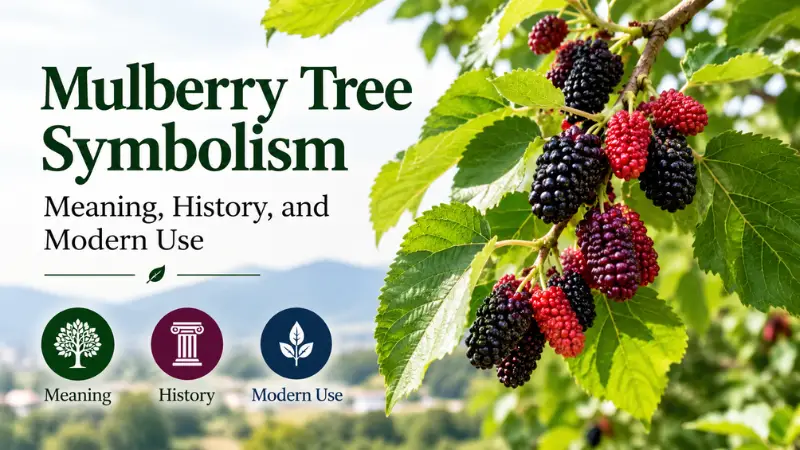
Mulberry trees belong to the genus Morus and are known for their broad leaves, spreading branches, and clusters of edible fruit. Depending on the species and stage of ripeness, the berries may be white, pink, red, deep purple, or nearly black.
Three characteristics help explain the tree’s symbolic associations.
First, a mature mulberry can provide shade and fruit, making it a familiar part of a productive landscape. Second, the fruit changes color as it ripens, offering a visible reminder of growth and change. Third, the leaves of certain mulberry species are essential food for silkworms, linking the tree to an industry that transforms natural materials into valuable cloth.
These features give the mulberry a practical basis for its symbolism. Unlike symbols whose meanings depend mainly on a religious story or formal tradition, many mulberry associations begin with things people can observe: food, shelter, seasonal change, and useful work.
2. The Core Meanings of Mulberry Tree Symbolism
There is no universal symbolic definition for the mulberry tree. Nevertheless, several interpretations are especially easy to understand when considered alongside its physical qualities and cultural history.
Nourishment and generosity: The fruit provides food for people and wildlife. A fruit-bearing tree can therefore suggest hospitality, sharing, and the ability to provide for others.
Abundance and prosperity: A productive tree represents resources that can be harvested and put to use. In historical silk-growing traditions, this connection extended from food to economic opportunity.
Patience and growth: Fruit requires time to develop. The tree can serve as a reminder that meaningful results often depend on favorable conditions, consistent care, and time.
Family roots and belonging: A tree established in a garden or near a home may become associated with childhood, family gatherings, and a particular place.
Transformation and remembrance: The changing color of the berries and the tree’s role in traditional stories make it suitable for representing transitions, lasting memories, and the relationship between love and loss.
These are interpretations rather than fixed meanings. A mulberry in a family garden may primarily evoke home, while one depicted in a literary illustration may refer to an entirely different story.
3. Ancient Roots and the Story of Pyramus and Thisbe
One of the best-known literary associations of the mulberry comes from Metamorphoses, written by the Roman poet Ovid around the beginning of the first century CE.
In the story, Pyramus and Thisbe are young lovers whose families forbid their relationship. They communicate through a small opening in a wall and eventually arrange to meet near a tomb beneath a mulberry tree.
Thisbe arrives first but flees after encountering a lioness, leaving behind her veil. When Pyramus finds the bloodstained garment, he mistakenly believes that Thisbe has died. Overcome by grief, he takes his own life. Thisbe later returns, discovers him, and dies as well.
According to the story, their blood changes the fruit of the previously pale mulberry tree to a dark color. The tree becomes a lasting reminder of their tragic love.
The episode gives the mulberry several literary associations:
- Devotion: The lovers remain committed despite their families’ opposition.
- Grief and mourning: The dark fruit becomes a memorial to their deaths.
- Consequences of misunderstanding: A mistaken conclusion turns a secret meeting into a tragedy.
- Memory: The tree preserves the story through a visible change in its fruit.
This is a mythological explanation of the fruit’s color, not a botanical account. It also does not establish that all mulberry trees carry a tragic meaning. Rather, the association becomes relevant when the tree appears in literature, art, or discussions of classical mythology.
4. Mulberries in Chinese Culture: Silk, Home, and Ancestr
The mulberry has a particularly important place in Chinese agricultural and cultural history because of its relationship with silk. The leaves of the white mulberry provide the principal food for domesticated silkworms, which produce the fibers used to make silk. Mulberry cultivation and sericulture consequently became closely connected with farming, household production, and economic life.
This practical relationship also shaped cultural associations. A tree that supported an important craft could represent productive labor, prosperity, and the relationship between people and the land.
In Chinese literary and linguistic traditions, sāng (桑), meaning mulberry, also appears in expressions associated with one’s native place. The expression sāngzǐ (桑梓), referring to mulberry and catalpa trees, came to evoke one’s hometown and ancestral home. These trees were associated with domestic landscapes and traditional responsibilities, making them meaningful images of belonging.
The connection offers a useful distinction: the mulberry’s symbolism does not come only from its fruit or appearance. It also comes from the work people perform around it, the knowledge they pass down, and the communities that depend on its resources.
For American readers, these associations provide a cultural perspective on why a mulberry may represent home, heritage, and continuity. They should not, however, be treated as universal Chinese beliefs shared identically by every community or historical period.
5. Indigenous Uses of the Native Red Mulberry in North Ameri
The native red mulberry has a history in North America that predates European colonization. Its fruit was a useful seasonal food, and Indigenous communities developed practical knowledge of how to gather, prepare, preserve, and use the plant.
For example, historical and museum documentation describes Haudenosaunee practices of drying mulberries in the sun or by a fire. The dried fruit could be stored for later use or carried during hunting and travel. Mulberries could also be mashed into cakes or incorporated into other foods.
These practices suggest themes of resourcefulness, food security, seasonal knowledge, and relationships with local ecosystems. Such themes are reasonable interpretations of the tree’s practical role, but they should not be presented as a single traditional spiritual meaning shared by all Indigenous nations.
That distinction matters. Indigenous peoples of North America have different histories, languages, ecological practices, and cultural traditions. The documented use of a plant does not automatically establish a specific religious or ceremonial symbolism.
It is also important to distinguish native red mulberry from white mulberry, an Asian species introduced to North America and later promoted for silk production. Their histories overlap in the American landscape, but their origins and roles are different.
6. Why Mulberry Trees Became Associated With American Prosperity
During the colonial period and the early decades of the United States, mulberry cultivation was connected to efforts to produce silk domestically. White mulberry trees were especially attractive because their leaves supported silkworms used in silk production.
The idea appealed to people who wanted North American colonies, and later the independent United States, to develop valuable industries of their own. Silk represented a potentially profitable commodity, and growing the necessary trees appeared to offer farmers another economic opportunity.
Interest in mulberry cultivation expanded during the early nineteenth century. Investors and growers increasingly treated the trees as assets that could produce future wealth. The enthusiasm became excessive in some places, contributing to speculative investment in mulberry trees before the market collapsed.
This episode adds an important complication to the tree’s American symbolism. The mulberry could represent ambition, enterprise, and self-reliance, but it could also illustrate the dangers of speculation and unrealistic expectations.
The story is a reminder that prosperity depends on more than the apparent promise of a resource. Labor, markets, production costs, and actual demand all matter.
In modern interpretations, the historical connection can make a mulberry a fitting emblem of craftsmanship and productive effort. It can also serve as a reminder to distinguish sustainable growth from the mere appearance of opportunity.
7. What the Mulberry Means in Modern American Culture
Unlike the American flag, the bald eagle, or the oak in certain civic contexts, the mulberry tree does not have one standardized national meaning in the United States.
Its symbolism is generally informal and context-dependent. People may associate a mulberry with a childhood home, a productive garden, a family property, or a particular memory rather than with an established national tradition.
The following table summarizes several common ways the tree can be interpreted.
| Context | Possible meaning in the USA | Common associations |
|---|---|---|
| Home garden | Comfort and provision | Shade, fruit, family gatherings |
| Family artwork | Heritage and continuity | Ancestry, childhood, belonging |
| Nature-inspired design | Growth and abundance | Renewal, seasonal change |
| Historical illustration | Enterprise and ambition | Silk cultivation, agriculture |
| Memorial artwork | Love and remembrance | Ovid’s story, grief, devotion |
These meanings are not official definitions. The same tree may communicate different ideas depending on its setting and the intentions of the person using it.
A family might include a mulberry in a drawing because one stood outside a grandparent’s house. A gardener might value it primarily as a food source. An artist illustrating a classical love story might choose it to evoke the tragedy of Pyramus and Thisbe.
In each case, the tree gains meaning from the relationship between its physical presence and the story attached to it.
8. Emotional and Psychological Associations
Trees often become part of personal memory because people encounter them repeatedly over many years. A familiar tree may mark a childhood home, a place where relatives gathered, or a landscape that has changed alongside a person’s life.
A mulberry can carry this kind of emotional significance particularly well when the fruit was picked by hand, the branches provided summer shade, or the tree attracted birds to a family garden.
Several emotional associations follow naturally from these experiences.
Security: A mature tree near a home can represent familiarity and shelter.
Generosity: Fruit-bearing branches suggest the idea of having enough to share.
Continuity: A tree that survives through changing seasons may remind someone of family traditions or enduring relationships.
Nostalgia: A remembered mulberry tree can become a mental connection to a place that no longer exists in the same form.
Grief and remembrance: The literary tradition surrounding Pyramus and Thisbe can give the tree a place in art that explores love and loss.
These responses are personal rather than universal psychological effects. There is no reliable basis for claiming that every person who sees a mulberry will experience the same emotions.
The setting, memories, and cultural knowledge a person brings to the tree help determine what it means to them.
9. Mulberry Tree Symbolism in Tattoos and Personal Art
A mulberry branch can work well in personal artwork because it combines recognizable leaves, clustered fruit, and a clear seasonal character. It also allows the wearer or artist to choose between several distinct interpretations.
A tattoo featuring ripe berries may suggest abundance, maturity, or appreciation for the natural world. A branch connected to a childhood memory can represent family roots or a meaningful place. Someone drawn to classical literature may choose the tree to reference Pyramus and Thisbe and the themes of love, loss, and remembrance.
Other possible interpretations include:
- Personal growth: A living tree reflects change over time.
- Family heritage: A branch can represent connections across generations.
- Resourcefulness: Fruit and leaves evoke practical usefulness.
- Lasting affection: The classical story offers a literary connection to devoted love.
These interpretations are creative choices, not established rules for mulberry tattoos. There is no widely recognized tattoo code that assigns one fixed meaning to a particular leaf shape, berry color, or branch arrangement.
For a more personal design, someone might include ripe and unripe berries, a family date, or a small detail recalling a particular garden. Such choices communicate a specific memory more clearly than relying on a supposedly universal symbolic definition.
10. Mulberries in Home Decor, Gardening, and Design
In home decor and landscape design, a mulberry can represent a connection between beauty and usefulness. Unlike a purely ornamental motif, the tree is associated with food, shade, seasonal activity, and the presence of wildlife.
A botanical print in a kitchen may emphasize fruit and harvest. An illustration in a family home may suggest a beloved garden or an older rural landscape. A naturalistic fabric pattern may use mulberry leaves and berries simply for their visual appeal, without any intended symbolic message.
Color can also influence how a design is interpreted. Deep purple or almost-black berries may suggest ripeness and richness, while green leaves emphasize growth and freshness. A branch carrying fruit at different stages can make seasonal change part of the composition.
However, these are design associations rather than scientifically established psychological effects. Color meanings vary between individuals and cultural contexts.
There is also a practical side to choosing the mulberry as a garden symbol. Its fruit can stain paving and surfaces, and some species have growth habits that require careful site selection. A drawing of a tree and the decision to plant one in a yard are different choices.
For homeowners who value edible landscaping, the tree may represent a preference for gardens that provide both visual interest and tangible benefits.
11. Religious and Spiritual Interpretations
The mulberry tree does not have one universal religious meaning, and it should not be assigned a standard spiritual message simply because it appears in a traditional story.
In Chinese cultural history, the tree’s association with silk production gave it an important place in the agricultural and domestic world. Certain mythological traditions also connect mulberry trees with cosmic imagery, including the legendary Fusang tree, which appears in accounts associated with the sun and the eastern regions of the world. These traditions vary, and the mythical Fusang should not be treated as an ordinary mulberry tree in every account.
In the Roman literary tradition, the tree’s role in the story of Pyramus and Thisbe connects it with mourning, love, and the consequences of misunderstanding. Later readers can interpret these themes spiritually, but the story itself is a classical myth rather than a universal religious teaching.
In contemporary American spirituality, an individual might use a mulberry as a personal symbol of gratitude, connection with nature, or remembrance of family members. Such an interpretation can be meaningful without being part of an established religious doctrine.
The key is to distinguish documented cultural traditions from personal spiritual beliefs. A mulberry can serve as a meaningful focus for reflection, but claims that it guarantees protection, attracts wealth, or possesses supernatural powers should not be presented as established facts.
12. What Different Berry Colors Can Represent
Mulberries are visually distinctive because their fruit changes appearance as it develops. This provides artists with an opportunity to explore growth and change through a single branch.
| Berry appearance | Possible symbolic interpretation | Context |
|---|---|---|
| White or pale | Beginning, potential, or an early stage | Creative artwork or personal interpretation |
| Red | Vitality, passion, or transition | Romantic or expressive imagery |
| Deep purple or nearly black | Maturity, remembrance, or mourning | Literary and memorial artwork |
| Mixed stages of ripeness | Change and development | Botanical designs and personal art |
These meanings require an important qualification: they are interpretive possibilities, not a standardized color-symbolism system.
The botanical process is real, but the meanings people assign to it are cultural or personal. White mulberry fruit, for example, does not universally represent innocence, nor does dark fruit automatically indicate grief.
Ovid’s story gives the changing color a specific literary meaning. In that account, the darkened berries memorialize the lovers’ deaths. Outside that narrative, the same fruit may simply signify a ripe harvest.
For an artist or tattoo designer, the choice of color can therefore help communicate an intended theme, provided the surrounding imagery gives viewers enough context to understand it.
13. Common Misunderstandings About Mulberry Tree Symbolism
Several popular claims about the mulberry deserve a closer look.
Misunderstanding 1: Every mulberry tree symbolizes tragic love.
The association with tragic love comes from Ovid’s story of Pyramus and Thisbe. It is relevant to classical literature and its later interpretations, but it does not define the tree in every culture.
Misunderstanding 2: The mulberry always represents wealth.
The tree’s connection with silk production and American agricultural speculation supports an association with prosperity. However, many people value mulberries for food, shade, wildlife, or family memories without thinking about money.
Misunderstanding 3: All Indigenous American traditions give the mulberry the same spiritual meaning.
North American Indigenous nations have distinct cultural histories. Evidence of a plant’s practical use does not justify assigning one shared religious interpretation to every nation.
Misunderstanding 4: Mulberry symbolism is a fixed ancient code.
The tree’s associations developed in different settings, including agriculture, literature, folklore, and personal memory. There is no single authoritative list that determines its meaning in every situation.
Misunderstanding 5: A mulberry tree has a guaranteed supernatural effect.
Claims that the tree automatically brings luck, wealth, healing, or protection are matters of belief, not established evidence.
Separating these claims from documented history makes it easier to appreciate the tree without overstating what its symbolism can tell us.
14. How Mulberry Symbolism Has Changed Over Time
The mulberry’s cultural history shows how a plant can acquire different meanings as people’s relationships with it change.
In communities that cultivated the tree for food, its value began with nourishment and practical use. In Chinese traditions connected with sericulture, the tree became associated with an important craft, household labor, and the economic value of silk.
In Roman literature, the tree took on a different role. Ovid used its fruit to give a tragic love story a lasting natural marker. The result was an association with devotion, grief, and remembrance that could travel through later literary adaptations.
In colonial and early American history, mulberry cultivation became connected with ambitions for domestic silk production. During the nineteenth century, speculation around the tree demonstrated how agricultural promise could turn into unrealistic financial expectations.
Today, its meanings are less standardized. A mulberry may represent sustainable gardening, a remembered family home, a literary reference, or a personal commitment to growth. Some people may simply enjoy the tree without assigning it symbolic significance at all.
This evolution illustrates an important principle: symbols are not detached from everyday life. Their meanings develop as people use plants, tell stories about them, and connect them with changing social priorities.
FAQs
1. What does a mulberry tree symbolize spiritually?
A mulberry tree can represent gratitude, nourishment, family connections, and personal growth when someone uses it as a spiritual symbol. These interpretations are personal or culturally specific; there is no single spiritual meaning accepted by all religions.
2. What does a mulberry tree tattoo mean?
A mulberry tree tattoo may represent family heritage, a meaningful childhood memory, abundance, or an appreciation for nature. It can also reference the tragic love story of Pyramus and Thisbe, particularly when the design emphasizes dark berries or themes of remembrance.
3. Is the mulberry tree a symbol of good luck?
Some individuals may associate a productive fruit tree with good fortune because it provides food and other useful resources. However, the mulberry is not a universal good-luck symbol, and there is no evidence that planting or depicting one guarantees prosperity.
4. What does a mulberry tree symbolize in Chinese culture?
The mulberry is closely associated with silk production because its leaves support silkworm cultivation. The Chinese expression sāngzǐ, referring to mulberry and catalpa trees, also evokes one’s hometown and ancestral place.
5. Why is the mulberry tree associated with love and death?
The connection comes from Ovid’s story of Pyramus and Thisbe. In the myth, the lovers die after a tragic misunderstanding, and their blood changes the color of the mulberry fruit, making the tree a literary reminder of devotion and mourning.
6. What is the difference between red mulberry and white mulberry symbolism?
Red mulberry has a native North American history that includes documented Indigenous food uses, while white mulberry became especially associated with silk cultivation and early American agricultural enterprise. These historical differences can inform interpretation, but neither species has an exclusive symbolic meaning.
7. Does a mulberry tree symbolize family and ancestry?
It can, particularly when a tree is associated with a family property, childhood memories, or a place passed between generations. The connection is also supported by Chinese cultural and linguistic traditions linking the mulberry with one’s hometown and ancestral home.
Conclusion
Mulberry tree symbolism brings together several meanings grounded in the tree’s real uses and cultural history. Its fruit and shade suggest nourishment and generosity, its growth can represent patience and continuity, and its role in silk production connects it with craftsmanship and prosperity. The story of Pyramus and Thisbe adds a literary association with devoted love, grief, and remembrance.
In the United States, the mulberry’s meaning depends largely on context. It may recall Indigenous relationships with native plants, early American economic ambitions, a family garden, or a meaningful piece of art. These interpretations are most useful when they reflect the tree’s actual history rather than unsupported claims about universal spiritual powers.
Ultimately, the most fitting interpretation is the one supported by the setting and the story behind it. A mulberry can be a source of food, a reminder of home, or a literary emblem of love and loss—and sometimes its significance lies simply in the life it supports.