Introduction
Nutmeg symbolism connects an everyday kitchen spice with ideas of warmth, comfort, prosperity, hospitality, and the pleasures of home. Nutmeg comes from the seed of the tropical evergreen tree Myristica fragrans, native to the Banda Islands in present-day Indonesia. Its distinctive aroma and use in sweet and savory dishes have made it familiar in American kitchens, particularly during the colder months.
Unlike animals, flowers, or religious emblems, nutmeg does not have one universally recognized symbolic meaning. Its associations develop through the experiences people connect with it: holiday meals, family recipes, welcoming homes, fragrant drinks, and the history of valuable spices traded across continents.
The spice also has a more complicated past. Nutmeg helped shape international commerce, colonial competition, and the lives of communities in the Indonesian islands where it originated. Understanding its symbolism means looking beyond its comforting scent to consider the cultural history behind an ingredient that now seems ordinary.
Quick Answer
Nutmeg symbolism most commonly represents warmth, comfort, hospitality, and abundance in modern American culture, especially through home cooking and holiday traditions. Historically, its rarity and value connected it with wealth, long-distance trade, and the pursuit of luxury, while its use in traditional food practices gave it associations with nourishment and well-being.
TL;DR
- Warmth and comfort: Nutmeg evokes cozy kitchens, familiar aromas, and seasonal meals.
- Hospitality: Its use in drinks and desserts can symbolize a welcoming home.
- Abundance: Historically valuable spices represented wealth and access to luxury.
- Holiday traditions: Nutmeg is associated with Thanksgiving, Christmas, and winter baking.
- Cultural history: Its origins connect it to Indonesia and global spice trading.
- Modern meaning: Nutmeg appears in food, home fragrance, gifts, and seasonal design.
1. What Nutmeg Looks Like and Where It Comes From
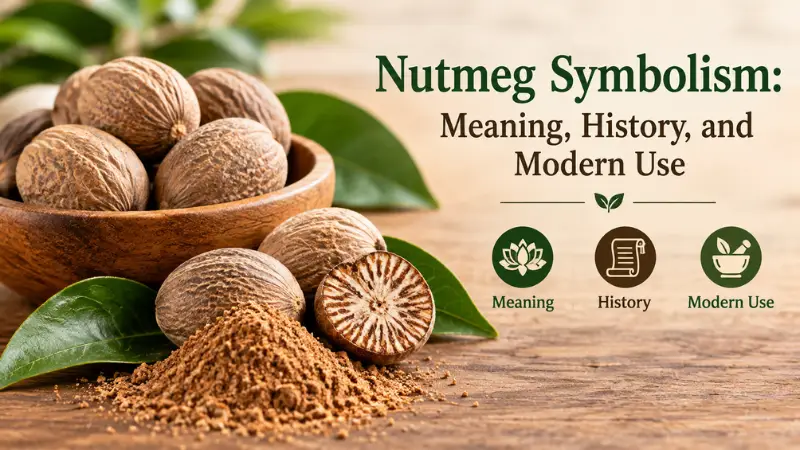
Nutmeg is the dried seed of Myristica fragrans, a tropical evergreen tree that produces a fleshy fruit. When the fruit opens, it reveals a dark seed surrounded by a bright red, lace-like covering called mace. After processing, the seed becomes the familiar brown nutmeg sold whole or ground.
Its physical characteristics contribute to its modern associations. The warm brown color suggests wood, earth, and natural materials, while its fragrant aroma is often linked with baked goods, warm beverages, and seasonal cooking.
The spice is commonly encountered in pumpkin pie, eggnog, custards, rice pudding, cream sauces, and baked vegetables. In American homes, it is especially recognizable during autumn and winter.
Nutmeg is not an established universal emblem with a fixed dictionary of meanings. Its symbolism develops from its appearance, scent, uses, and history.
2. The Core Symbolic Meanings of Nutmeg
Nutmeg has several common symbolic associations, although their importance depends on the context.
Warmth and comfort are among its most recognizable modern meanings. Its aroma is closely associated with hot drinks, freshly baked desserts, and meals enjoyed indoors during cold weather.
Hospitality and welcome arise from the spice’s place in home cooking. Serving a carefully prepared meal or offering a seasonal drink can communicate care, generosity, and attention to guests.
Prosperity and abundance reflect nutmeg’s earlier status as an expensive commodity. When access to exotic spices demonstrated wealth, nutmeg could signify privilege, luxury, and the ability to obtain goods from distant places.
Tradition and continuity emerge through family recipes. A particular smell or flavor may remind someone of a grandparent’s kitchen, an annual holiday gathering, or a childhood dessert.
These associations are related but distinct. Comfort concerns how a place or experience feels; hospitality concerns how people treat one another; prosperity concerns material resources; and tradition concerns practices passed between generations.
3. Ancient Origins and the Early Spice Trade
Nutmeg’s history begins in the Banda Islands, part of the Maluku region of present-day Indonesia. Archaeological evidence indicates that people were using nutmeg there thousands of years ago, long before European colonial powers entered the region.
Local communities cultivated and used the plant, while maritime trade eventually carried spices across wider Asian commercial networks. Nutmeg became valued for its flavor and its role in traditional preparations.
Its scarcity in distant markets helped increase its commercial value. For centuries, the Banda Islands were the principal source of nutmeg, making control over production and trade particularly important.
This history explains why nutmeg can symbolize more than domestic comfort. It also represents exchange between distant societies, specialized agricultural knowledge, and the movement of valuable goods across oceans.
The early history should not be reduced to a story of European discovery. Nutmeg was already part of established regional knowledge and commerce before Europeans arrived. The spice’s global reputation developed from the work and trade of communities in its place of origin.
4. Nutmeg as a Symbol of Wealth and Luxury
Before nutmeg became an affordable grocery-store ingredient, obtaining it in Europe could be expensive and difficult. Its distant origin, limited supply, and demand in cooking and traditional medicine contributed to its value.
Owning rare spices could signal access to international trade and the resources needed to purchase imported goods. Nutmeg therefore acquired an association with refinement and luxury, particularly in societies where exotic ingredients distinguished wealthy households from ordinary ones.
Today, the meaning has changed considerably. A small jar of ground nutmeg is inexpensive and widely available across the United States. Most people do not use it to demonstrate financial status.
However, the older association with luxury survives indirectly in the language of gourmet cooking. Freshly grated nutmeg, specialty spice collections, and carefully prepared seasonal meals can suggest craftsmanship and an appreciation for quality.
The symbolic shift is revealing: a spice once valued partly because it was difficult to obtain now represents the pleasure of making ordinary food feel special.
5. What Nutmeg Symbolizes in the United States
In modern American culture, nutmeg is most closely associated with food, seasonal comfort, and domestic life. Its meaning often emerges through familiar experiences rather than formal symbolic traditions.
During Thanksgiving, nutmeg may appear in pumpkin pie, sweet potato dishes, custards, and other traditional recipes. Around Christmas, it is commonly associated with eggnog, cookies, cakes, and warm desserts.
These foods help connect the spice with family gatherings and annual rituals. A person who smells nutmeg may remember preparing holiday meals with relatives or returning home to a familiar kitchen.
Nutmeg also fits the broader American preference for seasonal flavors. Autumn and winter products frequently combine nutmeg with cinnamon, ginger, and cloves to create a recognizable impression of warmth.
Its role in American culture is therefore primarily experiential. Nutmeg can symbolize a welcoming home, but it does not carry an official national meaning or a universally recognized cultural message.
The distinction matters because the spice’s American associations are shaped by changing food habits, family backgrounds, and regional traditions. A person who rarely eats nutmeg-flavored foods may attach little symbolism to it at all.
6. Nutmeg and the Symbolism of Holiday Traditions
Nutmeg’s strongest seasonal associations come from the foods in which Americans encounter it.
| Context | Symbolic meaning in the United States | Common association |
|---|---|---|
| Thanksgiving | Gratitude and togetherness | Pumpkin pie and family meals |
| Christmas | Celebration and generosity | Eggnog, cookies, and baked desserts |
| Autumn cooking | Comfort and seasonal change | Spiced cakes and roasted vegetables |
| Homemade gifts | Thoughtfulness and care | Cookies, cakes, and spice blends |
| Everyday meals | Nourishment and familiarity | Soups, sauces, and home cooking |
Nutmeg does not independently symbolize Thanksgiving or Christmas. Instead, it participates in the meaning of the dishes and gatherings with which people associate it.
This is an important distinction in food symbolism. A familiar ingredient becomes emotionally meaningful through repetition. When a family prepares the same dessert each December, its smell can become a reminder of the people, conversations, and rituals surrounding that occasion.
These associations can persist even when family members change locations or begin their own households. Recreating a traditional recipe offers a way to maintain continuity between generations.
7. Nutmeg, Hospitality, and the Feeling of Home
Hospitality is one of the most natural interpretations of nutmeg in contemporary American life.
The spice appears in foods that are often served to guests, from holiday desserts to warm beverages. Preparing these foods takes time and attention, making them a practical expression of welcome.
The symbolism does not come from nutmeg alone. It comes from the act of sharing something prepared for another person.
Imagine arriving at a friend’s home on a cold evening and being offered a warm drink topped with freshly grated nutmeg. The scent, temperature, and gesture may communicate comfort more effectively than an explicit statement of welcome.
Nutmeg can also suggest care in everyday cooking. A small amount added to a cream sauce or baked dish demonstrates attention to flavor and detail.
In this sense, the spice represents a particular kind of hospitality: understated, familiar, and expressed through food rather than ceremony.
Its meaning is especially relevant in homes where cooking is an important way of maintaining friendships, celebrating milestones, or keeping family customs alive.
8. Nutmeg in Traditional Medicine and Cultural Beliefs
Nutmeg has a long history of use in traditional medicinal systems, including practices in parts of South and Southeast Asia and China. Traditional preparations have associated the spice with digestion, warming qualities, and other bodily functions.
These uses have sometimes encouraged symbolic interpretations of nutmeg as a source of warmth, balance, or physical well-being. Such meanings developed within particular cultural frameworks rather than from a universal belief shared by all societies.
It is important to distinguish traditional beliefs from established medical evidence. Historical use does not prove that a preparation is effective or safe, and nutmeg should not be treated as a substitute for medical care.
Large quantities can cause serious adverse effects, including nausea, dizziness, confusion, and other symptoms of poisoning. Nutmeg is appropriate as a culinary spice in ordinary food amounts, not as a substance to consume in large quantities for supposed spiritual or medicinal benefits.
For symbolism, the useful point is that nutmeg has often been understood as more than a flavoring. In some traditions, its place in food and remedies connected it with the maintenance of health and the ordinary work of caring for the body.
9. Nutmeg’s Meaning Across Different Cultures
Nutmeg’s cultural meaning varies according to the communities that grow, trade, prepare, and consume it.
In Indonesia, particularly in the Banda Islands, nutmeg is part of local agricultural and cultural history. Its significance includes cultivation, regional identity, livelihoods, and the legacy of the international spice trade.
In parts of South and East Asia, nutmeg has appeared in culinary and traditional medicinal practices. Its meanings are best understood within those specific traditions rather than grouped into a single generalized Asian interpretation.
In Europe, the spice became associated with imported luxury and elite consumption when it was expensive and difficult to obtain. Over time, it became more widely available and entered everyday cooking.
In the United States, nutmeg is now strongly linked with home baking and seasonal food traditions.
These differences illustrate how symbols acquire meaning through use. A plant can represent a region’s history in one place, a prestigious imported commodity in another, and a familiar holiday flavor somewhere else.
Respectful interpretation requires acknowledging these different experiences rather than assigning nutmeg one universal spiritual definition.
10. The Darker History Behind Nutmeg’s Symbolism
Nutmeg’s association with prosperity has a troubling historical counterpart: the violence used to control its production.
During the seventeenth century, the Dutch East India Company sought a monopoly over the nutmeg trade in the Banda Islands. In 1621, Dutch conquest devastated the indigenous Bandanese population, and the colonial authorities established a plantation system dependent on coercion and enslaved labor.
This history complicates any simple celebration of nutmeg as a symbol of wealth or luxury. The prosperity enjoyed by some traders and consumers was connected to the exploitation of the people who produced the spice.
The history also demonstrates why cultural symbols should not be interpreted only from the perspective of their most familiar modern uses. A jar of nutmeg in an American kitchen may evoke comfort, but the ingredient’s global journey includes unequal power and human suffering.
This does not mean that nutmeg should be treated as a negative symbol in every context. It means that its commercial history deserves recognition alongside its everyday associations.
Understanding both sides allows a more complete interpretation: nutmeg can represent hospitality and abundance while also serving as a reminder of the historical costs of luxury and colonial control.
11. Nutmeg’s Emotional and Psychological Associations
The emotional meaning of nutmeg often begins with scent and memory.
Smell can prompt vivid autobiographical memories because the brain systems involved in processing odors are closely connected with regions involved in emotion and memory. A familiar aroma may therefore bring back a particular person, place, or occasion.
For someone who grew up helping a parent bake holiday pies, nutmeg might evoke safety, family closeness, or childhood excitement. For someone with different experiences, the same aroma may have no special significance.
This personal dimension helps explain why food ingredients can become symbols even without formal cultural rules.
Nutmeg may suggest:
- Nostalgia: memories of childhood meals and familiar kitchens.
- Security: the predictability of favorite foods and family routines.
- Connection: shared recipes and celebrations with loved ones.
- Pleasure: enjoyment of fragrance, flavor, and seasonal food.
- Continuity: maintaining traditions while life and circumstances change.
These meanings are possibilities, not psychological diagnoses. A person’s response depends on their memories and preferences, not on an inherent emotional property of nutmeg.
12. Nutmeg in Spirituality, Folklore, and Symbolic Practices
Nutmeg appears in some historical herbal, folk-magic, and esoteric traditions. In these settings, it may be included in preparations intended to represent prosperity, protection, luck, or well-being.
Such interpretations should be presented cautiously. There is no single, widely accepted nutmeg symbolism system across religions, and claims about its spiritual effects vary between practitioners and historical sources.
Nutmeg is not a universal religious symbol in Christianity, Judaism, Islam, Hinduism, Buddhism, or other major religious traditions. Its presence in a recipe, herbal preparation, or ritual does not automatically give it a fixed theological meaning.
For contemporary readers, nutmeg may still function as a personal symbol within a spiritual practice. Someone might associate it with abundance because it is used in a prosperity-themed ritual, while another person may simply regard it as a useful ingredient.
The difference is between a personally chosen meaning and a historically established cultural convention. Both can matter to individuals, but they should not be confused.
13. Nutmeg in Home Decor, Gifts, and Modern Lifestyle
Nutmeg’s modern symbolic associations often appear indirectly through seasonal design and lifestyle products.
In kitchens, glass spice jars, wooden bowls, and displays of whole spices can suggest natural materials, traditional cooking, and a carefully maintained home. Nutmeg’s brown color works well with the warm neutral palette commonly used in rustic and autumn-inspired interiors.
Its fragrance also appears in scented candles, room fragrances, and seasonal products. These products often combine nutmeg with cinnamon, vanilla, or clove to create an impression of comfort and familiarity.
Nutmeg can also play a role in thoughtful gifts. Homemade cookies, spice blends, and baked goods communicate effort and personal attention. The symbolism belongs to the gift-giving gesture as much as to the ingredient itself.
Unlike a flower with a conventional meaning in wedding or mourning customs, nutmeg does not have a standard role in American ceremonial design. Its value is more informal: it helps create an atmosphere associated with welcome, seasonal enjoyment, and home life.
14. Can Nutmeg Have a Negative Symbolic Meaning?
Nutmeg is generally associated with positive experiences in contemporary American food culture, but its interpretation is not entirely positive.
Historically, its value contributed to intense commercial competition, colonial conquest, and exploitation. In a discussion of global trade, nutmeg can therefore represent greed, monopoly, and the human consequences of pursuing profitable resources.
There is also a modern safety issue. Misleading claims about nutmeg’s psychoactive effects have circulated online, sometimes presenting large doses as a natural way to alter consciousness. Consuming excessive quantities can cause poisoning and should never be encouraged.
Neither issue means that nutmeg is inherently harmful or negative. Its meaning depends on the context in which it is discussed.
In a holiday kitchen, it may represent comfort and generosity. In a historical account of colonialism, it may represent exploitation and the unequal distribution of wealth. In a safety discussion, it may serve as a reminder that natural ingredients can still be dangerous when misused.
A balanced interpretation recognizes these differences without exaggerating either the positive or negative associations.
15. How Nutmeg’s Symbolism Has Changed Over Time
Nutmeg’s symbolic evolution reflects changes in availability, trade, and everyday life.
| Historical period | Position of nutmeg | Main symbolic association |
|---|---|---|
| Ancient and early regional use | Locally known and used in Indonesia | Nourishment and practical value |
| Medieval and early modern trade | Valuable imported commodity | Wealth, prestige, and luxury |
| Seventeenth-century colonial expansion | Target of monopoly and conquest | Commercial power and exploitation |
| Later household use | Increasingly available as a cooking ingredient | Familiarity and culinary tradition |
| Modern American culture | Common spice in seasonal foods | Comfort, hospitality, and nostalgia |
As nutmeg became easier to obtain, its symbolic emphasis shifted away from scarcity and toward familiarity.
The change did not erase its history. Instead, different meanings began to coexist. A modern cook may value nutmeg for its flavor without thinking about colonial trade, while a historian may regard the same ingredient as evidence of how international commerce transformed societies.
This is a common pattern in symbolism: everyday objects acquire new meanings as their economic and cultural roles change.
FAQs
1. What does nutmeg symbolize spiritually?
In some folk-magic and esoteric practices, nutmeg is associated with prosperity, protection, luck, or well-being. These meanings vary by tradition and should not be treated as universal religious beliefs or scientifically established effects.
2. What does nutmeg symbolize in American culture?
Nutmeg most commonly suggests warmth, comfort, hospitality, and seasonal celebration in the United States. Its connection with pumpkin pie, eggnog, and home baking makes it especially recognizable during autumn and winter holidays.
3. Does nutmeg symbolize wealth or abundance?
Historically, nutmeg could represent wealth because it was a valuable imported spice that was difficult to obtain in some markets. Today, abundance is more likely to be expressed through its association with generous meals, specialty cooking, and shared celebrations.
4. Why is nutmeg associated with Christmas and Thanksgiving?
Nutmeg is a familiar ingredient in American holiday recipes, including pumpkin pie, eggnog, cookies, and custards. Repeated use in seasonal meals has connected its aroma with family gatherings and annual traditions.
5. Does nutmeg have a negative meaning?
Nutmeg can represent greed, exploitation, or colonial power when discussed in the context of its historical trade. In ordinary cooking and home life, however, its associations are generally positive and do not imply anything negative about the person using it.
6. What does nutmeg symbolize in a dream?
There is no scientifically established or universally accepted meaning for nutmeg in dreams. If it appears in a dream, its significance may depend on personal memories, recent experiences, or associations with cooking, family, comfort, or a particular cultural practice.
7. Is nutmeg a religious symbol?
Nutmeg is not a universally recognized symbol of any major religion. It may appear in particular cultural, herbal, or spiritual practices, but its meaning depends on the specific tradition and how the ingredient is used.
Conclusion
Nutmeg symbolizes warmth, comfort, hospitality, and abundance most readily in modern American life. Its place in holiday baking and home cooking connects it with familiar routines, shared meals, and the memories people attach to family traditions. Historically, its value as a rare spice also linked it with wealth, international trade, and colonial competition.
Understanding nutmeg symbolism means recognizing both sides of its history. The spice can represent the simple pleasure of a homemade dessert while also reminding us how global trade connected everyday ingredients to distant places and complicated human histories.
Ultimately, nutmeg’s meaning depends on the setting and the experiences people bring to it. In a kitchen, it may evoke the warmth of home; in a historical account, it may tell a story about commerce, power, and the people whose labor brought the spice to the world.