Introduction
Orange poppies are bright, delicate flowers that bring color to fields, gardens, roadsides, and floral designs. Their vivid petals often suggest warmth, optimism, creativity, and renewal. In the United States, the orange California poppy also carries a distinct regional identity, connecting the flower to the landscapes, natural beauty, and history of the Golden State.
Understanding orange poppy symbolism means looking beyond the flower’s color. Poppies have acquired different associations across cultures, from sleep and remembrance to beauty and the return of life after destruction. However, not every meaning attached to a poppy applies equally to every variety or color.
For Americans, the orange poppy is especially recognizable because the California poppy (Eschscholzia californica) is California’s official state flower. Its golden-orange blooms appear in spring landscapes and public imagery, making it a natural emblem of sunshine, resilience, and regional pride.
Whether the flower appears in a garden, a tattoo, a painting, or a bouquet, its meaning depends on its color, setting, and the intention of the person using it.
Quick Answer
Orange poppy symbolism commonly represents optimism, warmth, creativity, and renewal in modern American culture, particularly through the bright California poppy and its association with sunny landscapes and state identity. More broadly, poppies can symbolize remembrance, beauty, and life returning after hardship, although the strongest historical remembrance tradition is associated with red poppies.
TL;DR
- Orange poppies commonly suggest optimism, warmth, creativity, and fresh beginnings.
- California’s state flower connects orange poppies with regional pride and natural beauty.
- Poppy remembrance traditions developed prominently after World War I.
- Orange poppies can express individuality, resilience, and appreciation of nature.
- Tattoos, gardens, artwork, and gifts give the flower personal meanings.
- Color and cultural context matter when interpreting a poppy’s symbolism.
1. What an Orange Poppy Looks Like
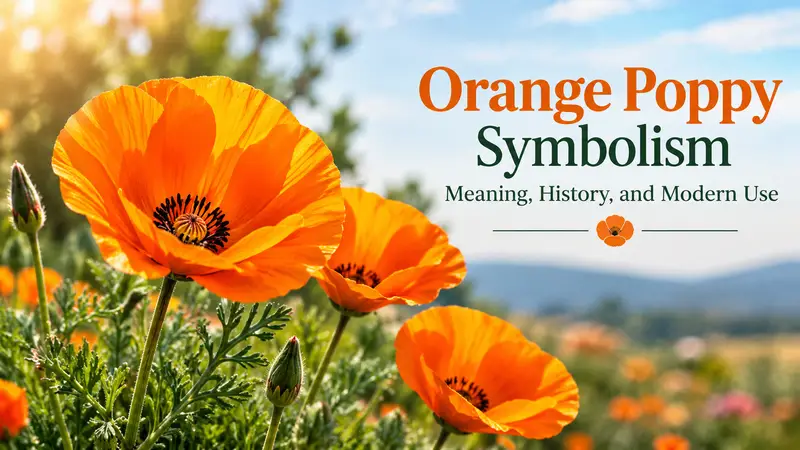
An orange poppy typically has thin, delicate petals arranged around a central cluster of stamens. Depending on the species, its color may range from pale apricot and yellow-orange to brilliant orange-red. The petals often look almost translucent in sunlight, giving the flower a light, open appearance.
One of the best-known orange poppies in America is the California poppy. Its four silky petals usually form a cup-like flower, while its blue-green foliage creates a striking contrast with the orange blooms. The plant grows naturally across parts of the western United States and is particularly associated with California’s spring hillsides.
Orange poppies also appear in cultivated gardens, wildflower illustrations, botanical prints, fabrics, greeting cards, and digital artwork. Their recognizable shape makes them useful in both naturalistic and stylized designs.
The exact species matters. A California poppy is botanically different from the familiar red corn poppy associated with World War I remembrance. Although both belong to the poppy family, their cultural associations are not identical.
2. The Main Symbolic Meanings of Orange Poppies
Orange poppies do not have one universally established symbolic definition. Their contemporary meanings usually emerge from a combination of flower symbolism, color associations, and regional identity.
Optimism and positivity
Orange is commonly associated with warmth, enthusiasm, and friendliness. An orange poppy can therefore represent an upbeat outlook, a hopeful attitude, or the desire to welcome more joy into everyday life.
Someone might choose orange poppies for a cheerful garden, an encouraging card, or artwork intended to brighten a room.
Creativity and self-expression
The flower’s vivid color can suggest imagination and originality. In illustrations, fashion, or personal artwork, orange poppies may communicate a willingness to stand out rather than follow conventional choices.
Renewal and fresh beginnings
Poppies often appear in seasonal wildflower displays, making them natural images of spring and renewed growth. Their blooms can represent a new chapter, recovery after a difficult period, or the decision to approach life with fresh energy.
Appreciation of nature
The California poppy’s association with open landscapes gives the flower another meaning: respect for the natural world. In gardens and environmental artwork, it can represent wild beauty, local ecosystems, and the value of protecting native plants.
These meanings are interpretations rather than fixed rules. An orange poppy may symbolize something different to someone who associates it with a particular place, person, or experience.
3. Why Orange Is Symbolically Important
Color contributes substantially to the way people interpret flowers. Although color symbolism varies by culture and individual experience, orange often occupies a middle ground between the energy associated with red and the brightness associated with yellow.
Red can suggest passion, urgency, courage, or sacrifice. Yellow commonly evokes sunlight, happiness, and warmth. Orange combines some of these associations, producing a color that often feels energetic without carrying exactly the same intensity as red.
When applied to a poppy, orange can emphasize the flower’s cheerful and life-affirming qualities rather than the mourning associations commonly attached to red remembrance poppies.
Orange also stands out against green leaves and blue skies. This visual contrast helps explain why orange poppies are frequently used to communicate vitality and draw attention in gardens, artwork, and decorative designs.
Color psychology is not a universal system, however. Orange does not automatically make everyone feel happy, and a flower’s meaning cannot be determined by color alone. Personal memories, cultural expectations, and the surrounding imagery all influence interpretation.
4. The California Poppy and American Identity
The California poppy holds a special place in American floral symbolism because it is the official state flower of California. The state designated Eschscholzia californica as its flower on March 2, 1903.
Its bright orange blooms are closely associated with California’s natural landscape. In favorable conditions, poppies can cover hillsides and open fields with expansive displays of orange and gold. These seasonal scenes have become recognizable images of the state’s outdoor beauty.
The flower’s symbolism often overlaps with the idea of the Golden State itself. Its warm color recalls sunshine and golden landscapes, while its ability to grow in dry conditions suggests adaptation to the environment.
For Californians, an orange poppy may express regional pride, affection for the outdoors, or a connection to home. For people elsewhere in the country, it may represent a memorable visit, a love of wildflowers, or an appreciation of the American West.
The California poppy is also celebrated on California Poppy Day, observed annually on April 6. Its official status makes the flower more than a decorative motif: it is a recognizable part of California’s public identity.
5. Historical Origins of Poppy Symbolism
Poppies have acquired different meanings over many centuries, and those meanings should not be treated as a single unchanging tradition.
In earlier European literary and floral traditions, poppies were sometimes associated with sleep, rest, and forgetfulness. These connections were influenced partly by the sleep-inducing properties of certain poppy species, particularly the opium poppy. Ancient Greek and Roman imagery also connected poppies with sleep-related deities and agricultural fertility.
Not all poppies contain the same compounds or have the same effects. The California poppy is a distinct species, and historical associations involving the opium poppy should not automatically be transferred to it.
In nineteenth-century Europe and America, the language of flowers became popular as a way to communicate emotions through bouquets. Particular flowers and colors could be used to convey affection, consolation, or other sentiments, although meanings differed among published guides.
The poppy’s modern association with military remembrance developed much later, particularly during and after World War I. That development created a new cultural meaning that became especially prominent for red poppies.
Orange poppy symbolism draws more directly on the flower’s appearance, color, and regional associations than on a single ancient symbolic tradition.
6. How the Poppy Became a Symbol of Remembrance
The poppy’s best-known modern historical association began during World War I. Red field poppies grew in areas of northern France and Belgium where fighting had disturbed the soil.
Canadian physician and soldier John McCrae drew inspiration from this landscape when he wrote the poem In Flanders Fields in 1915. The poem connected poppies growing among soldiers’ graves with loss, sacrifice, and the responsibility to remember those who had died.
In 1918, American humanitarian Moina Michael read McCrae’s poem and began advocating for the red poppy as a memorial emblem. She also promoted the sale of artificial poppies to support veterans and their families. The American Legion adopted the poppy as its official flower in 1920, helping establish its place in American remembrance traditions.
The Veterans of Foreign Wars subsequently developed its Buddy Poppy program, using artificial poppies to honor fallen service members and support veterans.
Today, red poppies remain associated with military remembrance, particularly around Memorial Day in the United States. In other countries, including the United Kingdom, the flower is strongly linked with November’s Remembrance Day observances.
This history matters when interpreting orange poppies because it provides an important distinction: the remembrance tradition is primarily associated with red poppies, not orange ones. An orange poppy can still commemorate a person or event, but that meaning generally depends on personal intention rather than an established national convention.
7. Orange Poppy Symbolism Compared With Other Poppy Colors
Different poppy colors can create different impressions, but there is no universal color dictionary that determines what every flower must mean.
| Poppy color | Common interpretation | Typical context | Important distinction |
|---|---|---|---|
| Orange | Optimism, warmth, creativity, renewal | Gardens, artwork, California imagery | Often based on color and regional associations |
| Red | Remembrance, sacrifice, love | Military memorials, commemorative displays | Strongly established in World War I remembrance |
| Yellow | Brightness, cheerfulness, hope | Wildflower gardens, floral designs | Meanings vary by setting |
| White | Peace, consolation, remembrance | Memorial artwork and floral arrangements | Not a universal religious or cultural code |
| Pink | Affection, tenderness, beauty | Gifts, decorative art, personal designs | Usually interpreted through general color associations |
These are common interpretations, not formal rules. A person may choose a particular color simply because they like it, or because it reminds them of someone important.
When the purpose is to honor military service, a red remembrance poppy carries a more widely recognized historical meaning in the United States. Orange is often a more natural choice for themes involving California, nature, optimism, or personal renewal.
8. Emotional and Psychological Meaning
Orange poppies can communicate a combination of brightness and delicacy. Their vivid petals attract attention, while their fragile appearance can suggest that beauty deserves care.
For some people, the flower represents optimism during a transition. Someone beginning a new career, recovering from a setback, or moving to another city might use orange poppies in artwork as a reminder to remain open to change.
For others, the association is more personal. A poppy growing near a childhood home, appearing during a memorable trip, or being planted by a family member can become a symbol of belonging and continuity.
The color can also convey energy without necessarily implying aggression or intensity. This makes orange poppies suitable for designs intended to feel lively, welcoming, or expressive.
Psychological responses to color are influenced by experience and context, so these interpretations should not be treated as scientific predictions about how every person will feel. The strongest emotional meaning is often the one attached to the flower by the individual using it.
9. Orange Poppies in Gardens and Home Decor
In gardens, orange poppies can represent an appreciation for natural beauty and seasonal change. California poppies are especially valued for their vivid blooms and their ability to thrive in sunny, relatively dry conditions.
Gardeners may associate them with a relaxed outdoor lifestyle, native-plant gardening, or the return of spring. Because they often grow in broad patches, they can also create a visual impression of abundance and shared growth.
Inside the home, orange poppy prints and decorative objects can introduce warmth into a room. A botanical print may communicate an interest in plants, while a stylized orange flower can serve as a cheerful accent in a living room, workspace, or kitchen.
In floral design, the flower’s open shape and saturated color can draw attention without requiring an elaborate arrangement. Orange poppies may work well in artwork and decorative compositions that emphasize sunlight, countryside scenery, or an informal garden aesthetic.
The meaning depends on presentation. A realistic field of California poppies may emphasize regional identity and nature, while a single orange bloom against a plain background may focus on individuality or personal growth.
10. What Orange Poppy Tattoos Can Represent
An orange poppy tattoo can combine the flower’s visual appeal with a personal interpretation of its color and natural associations. Unlike a widely recognized emblem, it does not have one standardized meaning in tattoo culture.
Common personal interpretations include:
- New beginnings: A reminder of a fresh start after a major life change.
- Resilience: An image of continued growth despite difficult circumstances.
- Creativity: A celebration of artistic expression or individuality.
- Connection to California: A tribute to a home state, a favorite landscape, or a meaningful trip.
- Nature and freedom: An expression of affection for wildflowers and the outdoors.
- Personal remembrance: A way to honor someone whose memory is connected with the flower.
Design choices can influence how the tattoo is understood. A small, simple bloom may feel understated and intimate, while several poppies across a forearm or shoulder may emphasize movement, color, and natural abundance.
Adding a date, name, landscape, or other personal detail can make the meaning more specific. Someone choosing a tattoo to commemorate a military death should also consider whether they want to use the historically established red remembrance poppy or a different color chosen for personal reasons.
Ultimately, a tattoo’s meaning belongs primarily to the person wearing it. Other people may recognize the flower but cannot reliably infer the wearer’s story from the color alone.
11. Orange Poppies in Gifts, Fashion, and Digital Culture
Orange poppies can be used in gifts and personal design when the intended message is cheerful, supportive, or connected to nature.
A botanical card featuring an orange poppy might congratulate someone on a new beginning. A printed scarf or piece of jewelry may express an interest in wildflowers, while a framed illustration can recall a favorite landscape.
In digital culture, orange poppy illustrations and photographs appear in seasonal posts, garden updates, nature photography, and personal artwork. Their vivid color makes them visually distinctive in a crowded image feed.
The flower may also appear in designs promoting native gardening or appreciation for local ecosystems. In those settings, the image can communicate a concrete interest in plants rather than a general symbolic message.
There is no single social media meaning or universal emoji interpretation for the orange poppy. If the flower is used in a post, its caption and surrounding images help establish whether it represents a place, a memory, a creative project, or simply a beautiful bloom.
12. Religious and Cross-Cultural Interpretations
Poppy symbolism differs across religious, literary, and cultural traditions. The species, color, and historical setting all influence its interpretation.
In ancient Mediterranean traditions, poppies were sometimes associated with sleep, rest, and fertility. Such associations appeared in mythology and agricultural imagery, but they did not create a universal meaning for every modern poppy variety.
In European remembrance traditions, red poppies became linked to military sacrifice through World War I poetry and commemorative practices. The association is historical and civic rather than a universal religious requirement.
Orange poppies do not have one widely accepted religious meaning across Christianity, Islam, Buddhism, Hinduism, or other faiths. An individual or community may use the flower in a spiritual setting, but its significance should be understood through that particular context rather than assumed from the color.
Cultural respect also requires distinguishing botanical traditions from broad claims about Indigenous peoples or other communities. Some Native peoples have used certain poppy species in traditional practices, but uses vary by community and plant. It would be inaccurate to assign a single spiritual meaning to all Indigenous traditions or to assume that every poppy is used in the same way.
For a general American audience, the clearest established cultural distinction remains the California poppy’s regional identity and the red poppy’s military-remembrance history.
13. Misunderstandings and Misuse of Poppy Symbolism
One common misunderstanding is that every poppy automatically symbolizes fallen soldiers. The red remembrance poppy has a well-established military history, but poppies also appear in gardening, art, mythology, and everyday decoration.
A second mistake is treating orange and red poppies as interchangeable. Their botanical relationship does not erase their different public associations. Orange poppies are often connected with California and bright natural landscapes, while red poppies are more widely recognized as memorial flowers.
Another source of confusion is the assumption that color meanings are universal. Orange may represent enthusiasm or warmth in one design, but a personal memory or cultural setting can give it another meaning. No color guarantees a specific emotional response.
Poppies can also be used in commercial designs that borrow the appearance of a commemorative flower without explaining the historical context. This is not automatically disrespectful, but it can cause confusion when a design appears to represent military remembrance while using a different flower or color.
Finally, botanical identity matters outside symbolism. California poppies are not the same species as opium poppies, and a flower’s appearance alone does not establish its chemical properties or safety. Symbolic interpretation should not be confused with medical or botanical claims.
14. How Orange Poppy Meaning Continues to Evolve
The meaning of the orange poppy continues to develop through gardening, design, regional identity, and individual experience. Its contemporary associations do not depend on a single ancient legend or official symbolic code.
In California, its status as the state flower gives it a public meaning that extends beyond personal taste. Photographs of orange hillsides can evoke the state’s landscape, while native-plant gardens connect the flower to local ecology.
In personal art and tattoos, the orange poppy can take on more individualized meanings, including recovery, creativity, or a connection to a particular place. These interpretations grow from the flower’s visual qualities and the experiences of the people who choose it.
The wider poppy family also carries a separate legacy of remembrance. That history remains important, but it should not overshadow the other ways poppies are used in ordinary life.
The result is a flexible symbol: recognizable enough to evoke nature and warmth, yet open to personal interpretation. Its meaning becomes clearest when the flower’s color, species, and setting are considered together.
FAQs
What does an orange poppy symbolize spiritually?
An orange poppy may represent renewal, gratitude, hope, or a renewed appreciation for nature in a personal spiritual practice. These are individual interpretations rather than a universally established religious meaning.
Does an orange poppy symbolize remembrance?
It can represent personal remembrance when someone chooses it to honor a loved one or commemorate an event. However, the established military-remembrance tradition in the United States is primarily associated with the red poppy.
What does an orange poppy tattoo mean?
An orange poppy tattoo can symbolize a fresh start, resilience, creativity, or a connection to California and the outdoors. Its precise meaning depends on the wearer’s experiences and any additional design elements.
Why is the orange poppy associated with California?
The California poppy is the state’s official flower, designated in 1903. Its bright orange blooms are a familiar feature of California’s spring landscape and have become a recognizable emblem of the Golden State.
Is an orange poppy a symbol of good luck?
There is no widely established American tradition that assigns orange poppies a specific good-luck meaning. A person may choose one as a wish for good fortune because its bright color suggests optimism and a positive outlook.
Are orange poppies and red remembrance poppies the same flower?
They belong to the poppy family, but they are not necessarily the same species, and their cultural associations differ. The California poppy is known for its orange blooms and regional identity, while the red corn poppy is strongly associated with World War I remembrance.
Can I give orange poppies as a gift?
Yes. Orange poppies can be a thoughtful choice for someone who loves wildflowers, appreciates California, or is celebrating a new chapter in life. Because flower meanings vary, a short personal note can make the intended message clear
Conclusion
Orange poppy symbolism centers on optimism, warmth, creativity, renewal, and appreciation of nature. In the United States, the California poppy adds a distinctive regional dimension, connecting the flower with the Golden State’s landscapes and identity. Its meaning can also become personal through gardens, gifts, artwork, and tattoos.
The poppy’s broader history includes associations with sleep and rest, as well as the red flower’s established role in military remembrance. Keeping these traditions distinct makes it easier to understand what an orange poppy communicates in a particular setting.
Whether it represents a fresh start, a beloved landscape, or simply the beauty of a wildflower, an orange poppy offers a clear reminder that meaning comes from both cultural history and personal experience.