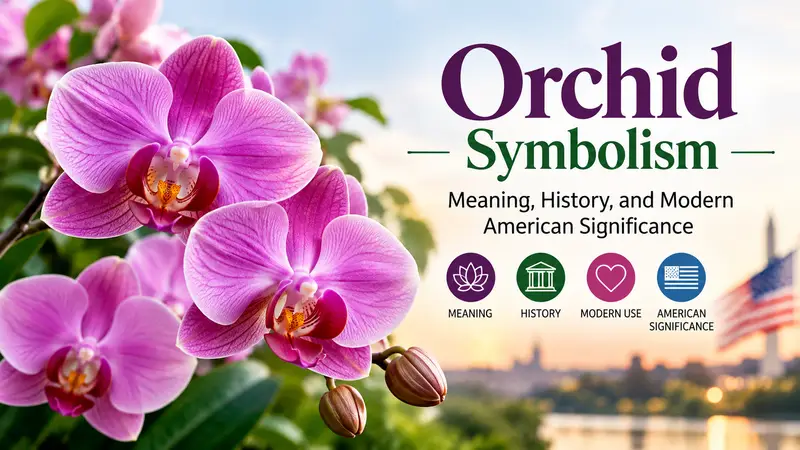
Orchid Symbolism: Meaning, History, and Modern American Significance
Introduction
Orchids are admired for their unusual shapes, graceful stems, and flowers that can remain attractive for weeks with proper care. In modern American culture, orchid symbolism commonly centers on beauty, elegance, love, admiration, and individuality. These flowers appear in wedding arrangements, anniversary gifts, home decor, and thoughtful gestures when ordinary roses feel too familiar.
Unlike flowers with a single, widely recognized association, orchids carry several meanings shaped by history, color, cultural traditions, and personal experience. Their reputation for refinement developed partly because many varieties were once difficult and expensive to obtain. In other traditions, orchids came to represent qualities such as moral character, friendship, and scholarly cultivation.
Understanding orchid symbolism means looking beyond appearance. The flower’s unusual structure, long history of cultivation, and place in different societies help explain why it can communicate romantic affection, respect, luxury, or personal growth.
Quick Answer
Orchid symbolism most commonly represents beauty, elegance, love, admiration, and refinement in modern American culture, especially in gifts, weddings, and home decor. Historically, orchids have also been associated with fertility in ancient Greek traditions, moral virtue and friendship in Chinese culture, and wealth and exclusivity during the Victorian era.
TL;DR
- Orchids commonly symbolize beauty, elegance, affection, and admiration.
- Ancient Greek associations connected orchids with fertility and reproduction.
- Chinese traditions linked orchids with virtue, integrity, and refined character.
- Victorian orchid collecting helped establish associations with luxury and status.
- Flower color can influence modern interpretations of orchid gifts.
- Tattoos, jewelry, weddings, and interiors use orchids to express personal style.
1. What Makes an Orchid Symbolically Distinctive?
Orchids belong to one of the largest families of flowering plants, with species adapted to a remarkable range of environments. Their flowers often feature bilateral symmetry, distinctive petals, and a specialized structure called the lip, which helps attract pollinators.
Many popular orchids, including moth orchids (Phalaenopsis), have broad, rounded petals and arching flower spikes. Others, such as Cattleya orchids, produce large, showy blooms, while Dendrobium varieties can form clusters along upright canes.
These differences contribute to the flower’s symbolic appeal. An orchid can look delicate without being short-lived, exotic without being unfamiliar, and decorative without appearing ordinary. Its combination of unusual form and careful cultivation encourages associations with individuality, refinement, and attention.
Orchids are also widely available in American garden centers and grocery stores today. This accessibility has changed their everyday meaning: a flower once associated with expensive collections can now be a housewarming gift, a birthday present, or a plant someone grows on a windowsill.
2. The Core Meanings of Orchid Symbolism
Several associations recur in contemporary interpretations of orchids, although no single meaning applies to every species or situation.
Beauty and elegance: The orchid’s distinctive shape and graceful presentation make it a natural choice for formal events, sophisticated interiors, and gifts intended to feel special.
Love and affection: Orchids can communicate romantic interest, enduring affection, or appreciation. They offer an alternative to conventional red roses, particularly when the recipient prefers distinctive flowers.
Admiration and respect: Giving an orchid can acknowledge someone’s achievements, taste, or character. Its refined appearance makes it suitable for professional milestones, graduations, and meaningful personal occasions.
Luxury and distinction: Rare varieties, unusual colors, and elaborate hybrids have contributed to the orchid’s association with exclusivity and cultivated taste.
Strength and resilience: Some people interpret the plant’s ability to bloom repeatedly under suitable conditions as a reminder of patience, adaptation, and renewal. This is a modern personal interpretation rather than a universal historical definition.
These meanings overlap, but context matters. A flowering orchid sent to a partner may suggest affection, while the same plant presented to a colleague may communicate appreciation and respect.
3. Ancient Greek Origins and Associations With Fertility
The word orchid derives from the ancient Greek orchis, meaning testicle. The name refers to the shape of the paired underground tubers found in certain terrestrial orchids.
Ancient Greek writers associated these plants with reproduction and fertility. Theophrastus, an early Greek writer on plants, discussed orchids in works on botanical subjects, and later traditions connected the appearance of their tubers with beliefs about conception and a child’s sex.
These associations belong to the historical understanding of plants and reproduction, not modern medical science. The shape of a plant does not establish a biological effect, and orchids should not be treated as fertility remedies on the basis of ancient beliefs.
Nevertheless, this history helps explain why fertility sometimes appears in discussions of orchid symbolism. It is an older association rooted in the plant’s name and physical appearance, distinct from the modern American emphasis on elegance and admiration.
It is also important not to assume that every orchid species carried the same meaning in ancient Greece. The orchid family is extraordinarily diverse, and historical references to particular plants cannot automatically be applied to every species grown today.
4. Orchid Symbolism in Chinese Culture
Chinese cultural traditions provide a different perspective on the orchid. Rather than emphasizing luxury alone, classical Chinese literature and artistic traditions have associated the flower with virtue, integrity, refinement, and cultivated character.
The orchid became one of the plants associated with the Confucian ideal of the junzi, often translated as a noble person or exemplary gentleman. The comparison draws on the idea that a person of good character maintains integrity even without public recognition.
In classical writing, the orchid’s fragrance and ability to grow away from crowded, prominent places could suggest goodness that does not depend on praise. Its beauty was therefore connected with character rather than simply outward appearance.
Orchids also appear in Chinese painting, poetry, and calligraphy. Their depiction can communicate restraint, scholarly taste, and an appreciation for natural forms. In these settings, the artist may value the flower’s understated elegance rather than its commercial rarity.
For a modern reader, this tradition offers a useful distinction: an orchid can represent not only looking refined but also possessing qualities worthy of respect. The interpretation depends on the cultural and artistic context, rather than on a universal meaning shared by all Chinese people.
5. Victorian Orchid Mania and the Symbol of Luxury
During the nineteenth century, orchids became highly desirable among wealthy European collectors. Improved transportation, botanical exploration, greenhouse technology, and the introduction of unfamiliar tropical species helped fuel a collecting craze often called orchidelirium.
For affluent collectors, rare orchids demonstrated access to money, specialized knowledge, and the resources needed to maintain delicate or demanding plants. Greenhouses and private collections could become visible signs of social standing.
This association helped establish the orchid as a symbol of luxury, exclusivity, and sophistication in Western culture. The flower’s unusual appearance was part of its appeal, but scarcity and expense also shaped how people perceived it.
The Victorian period also popularized floriography, or the language of flowers, in Britain and North America. People used flower dictionaries to interpret bouquets and communicate sentiments indirectly. These systems were not standardized, however, and different publications could assign different meanings to the same plant.
Some Victorian references connected particular orchids with refinement, beauty, virtue, or mature charm. Those historical associations should be treated as period-specific interpretations rather than an official code governing every orchid today.
The legacy remains visible in contemporary floral design. An orchid arrangement can still suggest a special occasion or elevated taste, even though many cultivated orchids are now affordable and widely available.
6. What Orchids Mean in the United States Today
In the United States, orchids are commonly associated with elegance, affection, admiration, and thoughtful presentation. Their meaning often emerges from the occasion rather than from a fixed cultural rule.
At weddings, orchids may appear in bouquets, boutonnieres, ceremony arrangements, and reception centerpieces. Their sculptural shapes work well in both traditional and contemporary designs. Depending on the couple’s choices, they can suggest romance, sophistication, or an appreciation for distinctive natural beauty.
In homes, a potted orchid can communicate care and attention to detail. It may sit on a dining table, brighten an office, or serve as a housewarming present. Because many orchids rebloom when their growing needs are met, owners may also associate them with patience and continuing renewal.
In professional settings, orchids are often suitable gifts for promotions, retirements, business openings, and expressions of gratitude. They generally feel polished without carrying the strongly romantic association that red roses can have.
American interpretations are not uniform. Someone who has grown orchids for years may value their botanical diversity, while another person may simply appreciate a beautiful flowering plant. Family traditions, memories, and individual preferences can be as important as historical symbolism.
7. Orchid Colors and Their Symbolic Associations
Orchid color can shape the message a gift communicates, but color meanings are flexible cultural conventions rather than universal rules.
| Orchid color | Common modern association | Suitable context | Important nuance |
|---|---|---|---|
| White | Elegance, sincerity, simplicity | Weddings, formal gifts, home decor | Not every white orchid has a religious meaning. |
| Pink | Affection, tenderness, admiration | Birthdays, anniversaries, appreciation | The intensity of pink can change the overall impression. |
| Purple | Luxury, dignity, distinction | Milestones, formal occasions, decor | The association with royalty and prestige varies by culture. |
| Yellow | Cheerfulness, friendship, optimism | Thank-you gifts, celebrations | Yellow does not automatically signify jealousy or betrayal. |
| Red | Passion, desire, romantic interest | Romantic gifts and expressive arrangements | The specific meaning depends on the recipient and occasion. |
| Orange | Enthusiasm, energy, creativity | Congratulations and celebratory gifts | These are contemporary associations, not a fixed historical code. |
When choosing an orchid, consider the recipient’s taste and the setting. A white orchid may feel understated and formal, while a vivid purple or orange variety may suit someone who enjoys bold colors.
Color can support the intended message, but it should not replace personal judgment. There is no universally accepted orchid-color dictionary that determines exactly what a recipient will understand.
8. Orchid Symbolism in Love, Romance, and Relationships
Orchids can express affection without relying on the familiar visual language of roses. Their distinctive appearance makes them appealing to people who want a romantic gift that feels individual or understated.
A pink orchid may communicate tenderness or admiration, while a red variety can create a more passionate impression. A carefully chosen potted orchid may also suit a long-term relationship because it can continue growing after the original occasion has passed.
In a wedding or anniversary arrangement, orchids can represent the beauty of a relationship and the intention to nurture it. Their continued flowering under suitable conditions may encourage a personal association with commitment and care, although this is an interpretation rather than an established botanical guarantee.
Orchids are not exclusively romantic, however. They can also express gratitude between friends, appreciation for a mentor, or congratulations for a meaningful achievement.
The clearest message usually comes from the relationship itself. A thoughtful note explaining why the recipient was chosen for the gift communicates more than assuming the flower carries a single hidden meaning.
9. Emotional and Psychological Meaning of Orchids
Flowers can influence how people experience a space, remember an event, or interpret a gesture. Orchids often create an impression of order and refinement because their blooms have distinctive shapes and are commonly displayed in carefully arranged pots or floral designs.
For some people, an orchid represents patience. The plant may spend periods without flowers, and successful reblooming can require attention to light, temperature, watering, and the needs of its particular variety. Caring for it may become a reminder that progress is not always immediately visible.
Others associate orchids with personal milestones. A plant received after graduation, during recovery from a difficult period, or at the beginning of a new home may become attached to that memory. The meaning comes from the experience, not solely from the flower’s traditional associations.
Orchids can also express identity. Someone who grows unusual species may see the hobby as a sign of curiosity, botanical knowledge, or appreciation for detail. A person who chooses orchids for interior design may value their sculptural appearance and understated formality.
These emotional responses are individual. There is no reliable basis for claiming that every person interprets orchids in the same psychological way.
10. Orchid Tattoos, Jewelry, and Personal Style
Orchid imagery appears in tattoos, necklaces, earrings, brooches, clothing, and decorative accessories. In these settings, the flower becomes a lasting visual statement rather than a temporary gift.
An orchid tattoo may represent elegance, affection, individuality, personal growth, or a significant relationship. Someone may choose a specific species because it reminds them of a family member, a memorable trip, or a plant they grew at home.
The design can change the impression. A fine-line orchid may emphasize delicacy and restraint, while a large, brightly colored design can highlight confidence and expressive personal style. Roots, leaves, unopened buds, and multiple blooms can add personal details without carrying universally established meanings.
In jewelry, orchids can suggest refinement or appreciation for botanical art. Their distinctive petals lend themselves to stylized metalwork, gemstone arrangements, and floral motifs.
The same caution applies to tattoo symbolism as to flower gifts: an orchid tattoo does not automatically reveal a person’s romantic history, personality, or beliefs. The wearer’s explanation is more reliable than a generalized meaning found in a symbolic dictionary.
11. Orchids in Interior Design, Fashion, and Digital Culture
Orchids occupy a distinctive place in American visual culture because they can look natural while also appearing carefully composed. Designers use them in hotel lobbies, offices, spas, restaurants, and residential interiors where a clean, refined atmosphere is desired.
A single orchid in a simple pot can serve as a focal point without requiring a large arrangement. Several flowering stems can create a more formal display for celebrations or public spaces.
In fashion, orchid prints and floral accessories may suggest romance, sophistication, or a connection with tropical landscapes. These meanings depend on the design: a delicate pastel pattern creates a different impression from a vivid, oversized orchid motif.
On social media, orchids frequently appear in plant-care posts, gardening communities, home-decor photographs, and images celebrating a new bloom. For experienced growers, a photograph may document a rare species or a successful flowering cycle rather than communicate a symbolic message.
Digital culture also makes personal interpretations easier to share. Someone may describe an orchid as a reminder of resilience or a fresh start, but that individual association should not be confused with a meaning accepted across all cultures.
12. Orchid Symbolism in Other Cultural Traditions
Orchid symbolism varies across cultures, and it is important to distinguish well-established traditions from modern interpretations.
In Chinese artistic and literary traditions, orchids can represent virtue, refinement, integrity, and scholarly character. Their importance comes partly from associations between the plant and ideals of cultivated conduct.
In Japan, orchids have also been appreciated in horticulture, art, and traditional plant cultivation. Certain orchids can evoke refinement and restrained beauty, although the meaning depends on the species, period, and setting. It would be inaccurate to claim that all Japanese traditions assign orchids one fixed symbolic message.
In Western societies, the orchid’s associations with beauty and luxury were reinforced by nineteenth-century collecting and later floral design. Contemporary gifts often combine those inherited associations with personal ideas about affection and celebration.
Orchids have also become meaningful symbols in some intersex advocacy contexts. The connection draws in part on the Greek origin of the plant’s name and its historical association with reproductive anatomy. In this context, the flower may be used to express intersex visibility, identity, and opposition to non-consensual medical interventions on intersex children.
This use is distinct from the orchid’s more familiar decorative and romantic meanings. It should be understood in its specific social context rather than treated as a universal interpretation of every orchid image.
13. Common Misunderstandings About Orchid Symbolism
Popular flower-meaning lists can make symbolism appear more precise than it really is. Several common misconceptions are worth avoiding.
Every orchid has the same meaning. Orchid species differ in appearance, growing habits, history, and cultural associations. A symbolic interpretation connected with one variety does not automatically apply to the entire family.
Every color has a fixed emotional message. White, pink, purple, and yellow orchids may suggest particular moods, but these associations are not universal. The occasion and the recipient’s preferences can matter more than color alone.
Ancient symbolism proves a practical effect. Historical associations between orchids and fertility reflect earlier beliefs about plants and reproduction. They do not demonstrate that orchids improve fertility or have medical benefits.
Orchids are always symbols of wealth. This association has a historical basis in expensive Victorian collecting, but modern orchids are widely available. Today, they can represent a simple appreciation for flowers as easily as luxury.
A flower gift always communicates romance. Orchids are also given to friends, colleagues, relatives, and hosts. The relationship and circumstances help determine what the gesture means.
A careful interpretation leaves room for history without forcing every flower into a single symbolic category.
14. How Orchid Symbolism Has Evolved
The orchid’s symbolic history reflects changes in how people understood plants and assigned value to them.
In ancient Greece, the plant’s name and the appearance of certain tubers contributed to fertility-related associations. In Chinese literary traditions, the orchid developed a connection with virtue, refinement, and cultivated character.
During the nineteenth century, the growing availability of exotic plants and the expense of collecting them strengthened the orchid’s association with prestige in Europe. Victorian flower-language books added another layer by treating blooms as possible vehicles for expressing emotions.
Modern American culture has broadened the flower’s everyday role. Orchids are no longer limited to specialist collections or elaborate formal arrangements. They are sold as houseplants, used in contemporary weddings, presented as gifts, and incorporated into fashion and art.
This evolution shows why orchid symbolism cannot be reduced to one ancient definition. The flower’s meaning changes as people encounter it in new settings, while older associations remain available to those who know its history.
FAQs
1. What does an orchid symbolize spiritually?
Some people interpret orchids as symbols of harmony, renewal, patience, or personal development. These spiritual associations vary by individual and tradition; there is no single spiritual meaning accepted by every religion or culture.
2. Are orchids a symbol of love?
Yes, orchids are commonly used to express affection, admiration, and romantic interest in modern American gift-giving. They can also communicate friendship or appreciation, so their meaning depends on the relationship and occasion.
3. What does an orchid tattoo mean?
An orchid tattoo may represent elegance, individuality, affection, resilience, or a meaningful personal memory. Its specific meaning depends on the wearer’s intentions, the design, and any additional elements included in the tattoo.
4. What does a white orchid symbolize?
White orchids often suggest elegance, sincerity, simplicity, and a formal sense of beauty. They are popular in weddings and interior arrangements, but they do not automatically indicate mourning, purity, or a particular religious belief.
5. Are orchids considered good luck?
Some people give or grow orchids as positive symbols of growth, prosperity, or a fresh beginning. However, there is no universal rule that orchids bring good or bad luck; such beliefs depend on personal and cultural traditions.
6. What did orchids mean in Victorian times?
Victorian-era associations included refinement, beauty, distinction, and, in some contexts, mature charm or virtue. The exact interpretation varied across flower dictionaries, and the orchid’s expense and rarity also made it a recognizable sign of status.
7. Why are orchids associated with luxury?
Rare tropical orchids were highly prized by nineteenth-century collectors, who invested considerable resources in obtaining and cultivating them. That history helped establish an association with exclusivity and refined taste, even though many orchids are affordable today.
Conclusion
Orchid symbolism brings together several ideas: beauty, elegance, affection, admiration, and distinction. Its history adds further layers, from ancient Greek fertility associations to Chinese ideals of virtue and the Victorian fascination with rare plants. In modern American life, orchids have become versatile gifts and decorative plants whose meanings depend on color, occasion, and personal experience.
The most useful way to interpret an orchid is to consider both its cultural history and the reason it was chosen. Whether it marks a celebration, expresses appreciation, or reminds someone of a personal milestone, the flower’s meaning becomes clearest when its appearance is connected to the intention behind it.