Introduction
Pecans are more than a familiar ingredient in pies, pralines, and holiday desserts. In American culture, pecan symbolism often reflects prosperity, nourishment, family connection, patience, and the rewards of long-term growth. These associations come from the nut’s natural characteristics, its agricultural history, and its place in regional food traditions.
Unlike symbols that carry a single established meaning across religions or cultures, the pecan has a more practical and personal kind of significance. A bowl of pecans on a kitchen table might suggest hospitality, while a mature pecan tree can represent endurance, family roots, and the value of caring for something over many years.
Pecans also have a distinct place in the United States, particularly across the South, where they appear in family recipes, seasonal celebrations, local agriculture, and regional identity. Understanding their symbolism means looking at both their natural qualities and the human traditions that have grown around them.
Quick Answer
Pecan symbolism most commonly represents prosperity, nourishment, family togetherness, patience, and lasting growth in modern American culture, especially through Southern food traditions, holiday gatherings, and the pecan tree’s long life. Historically, pecans were an important food for Indigenous peoples of North America and later became closely associated with Southern agriculture, regional identity, and hospitality.
TL;DR
- Prosperity: A plentiful pecan harvest can suggest abundance and material well-being.
- Family: Pecan desserts often represent shared memories and multigenerational traditions.
- Patience: The slow growth of pecan trees reflects commitment and long-term rewards.
- Nourishment: Pecans symbolize practical care, sustenance, and generosity.
- American identity: Pecans are strongly connected with Southern cuisine and agricultural heritage.
- Personal meaning: A pecan tree or nut can represent roots, resilience, and continuity.
1. What Does a Pecan Look Like as a Symbol?
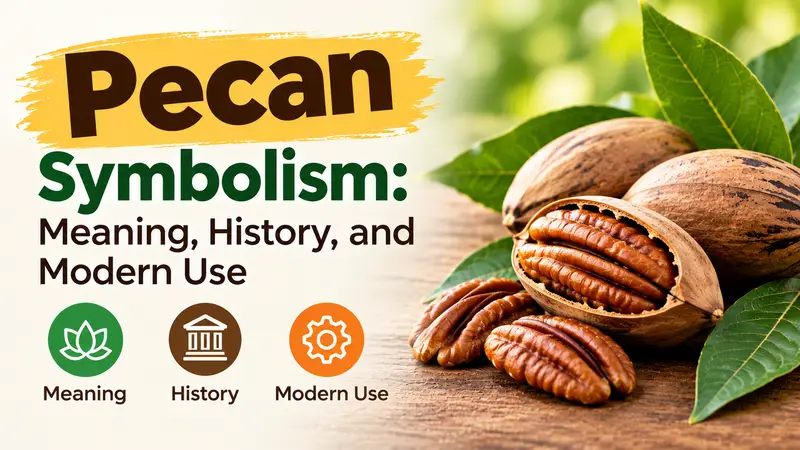
A pecan is the edible seed of a tree native to North America. It typically has an elongated, oval shape, a thin brown shell, and a ridged surface. Once opened, the nut reveals a golden-brown kernel with a distinctive wrinkled appearance.
The pecan’s physical characteristics help explain its symbolic associations. Its hard outer shell protects the edible kernel inside, making it a natural image of protection, inner value, and the idea that worthwhile things sometimes require effort to uncover.
The pecan tree adds another layer of meaning. It can grow into a large, long-lived shade tree, producing nuts over many seasons under suitable conditions. Its broad canopy and recurring harvest can suggest stability, shelter, continuity, and the rewards of sustained care.
Pecans appear in several familiar settings:
- On kitchen tables during family gatherings.
- In pies and other desserts served at Thanksgiving and Christmas.
- In orchards and agricultural landscapes across the South.
- In decorative illustrations featuring leaves, branches, and nuts.
- In personal gifts that celebrate regional identity or family heritage.
These everyday appearances provide the foundation for most interpretations of the pecan as a symbol.
2. Prosperity and Abundance
One of the most recognizable symbolic meanings associated with pecans is prosperity. This interpretation is closely connected to the practical value of a successful harvest.
A healthy pecan tree can produce a substantial crop, providing food that can be stored, sold, shared, or used in cooking. Historically and today, pecan production can contribute to household income and local economies. The sight of a full harvest therefore offers a natural image of resources that are available rather than scarce.
In symbolic terms, pecans may represent:
- Financial security built through consistent work.
- A household with enough food to share.
- The rewards of agricultural labor.
- Opportunities for growth and future stability.
- Gratitude for what a person or family has accumulated.
In modern American life, this association is usually informal rather than ritualistic. A gift basket containing pecans might communicate generosity, appreciation, or a wish for a prosperous season.
A pecan tree planted on family property can carry a similar meaning. It may represent an investment in the future, particularly when the people planting it understand that its greatest benefits may come years later.
Importantly, pecans are not a universally recognized symbol of wealth. Their association with prosperity is an interpretation grounded in abundance, harvest, and economic value rather than a fixed religious or traditional rule.
3. Family, Togetherness, and Belonging
Pecans frequently appear in foods prepared for family gatherings, which makes them natural reminders of belonging and shared experience.
In many American households, recipes involving pecans are connected to a particular relative, holiday, or childhood memory. A grandparent’s pecan pie, a parent’s homemade pralines, or a bowl of roasted pecans offered to visitors can become part of a family’s personal history.
The symbolism comes less from the nut itself than from the repeated act of preparing and sharing food. Ingredients used in familiar recipes can become emotional markers of the people and places associated with them.
A pecan may therefore represent:
- Memories of childhood and home.
- Connections between older and younger generations.
- Family recipes preserved over time.
- The comfort of familiar seasonal traditions.
- A sense of belonging to a region or community.
The pecan tree can also serve as a symbol of family roots. A tree growing beside an older home may remind relatives of previous generations who planted it, cared for it, or gathered beneath its branches.
Not every family attaches these meanings to pecans, of course. For some, they are simply a favorite food. Symbolism becomes meaningful when an ordinary object repeatedly appears in experiences that people value.
4. Patience, Perseverance, and Long-Term Growth
A pecan tree is a fitting symbol of patience because growing one successfully requires time, suitable conditions, and ongoing care. Some pecan trees begin bearing nuts relatively early, while trees growing naturally may take many years to produce a meaningful harvest. The timing varies with the variety and growing conditions.
This slow development offers a useful comparison with human goals. Education, a career, a business, or a lasting relationship rarely reaches maturity in a single season. Progress often depends on small decisions repeated over time.
The pecan tree can consequently represent:
- Patience: Allowing progress to develop at its own pace.
- Perseverance: Continuing to care for a goal through difficult periods.
- Investment: Putting effort into something that may benefit the future.
- Maturity: Developing the experience and stability needed to support others.
- Legacy: Creating something that can outlast the person who began it.
This interpretation is especially appropriate when someone plants a pecan tree to mark a birth, a marriage, or the purchase of a home. The tree becomes a living reminder that meaningful achievements can take time.
Its symbolism is not a promise that patience will always produce success. Rather, it reflects the practical truth that living trees, like many human projects, require appropriate conditions and sustained attention.
5. Historical Roots in Indigenous North America
The pecan’s history in North America began long before it became a familiar ingredient in American holiday baking. Pecan trees are native to parts of North America, particularly areas associated with river systems in the south-central United States and neighboring regions.
Indigenous peoples collected and used pecans as food for generations. Their nutritional value, availability in natural groves, and usefulness as a harvestable resource made them important in local food systems. Pecan gathering also belonged to broader relationships among people, plants, animals, seasonal cycles, and the landscapes that sustained communities.
The word pecan is commonly traced to an Algonquian-language term associated with nuts that require a hard object to crack. The precise form and history of related words vary across linguistic accounts, but the name itself reflects the practical experience of handling nuts with hard shells.
These historical connections support several interpretations:
- Resourcefulness: Making effective use of available natural resources.
- Seasonal awareness: Recognizing when food becomes available.
- Knowledge passed between generations: Preserving practical understanding of plants and harvesting.
- Relationship with place: Connecting food traditions to particular landscapes.
It is important not to treat all Indigenous peoples as having one shared pecan tradition. Different communities have distinct histories, languages, food practices, and relationships with the natural world.
Nor should modern symbolic interpretations be presented as universal Indigenous spiritual beliefs. The better-supported historical point is that pecans had practical and cultural importance as a food resource long before European settlers developed commercial pecan orchards.
6. How Pecans Became Part of Southern American Identity
The pecan’s modern American identity developed through several overlapping histories: Indigenous food traditions, European settlement, enslaved labor, agricultural experimentation, commercial cultivation, and regional cooking.
A particularly important development occurred in Louisiana in 1846, when an enslaved Creole gardener known as Antoine successfully grafted pecan trees to produce a cultivated variety associated with the name Centennial. Grafting made it easier to reproduce desirable characteristics, helping improve the prospects for commercial pecan production.
Antoine’s contribution also reveals a less comfortable part of agricultural history. The development of American crops was not simply the work of celebrated landowners or professional scientists. Enslaved people contributed horticultural knowledge and skilled labor while being denied freedom and fair recognition.
As pecan cultivation expanded, the nut became increasingly associated with Southern landscapes and cuisine. Texas adopted the pecan tree as its state tree, while pecans became important to the identities of growers and communities in several Southern states.
Today, pecans can suggest a distinctly regional sense of belonging. Someone who grew up in Texas, Georgia, Louisiana, Alabama, or another pecan-producing area may associate them with orchards, roadside markets, family kitchens, or local festivals.
For some Americans, the pecan is simply a delicious ingredient. For others, it represents a connection to a particular place and its agricultural history.
Pecan pie is one of the clearest examples of how a food can acquire symbolic meaning through repeated social use.
Although pecans were used as food long before the United States existed, the familiar sweet pecan pie is a comparatively recent development. Recipes for pecan pies appeared in American publications during the late nineteenth century, and commercial promotion helped popularize the modern syrup-based version during the twentieth century.
Its association with Thanksgiving grew alongside its popularity in American home baking. The dessert became part of a wider seasonal tradition of preparing abundant meals and sharing them with relatives and guests.
In this setting, pecans can symbolize:
- Hospitality: Making food for visitors and loved ones.
- Gratitude: Appreciating a meal and the people gathered around it.
- Tradition: Repeating recipes associated with previous generations.
- Celebration: Marking a holiday with a special dessert.
- Comfort: Returning to familiar flavors during a busy or emotional season.
Pecans also appear in Christmas cookies, candies, pralines, and gift assortments. Their role in seasonal baking reinforces their association with generosity and domestic warmth.
These meanings are cultural associations rather than formal religious teachings. Pecans do not have a prescribed meaning in Christianity, and they are not required for Thanksgiving or Christmas observances.
Still, a dessert can become emotionally significant without an official symbolic status. When a family serves the same pecan pie every November, the dish can become part of what makes that holiday feel like home.
8. Nourishment, Generosity, and Caring for Others
Pecans symbolize nourishment partly because they are genuinely nutritious food. They contain unsaturated fats, protein, fiber, and various micronutrients, making them more than a decorative addition to a meal.
That practical usefulness helps explain why pecans can represent care. Offering food is a familiar way of expressing affection, welcoming someone, or helping a person feel included.
The symbolism can appear in ordinary gestures. A host might put out a bowl of nuts before dinner, a neighbor might deliver homemade pecan cookies, or a relative might send a package of regional treats to someone living far away.
In each example, the meaning comes from the action surrounding the food. The pecans become a vehicle for expressing attention and generosity.
This interpretation also applies to a mature pecan tree. Its branches provide shade, and its nuts can feed people and wildlife. The tree offers a natural image of usefulness that extends beyond its immediate owner.
The association with care is especially relevant when the tree or its harvest is shared. A tree planted in a community space, for example, can suggest a willingness to contribute to something that benefits others.
Pecans do not automatically symbolize generosity in every setting. Their meaning becomes more apparent when they are given, shared, cultivated, or incorporated into acts of hospitality.
9. What the Pecan Tree Represents
The pecan nut and the pecan tree overlap symbolically, but they are not quite interchangeable.
The nut is often associated with nourishment, abundance, comfort, and the value found inside a protective shell. The tree more naturally suggests continuity, stability, growth, shelter, and a connection between generations.
Its life cycle strengthens these interpretations. A pecan tree develops through changing seasons, produces foliage and nuts, and may continue bearing fruit for decades. Under favorable conditions, some trees can live for centuries.
This makes the tree an appealing symbol for occasions that involve long-term commitments.
| Context | Common symbolic meaning | Why it fits |
|---|---|---|
| Family property | Roots and continuity | The tree can remain part of a landscape across generations. |
| New home | Stability and future growth | Planting a tree represents an investment in the years ahead. |
| Personal milestone | Patience and achievement | Growth takes time and ongoing care. |
| Community garden | Shared benefit | The tree can offer shade and a harvest to multiple people. |
| Agricultural setting | Work and abundance | Nut production connects the tree with seasonal labor and harvests. |
A pecan tree planted to remember a loved one may also represent continuing connection. Its yearly cycle can give the family a recurring opportunity to remember the person, care for the tree, and observe the passage of time.
That is a personal memorial interpretation, not an established pecan-specific mourning custom.
10. Emotional and Psychological Meaning
The emotional meaning of a pecan often depends on personal experience rather than a universal symbolic system.
For someone raised in the American South, the smell of pecan pie might bring back memories of a grandparent’s kitchen. For an orchard owner, pecans might represent years of work and the uncertainty of each harvest. For someone who has moved away from home, a familiar pecan dessert might evoke a place they miss.
Several emotional associations are particularly understandable:
Comfort and familiarity. Familiar foods can trigger memories of people, places, and routines. Pecans used in a traditional family recipe may become a reminder of security and belonging.
Pride and accomplishment. Growing a productive tree or maintaining an orchard requires knowledge and effort. A successful harvest can represent the satisfaction of work completed.
Hope and anticipation. A young tree offers a visible reminder of future possibilities, even when the results are not immediate.
Connection and remembrance. An inherited recipe or an old tree can help someone maintain a relationship with family history.
Resilience and adaptation. Trees survive through changing seasons, although their health depends on environmental conditions and proper care. This can provide a natural comparison for people working through change.
These associations should not be confused with a formal psychological diagnosis or a universal emotional response. A pecan may evoke happiness for one person and no particular feeling for another.
The useful question is not whether pecans have one correct emotional meaning, but which experiences have made them meaningful to a particular person.
11. Pecan Symbolism in Tattoos, Jewelry, and Home Decor
Pecans are less established as tattoo or jewelry symbols than familiar images such as oak leaves, acorns, flowers, or trees. Nevertheless, someone can use a pecan or pecan tree to express a personal story.
8
Here are several ways the image might be used.
Tattoos. A pecan tree could represent family roots, a childhood home, or a commitment to long-term growth. A small pecan illustration might honor a family member associated with a particular recipe or region.
Jewelry. A pendant shaped like a nut or leaf could serve as a personal reminder of a home state, family orchard, or meaningful place. Its significance would usually come from the wearer’s story rather than an established jewelry tradition.
Home decor. Botanical prints, wooden bowls, harvest arrangements, and pecan-themed kitchen decorations can suggest seasonal abundance and a welcoming home. They are especially fitting in rustic, farmhouse, and Southern-inspired interiors.
Gifts. Pecans packaged in a regional gift basket can express appreciation, hospitality, or a connection to local food traditions.
Personal keepsakes. A drawing of an inherited pecan tree or a framed family recipe can preserve a memory without requiring a conventional memorial object.
The best design depends on the meaning the person wants to communicate. A botanical illustration may emphasize nature, while a tree with spreading branches may emphasize family and continuity.
There is no standard tattoo dictionary or universally accepted jewelry code that assigns these meanings to pecans. Personal context matters more than a supposedly fixed interpretation.
12. Cross-Cultural Perspectives and Religious Associations
Pecans are native to North America, so their historical associations are especially tied to Indigenous food traditions and the agricultural cultures that developed around them.
Pecans also appear in contemporary food cultures beyond the United States. Commercial cultivation and international trade have introduced them to different cuisines, where they may be used in desserts, confectionery, and other dishes.
However, it would be misleading to assign a single spiritual meaning to pecans across these cultures. The fact that a food travels internationally does not mean that its original associations travel with it.
Some broad interpretations, such as nourishment, hospitality, and abundance, are understandable in many societies because they relate to ordinary human experiences. Yet the specific meaning of a pecan depends on local customs, individual memories, and how the nut is used.
Religiously, pecans have no universally prescribed meaning in Christianity, Judaism, Islam, Buddhism, or Hinduism. Individuals may incorporate them into meals associated with religious celebrations, but their presence does not establish a formal religious symbol.
Similarly, a person may regard a pecan tree as spiritually meaningful because it reminds them of nature, ancestors, or the continuity of life. That personal interpretation can be sincere without being attributed to an entire religious or cultural tradition.
A respectful interpretation distinguishes between documented cultural practices and meanings people create for themselves.
13. Misunderstandings, Overinterpretation, and Cultural Context
Because pecans are ordinary foods and plants rather than symbols with a standardized interpretive system, claims about their meaning can easily become exaggerated.
One common mistake is to describe pecans as universally recognized signs of wealth, luck, fertility, or spiritual protection. These interpretations may be personally meaningful, but they should not be presented as established facts without evidence of a specific tradition.
Another mistake is to assume that every pecan-related practice is ancient. Indigenous communities used pecans long before European colonization, but the modern pecan pie associated with American holidays developed much later. The history of the nut and the history of the dessert are connected, yet they are not the same story.
It is also important to recognize the role of enslaved labor in the development of commercial pecan cultivation. Celebrating the pecan’s place in Southern food culture should not erase the contributions of people whose horticultural skills were exploited.
Finally, symbolic interpretations should not be used to stereotype Southern Americans or Indigenous communities. A pecan can be an emblem of regional pride without representing every person who lives in that region.
The most reliable approach is to ask three questions:
- Is the meaning documented in a particular historical or cultural tradition?
- Is it a modern association that developed through food, agriculture, or popular culture?
- Is it an individual’s personal interpretation?
Keeping these categories separate makes the symbolism more useful and historically responsible.
14. How Pecan Symbolism Continues to Evolve
The pecan’s meaning has changed alongside the ways people grow, trade, prepare, and consume it.
For Indigenous communities, pecans have long been associated with food and the environments that support their collection. As commercial orchards developed, the nut acquired additional economic significance. Later, Southern cooking and holiday baking helped make it a recognizable feature of American regional identity.
Today, pecans occupy several roles at once. They are an agricultural commodity, an ingredient in familiar recipes, a source of regional pride, and a potential reminder of family history.
Contemporary food festivals demonstrate how these meanings overlap. Communities use pecan-themed events to celebrate local businesses, agricultural heritage, seasonal foods, and shared civic life. Such celebrations give an everyday crop a public identity beyond the kitchen.
Interest in local food systems and native plants can also encourage people to view pecan trees through environmental and historical perspectives. A tree may represent not just personal growth but the relationship between a community and its landscape.
At the same time, modern personal symbolism continues to develop independently. Someone might plant a pecan tree to celebrate a new beginning, use a pecan illustration in a family cookbook, or choose a tree motif to honor a place where they grew up.
There is no single new meaning replacing the old ones. Instead, the pecan continues to collect associations as people bring its history into new settings.
FAQs
1. What does a pecan symbolize spiritually?
A pecan can represent gratitude, personal growth, nourishment, and a connection with nature when someone assigns it a spiritual meaning. These interpretations are personal rather than part of a universally recognized spiritual tradition.
2. What does a pecan tree symbolize in a dream?
A pecan tree in a dream might remind someone of family, stability, future goals, or memories of home. Dream meanings are not scientifically established, so the most useful interpretation depends on the dreamer’s feelings and personal experiences.
3. What does a pecan symbolize in a tattoo?
A pecan tattoo may represent Southern heritage, family memories, patience, or a connection to a particular place. A pecan tree design can emphasize roots and continuity, while a single nut may represent a meaningful personal association.
4. Are pecans a symbol of good luck or wealth?
Pecans can suggest prosperity because of their association with successful harvests, food security, and economic value. However, there is no universal tradition establishing pecans as a good-luck charm or guaranteeing financial success.
5. Why are pecans associated with Thanksgiving?
Pecans became closely associated with American holiday cooking through the popularity of pecan pie and other seasonal recipes. Sharing these foods can represent hospitality, gratitude, family traditions, and the pleasure of gathering around a meal.
6. What does a pecan tree symbolize for a family?
A pecan tree can represent family roots, continuity, and the effort invested in future generations. When a tree has grown on family property for decades, its branches and annual harvest may become reminders of shared history.
7. Do pecans have a traditional Native American spiritual meaning?
Indigenous peoples have long used pecans as a food resource, and the nut has a significant history in North American foodways. However, there is no single spiritual meaning shared by all Indigenous nations, and specific beliefs should be understood within their individual cultural contexts.
Conclusion
Pecan symbolism is rooted in the relationship between nature, food, and everyday American life. Pecans commonly suggest prosperity, nourishment, patience, family connection, and the rewards of sustained effort. Their place in Indigenous food traditions, Southern agriculture, and holiday cooking explains why they can represent both practical abundance and personal belonging.
The meaning of a pecan ultimately depends on how it appears in someone’s life. It might be a reminder of a family recipe, a tree planted for the future, or a regional tradition worth preserving. What makes the pecan meaningful is not a secret or universal code, but the history, care, and memories people connect with it.