
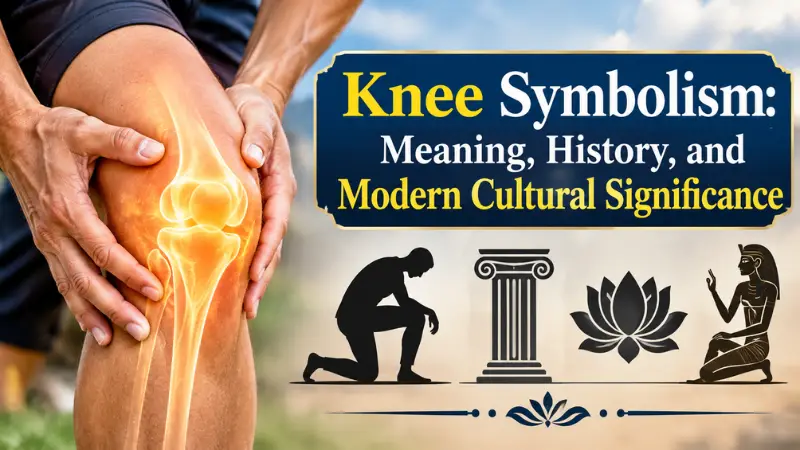
The human knee is more than a joint that allows the body to bend, walk, and stand. In knee symbolism, it represents support, flexibility, humility, vulnerability, and the ability to move forward through life’s challenges. Its meaning becomes especially noticeable in gestures such as kneeling, bending down, taking a knee, or standing firmly on one’s feet.
People often associate knees with submission, prayer, respect, and emotional weakness because of the physical position the body takes when the knees bend. At the same time, healthy knees represent stability, movement, independence, and physical strength. These contrasting associations make the knee an interesting symbol in religious traditions, literature, relationships, and American popular culture.
In the United States, the knee has also acquired modern cultural significance through marriage proposals, athletic celebrations, religious practices, and political demonstrations. Understanding these different interpretations helps explain why a simple physical gesture can communicate such different messages depending on the situation.
Quick Answer: What Does Knee Symbolism Mean?
Knee symbolism commonly represents humility, respect, strength, flexibility, vulnerability, and the ability to move forward. Historically, bending the knee has been associated with prayer, submission, loyalty, and reverence, while the physical knee itself represents support, movement, and the foundation of bodily stability.
TL;DR
- Knees symbolize flexibility, stability, and the ability to move forward.
- Kneeling traditionally represents humility, prayer, respect, and submission.
- In American culture, taking a knee can communicate protest or solidarity.
- A marriage proposal on one knee represents commitment and devotion.
- Injured or weakened knees can symbolize vulnerability and personal struggles.
- Religious traditions use kneeling to express reverence and spiritual devotion.
1. What the Knee Represents as a Symbol
The knee is one of the body’s most important joints. It connects the upper and lower leg, supports body weight, and makes activities such as walking, running, climbing, and sitting possible.
Because of these physical functions, the knee has several symbolic associations.
Support and stability: The knee helps maintain balance and supports movement. Symbolically, it can represent the foundation that allows someone to remain steady during difficult circumstances.
Flexibility and adaptability: Bending the knee allows the body to change position. This movement can represent a willingness to adapt, compromise, and respond to changing situations.
Humility and respect: Lowering oneself onto the knees traditionally communicates deference toward another person, a religious figure, or a higher authority.
Vulnerability: Knees are important for mobility, and an injury can make ordinary activities difficult. They can therefore represent physical dependence, emotional exposure, or the fear of losing independence.
Progress and determination: Strong knees help people continue moving. In symbolic language, they can represent endurance, persistence, and the willingness to keep going.
The meaning depends on whether the knee is being considered as an anatomical structure or as part of a human gesture.
2. The Historical Origins of Knee Symbolism
The symbolic importance of the knee developed through ordinary human behavior long before modern psychology or popular culture gave names to different gestures.
In ancient societies, body posture communicated social position. Standing upright could demonstrate confidence or authority, while lowering the body showed respect toward someone considered more powerful.
Kneeling became an important gesture in relationships between rulers and subjects, worshippers and religious authorities, and individuals seeking assistance.
In parts of the ancient Near East, kneeling and prostration were associated with obedience and reverence. Artistic representations from ancient civilizations also depicted people lowering themselves before rulers and divine figures.
The knee had additional associations in ancient Hebrew traditions. Biblical passages describe children being placed on a patriarch’s knees, a gesture connected with family relationships and the recognition of descendants. This suggests that the knee could represent more than submission; it also had associations with family continuity and belonging.
Over time, religious institutions developed more formal practices involving kneeling. The physical action became connected with confession, prayer, repentance, and devotion.
These historical traditions helped establish many of the associations people still recognize today.
3. Humility, Submission, and Respect
One of the most widely recognized meanings of the knee comes from the act of lowering oneself.
When someone kneels, their body becomes physically lower than it would be when standing. This change in position can communicate that the person recognizes another individual’s authority, importance, or dignity.
Historically, subjects sometimes knelt before monarchs, religious leaders, and other powerful figures. In these settings, the gesture communicated loyalty and acknowledgment of social hierarchy.
However, humility and submission are not necessarily negative qualities.
A person may kneel voluntarily because they respect someone, recognize their own limitations, or wish to show gratitude. A person forced to kneel, on the other hand, may be experiencing humiliation or coercion.
This distinction matters when interpreting the gesture.
For example:
- A person kneeling before a respected leader may communicate honor.
- Someone kneeling to apologize may express remorse.
- A person forced onto their knees may represent oppression.
- Someone kneeling to help another person may demonstrate compassion.
The physical position remains similar, but the intention changes its meaning.
4. Religious Meaning of Knees and Kneeling
Knees have a long history of association with religious devotion. In several faith traditions, kneeling or lowering the body is a physical expression of reverence, humility, and submission before God.
Christianity
Kneeling is particularly familiar in Christian worship. Many Catholic churches include kneelers that allow worshippers to adopt a kneeling position during prayer and parts of the Mass.
The gesture can communicate repentance, gratitude, worship, and recognition of God’s authority.
The Bible also uses the image of every knee bowing as a representation of universal acknowledgment of divine authority. This imagery contributes to the association between knees and spiritual submission.
Different Christian denominations practice kneeling differently. Some emphasize it during formal worship, while others primarily use standing or sitting positions.
Islam
In Islam, the daily prayer practice known as Salah includes several physical positions, including standing, bowing, and prostration.
The sitting position between prostrations involves the knees, while the full act of prostration places the forehead on the ground.
These movements express devotion, humility, and submission to Allah.
Judaism
Jewish prayer traditions have historically included standing, bowing, and other physical gestures. Kneeling and full prostration appear in particular historical and religious contexts, although they are not universal features of everyday Jewish prayer.
The broader lesson is that religious posture carries meaning through tradition, intention, and community practice. Kneeling should not be assumed to mean exactly the same thing in every faith.
5. What Knees Symbolize in American Culture
In the United States, the knee has acquired several recognizable meanings through everyday customs, religious life, entertainment, and public events.
One particularly familiar example is the marriage proposal.
A person traditionally gets down on one knee when asking their partner to marry them. This gesture has become a recognizable expression of commitment, devotion, and the seriousness of the question.
American sports culture also uses the knee in several ways. Athletes may kneel to pray, show respect after a significant event, or participate in moments of silence.
The expression “take a knee” became especially prominent in American public discussion after NFL quarterback Colin Kaepernick began kneeling during the national anthem in 2016 to protest racial injustice and police brutality.
The gesture generated disagreement because Americans interpreted it through different understandings of patriotism, protest, military respect, and civil rights.
For supporters, kneeling represented peaceful protest and a demand for greater equality. Critics viewed the timing during the national anthem as disrespectful to national symbols.
This disagreement demonstrates an important feature of American symbolism: the meaning of a gesture can depend heavily on the values and experiences of the people interpreting it.
6. Knee Symbolism in Marriage and Romantic Relationships
Few modern American gestures involving the knee are as recognizable as the traditional marriage proposal.
Getting down on one knee has become a familiar way to ask someone to marry you. Although proposal customs vary, the gesture is often interpreted as an expression of devotion and commitment.
Several symbolic ideas contribute to its popularity:
- Commitment: The proposal communicates an intention to build a shared future.
- Respect: The person proposing adopts a humble posture toward their partner.
- Vulnerability: Asking for marriage involves emotional risk and the possibility of rejection.
- Devotion: The gesture communicates that the relationship is important.
- Tradition: A familiar custom connects the couple’s experience with generations of proposals.
The practice is not a requirement for a meaningful engagement. Some couples choose private conversations, creative proposals, or arrangements that do not involve kneeling.
Nevertheless, the image of a person on one knee remains a widely understood symbol of romantic commitment in American popular culture.
7. Strength, Stability, and Physical Independence
While kneeling often represents humility, the knee itself can symbolize physical strength.
The joint supports the body’s weight and enables movement across different environments. Without functioning knees, everyday activities such as walking upstairs, exercising, or standing for extended periods can become difficult.
This makes the knee a natural symbol of independence and personal capability.
In literature and everyday language, strong legs and stable knees can represent the ability to withstand challenges.
Consider someone recovering from a serious injury. Learning to walk again may represent more than physical rehabilitation. It can also communicate determination, patience, and the restoration of independence.
Likewise, an athlete who continues training after recovering from a knee injury may represent resilience.
The symbolism here is not about never experiencing difficulty. It is about rebuilding the physical and emotional capacity to move forward.
8. Vulnerability, Fear, and Emotional Weakness
The knee can also represent vulnerability because it is essential to physical stability.
Expressions such as “weak in the knees” illustrate how people connect physical sensations with emotional experiences.
Someone might describe feeling weak in the knees when meeting a romantic interest, experiencing overwhelming excitement, or confronting an intimidating situation.
In these expressions, the knee represents the body’s response to strong emotion.
Other familiar examples include:
- Shaking knees: Nervousness, fear, or uncertainty.
- Being brought to one’s knees: Experiencing a major setback or overwhelming challenge.
- Knees buckling: Losing confidence, balance, or emotional control.
- Getting back on one’s feet: Recovering after difficulty.
These expressions demonstrate how physical movement becomes a metaphor for emotional experience.
Importantly, vulnerability does not always indicate weakness. It can also represent honesty, openness, and the willingness to acknowledge difficult feelings.
9. Knee Symbolism in Dreams
Dreams involving knees can be interpreted through themes of movement, stability, vulnerability, and control.
However, dream symbolism is subjective. There is no universally accepted scientific dictionary that establishes one fixed meaning for every knee-related dream.
The circumstances of the dream and the dreamer’s personal experiences matter.
Dreaming of healthy knees: This may reflect confidence in one’s ability to move forward or manage everyday responsibilities.
Dreaming of injured knees: An injury may symbolize feelings of limitation, uncertainty, or difficulty making progress.
Dreaming of kneeling: This could reflect humility, prayer, respect, apology, or a desire for acceptance.
Dreaming of weak knees: This may relate to anxiety, emotional pressure, or a situation that feels difficult to control.
Dreaming of standing up after kneeling: This can represent recovery, renewed confidence, or a willingness to take responsibility.
Rather than treating these interpretations as predictions, consider what is happening in your waking life. A knee-related dream may be meaningful because it reflects a personal concern about independence, relationships, or an important decision.
10. Cross-Cultural Interpretations of Kneeling
Although kneeling is widely recognized, its meaning changes across cultures and social settings.
| Cultural Context | Symbolic Meaning | Common Association | Important Detail |
|---|---|---|---|
| Christian traditions | Devotion and repentance | Prayer and worship | Practices differ by denomination |
| Islamic traditions | Humility and submission | Salah and prostration | Kneeling is part of a larger prayer sequence |
| Ancient Near Eastern societies | Obedience and reverence | Royal and religious authority | Posture communicated social hierarchy |
| Traditional royal ceremonies | Loyalty and respect | Homage to monarchs | Customs vary between countries |
| Modern United States | Commitment or protest | Marriage proposals and taking a knee | Context strongly influences interpretation |
In some East Asian cultural settings, kneeling or lowering oneself can also communicate respect toward elders, ancestors, or important social figures. However, customs differ considerably between communities and should not be treated as interchangeable.
The important distinction is that kneeling is not a universal statement of weakness. In one setting, it may demonstrate respect; in another, it may represent religious devotion or a deliberate political statement.
11. The Psychological Meaning of Bending the Knee
Human beings communicate through posture as well as words.
Standing tall, leaning forward, sitting down, and kneeling all change how a person occupies physical space. These positions can influence how observers interpret confidence, authority, openness, and vulnerability.
Bending the knee can make someone appear less physically dominant. In certain social situations, this communicates deference or a willingness to cooperate.
There are also practical reasons that kneeling can communicate care.
For example, an adult who kneels to speak with a young child brings their face closer to the child’s eye level. This can make the interaction feel more welcoming and less intimidating.
A healthcare worker might kneel beside a patient to communicate attentiveness. A person might kneel to comfort a grieving friend or help someone who has fallen.
In these situations, the gesture is not necessarily about submission. It can demonstrate empathy and a willingness to meet another person where they are.
The psychological meaning therefore depends on the relationship between the people involved and the circumstances surrounding the action.
12. Knee Symbolism in Tattoos, Jewelry, and Modern Art
Knee imagery is less common than symbols such as hearts, birds, flowers, or hands, but the body part can still appear in personal artwork and visual storytelling.
A knee tattoo may communicate a person’s interest in physical endurance, recovery, sports, or the experience of overcoming a difficult period.
For some people, an image of a kneeling figure represents religious devotion or personal faith. Others may use the pose to represent romantic commitment, remembrance, or humility.
Artists may also use bent knees and kneeling figures to communicate emotional vulnerability.
In sculpture and painting, a kneeling person can create a visual contrast between authority and submission. A standing figure may appear dominant, while the kneeling figure appears dependent, respectful, or emotionally exposed.
Jewelry generally uses broader visual symbols rather than realistic knee imagery. However, pendants or designs representing prayer, faith, and commitment may indirectly connect with the traditional meaning of kneeling.
The interpretation of any such artwork depends on its design and the story the person wishes to communicate.
13. Negative Symbolism and Common Misunderstandings
Knee symbolism is not always positive.
In some situations, kneeling can represent humiliation, forced obedience, defeat, or the loss of personal authority.
Historical images of prisoners or defeated individuals kneeling before rulers demonstrate how the gesture could communicate unequal power relationships.
Modern audiences sometimes misunderstand kneeling because they assume that the posture has only one meaning.
For example, someone may interpret a person kneeling as an admission of weakness, while another person sees the same action as courage or respect.
The American national anthem controversy illustrates this problem particularly clearly.
Colin Kaepernick’s protest was not intended as a demonstration of personal submission. It was a deliberate political statement about racial injustice and police violence. His choice of kneeling rather than sitting also reflected a discussion about showing respect while protesting.
Another common misunderstanding involves religious practices. Kneeling during prayer should not automatically be interpreted as worshipping a human authority. In many traditions, the gesture is directed toward God.
To understand the meaning correctly, consider the person’s intention, cultural background, and the setting in which the action takes place.
14. How Knee Symbolism Has Evolved in Modern Society
The symbolic meaning of the knee has expanded as social customs, religious practices, and public communication have changed.
In ancient societies, kneeling was frequently associated with hierarchy, obedience, and relationships between rulers and subjects.
Religious traditions developed additional meanings involving devotion, repentance, and spiritual humility.
Later, romantic customs made the one-knee proposal a familiar expression of commitment in Western popular culture.
American sports and entertainment introduced other interpretations, including athletic celebration, prayer, and public protest.
Social media has further increased the visibility of these gestures. A photograph of someone kneeling can circulate widely, sometimes reaching audiences who interpret it differently from the original participants.
The modern knee therefore carries several overlapping meanings:
- A symbol of humility in religious and personal settings.
- An expression of commitment in romantic relationships.
- A representation of vulnerability during emotional experiences.
- A sign of endurance and recovery in athletic settings.
- A form of peaceful protest in public life.
- A reminder of the relationship between physical strength and independence.
Rather than replacing its historical meanings, modern culture has added new interpretations to an already established set of associations.
FAQs
1. What does the knee symbolize spiritually?
Spiritually, the knee commonly represents humility, devotion, repentance, and submission to a higher power. In several religious traditions, kneeling or lowering the body is a physical expression of reverence during prayer.
2. What does kneeling on one knee symbolize?
Kneeling on one knee commonly represents respect, commitment, devotion, or a request for acceptance. In modern American culture, it is especially associated with marriage proposals and public gestures of respect.
3. Is knee symbolism positive or negative?
Knee symbolism can be positive or negative depending on the situation. It may represent strength, flexibility, humility, and devotion, but forced kneeling can symbolize humiliation, oppression, or a loss of personal freedom.
4. What does it mean when someone is weak in the knees?
Being weak in the knees is a common expression describing an intense emotional or physical reaction. It can refer to romantic excitement, nervousness, fear, exhaustion, or overwhelming feelings.
5. What does a knee injury symbolize?
Symbolically, a knee injury may represent vulnerability, interrupted progress, or concerns about independence. In real life, however, an injury is a medical or physical condition and does not automatically carry a spiritual meaning.
6. Why did kneeling become a symbol of protest in America?
Kneeling became nationally prominent as a protest gesture after Colin Kaepernick began kneeling during NFL national anthem ceremonies in 2016. He used the gesture to draw attention to racial injustice and police brutality, prompting a wider debate about patriotism and peaceful protest.
7. What does dreaming about kneeling mean?
Dreaming about kneeling may reflect humility, a desire for forgiveness, religious devotion, or a need for support. Its possible meaning depends on the dream’s circumstances and the emotions experienced by the dreamer.
Conclusion
Knee symbolism connects physical movement with some of the most recognizable human experiences: humility, respect, vulnerability, strength, and perseverance. The knee supports the body, allows people to change direction, and makes independent movement possible. When someone bends or lowers their knees, the gesture can communicate devotion, commitment, apology, or protest.
In American culture, these meanings appear in religious worship, marriage proposals, athletic traditions, and public demonstrations. Historical customs have shaped how people understand the gesture, while modern society continues to give it new interpretations.
Ultimately, knee symbolism reminds us that the same physical position can communicate very different ideas. A person may kneel out of love, faith, respect, or a desire for justice. Understanding the intention behind the gesture is what reveals its true meaning.