Introduction
Spider plants are familiar sights in American homes, offices, classrooms, and apartments. Their long, arching green-and-white leaves and small plantlets dangling from slender stems make them easy to recognize. Beyond their decorative appeal, spider plants have acquired associations with growth, resilience, renewal, and the connections people maintain with family and friends. Understanding spider plant symbolism helps explain why this modest houseplant can feel more meaningful than an ordinary piece of home decor.
The plant’s appeal comes partly from its ability to produce new offshoots that can grow into separate plants. A gardener can share these young plants with relatives, give one to a friend moving into a new home, or grow several from a single established plant. These everyday experiences provide a practical foundation for the plant’s modern symbolic associations.
In the United States, spider plants are especially connected with welcoming spaces, beginner-friendly gardening, and thoughtful gifts. Their meanings are not fixed by a universal religious tradition or a single historical legend. Instead, much of their symbolism develops through their appearance, growth habits, and the personal experiences people associate with caring for them.
Quick Answer
Spider plant symbolism most commonly represents growth, resilience, renewal, and family connection in modern American culture, particularly when the plant is shared as a gift or used to decorate a home. Its ability to produce new plantlets also makes it a natural symbol of nurturing, continuity, and fresh beginnings, although these meanings are modern interpretations rather than established universal beliefs.
TL;DR
- Growth: New leaves and plantlets represent ongoing development.
- Resilience: Adaptability reflects the ability to recover from setbacks.
- Family connection: Propagated plants can represent lasting relationships.
- New beginnings: A growing houseplant suits moves, fresh starts, and new routines.
- Hospitality: Green foliage helps make homes and workplaces feel welcoming.
- Personal meaning: Its symbolism often comes from lived experience rather than ancient tradition.
What Does a Spider Plant Look Like?
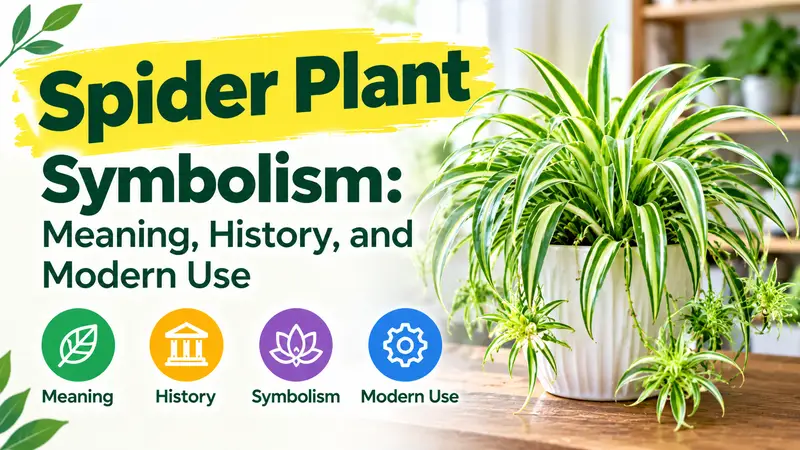
The spider plant, botanically known as Chlorophytum comosum, is a perennial plant native to tropical and southern Africa. It grows in clumps of narrow, arching leaves, often green with a pale central stripe or lighter margins, depending on the variety. Mature plants can produce long stems bearing small flowers and miniature plantlets that hang down like little versions of the parent plant.
These dangling plantlets explain the common name. They may resemble tiny spiders suspended from threads, although the plant is not related to spiders and does not carry their symbolism automatically.
The plant’s shape contributes to its visual character. Its curved leaves suggest movement, while the young plants suspended from the stems create an impression of abundance and continuing life. In hanging baskets, the foliage spills outward and downward, softening shelves, windows, and corners.
For symbolism, these physical characteristics matter. People often attach meaning to what they can observe: a plant that keeps producing new growth can suggest progress, while one that creates easily shared offshoots can represent connection.
The Core Symbolic Meanings of Spider Plants
Spider plants have several common symbolic interpretations, and each grows naturally from a different feature of the plant.
Growth and development are among the clearest associations. Fresh leaves and developing plantlets provide visible reminders that living things can continue changing even when the process is gradual. This makes the plant a fitting companion for someone learning a skill, building a career, or establishing a new routine.
Resilience and adaptability come from the plant’s reputation as a forgiving houseplant. Spider plants generally tolerate ordinary indoor conditions and can recover from some common care mistakes when their growing conditions improve. Their hardiness can represent patience, flexibility, and the willingness to begin again.
Connection and nurturing are especially relevant because new plantlets can be rooted and shared. One plant can become several, with each new plant carrying a connection to the original. In this sense, the spider plant can symbolize family relationships, friendship, mentorship, and the ways care passes from one person to another.
Renewal and fresh beginnings reflect the plant’s continuing production of leaves and offshoots. A spider plant may therefore suit a new apartment, a new job, or a period of rebuilding after a difficult change.
These interpretations are not formal botanical facts or universally accepted spiritual rules. They are ways people translate the plant’s visible qualities into meaningful ideas.
Historical Origins: How Did Spider Plant Symbolism Develop?
Spider plant symbolism does not have a clearly documented ancient origin comparable to the symbolism of the lotus, olive branch, or laurel wreath. The plant’s modern meanings are better understood through its botanical characteristics and its history as a cultivated ornamental plant.
Native to Africa, Chlorophytum comosum became widely grown beyond its natural range as gardeners adopted it for its attractive foliage and adaptability. Its popularity as an indoor plant increased as houseplants became a familiar part of domestic decoration. Hanging baskets, plant stands, and windowsills offered practical ways to display its cascading leaves and hanging plantlets.
As the plant became common in homes, people gained opportunities to observe how easily it could be propagated. A plantlet could be separated, rooted, and grown elsewhere, making the plant useful for sharing among households. This practice helped create a straightforward symbolic connection between living growth and human relationships.
It is important not to confuse a modern interpretation with a documented historical belief. Although a person may associate a spider plant with protection, luck, or spiritual balance, those associations should not be presented as ancient traditions without evidence. The most defensible account is that its symbolism largely developed through ordinary gardening, domestic use, and personal experience.
Spider Plant Symbolism in the United States
In American homes, spider plants are often associated with comfort, practical care, and approachable greenery. They are common choices for people who want a living plant without committing to a demanding gardening routine.
Their symbolism fits several familiar American experiences. A first apartment may represent independence; a new house can represent family stability; and a small plant on an office desk can make a workspace feel more personal. In each situation, a spider plant can serve as a reminder that a living environment develops through small acts of attention.
The plant also suits the American tradition of informal gift-giving. A rooted cutting can be shared without the expense or formality of a large bouquet. It may mark a move, graduation, birthday, or simple gesture of friendship. Because the cutting grows from a plant someone already owns, the gift can carry a personal story.
Spider plants are not official symbols of the United States, nor are they closely tied to a particular national holiday. Their cultural significance is domestic rather than civic: they belong to the everyday world of homes, relationships, and the small routines through which people care for their surroundings.
Family, Friendship, and the Meaning of Sharing Plantlets
One of the most distinctive aspects of spider plant symbolism is the way the plant reproduces. Mature plants may develop small offshoots along long stems. When conditions are suitable, these plantlets can develop roots and grow independently.
This makes the plant an especially natural symbol of family continuity. A parent plant can produce new plants that are passed to children, relatives, or friends. Each new plant remains biologically connected to the original, even as it grows in a different place.
The symbolism can also extend to mentorship and community. Someone who shares a cutting is passing along more than foliage: they are sharing a living thing that requires care and will change over time. The recipient becomes responsible for its next stage of growth.
For this reason, a spider plant can be a thoughtful gift between generations. A plant inherited from a grandparent or propagated from a longtime family plant may preserve a connection to a person or home. The meaning comes from the history attached to that individual plant, not from a universal rule about the species.
Resilience, Patience, and Personal Growth
A spider plant can symbolize resilience because it often tolerates the ordinary imperfections of indoor life. Light levels fluctuate, watering schedules become irregular, and leaves occasionally turn brown. With suitable care, a plant can continue growing despite these setbacks.
That makes it a useful symbol for gradual recovery rather than instant transformation. A person rebuilding a routine after a move, returning to school, or learning to manage a new responsibility may appreciate the plant’s steady development.
Its growth also illustrates patience. A young plantlet does not become a mature plant overnight, and new leaves appear on their own schedule. Progress is visible, but it cannot always be rushed.
The comparison has limits. A houseplant cannot explain human hardship or guarantee a successful outcome. Still, caring for one can provide a practical reminder that improvement often depends on repeated, manageable actions. Watering when needed, adjusting light, and checking the roots are small tasks that support a larger process.
In this context, spider plant symbolism is less about overcoming every obstacle and more about continuing to grow while adapting to changing conditions.
What Spider Plants Symbolize as Gifts
Spider plants work well as gifts because they combine an accessible price, manageable care, and the possibility of future propagation. Their meaning depends on the occasion and the relationship between giver and recipient.
For someone moving into a new home, a spider plant can represent settling in and creating a welcoming environment. For a student or young adult, it may suggest independence and the beginning of a new chapter. For a friend facing a transition, it can offer a quiet expression of encouragement.
A propagated cutting may be particularly meaningful because it comes from an established plant. The giver can explain where the original plant came from, how long it has been growing, or why it matters to the family. That story can give an otherwise simple gift lasting significance.
Spider plants can also be appropriate for offices, classrooms, and shared living spaces, provided the environment suits the plant and someone can care for it. Unlike a bouquet, a healthy potted plant can continue growing long after the occasion has passed.
A thoughtful gift does not need to carry an elaborate spiritual message. Sometimes the symbolism is simply this: I hope you feel at home here, and I wanted to give you something that can grow with you.
Emotional and Psychological Meaning
The emotional appeal of spider plants is connected to the ordinary experience of caring for a living thing. People may feel satisfaction when a new leaf appears, concern when a plant wilts, or pride when a cutting develops roots. These responses can make the plant feel connected to personal routines and memories.
Green foliage can also soften the appearance of indoor spaces. A spider plant placed near a desk or window introduces natural shapes and visible growth into an environment otherwise dominated by furniture, screens, and hard surfaces. Some people find this calming or comforting, although individual responses vary.
The plant may also represent competence for beginners. Because spider plants are often considered relatively easy to grow, they can provide an approachable introduction to plant care. Successfully maintaining one may encourage someone to try other plants or develop a more regular gardening habit.
These experiences should not be mistaken for a guaranteed psychological effect. A spider plant is not a treatment for stress or emotional difficulties. Its symbolic value is personal: it may remind someone of a supportive relationship, a home they loved, or a period when they learned to care for something independently.
Spider Plants in Interior Design and Modern Life
In contemporary American interiors, spider plants appear in hanging baskets, home offices, kitchens, classrooms, and common areas. Their flexible shape works with many decorating styles, from casual and traditional rooms to minimalist apartments filled with natural materials.
The plant’s symbolism often follows its placement. In a living room, it can suggest warmth and everyday hospitality. In a workspace, it may represent concentration, development, or a desire to make the environment more comfortable. In a classroom, its visible plantlets can provide an accessible example of plant reproduction and growth.
Spider plants also fit smaller homes because they can be displayed vertically in hanging containers or placed on shelves where their leaves can spread. As a plant matures, its changing appearance makes it a living feature rather than a static decoration.
On social media, spider plants commonly appear in plant-care photographs, propagation tutorials, home tours, and posts celebrating new growth. Their appeal is practical as well as aesthetic: the plantlets provide an obvious reason to document progress and share cuttings with other plant enthusiasts.
These uses do not establish a single official meaning. Instead, modern decor and online gardening culture allow people to develop their own interpretations through how they grow, display, and share the plant.
Religious and Cross-Cultural Interpretations
Spider plants do not have one widely recognized religious meaning shared across major faiths. They may be incorporated into personal spiritual practices or used in spaces devoted to reflection, but those choices are different from an established religious doctrine.
In many cultures, plants more generally can represent renewal, fertility, continuity, or the relationship between people and the natural world. Such broad associations help explain why someone might interpret a flourishing spider plant as a sign of growth or household well-being. They do not prove that every culture assigns those meanings to this particular species.
Likewise, claims that spider plants universally attract wealth, repel negative energy, or guarantee protection should be treated as personal beliefs rather than established facts. People may find these interpretations meaningful, but there is no reason to present them as scientifically verified effects.
A culturally respectful approach recognizes the distinction between documented tradition and individual spirituality. If someone gives a spider plant a religious or ceremonial role, its significance may be genuine within that person’s life without being universal to everyone who grows one.
Positive and Negative Symbolism: Are Spider Plants Always a Good Sign?
Spider plants are generally associated with positive ideas because their appearance and growth habits readily suggest vitality, continuity, and care. However, no plant has a universally fixed symbolic meaning, and personal associations can change how someone interprets it.
For one person, a spider plant may recall a relative who shared cuttings for years. For another, it may remind them of an apartment or relationship they would rather leave behind. The plant itself has not changed; the memories attached to it have.
Some people may also interpret drooping leaves, brown tips, or a struggling plant as signs of neglect or a difficult period. These readings are emotional interpretations, not reliable predictions of future events. Leaf damage usually reflects practical factors such as watering, light, humidity, or water quality.
The most balanced interpretation is that spider plants tend to carry hopeful associations, but their personal significance depends on context. A healthy plant can represent growth, while a struggling one can prompt reflection or simply signal that its care needs adjusting.
Spider Plant Meaning by Context
The same plant can communicate different ideas depending on where it appears and why someone chose it. The following table summarizes common interpretations in everyday American life.
| Context | Symbolic meaning | Common association |
|---|---|---|
| New home | Fresh beginnings | Creating a comfortable living space |
| Family gift | Continuity and connection | Sharing a plant from an established collection |
| Office or study | Growth and development | Building skills and establishing routines |
| Personal garden | Resilience | Maintaining life through changing conditions |
| Memorial or keepsake | Remembrance | Preserving a connection through a living plant |
These meanings are suggestions, not a fixed symbolic code. A plant given to a new homeowner might represent independence to one person and family support to another. The relationship, occasion, and accompanying message usually matter more than the plant species alone.
What Do Spider Plant Colors Symbolize?
Spider plants are commonly grown in several forms, including varieties with green leaves, white central stripes, or pale margins. Their colors can influence how people interpret them, although these associations come from general color symbolism rather than a documented spider-plant tradition.
Green is widely associated with nature, renewal, vitality, and growth. Because green is the dominant color in many spider plants, it reinforces the impression of continuing life and development.
White or cream-colored stripes can suggest simplicity, clarity, freshness, or balance to someone who associates those qualities with lighter colors. The contrast between green and white may also give the plant a neat, orderly appearance that suits contemporary interior design.
These interpretations are subjective. There is no established rule that a green spider plant symbolizes one thing while a striped variety symbolizes another. Choose a variety based on appearance and growing conditions, then let the personal meaning develop naturally.
Common Misunderstandings About Spider Plant Symbolism
Several popular claims about houseplants can make their symbolic meanings sound more definite than they are. Spider plants are sometimes described online as guaranteed sources of good luck, household protection, financial success, or positive spiritual energy. Such claims may reflect personal beliefs, but they are not established universal traditions.
Another misunderstanding is that the plant’s name connects it symbolically to spiders. The name refers primarily to the appearance of the small plantlets hanging from slender stems. Spider-related folklore varies widely, and it would be misleading to transfer every meaning associated with spiders to a spider plant.
It is also easy to confuse symbolic interpretations with scientific benefits. A plant can make a room feel more inviting without guaranteeing improved mental health, and it can represent prosperity without causing financial success.
Finally, spider plants should not be treated as omens. A new plantlet is evidence of plant growth, while a brown leaf tip usually points to a care or environmental issue. Neither event reliably predicts good fortune or misfortune.
The most useful approach is to appreciate the symbolism while keeping it separate from botanical facts and unsupported promises.
How Spider Plant Symbolism Has Evolved
The spider plant’s modern meaning is largely a product of everyday domestic life. Its African botanical origins provide the natural history, while its popularity as a cultivated houseplant explains how it became familiar in homes far beyond its native range.
As indoor gardening became part of home decoration, spider plants earned a reputation as adaptable, easy-to-propagate plants. Their long leaves suited hanging baskets, and their young offshoots offered a simple way to expand a collection without buying another mature plant.
That practical usefulness created opportunities for personal symbolism. A plant passed between friends could become a reminder of a relationship; one kept in a family home could become associated with childhood; and a new cutting could mark a move or a fresh start.
Contemporary plant-sharing communities have extended this pattern through online photographs, propagation advice, and informal exchanges. The meanings remain flexible because people continue to attach their own experiences to the plant.
Rather than inheriting one ancient symbolic definition, spider plants have accumulated meaning through repeated acts of growing, sharing, and caring. Their symbolism continues to evolve because those everyday practices remain relevant.
FAQs
1. What is the spiritual meaning of a spider plant
Some people interpret a spider plant as a reminder of renewal, nurturing, and the continuity of life. These spiritual associations are personal interpretations rather than beliefs shared by all religions or spiritual traditions.
2. Is a spider plant a good gift for a new home?
Yes. A spider plant can represent fresh beginnings, comfort, and the gradual process of making a house feel like home. Giving a rooted cutting from your own plant can make the gift more personal.
3. Does a spider plant symbolize good luck?
Some people associate healthy houseplants with good fortune and household well-being, but spider plants are not universally recognized as luck symbols. Their strongest everyday associations are growth, adaptability, and connection.
4. What does it mean when a spider plant produces many babies?
Botanically, the plantlets are a normal part of the plant’s reproductive growth. Symbolically, people may interpret them as signs of abundance, family continuity, or the ability to nurture new beginnings.
5. Are spider plants associated with any religion?
There is no single, widely established religious interpretation specific to spider plants. Individuals may use them in prayer spaces, meditation areas, or personal spiritual practices, but those uses should not be confused with universal religious teachings.
6. What does a spider plant symbolize in a relationship?
A spider plant can represent a relationship that develops through patience, care, and shared experiences. Giving someone a propagated cutting may also symbolize a lasting connection that continues to grow even when two people live apart.
Conclusion
Spider plant symbolism centers on growth, resilience, renewal, and connection. Its cascading leaves and ability to produce new plantlets provide natural reasons for these associations, while its popularity in American homes gives the plant a familiar place in everyday life. Although some people assign it spiritual meanings, there is no single ancient or universal interpretation that everyone must follow.
Whether displayed in a living room, given to a friend, or propagated from a family plant, a spider plant can become a personal reminder of how relationships and new beginnings develop over time. Its meaning is ultimately shaped by the care it receives and the memories people grow alongside it.